Highlighting Cerner

August 31, 2018 in Diary, Equities, Ideas, Letters

This article is excerpted from a letter by Luis Sanchez and John Pelly, co-founders and managing partners of Overlook Rock Asset Management, based in New York.

This quarter we would like to highlight an investment we have made in Cerner (NASDAQ: CERN). Luis recently presented Cerner at Wide-Moat Investing Summit 2018, hosted by MOI Global.

Cerner is an investment made in our High Quality Company Strategy. The High Quality Strategy focuses on investing in businesses that can compound their earnings power at an above market rate over an extended time horizon. In this strategy, we are focused on identifying businesses with sustainable competitive advantages and are less sensitive to short-term valuation metrics. Cerner exemplifies these characteristics.

Cerner is a leading healthcare IT business, primarily selling electronic health records software and revenue cycle management software to hospitals. The company’s software is critical infrastructure for hospitals and serves as the basic foundation for a hospital’s IT ecosystem. Cerner is deeply integrated with its customers, creating a very sticky client base with a 99% retention rate.

The company is benefiting from tailwinds that will enable revenue to grow at a high single-digit rate for the next 10 years. Furthermore, Cerner is executing a plan to increase operating margins by 30 to 60 basis points per year. The combination of tailwinds and margin enhancement will enable the company to compound its earnings growth at a double-digit rate for the foreseeable future.

Cerner recently traded at a valuation multiple of roughly 18x cash flow. This valuation is a slight premium to the average market multiple but we believe this is a bargain because Cerner is a high quality business with very strong earnings growth prospects.

Disclaimer: Overlook Rock Asset Management is a registered investment adviser. Information presented is for discussion and educational purposes only and does not intend to make an offer or solicitation for the sale or purchase of any specific securities, investments, or investment strategies. Investments involve risk and, unless otherwise stated, are not guaranteed. Be sure to first consult with a qualified financial adviser and/or tax professional before implementing any strategy discussed herein. The information and statistical data contained herein have been obtained from sources, which we believe to be reliable, but in no way are warranted by us to accuracy or completeness. We do not undertake to advise you as to any change in figures or our views. This is not a solicitation of any order to buy or sell. We, any officer, or any member of their families, may have a position in and may from time to time purchase or sell any of the above mentioned or related securities. Past results are no guarantee of future Results. This report includes candid statements and observations regarding investment strategies, individual securities, and economic and market conditions; however, there is no guarantee that these statements, opinions or forecasts will prove to be correct. These comments may also include the expression of opinions that are speculative in nature and should not be relied on as statements of fact. Overlook Rock Asset Management is committed to communicating with our investment partners as candidly as possible because we believe our investors benefit from understanding our investment philosophy, investment process, stock selection methodology and investor temperament. Our views and opinions include “forward-looking statements” which may or may not be accurate over the long term. You should not place undue reliance on forward-looking statements, which are current as of the date of this report. We disclaim any obligation to update or alter any forward-looking statements, whether as a result of new information, future events or otherwise. While we believe we have a reasonable basis for our appraisals and we have confidence in our opinions, actual results may differ materially from those we anticipate. The information provided in this material should not be considered a recommendation to buy, sell or hold any particular security.

La inversión en valor según Horos AM

August 31, 2018 in Miscelánea, MOI Global en Español

NOTA DEL EDITOR: El siguiente texto escrito por Javier Ruiz, CFA, es un extracto de una carta trimestral de Horos Asset Management.

* * *

Estas primeras semanas en Horos, tanto Alejandro, como Miguel o yo, hemos atendido a distintos medios de comunicación que estaban interesados en que les explicáramos este ilusionante proyecto en el que nos hemos embarcado. Dentro del sinfín de preguntas que hemos tratado de responder, puede que una de las que más se haya repetido en estas entrevistas sea si pensamos que hay cabida para tanta gestora value en el mercado español, hablando incluso de burbuja o moda de este estilo de inversión. Al margen de que estamos convencidos de que la aparición de nuevos proyectos, independientemente del estilo inversor que tengan, nos parece sana y necesaria, al incrementar el abanico de posibilidades para el ahorrador español, esta insistencia me ha llevado a preguntarme si no estaremos cayendo en una generalidad excesiva a la hora de calificar a un gestor como value e, incluso, he llegado a cuestionarme si nosotros mismos podemos considerarnos como tal.

Quizás le sorprenda una afirmación de estas características. A fin de cuentas, siempre hemos defendido que seguimos este estilo de inversión. Sin embargo, en una sociedad tan dada a etiquetar todo, el mundo de la gestión de activos no es ajena a esa corriente y, en particular, los estilos de inversión seguidos por los gestores son uno de sus focos favoritos. Por ejemplo, un gestor que tenga el grueso de su cartera invertido en compañías con elevado crecimiento de beneficios es catalogado, rápidamente, como growth (crecimiento en inglés). Mientras que invertir en compañías que coticen baratas hoy, independientemente de lo que haga el negocio los próximos años, se considera generalmente como value. Atendiendo a estas etiquetas, si uno estudia la cartera de nuestro fondo Horos Value Internacional, puede pensar que llevamos un estilo de inversión un poco ecléctico, con compañías de estilo claramente growth (caso de Alphabet [GOOGL], el holding que aglutina productos como Google o Youtube) o value (caso de algunas de las inversiones que tenemos en el sector inmobiliario, como Keck Seng Investments [HKG: 0184] o Asia Standard International [HKG: 0129], compañías con una valoración muy inferior a su valor de liquidación). ¿Estaremos perdiendo el foco sobre los principios de valoración tradicionales del value investing? ¿O, a lo mejor, es el value investing el que debiera evolucionar de la mano de los nuevos modelos de negocio vinculados a internet?
Continue reading »

Tucows: High Reinvestment Rate to Drive Cash Flow Growth

August 29, 2018 in Ideas, Letters

This article by MOI Global instructor John Lewis is excerpted from a letter of Osmium Partners, based in Greenbrae, California.

Tucows[1], an ICANN accredited registrar, provides domain name and email services through a global distribution network. The company also operates a rapidly growing MVNO (wireless service) called Ting, which features innovative pricing and category-leading customer service. The company also derives revenue from the sale of fixed high-speed internet access via fiber (Ting Internet) in select towns. TCX generated $252 million in sales for the LTM ending June 30, 2017 and has a current market capitalization of approximately $583 million. (TCX is a holding across all funds.)

• TCX is set to launch Ting TV (a 75 cable channel package) which should accelerate revenue growth of Fiber as a homeowner will be able to fully replace their Cable provider with Ting TV + Ting Fiber in one package.

• TCX increased Fiber spend +200% yr/yr to $7.2 million for the quarter

• TCX Fiber only operates in small towns w/o much competition whereby Ting can reach 20% of the households in year 1 and 50% by year 5

• Ting Fiber is $89 a month or $1068 a year (which is largely profit), the cost to engineer and lay the fiber in the ground is between $2500-3000 per home. The annual retention rate for Fiber is about 95-98%. EBITDA margins should be in the 67-70% range.

• TCX current ROE is about 40%

• TCX EBITDA-Maintenance CAPEX is about $5.00 per share or $54 million cash EBITDA, w/o startup costs of Ting Fiber would be $59 million (growth CAPEX Fiber is about $2.50-3.00 per share per year)

• TCX maintenance CAPEX for Domains/Mobile is sub 1% or $2-3 million per year

• Ting Mobile will re-launch new features to the platform in late 2018 or early 2019, they are testing unlimited data plans.

• Tucows’ Domain business is about $4.00 a share in EBITDA-CAPEX.

• We think TCX can hit $10 a share in EBITDA over the next 4-5 years (possibly sooner with the CEO’s long history of exceptional reinvestment bets)

• We think TCX is a 20% IRR target over the next 4-5 years

• Ting: We believe Fiber/Mobile/TV is worth $30 per share, Domains: $40 per share, with about $6-7 a share net in hidden assets.

• With 40% ROE and even higher returns on capital on Ting Fiber combined with reinvesting $50 million a year in high return on capital buckets should drive material cash flow growth per share on just 10 million shares and starting off a base of nearly $5.00 per share.

“First, and probably most importantly, all of our business lines are significantly recession proof. Relatively speaking, low price items, whether they are domain names or mobile phone service or home Internet, they are core needs, things that people cannot do without. They are not luxuries. They are, in the context of today’s world, necessities. And so we believe our business to be relatively recession-proof.” -TCX CEO August 21, 2018

This is not surprising given the price/value relationships: Mobile Voice/Text/Data average bill is $23 a month, and 1GBPS Fiber is $89 in small towns, and Wholesale Internet Domains are $6-9 a year.

“When looking at the Ting Internet pipeline, there are a few things that I want to reiterate up front. First, we are not cash constrained. We are not opportunity constrained. We are resource constrained. There is plenty of opportunity out there.” – TCX CEO August 21, 2018

This is for 1GBPS high speed fiber. As we understand it, the unit economics are north of a +50% cash on cash return business.
______
[1] Market price as of the date of dissemination of the letter

Certain factual and statistical (both historical and projected) industry and market data and other information contained herein was obtained by Osmium Partners from independent, third-party sources that it deems to be reliable. However, Osmium Partners has not independently verified any of such data or other information, or the reasonableness of the assumptions upon which such data and other information was based, and there can be no assurance as to the accuracy of such data and other information. Further, many of the statements and assertions contained herein reflect the belief of Osmium Partners, which belief may be based in whole or in part on such data and other information. The information contained herein is provided for informational purposes only. This is not an offer to sell, or a solicitation to buy, limited partnership interests in Osmium. An investment in Osmium is not suitable for all investors. Graphs/charts are provided for illustrative purposes only and should not be relied on to form an investment decision. Stocks mentioned in the newsletter do not constitute a recommendation to buy or sell the individual securities.

Thoughts on Life: How to Get Lucky

August 28, 2018 in Commentary, Letters

This article by MOI Global instructor Robert Leitz has been excerpted from a letter of iolite Partners, a value-oriented investment firm based near Zurich, Switzerland.

Over the last few years, I have become somewhat obsessed with studying highly accomplished people in business, technology, sports and philosophy. The idea is to learn from them, according to Warren Buffett’s gospel: “Surround yourself with people better than you and you’ll drift in that direction.” One of my favorite “classes” is the U.S.-based National Public Radio (NPR) podcast “How I Built This” hosted by Guy Raz, where Guy allows successful entrepreneurs to tell their “rags to riches” story.

After having listened to several episodes, I would summarize the patterns I see as follows:

– Successful entrepreneurs pursue a practical approach to fulfill certain needs. Those could be entirely unfulfilled ones or improvements to existing products and services. According to most of the entrepreneurs interviewed, they were obsessed with developing a product or service, not making money (or so they say).

– All interviewees worked very hard in a very hands-on way. I am often surprised as to how simple their original setup was, and how much they did themselves to get the business off the ground. In most cases, it took years before they delegated key responsibilities, and they continued to be involved in many hands-on tasks as their businesses grew. It is astonishing what one can achieve by just picking up the phone.

– They approached everything as a learning opportunity, and failure never stopped them. Almost all of them faced severe resistance at multiple points in time, and it was their stubbornness and persistence that prevented them from giving up.

– Almost all interviewed entrepreneurs are good storytellers. I acknowledge that it is easy to tell your story once you are successful (and by the time you make it on national public radio, you are probably well trained in telling your story).

At the end of the interview, Guy’s last question tends to be: “do you attribute your success to luck, hard work, a combination of both, or something else?” The answer tends to be: a combination of both. Most people credit a healthy portion of luck, but also their hard work, persistence, and the support from a few friends that helped along the way. An often-expressed view is that their approach and dedication made luck happen.

“Making luck happen” really struck my interest. It took me a while to realize the power and relevance of this skill and that the concept applies to all walks of life. In fact, I have come to the conclusion that success — and happiness — depend on the way people approach life.

Richard Wiseman, a British psychologist, researches the nature of luck and his studies have been published in the Skeptical Inquirer. According to him, people largely make their own good and bad fortune. He thinks it is possible to enhance the amount of luck that people encounter in their lives. In his conclusion, lucky people tend to create their own luck by four principles: 1) they are skilled at creating and noticing chance opportunities, 2) they make “lucky” decisions by listening to their intuition, 3) they create self- fulfilling prophecies via positive expectations, and 4) they adopt a resilient attitude that transforms bad luck into good.

Wiseman thinks unlucky people are generally much more anxious than lucky people, and research has shown that anxiety disrupts people’s ability to notice the unexpected. The more they look, the less they see. Unlucky people miss chance opportunities because they are too focused on looking for something else. They go to parties intent to find the perfect partner and miss opportunities to make friends. They look through newspapers determined to find a certain job type in job advertisements and as a result miss other types of jobs. In contrast, lucky people are more relaxed and open, and as a result see what is there rather than just what they are looking for. Many lucky people go to considerable length to introduce chance and luck to their lives. Lucky people — who are optimistic, resilient, open to new ideas, and ready to take chances — are more likely to be successful entrepreneurs.

Members, log in below to access the restricted content.

Not a member?

Thank you for your interest.  Please note that MOI Global is closed to new members at this time. If you would like to join the waiting list, complete the following form:

Bogle’s Truth and Buffett’s Dud

August 28, 2018 in Commentary, Curated, Equities, Featured, Risk Management

This article is authored by Massimo Fuggetta, MOI Global instructor and ‎director of Bayes Investments. The article includes two posts from Massimo’s Bayes blog.

Look at the top holdings of Italian Equities funds (Azionari Italia) on morningstar.it. They are the same for most of them: ENI, Intesa Sanpaolo, Enel, Unicredit, Luxottica, Assicurazioni Generali, Fiat Chrysler, and so on. Why? Do most fund managers agree that these are the best and most attractive companies quoted on the Italian stock market? No. The reason is that these are the largest companies by market capitalization, and therefore the largest components of the most commonly used Italian Equities index, the FTSE MIB. The same is true for other countries and regions, as well as for sector funds: look at the composition of the relevant index and you will work out a large portion of the funds’ holdings.

To a candid layman this looks very strange. ENI may be a good company, but why should it be as much as 10% of an Italian Equities fund? Surely, a company’s size has nothing to do with how valuable it is as an investment. Aren’t there more attractive choices? And if so, shouldn’t the fund invest in them, rather than park most of the money in the larger companies?

No, is the fund manager’s answer: the fund’s objective is not simply to find attractive investments. It is to obtain over time a better return than its peers and the index. This is what drives investors’ choices, determines the fund’s success and its manager’s reward. To beat the index – says the manager – I have to face it: take it as a neutral position and vary weights around it. So if I think that ENI is fairly valued I will hold its index weight, if I think it is undervalued I will hold more, and if I think it is overvalued I will hold less. How much more or less is up to me. But if ENI is 10% of the index I would have to regard it as grossly overvalued before deciding to hold none of it in the fund. A zero weight would be a huge bet against the index, which, if it goes wrong – ENI does well and I don’t have it – would hurt the fund’s relative performance and my career.

Sorry to insist – says the outspoken layman – but shouldn’t the fund’s performance and your career be better served if you take that 10% and invest it in stocks that you think will do better than ENI? If you do the same with the other large stocks which, like ENI, you hold in the fund just because they are in the index, you may be wrong a few times, but if you are any good at stock picking – and you tell me you are, that’s why I should buy your fund – then surely you are going to do much better than the index. What am I missing?

Look sir, with all due respect – says the slightly irritated manager – let me do my job. You want the fund to outperform, and so do I. So let me decide how best to achieve that goal, if you don’t mind.

I do mind – says the cheeky layman, himself showing signs of impatience. Of course I want you to beat the index. But I want you to do it with all my money, not just some of it. The index is just a measure of the overall market value. If ENI is worth 53 billion euro and the whole Italian stock market is worth 560 billion – less than Apple, by the way – then, sure, ENI is about 10% of the market. But what does that have to do with how much I, you or anybody else should own of it? The market includes all stocks – the good, the bad and the ugly. If you are able to choose the best stocks, you should comfortably do better than the market. If you can’t, I will look somewhere else.

Oh yeah? Good luck with that – the manager has given up his professional demeanour – hasn’t anybody told you that most funds do worse than the index?

Yes, I am aware of it – says the layman – that’s why I am looking for the few funds that can do better. You’re right, if your peers do what you do, I am not surprised they can’t beat the index. But I’ll keep looking. Good bye.

Well done, sir – someone else approaches the layman – let me introduce myself: I am the indexer. You’re right, all this overweight and underweight business is a complete waste of time and money. The reality is that, sooner or later, most funds underperform the index – and they even want to get paid for it! So let me tell you what I do: in my fund, I hold the stocks in the index at exactly their neutral weight, but I charge a small fraction of the other funds’ fees. This way, my fund does better than most other funds, at a much lower cost. How does that sound?

Pretty awful, I must say – says the layman – I am looking for a fund that invests all my money in good stocks and you are proposing one that does none of that and mindlessly buys index stocks. And you call yourself an investor?

Pardon me, but you’re so naïve – says the indexer – I am telling you I do better than most, at a lower cost. What part of the message don’t you understand?

Well, it’s not true – say the layman – and proceeds to show the indexer a list of funds that have done better than the relevant index and the other funds for each category over several periods after all costs – he may be a layman but he’s done his homework.

Oh, that’s rubbish – retorts the indexer – and performs his well-rehearsed coin-tossing gig. These are just the lucky guys who happen to sit on the right tail of the return distribution for a while. Sooner or later, their performance will revert to the mean. And do you know why? Because markets are efficient. Have you heard of the Efficient Market Theory? – he asks with a smug look. There is tons of academic evidence that proves that consistent market beating is impossible.

Yes, I know the EMT – says the layman – and I think it is wrong. Beating the market is clearly difficult – if it were easy everybody could do it, hence nobody would – but it is not impossible. The numbers I just showed you prove my point, and to dismiss them as a fluke is a miserable argument, fit only for haughty academics in need of a soothing answer to a most nagging question: If you’re so smart, why aren’t you rich? Tell me something – continues the layman – what drives market efficiency? Certainly not you, or the other gentleman with his marginal tweaking. You buy any company in the index regardless of price.

Yes – says the indexer, hiding his discomfort – but we are powerful and responsible shareholders and make sure that our voice gets heard.

Give me a break – the layman laughs – companies don’t care about you. They know you have to hold their shares no matter what. You’re the epitome of an empty threat. You don’t even know or care what these companies do. You are not an investor – you’re a free rider.

Ok then – says the indexer (he knew his was a phony argument but he tried it anyway) – what’s wrong with that? If there are enough active investors busy driving prices to where they should be, my passive fund reaps the benefits, my investors pay less and everyone is happy.

You should be ashamed of yourself, you know – says the layman, ready to end his second conversation.

Aw come on now! – blurts the indexer – who’s worse: me, transparently declaring what I do and charging little for it, or the other guy, pretending to be smart, doing worse than me and charging ten times as much?

You’ve got a point there – says the layman – you’re better than him. But you’re not going to get my money either. Good bye.

As you like, it’s your money – says the indexer, before launching his departing salvo: you know, even Warren Buffett says that index investing is the smart thing to do.

I have seen that – says the layman – what was he thinking?

Yes, what was Warren Buffett thinking when in his 2016 shareholder letter he proposed (p. 24) to erect a statue to John Bogle? Let’s see.

Back in the 2005 letter, Buffett prognosticated that active managers would, in aggregate, underperform the US stock market. He was reiterating the ‘fundamental truth’ of index investing. In the latest words of its inventor and proselytiser:

“Before intermediation costs are deducted, the returns earned by equity investors as a group precisely equal the returns of the stock market itself. After costs, therefore, investors earn lower-than-market returns.” (p. 2)

In its most general sense, this is an obvious tautology: the aggregate return equals the market return by definition. However, ‘Bogle’s truth’ is usually intended to apply as well to mutual funds, which for US equities represent about 20% of the aggregate (see e.g. Exhibit 3 here). As such, there is no logical reason why mutual funds should necessarily perform like the market as a group, and worse than the market after costs. In fact, a layman would be justified in expecting professional investors to do better, before and after costs, compared to e.g. households. Whether mutual funds do better than the market is therefore an empirical rather than a logical matter.

The question has a long history, dating back to Jensen (1968) all the way to the latest S&P SPIVA report. Most of these studies make it particularly hard for outperformance to show up. Rather than squarely comparing fund returns to the market index, they either adjust performance for ‘risk’ (Jensen) using the now abandoned CAPM model, or slice and dice fund returns (SPIVA), box them into a variety of categories and compare them to artificial sub-indices. As a result, the commonly held view – reflected in Buffett’s 2005 prediction – is that ‘most funds underperform the market’. From this, the allure of index investing is a small logical step and a seemingly impregnable conclusion. All you need to say is, as Buffett puts it (p. 24):

“There are, of course, some skilled individuals who are highly likely to out-perform the S&P over long stretches. In my lifetime, though, I’ve identified – early on – only ten or so professionals that I expected would accomplish this feat.

There are no doubt many hundreds of people – perhaps thousands – whom I have never met and whose abilities would equal those of the people I’ve identified. The job, after all, is not impossible. The problem simply is that the great majority of managers who attempt to over-perform will fail. The probability is also very high that the person soliciting your funds will not be the exception who does well.”

Further complicating the quest for worthy managers – says Buffett – is the fact that outperformance may well be the result of luck over short periods, and that It typically attracts a torrent of money, which the manager gladly accepts to his own benefit, thus making future returns more difficult to sustain.

“The bottom line: When trillions of dollars are managed by Wall Streeters charging high fees, it will usually be the managers who reap outsized profits, not the clients. Both large and small investors should stick with low-cost index funds.”

It was on this basis that Buffett followed his 2005 prophesy by offering a bet to any investment professional able to select at least five hedge funds that would match the performance of a Vanguard S&P500 index fund over the subsequent ten years. He called for hedge funds, which represent an even smaller portion of the US equity investor universe, as he considers them as the most strident example of divergence between bold return promises – reflected in hefty fees – and actual results. Most hedge funds do not set beating the S&P500 as their stated objective, preferring instead to target high returns independent of market conditions. But Buffett’s call was right: what’s the point of charging high fees if you can’t deliver more than index returns? At the same time, presumably he would not have objected to betting against long-only active funds explicitly managed to achieve S&P500 outperformance.

What followed – said Buffett – was the sound of silence. This is indeed surprising. Hedge fund managers’ objectives may be fuzzier, but if you manage a long-only US equity fund with a mandate to outperform the S&P500 and you genuinely believe you can do it, what better promotional opportunity is there than to bet against Warren Buffett and win?

Be that as it may, only one manager took up the challenge. And – bless him – he did not choose five long-only funds, nor five hedge funds, but five funds of hedge funds: he picked five funds that picked more than 100 hedge funds that picked thousands of stocks. Nothing wrong with that, in principle. Presumably, each of the five funds of funds managers believed he could select a portfolio of hedge funds that, at least on average, would do so much better than the S&P500 that, despite the double fee layer, it would itself end up well ahead of the index. They were wrong, very wrong (p. 22). Over the nine years from 2008 to 2016, the S&P500 returned 85.4% (7.1% per annum). Only fund of funds C got somewhat close, with a return of 62.8% (5.6% per annum). The other four funds returned, in order: 28.3%, 8.7%, 7.5% and 2.9% (that is 2.8%, 0.9%, 0.8% and 0.3% per annum).

Result: Buffett’s valiant and solitary challenger, Mr. Ted Seides, co-manager, at the time, of Protégé Partners, played a very bad hand and made a fool of himself. But Buffett was lucky: he set out to prove ‘Bogle’s truth’ and observe index-like returns before fees, turning into underperformance after fees, but what he got was abysmal returns. Except perhaps for fund C, the gaping hole between the funds and the S&P500 had very little to do with fees. Buffett estimated that about 60% of all gains achieved by the five funds of funds went into the two fee layers. But even if fund D, returning a whopping 0.3% per year, had charged nothing, to select hedge funds that charged nothing, it would still have ended up well below the index. Same for funds A and E and, likely, for fund B.

To recap: when applied to mutual and hedge funds, ‘Bogle’s truth’ is not a logical necessity – as it is often portrayed to be – but is an empirical statement. Performance studies make it hard for outperformance to emerge, but beating the index in the long run is certainly no easy task, even for professional investors. Fees make it even harder – the higher the fees, the harder the task. However, while difficult to achieve and therefore rare to observe, long-term outperformance is not impossible – Buffett is the first to acknowledge it: he’s a living proof!

Why is it then that he interpreted his bet win against Seides as evidence of ‘Bogle’s truth’? Imagine he had called for five value stocks and got five duds. Would he have interpreted this as evidence of the impossibility of value investing? What’s the difference between picking stocks and picking funds? Why does Buffett consider the former a difficult but valiant endeavour while the latter an impossible waste of time?

In the latest chapter of his life-long and eventually triumphal effort to promote index investing, John Bogle explains what lays at the foundation of his philosophy: ‘my first-hand experience in trying but failing to select winning managers’ (p. 6). In 1966, as the new 37-year old CEO of Wellington Management Company, Bogle decided to merge the firm with ‘a small equity fund manager that jumped on the Go-Go bandwagon of the late 1960s, only to fail miserably in the subsequent bear market. A great – but expensive – lesson’ (p. 7), which cost him his job.

It reminded me of another self-confessed failure, as recounted by Eugene Fama, who in his young days worked as a stock market forecaster for his economics professor, Harry Ernst: ‘Part of my job was to invent schemes to forecast the market. The schemes always worked on the data used to design them. But Harry was a good statistician, and he insisted on out-of-sample tests. My schemes invariably failed those tests’. (My Life in Finance, p. 3).

I can’t help seeing both incidents as instances of Festinger’s cognitive dissonance. It runs more or less like this: 1) I know a lot about economics and stock markets. 2) I am smart – truth be told, very smart. 3) I could use my brains to predict stock prices/select winning managers and make a lot of money. 4) I can’t. Therefore: it must be impossible. I think this goes a long way towards explaining the popularity and intuitive appeal of the Efficient Market Theory in academia.

The theoretical underpinnings of the EMT were set by the Master himself, Paul Samuelson, who in 1965 gave the world the Proof that Properly Anticipated Prices Fluctuate Randomly, followed in 1973 by the Proof that Properly Discounted Present Values of Assets Vibrate Randomly.

Typical academics are keen to take these as conclusive demonstrations – derived from first principles, like Euclidean theorems – of the impossibility of market beating. But the Master knew better. At the end of ‘Fluctuate’ he wrote:

“I have not here discussed where the basic probability distributions are supposed to come from. In whose minds are they ex ante? In there any ex post validation of them? Are they supposed to belong to the market as a whole? And what does that mean? Are they supposed to belong to the “representative individual”, and who is he? Are they some defensible or necessitous compromise of divergent expectation patterns? Do price quotations somehow produce a Pareto-optimal configuration of ex ante subjective probabilities? This paper has not attempted to pronounce on these interesting questions.”

And at the end of ‘Vibrate’:

“In summary, the present study shows (a) there is no incompatibility in principle between the so-called random-walk model and the fundamentalists’ model, and (b) there is no incompatibility in principle between behaviour of stocks’ prices that behave like random walk at the same time that there exists subsets of investors who can do systematically better than the average investors.”

Then in 1974 he reiterated the point in crystal clear terms, addressed to both academics and practitioners on the first issue of the Journal of Portfolio Management:

“What is at issue is not whether, as a matter of logic or brute fact, there could exist a subset of the decision makers in the market capable of doing better than the averages on a repeatable, sustainable basis. There is nothing in the mathematics of random walks or Brownian movements that (a) proves this to be impossible, or (b) postulates that it is in fact impossible. (Challenge to Judgment, p. 17, his italics).”

And for the EMT zealots:

“Many academic economists fall implicitly into confusion on this point. They think that the truth of the efficient market or random walk (or, more precisely, fair-martingale) hypothesis is established by logical tautology or by the same empirical certainty as the proposition that nickels sell for less than dimes.

The nearest thing to a deductive proof of a theorem suggestive of the fair-game hypothesis is that provided in my two articles on why properly anticipated speculative prices do vibrate randomly. But of course, the weasel words “properly anticipated” provide the gasoline that drives the tautology to its conclusion.” (p. 19).

There goes ‘Bogle’s truth’. And the irony of it is that in his latest piece Bogle reminisces on how, as he read it at the time, ‘Dr. Samuelson’s essay … struck me like a bolt of lightning’ (p. 6). A hard, obnubilating blow indeed.

There was, nevertheless, a legitimate reason for the fulmination. Samuelson’s Challenge to Judgment was a call to practitioners:

“What is interesting is the empirical fact that it is virtually impossible for academic researchers with access to the published records to identify any member of the subset with flair. This fact, though not an inevitable law, is a brute fact. The ball, as I have already noted, is in the court of those who doubt the random walk hypothesis. They can dispose of the uncomfortable brute fact in the only way that any fact is disposed of – by producing brute evidence to the contrary.” (p. 19).

He was referring to Jensen (1968) and the copious subsequent literature presenting lack of evidence on identifying a consistent subset of long-term outperforming funds. What Samuelson missed, however – and still goes largely unnoticed – is that the ‘risk adjustments’ to fund and index returns used in these studies are based on definitions of risk – as volatility, beta and the like – that presume market efficiency. To his credit, Eugene Fama has always been very clear on this point, which he calls the joint hypothesis problem:

“Market efficiency can only be tested in the context of an asset pricing model that specifies equilibrium expected returns. […] As a result, market efficiency per se is not testable. […] Almost all asset pricing models assume asset markets are efficient, so tests of these models are joint tests of the models and market efficiency. Asset pricing and market efficiency are forever joined at the hip.” (My Life in Finance, p. 5-6).

Typically, outperforming funds are explained away, and their returns driven to statistical insignificance, by the ‘higher risk’ they are deemed to have assumed. But such risk is defined and measured according to some version of the EMT! It is – as James Tobin wryly put it – a game where you win when you lose (see Tobin’s comment to Robert Merton’s essay in this collection).

It was precisely in defiance of this game that Warren Buffett wrote his marvellous Superinvestors piece, which sits up there next to Ben Graham’s masterwork in every intelligent investor’s reading list. As in his latest shareholder letter, Buffett used the coin-flipping story, fit for humans as well as orangutans, to point out that past outperformance can be the product of chance. But then he drew attention to an important difference:

“If (a) you had taken 225 million orangutans distributed roughly as the U.S. population is; if (b) 215 winners were left after 20 days; and if (c) you found that 40 came from a particular zoo in Omaha, you would be pretty sure you were on to something. So you would probably go out and ask the zookeeper about what he’s feeding them, whether they had special exercises, what books they read, and who knows what else. That is, if you found any really extraordinary concentrations of success, you might want to see if you could identify concentrations of unusual characteristics that might be causal factors.” (p. 6).

Hence he proceeded to illustrate the track record of his nine Superinvestors, stressing that it was not an ex post rationalisation of past results but a validation of superior stock picking abilities that he had pre-identified ex ante.

So let’s do a thought experiment and imagine that Buffett 2007 went back 40 years to 1967 and wagered a bet: ‘I will give 82,000 dollars (about 500,000 2007 dollars in 1967 money) to any investment pro who can select five funds that will match the performance of the S&P500 index in the next ten years’. Would Buffett 1967 have taken the bet? Sure – he would have said – in fact, I got nine! And after nine years, one year prior to the end of the bet, he would have proclaimed his victory (I haven’t done the calculation on Buffett’s Tables, but I guess it’s right). Now let’s teleport Buffett 2016 to 1976. What would he have said? Would he have endorsed those funds or recommended investing in the then newly launched Vanguard S&P index fund?

Here is then why I am disoriented – and I’m sure I’m not alone – by Mr. Buffett’s current stance on index investing. To be clear: 1) I am sympathetic to his aversion to Buffett impersonators promoting mediocre and expensive hedge funds. 2) I think index funds can be the right choice for certain kinds of savers. 3) I think Jack Bogle is an earnest and honourable man. However, as a grateful and impassioned admirer of Buffett 1984, Buffett 2016 puzzles me. Like the former, the latter agrees with Paul Samuelson against ‘Bogle’s truth’: long term outperformance, while difficult and therefore uncommon – no one denies it – is possible. But while Buffett 1984 eloquently expanded on the ‘intellectual origin’ (p. 6) of such possibility, and on the ex ante characteristics of superior investors, Buffett 2016’s message is: forget about it, don’t fall for ex post performance and stick to index funds.

Notice this is not a message for the general public: it is addressed to Berkshire Hathaway’s shareholders – hardly the know-nothing savers who may be better served by basic funds. Buffett is very clear about this: buying a low-cost S&P500 index fund is his ‘regular recommendation’ (p. 24), to large and small, individual as well professional and institutional investors – noticeably including the trustees of his family estate (2013 shareholder letter, p. 20).

Great! There goes a life-long dedication to intelligent investing. You may as well throw away your copy of Security Analysis. Alternatively, you may disagree with Mr. Buffett – nobody is perfect – and hope he reconsiders his uncharacteristically unfocused analysis. From the Master who taught us how to select good stocks one would expect equivalent wisdom on how to select good funds. It is not the same thing, but there are many similarities. As in stock picking, there are many wrong things one can do in fund picking. Past performance is no guarantee of future performance. Expensive stocks as well as expensive funds deceptively draw investors’ attention. There is no reason why large stocks or large funds should do better than small ones. Don’t go with the crowd. And so on. Similarly, just like Mr. Buffett taught us how to do the right things in stock picking, he could easily impart comparable advice in fund picking.

Here is the first one that comes to mind: look at the first ten stocks in a fund and ask the fund manager why he holds them. If he makes any reference to their index weight, run away.

Las posiciones de Andromeda Value en el primer semestre 2018

August 27, 2018 in Ideas de inversión, MOI Global en Español

NOTA DEL EDITOR: Estas ideas de inversión son obtenidas de la carta primer semestre 2018 de Andromeda Value Capital.

* * *

Ventas

Vivendi [EPA: VIV]

El gran motivo de que en su día comprásemos Vivendi fue el activo menospreciado de Universal Music, más la participación en Spotify [SPOT]. Cierto es que Vivendi supone un conglomerado de compañías, pero tras la salida a bolsa de Spotify y la venta completa de la participación en Ubisoft los motivos de seguir manteniendo Vivendi, considerada ya la apreciación de la cotización, eran menores. De modo que acabamos liquidando lo que nos quedaba al final del trimestre que suponía un 1.92%.
El resto de los negocios del conglomerado, la verdad, nunca nos entusiasmaron mucho, pero estaba barata a nivel general…
En su momento, Vivendi llegó a pesar más del 3% con un precio de compra que fue en torno a los 18€ y que vendimos siempre por encima de 21€. Casi todo, de hecho, entre 22€ y 23€.

Intel [INTC]

Nuestra relación con Intel es como la de un adolescente enamorado, nos gusta irracionalmente, pero en frio hay cosas que fallan.
Intel la compramos al detectar el aumento de velocidad en el segmento de servidores para los proveedores de servicios en la nube. Considerado a lo que cotizaba la compañía en su momento, y la demanda que iba a absorber, estaba claramente barata. De hecho, actualmente todavía estamos dentro de la curva.
El problema, sin embargo, es que ese es prácticamente el único mercado donde Intel está mostrando fuerza. Y es simplemente una cuestión de dos o tres trimestres más hasta que se empiece a apagar. En el resto de los segmentos o ya no crecen (procesadores para uso doméstico y empresa) o no está logrando la fuerza suficiente pese a ser un mercado incipiente (IoT, AI, 5G). Por eso decimos que nos gusta irracionalmente. Intel, si hubiese sido lo suficientemente atrevida podría estar empezando a dominar cualquiera de estos mercados. Pero el hecho es que la acumulación de pequeños fallos, adquisiciones que no han sabido explotar y el empeño de centrarse en su arquitectura de X86, han impedido que Intel llegase a convertirse en el ejercito que conquista todo el campo de batalla. Deviniendo, sin embargo, en un mero terrateniente al que cada vez se le van estrechando más las lindes.
Es más, el motivo de la venta no tiene realmente nada que ver con la propia Intel, sino con su competidor más cercano: AMD. Es decir, la curva de demanda de servidores para el cloud se ha acelerado los últimos trimestres. Pero AMD está, sorprendentemente, acelerando la suya también para justo este segmento. Y eso perjudica gravemente a Intel en un futuro próximo.
Dos ejemplos claros muestran esto. Por un lado, AMD conseguirá sacar nuevos procesadores bajo la nueva arquitectura de 7 nanómetros a principios de 2019, cosa que hace unos 6 meses se estimaba más bien para bastante adentrados 2019. Intel, por su parte, sigue teniendo problemas con su nueva arquitectura. Lo que materialmente se traduce en que durante 2019 AMD va a tener ciertas ventajas respecto a Intel.
Y el segundo ejemplo. Hace un mes fue la Computex en Taiwan. Una feria dedicada al mundo del hardware. En el primer día Intel presentó sus procesadores para servidores con más núcleos posibles, 28, a frecuencias altísimas, sorprendiendo a todos los asistentes. Sin embargo, después de estudiar el procesador se vio que Intel había hecho trampas (el sistema de refrigeración era imposible de replicar y el procesador venía “overclockeado”). Al día siguiente llegó el turno de AMD y presentó su Threadripper 2 (el competidor de Intel en este segmento) con 32 núcleos nada menos, sin trampas y a una fracción del precio de salida del de Intel. Por la tarde, Intel había quitado su panel de exposición en la feria…
Siendo sinceros, nos gustaría ver a Intel tener éxito en otras áreas. Compitiendo con AMD en la siguiente arquitectura de procesadores, en inteligencia artificial, IoT, etc. así que tal vez con algo de suerte podamos volver a la compañía en un futuro. Pero necesitamos que los datos nos justifiquen la inversión. Y por el momento, más bien, lo que vemos es justo lo contrario, una desaceleración que apoya nuestra tesis de desinvertir del negocio tras una buena rentabilidad desde que entramos.
Continue reading »

Paratek Pharmaceuticals: Deep Sell-off Renders Shares Cheap

August 25, 2018 in Equities, Ideas, Letters

This article is excerpted from a letter by MOI Global instructor Jim Roumell, partner and portfolio manager of Roumell Asset Management (RAM), based in Chevy Chase, Maryland. Jim is a valued participant in The Zurich Project.

PRTK is a biotech company focused on developing new novel antibiotics, principally Omadacycline (OMC). I met with Evan Loh, President, COO and CMO, Adam Woodrow, COO and Ben Strain, Investor Relations at their office in King of Prussia, PA. Ben recently left a very good job at Biogen, where he worked for the past eight years, to join PRTK.

The PRTK team remains convinced that the market needs a broad-spectrum antibiotic, particularly with an IV to oral capability for community acquired bacterial pneumonia (CABP). This, of course, has been their claim since the beginning. The August 8th FDA Advisory Committee meeting is expected to produce a favorable vote for three indications. There will be 14 to 15 people on the committee.

The FDA significantly weighs the Committee’s recommendation, but it is not bound by the committee’s vote. The three indications are: IV to oral skin; oral-only skin; and IV to oral CABP. I will be attending the FDA Advisory Committee meeting on August 8th in Washington, DC.

PRTK’s next challenge will be winning the commercialization battle. PRTK has always articulated a clear, thoughtful approach to gain market acceptance.

Members, log in below to access the restricted content.

Not a member?

Thank you for your interest.  Please note that MOI Global is closed to new members at this time. If you would like to join the waiting list, complete the following form:

Disclosure: The specific securities identified and described do not represent all of the securities purchased, sold, or recommended for advisory clients, and the reader should not assume that investments in the securities identified and discussed were or will be profitable. The top three securities purchased in the quarter are based on the largest absolute dollar purchases made in the quarter. Roumell Asset Management, LLC claims compliance with the Global Investment Performance Standards (GIPS®) and has prepared and presented this report in compliance with the GIPS standards. Roumell Asset Management, LLC has been independently verified for the periods January 1, 1999 through December 31, 2017. Verification assesses whether (1) the firm has complied with all the composite construction requirements of the GIPS standards on a firm-wide basis and (2) the firm’s policies and procedures are designed to calculate and present performance in compliance with the GIPS standards. Verification does not ensure the accuracy of any specific composite presentation. The Balanced Composite has been examined for the periods January 1, 1999 through December 31, 2017. The verification and performance examination reports are available upon request. Roumell Asset Management, LLC is an independent registered investment adviser. The firm maintains a complete list and description of composites, which is available upon request. Results are based on fully discretionary accounts under management, including those accounts no longer with the firm. Past performance is not indicative of future results. The U.S. dollar is the currency used to express performance. Returns are presented net of management fees and include the reinvestment of all income. Net of fee performance was calculated using actual management fees. From 2010 to 2013, for certain of these accounts, net returns have been reduced by a performance-based fee of 20% of profits, paid annually in the first quarter. Net returns are reduced by all fees and transaction costs incurred. Wrap fee accounts pay a fee based on a percentage of assets under management. Other than brokerage commissions, this fee includes investment management, portfolio monitoring, consulting services, and in some cases, custodial services. Prior to and post 2006, there were no wrap fee accounts in the composite. For the year ended December 31, 2006, wrap fee accounts made up less than 1% of the composite. Wrap fee schedules are provided by independent wrap sponsors and are available upon request from the respective wrap sponsor. Returns include the effect of foreign currency exchange rates. Exchange rate source utilized by the portfolios within the composite may vary. Composite performance is presented net of foreign withholding taxes. Withholding taxes may vary according to the investor’s domicile. The annual composite dispersion presented is an asset-weighted standard deviation calculated for the accounts in the composite for the entire year. Dispersion calculations are greater as a result of managing accounts on a client relationship basis. Securities are bought based on the combined value of all portfolios of a client relationship and then allocated to one account within a client relationship. Therefore, accounts within a client relationship will hold different securities. The result is greater dispersion amongst accounts. The 3-year annualized ex-post standard deviation of the composite and/or benchmark is not presented for the period prior to December 31, 2012, because 36 monthly returns are not available. Policies for valuing portfolios, calculating performance, and preparing compliant presentations are available upon request. The investment management fee schedule for the composite is as follows: for Direct Portfolio Management Services: 1.30% on the first $1,000,000, and 1.00% on assets over $1,000,000; for Sub-Adviser Services: determined by adviser; for Wrap Fee Services: determined by sponsor. Actual investment advisory fees incurred by clients may vary.

The Importance of Price Discipline

August 24, 2018 in Equities, Letters

This article is excerpted from a letter by Luis Sanchez and John Pelly, co-founders and managing partners of Overlook Rock Asset Management, based in New York.

“At some price, every company is a buy; at some price, every company is a hold; and at a still higher price, every company is a sell.” –Seth Klarman

We agree with fellow value investor Seth Klarman, price discipline is extremely important, if not the most important factor for good investment results. Experienced stock market investors recognize that the market is fickle. Stocks that are dear in the first quarter can quickly become despised by the third quarter and prices can swing on the turn of a dime. This is true for large blue chip stocks that frequently make headlines. This is especially true for lesser-known small capitalization stocks that can trade wildly on sentiment or rumors.

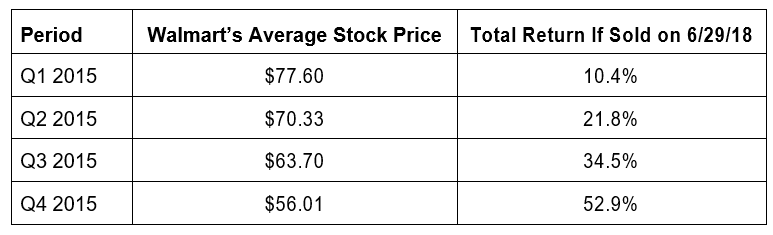
Let’s use the last four years of Walmart’s stock price as an example. If four different investors bought Walmart at four different points in 2015 and sold the stock at the end of the last quarter, they could have had widely different investment returns. The table below shows the average dividend adjusted stock price Walmart traded at during each quarter in 2015. The range of possible returns is over 40%! Keep in mind that Walmart is one of the largest and most-followed stocks in the entire world.

As active managers, we take advantage of the volatility in the stock market to buy and sell at opportunistic prices. However, we are presented with a problem when new clients become partners at Overlook Rock and when existing clients provide us with more capital to invest. The problem is that over the course of time the opportunity set of what is trading for an attractive price changes. In other words the stocks we bought for clients in the first quarter may no longer be the best stocks for new money in the second or third quarter.

We have decided the best way to maximize investment returns for all clients is to invest fresh capital in the best opportunities at the time capital is deployed. For most active managers, this approach is out of the question because it would be impractical to conduct research on a new set of companies while maintaining research coverage on existing investments. However, we have leveraged our combined technical and analytical proficiencies (something we believe is quite unique in the investment industry) in a way that allows us to effectively maintain multiple portfolios which represent the best opportunities according to our process at the time of formation.

Our software and human analysts evaluate the top investment ideas on a daily basis. Because we are always on top of the best investment ideas at any given time, we have the ability to fully invest a new portfolio with little notice. In addition, our software monitors each investment idea and provides the human analysts with the determination on when to sell. As a result, our software plus human oversight investment process is highly scalable. Not only does our technology enable us to better pick stocks but it enables us to better manage money.

While there may be a day in the not so distant future when we allow clients to send us money to be invested with little to no advanced warning, for now we have decided to gate inflows to just once or twice a year in “vintages”. Each vintage will be invested in the top ideas at the time capital is deployed. Our first vintage was deployed in January 2018 and we are currently collecting investor interest for our second vintage which will be established in the second half of 2018.

Disclaimer: Overlook Rock Asset Management is a registered investment adviser. Information presented is for discussion and educational purposes only and does not intend to make an offer or solicitation for the sale or purchase of any specific securities, investments, or investment strategies. Investments involve risk and, unless otherwise stated, are not guaranteed. Be sure to first consult with a qualified financial adviser and/or tax professional before implementing any strategy discussed herein. The information and statistical data contained herein have been obtained from sources, which we believe to be reliable, but in no way are warranted by us to accuracy or completeness. We do not undertake to advise you as to any change in figures or our views. This is not a solicitation of any order to buy or sell. We, any officer, or any member of their families, may have a position in and may from time to time purchase or sell any of the above mentioned or related securities. Past results are no guarantee of future Results. This report includes candid statements and observations regarding investment strategies, individual securities, and economic and market conditions; however, there is no guarantee that these statements, opinions or forecasts will prove to be correct. These comments may also include the expression of opinions that are speculative in nature and should not be relied on as statements of fact. Overlook Rock Asset Management is committed to communicating with our investment partners as candidly as possible because we believe our investors benefit from understanding our investment philosophy, investment process, stock selection methodology and investor temperament. Our views and opinions include “forward-looking statements” which may or may not be accurate over the long term. You should not place undue reliance on forward-looking statements, which are current as of the date of this report. We disclaim any obligation to update or alter any forward-looking statements, whether as a result of new information, future events or otherwise. While we believe we have a reasonable basis for our appraisals and we have confidence in our opinions, actual results may differ materially from those we anticipate. The information provided in this material should not be considered a recommendation to buy, sell or hold any particular security.

La filosofía de inversión de ABACO Capital

August 24, 2018 in Miscelánea, MOI Global en Español

NOTA DEL EDITOR: El siguiente texto es obtenido de una carta trimestral de ABACO Capital.

* * *

En 1991 el gestor-inversor value Seth Klarman escribió su famoso libro Margin of Safety y sus consideraciones se mantienen con actualidad. Uno de sus comentarios es el siguiente:

Comprender la diferencia entre inversión y especulación es el primer paso para el éxito de una inversión. Para los inversores las acciones representan una fracción de la propiedad de las empresas y los bonos son préstamos para el desarrollo de sus negocios. Los inversores toman las decisiones de compra o venta comparando los precios actuales de los activos con el valor de los mismos. Realizan una operación cuando piensan que saben algo que los demás desconocen, o no les importa o prefieren ignorar. Compran activos cuando les parece que ofrecen una rentabilidad atractiva, para el riesgo asumido, y los venden cuando la rentabilidad ya no justifica dicho riesgo.
Por el contrario, los especuladores compran y venden activos únicamente en función de si piensan que el precio va a subir o a bajar. Y su opinión sobre lo que vaya a hacer el precio no se basa en los fundamentales de las empresas sino en lo que otros predicen, hacen (Klarman, 1991, págs. 3-4) … o les dicen.

Continue reading »

MOI Global