True Value sobre Aercap

June 4, 2018 in Ideas de inversión, MOI Global en Español

NOTA DEL EDITOR: Esta idea de inversión es obtenida de una carta trimestral a los accionistas de True Value FI.

* * *

En esta sección vamos a explicar AerCap [AER] en detalle, pero también aplica a Air Lease [AL] (empresa también presente en cartera). Air Lease es una empresa similar que cuenta con un equipo gestor igual de bueno, solo que su modelo de negocio es crecer y reinvierte losbeneficios a tasas superiores del 15%, cotiza a 8x veces beneficios de 2018 contra 7x veces beneficios de 2018 de Aercap. La TIR a generar es casi igual y lo que se describe a continuacióndel sector es también aplicable a Air Lease.

El negocio de Aercap es sencillo de explicar. Simplemente compra los aviones comerciales más demandados y los alquila a aerolíneas  alrededor del mundo. En cierta medida funciona como un banco donde el activo en vez de ser hipotecas que producen un 3% de interés son aviones que producen un 12% de interés sobre el valor en libros. Del lado del pasivo, en vez de financiarse con depósitos de clientes lo hace con emisiones de bonos y deuda bancaria a largo plazo.

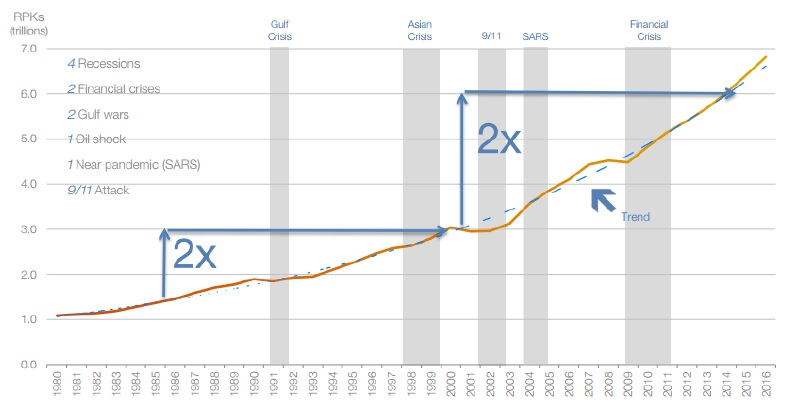
El sector de la aviación crece al doble de ritmo que el PIB mundial (6% de media), incluso e presenta crecimiento durante las crisis, diferentes factores demográficos y tecnológicos hacen que sea el medio de transporte más seguro, rápido y rentable.

Para beneficio de Aercap, el porcentaje de aviones en leasing frentes a aviones en propiedad de las aerolíneas no ha parado de aumentar siendo ahora casi el 50% de toda la flota mundial.

Continue reading »

The Manual of Ideas – May/June 2018 Edition

June 3, 2018 in The Manual of Ideas

We continue to hear from members how much they enjoy interacting with like-minded investors. What stands out is the consistent feedback about the openness and authenticity of MOI Global members.

In part, I believe it simply reflects the nature of most value investors — they are long term-oriented wisdom seekers and view themselves as somewhat apart from the mainstream investment industry.

I also believe — or, hope — that this feedback results from the deliberate design of MOI Global. We strive to be a forum for authentic investors, a service that builds value over the long term, and a community in which members appreciate that giving value is not only a catalyst for receiving value, but that giving value is in itself gratifying.

Our goal is to see members build lifelong relationships — friendships — and to keep out of the community the highly transactional, short-term nature of so many interactions in the business world. We are different in this regard, and proudly so. It is always telling to me when this difference is genuinely not understood by a prospective member or sometimes even by an existing member who views herself merely as a “subscriber” to a bunch of content.

I get two types of pushback: From a prospective member it’s usually something along the lines of, “What’s this ‘waiting list’ thing? It must be some kind of a marketing gimmick. Kindly tell me where to sign up. Oh, and can I get a free trial?” From an existing member who may have originally signed up for a newsletter, I occasionally hear, “I don’t have time to read through my subscriptions right now, so I’ll cancel and return when my schedule is less hectic.”

People reveal themselves in such statements, which is wonderful because it helps us to keep refining the community by removing those that do not belong. The latter opens the door to those who do belong, those who should have a seat at our limited-capacity events. Part of my role is finding people who would add massive value to the community—and to delight them over time so that they become an integral part of MOI Global. Our online and offline events are wonderful opportunities for me to spot investors who embody the ethos of MOI Global. This is in part why we are so enthusiastic about creating additional opportunities for member interaction.

We were pleased to co-host the Best Ideas Omaha 2018 mini-conference during the Berkshire Hathaway annual meeting weekend. With the generous support of Bob Robotti, we brought together one hundred MOI Global members for an idea-sharing event. In this edition of The Manual of Ideas, you’ll find key takeaways from the event and a transcript of Bob’s remarks. I am also pleased to share selected member impressions from Omaha.

A few voices on Best Ideas Omaha 2018:

“Perhaps the most valuable, and certainly unique, aspect of an event with such high-quality attendees is the unforeseeable, but probable, chance of making new acquaintances with people who bring deep insights from unexpected backgrounds. The gentleman who chose the seat next to me was an engineer/investor with decades of experience in managing offshore drilling projects, which led to animated sharing of ideas on related industry topics.” —Vincent Linz

“As usual, members of the value investing community were all communicative and cordial with one another. Very refreshing! Meeting attendee Charles Royce was a highlight for me. It’s always inspiring to see such a successful and tenured investor still eager to learn.” —Thomas Poehling

“…gaining exposure to a diverse group of speakers and seeing how their individual preferences as people/investors differ was an insightful experience. On one hand, it challenged my own framework. On the other hand, it solidified my own views and that they are distinct in their own way.” —Ross Bendetson

“Matt Haynes spent two months learning a completely new industry, industrial sand. Matt showed how to learn an industry from the ground up and used the term ‘R&D position’ to describe how his position is weighted so he can continue to learn more about the industry. I appreciated Matt’s humility in answering a question he hadn’t yet learned how to answer. This can be hard to do in front of peers, but Matt modeled for me how to live value investing principles by essentially saying ‘I don’t know…yet.’” —Justin Foeppel

A few voices on the Berkshire Hathaway weekend:

“…my favorite line came from Charlie comparing trading cryptocurrency to trading turds!” —Walter Lehman

“Takeaways: (1) setting myself up for success by creating an environment that is conducive for patience, contrarianism and value investing as well as making an effort to interact with people that are better than me; and (2) reinforcement of the importance of patience and contrarianism, illustrated by Berkshire’s large cash balance in a richly valued private and public market environment.” —Theodore Rosenthal

“Buffett’s opening remarks were excellent. He took us back to March 1942. The headlines were full of bad news. Buffett talked about how he told his dad he wanted to buy 3 shares of Citi Service preferred stock. It was all the money he had. The stock was $84 the year before and he watched it hit $55 at the start of 1942. They fell further to $40. Buffett got his shares at $38.25. That was the high price for the day. The stock closed at $37. They fell to $27 as the war raged on. Scary. Then they rallied to $40. Buffett sells. He clears $5.25. Serious money in those days. Sounds like a pretty good outcome, right? But you know what happens next. The stock keeps rallying and Citi soon after redeems the preferred shares for $200. Buffett would’ve have made $485.25 – about 90x more than he did make. First, you can’t help but be impressed Buffett was trading preferred stock at age 11. With all the money he had, no less! But the more important lesson was the idea that you have to look past today’s troubles and take the long view. How often do we allow what’s happening today influence our investment decisions?” —Chris Mayer

“Tom [Gayner] shared his thoughts on moats. In a dynamic world, the ability to change and adapt is a moat. Some of the best companies — Berkshire, Disney, Alphabet — have been ‘shape-shifters’. They adapt and evolve to the opportunities in an ever-changing world. Consistent values provide an anchor to do that. Mindset and culture matter.” —Saurabh Madaan

“Especially here in the Washington DC beltway (as well as in New York or other influential cities), we tend to become a bit myopic as to how things are viewed, business wise as well as politically. It is stunning that so many can converge on a small Midwestern city from such disparate places and share, enjoy, and learn from each other. Somehow I hear the old Coca-Cola commercial playing in the background (‘I’d like to teach the world to sing…’) though it proves to me that humanity is so much better off when we seek out the things that unite us rather than ‘demagogue’ what divides us. In this case it is an octogenarian and nonagenarian taking five hours of questions. AI may provide us with more and better information but it will not replace the benefit gained by a handshake and looking someone in the eye.” —Howard Lichstrahl

We are gearing up for the sixth annual edition of our online conference, Wide-Moat Investing Summit, to be held from June 27-29. This will be our largest quality-focused idea conference ever, featuring the best ideas of more than fifty instructors from the MOI Global community, all of whom share a value-oriented investment philosophy.

In the past, Wide-Moat Investing Summit and other online conferences hosted by MOI Global were available to anyone purchasing a conference pass. Since last year, only members of MOI Global have access to these summits. Access is not only exclusive to members but also fully complimentary.

Tune into the sessions at Wide-Moat Investing Summit 2018. You’ll enjoy LIVE access in late June, followed by unlimited replay access.

Members, log in below to access the restricted content.

Not a member?

Thank you for your interest.  Please note that MOI Global is closed to new members at this time. If you would like to join the waiting list, complete the following form:

Edelweiss: Well-Managed, Growing, Diversified Financial Services Firm

June 3, 2018 in Asia, Asian Investing Summit, Asian Investing Summit 2018, Asian Investing Summit 2018 Featured, Audio, Equities, Financials, GARP, Jockey Stocks, Mid Cap, Small Cap, Transcripts

Rashmi Kwatra of Sixteenth Street Capital presented her investment thesis on Edelweiss Financial Services (India: EDEL) at Asian Investing Summit 2018.

Summary thesis:

Edelweiss, a secular growth story in Indian financials, was co-founded by Rashesh Shah and Venkat Ramaswamy in 1995. Founded as an investment banking and advisory services firm, it has consistently allocated capital well, using bear markets to invest in its people and incubate new businesses. Edelweiss is now a diversified financial services company.

It plans to shift the mix of its credit business from 39% retail-focused (FY17) to 70% retail-focused (FY20). There is potential for Edelweiss’ credit business to re‐rate given its strong ROE of 18% (retail segment), two‐year growth of 57% CAGR, and planned segment mix shift to retail. Rashmi projects a loan book CAGR of 40% from FY18-20 for the retail book, driven by strong macro conditions for affordable housing and SME financing (and a low base for Edelweiss) and a muted corporate loan book growth of 13.5% in the same period. Edelweiss has shown significant traction in the wealth/asset management business to become the third-largest player in wealth management in India. The firm is also seeing growth in the asset reconstruction business.

Based on Rashmi’s conservative estimates, Edelweiss was recently available at a fair price, and should compound capital at a significant rate in the long term.

The full session is available exclusively to members of MOI Global.

Members, log in below to access the full session.

Not a member?

Thank you for your interest.  Please note that MOI Global is closed to new members at this time. If you would like to join the waiting list, complete the following form:

About the instructor:

Rashmi Kwatra is the Founder of Sixteenth Street Capital, and the Portfolio Manager of the Sixteenth Street Asian GEMS fund. The Sixteenth Street Asian GEMS strategy is focused on providing equity exposure to the highest growth Frontier and Emerging Asian markets. Though focused on public equities, Rashmi values a business as would a long-term private buyer. Rashmi was previously Partner at Prince Street Capital Management, a specialist in Frontier and Emerging markets . She was recently named one of 50 leading women in hedge funds globally by the Hedge Fund Journal. Rashmi holds a dual degree in Finance and Management from The Wharton School of The University of Pennsylvania, where she graduated magna cum laude. She is a Thai national, of South and Southeast Asian descent, and speaks English, Thai, Hindi, and Punjabi.

Infinite Horizon, Finite Assets

June 2, 2018 in Commentary, Equities

This article is authored by MOI Global instructor Bogumil Baranowski, Co-Founder and Partner of Sicart Associates.

Investing’s greatest challenge

Investing in finite assets with an infinite investment horizon is one of the unstated challenges of our business. The task becomes even more difficult as the markets boost prices of assets that are not only intangible in nature, but also whose profit-generating ability is questionable or potentially short-lived.

First, some definitions. For us, an “infinite horizon” is one without a specific point in time when all investments must be liquidated and proceeds have an immediate use. We consider any asset whose eventual value is zero (or not far from it) as “finite.”

If you invest with an infinite horizon in assets that will eventually expire worthless, you are facing a challenge much greater than just keeping up with a rising bull market or trailing an arbitrary index by a point or two. This is how we at Sicart look at investing, though. We help families and entrepreneurs retain and grow their fortunes over multiple generations. As much as wealth creation is a combination of skill, hard work and luck, wealth preservation is an exacting time-tested process that can be consistently repeated over generations.

In the long run we might be all dead, but our wealth isn’t

John Maynard Keynes, a well-known Great Depression era British economist, reminded us that “in the long run we are all dead”, and we don’t argue with that, but there is a way to preserve wealth beyond our time on Earth. It is secondary whether we keep the wealth in the family or give it away. The wealth will live on, and benefit others.

As a matter of fact, all the wealth ever created, and accumulated that wasn’t destroyed or lost is still around us. Its nature is infinite, though assets it is stored in are very often finite.

Investors with an infinite horizon face one big challenge that is also a big opportunity.

–The challenge is finding assets that have the highest likelihood of retaining and increasing their value over time.

–The opportunity exists in the mispricing of assets that will continue to occur as long as fear and greed influence markets. Our patient long-term perspective allows us and our clients to benefit. This is as true as it was in the mid-20th century, when Benjamin Graham, the father of value investing reminded us that “in one important respect we have made practically no progress at all, and that is human nature.”

From a cigarette butt to a wide moat – the investment horizon gets longer

It was Benjamin Graham who, in the 1930s, laid the foundation for value investing. His philosophy has influenced generations of successful investors, including Warren Buffett. Ben Graham found early success in the 1920s by doing what few did at the time: he actually read and analyzed company records to establish the value of a business. He was searching for obvious mispricing. (Unfortunately, even Graham’s acumen didn’t protect him from harm in the 1929 market crash, which, let us remember, led to a 90% decline in the Dow Jones Industrial Average through 1932.)

Graham’s simple method was to focus primarily on the quantitative side of the businesses he studied, almost ignoring the qualitative side.  He tested the concept in 1930-32 as the market sought its lowest level and published it in the first edition of his ground-breaking book Security Analysis. He introduced the concept of net current asset value as “current assets alone, minus all liabilities and claims ahead of the issue.” Graham notably took into account only cash and assets easily convertible into cash. His definition of net current asset value excluded not just intangible but also fixed assets, including land and buildings. His investment priority was buying companies at a discount to the net current asset value – in other words, companies that were worth more dead than alive. Graham knew that many companies fail, and he had no intention of holding them forever. He purchased finite assets with the intention of holding them for the duration of a finite investment horizon.

Why would he do that? First, he learned the hard way, as so many investors did during the Depression. Through October 1929 companies were trading at very high valuations, assuming endless investor enthusiasm and increasing prosperity for American business. That turned out to be a recipe for disaster. Second, countless companies on the stock exchange did trade at a large discount to net current asset value, so he had ample opportunities. Third, he was more focused on wealth preservation than on phantom market gains. The economy was shrinking, deflation was rampant, and few people, in the 1930s, remained interested in stock investing.

As the economy picked up and the post-WW2 boom brought a huge demographic tailwind in the Baby Boom, the obvious mispricings that Graham sought to profit from started to disappear. His thinking evolved, and in 1974 his intrinsic value formula took into account not only earnings and growth, but also interest rates. This was a big leap away from buying stocks for less than net cash assets on the balance sheet.

It was Warren Buffett, however, who, with the help of his partner Charles Munger, successfully graduated from cigarette butt investing (i.e. searching out the last puff in assets discarded by the market) to wide moat investing, where the long-term earning power of companies takes precedence over liquidation value.

Over the last 50 years, Buffett’s Berkshire Hathaway annual letters have taught us the importance of a lasting competitive advantage – a “wide moat” that defends a business from possible competitors. Buffett knew well that it is not enough to find businesses with fat margins. Businesses need to hold on to those margins for many decades.

This “wide moat” approach brought Buffett closer to an infinite investment horizon, which is how we at Sicart think of managing family fortunes. As a matter of fact, Buffett often says that his preferred holding period is “forever.” Many of his investments not only successfully defended their market share and margins, but also grew many times over – Coca-Cola, GEICO, and American Express, for instance.  Others succumbed to technological change – newspapers and textile mills are two examples. Berkshire Hathaway, in fact, originated as a textile mill, which proved to be a textbook example of a finite asset. The whole industry eventually lost the battle to low-cost overseas competitors. Berkshire Hathaway was possibly one of Buffett’s last “cigarette butt” investments, held too long past the last proverbial puff.

Although Ben Graham had no interest in intangible assets like brand, Warren Buffett taught us to pay attention to the power that brands have over consumers. That’s what allows businesses to reach more people, stay relevant, and most of all, charge a premium price!

Intangible economy, intangible assets

It’s a long way from the early-1930s value mindset — shopping for businesses which can be bought for less than net cash assets — to taking the brand’s intangible value into account. It’s been a journey from “cigarette butts” to “wide moats” and now we are headed beyond that.

We consider ourselves contrarian long-term value investors, but we don’t care if a company’s operations rely on hard assets or intangible assets. Ultimately, we look for bargains:  quality at a meaningful discount. As long as there is an existing or potential earning power, we will consider investing in a company whose only meaningful assets are intangible in nature. We appreciate the benefits of the wide moat that can be established by lasting competitive advantage derived from a brand, network effect, or scale. We also notice that companies built with intangible assets tend to require less capital and have potentially higher margins – which is music to our ears.

It can be complicated to assess how finite these assets are – what the expiration date might be. We’ve all had food go bad in our homes, and investing is no different. Consumer habits change slowly, and the brand value of a chewing gum can last for many decades before slowly eroding. A competitive advantage earned by technological progress reaps benefits fast, but also vanishes abruptly.

We have seen market leaders like Blackberry, Kodak or Nokia lose customers, market share, and market value in what felt like a heartbeat. That’s especially dangerous for value investors who are prone to reaching deep into bargain bins and may at times pick up a “value trap” – a company that looks cheap but will only get cheaper.

At the other end of the spectrum, we see the growing importance in market indices of today’s highest-valued tech stocks, and their breathtaking outperformance of the rest of the stock market in the last few years. The more they grow, the higher the market values them. It’s not the first and won’t be the last time the market gets excited by a new wave of fast-growing companies. Radio stocks created equal enthusiasm during Ben Graham’s early days on Wall Street. Remember radios? Nothing lasts forever.

We fear that investors might be forgetting the finite nature of those fashionable intangible assets, which may be poor choices for investors with an infinite investment horizon. They might want to focus on a durable “wide moat” that can extend the life of an asset or provide enough time to exit unscathed.

The challenge of wealth preservation has possibly never been bigger.

The challenge is threefold:

  • We are facing unprecedented prices in most assets around the world. Seldom has this much future earning power been attributed to not only intangible, but also finite assets; two early 18th century “bubbles” involving the South Sea Company and the Mississippi Company come to mind.
  • All asset prices are denominated in fiat currencies, i.e. they are legal tender not backed by any commodity such as gold. Instead they are backed by weakening governments’ power to tax an ageing world population.
  • We see unsettling levels of debt at the consumer, business, and government levels.

The three challenges are entwined. And much as we appreciate the value of the intangible economy, in times like this we gravitate toward businesses with wide and lasting moats that are less susceptible to changes than the high-flying stars of the tech world with its intangible assets.

Creating a wide moat and retaining one are separate accomplishments. So are making a fortune and holding on to it. Investing with an infinite time horizon, but in unavoidably finite assets poses a real though not necessarily clearly visible challenge for those aspiring to keep and grow their fortune in the long-run.

Disclosure: This article is not intended to be a client‐specific suitability analysis or recommendation, an offer to participate in any investment, or a recommendation to buy, hold or sell securities. Do not use this report as the sole basis for investment decisions. Do not select an asset class or investment product based on performance alone. Consider all relevant information, including your existing portfolio, investment objectives, risk tolerance, liquidity needs and investment time horizon. This report is for general informational purposes only and is not intended to predict or guarantee the future performance of any individual security, market sector or the markets generally.

MMA Offshore: Recapitalized Operator of Offshore Supply Vessels

June 1, 2018 in Asia, Asian Investing Summit, Asian Investing Summit 2018, Asian Investing Summit 2018 Featured, Audio, Communication Services, Deep Value, Energy, Equities, Micro Cap, Small Cap, Special Situations, Transcripts

Peter Kennan of Black Crane Capital presented his in-depth investment thesis on MMA Offshore (ASX: MRM) at Asian Investing Summit 2018.

Thesis summary:

MMA Offshore is a leading operator of offshore supply vessels. The company is headquartered in Perth, Australia, with key operations in Australia, Southeast Asia, and the Middle East.

The company has recently been recapitalized and has a strong balance sheet to wait out the industry downturn. Peter’s firm, Black Crane, played a key role in the recapitalization process, including assisting in defending the company from an opportunistic attack by another major shareholder. The fleet has been reduced in scale following a successful non-core vessel disposal program and now comprises 30 niche, specialized vessels.

Net tangible asset value is A$0.36 per share based on recent market values of vessels. The upside is north of A$0.60 per share as the sector rebounds. MMA shares recently traded at A$0.23 per share.

The full session is available exclusively to members of MOI Global.

Members, log in below to access the full session.

Not a member?

Thank you for your interest.  Please note that MOI Global is closed to new members at this time. If you would like to join the waiting list, complete the following form:

About the instructor:

Peter Kennan is Managing Partner and CIO of Black Crane Capital. He has 15 years of corporate finance experience across a diverse range of sectors and transactions with UBS Asia and Australia. With UBS, Peter was formerly the Head of Asian Industrials Group for UBS Asia, a corporate finance sector team covering energy, infrastructure, resources, consumer/retail and general industrial companies. He achieved number 1 team rating in Asia. Peter was also the Head of Telecoms and Media sector team for UBS Australia specializing in M&A, advising on many large, complex transactions. Prior to UBS, Peter spent 7 years with BP in a variety of engineering and commercial roles.

Meritz: Financial Holding Company in Korea, with Merit-Based Culture

June 1, 2018 in Asia, Asian Investing Summit, Asian Investing Summit 2018, Asian Investing Summit 2018 Featured, Audio, Deep Value, Equities, Financials, Jockey Stocks, Small Cap, Transcripts

James Lim of Dalton Investments presented his in-depth investment thesis on Meritz Financial Group (Korea: 138040) at Asian Investing Summit 2018.

Thesis summary:

Meritz Financial is a financial holding company that owns 52% of Meritz Fire & Marine (#5 in size and #1 in ROE in South Korean non-life insurance business) and 43% of Meritz Securities (#6 in size and #1-2 in ROE).

Since the appointment of talented new management a few years ago, Meritz Fire & Marine has improved ROE from 9% to 20% and Meritz Securities from 4% to 14%. Meritz Fire & Marine is seeing high growth in new premiums (#2) due to a competitive sales commission rate, based on low fixed costs and relationship building with general agencies, which have displayed strong growth. Meritz Securities has become a dominant player in the real estate financing business, with strong risk management, and is now going after large-scale deals and foreign deals. The shares recently traded at 1x P/B, 6x P/E, and a dividend yield of 3.4% despite a payout ratio of only 20%.

The main shareholder owns 68% of the equity, and the talented co-CEOs each have a $10 million base of stock options while most of their performance-based bonuses get paid out over ten years and linked to share price performance, inducing long-term thinking and strong alignment of interests with minority shareholders. The group has a merit-based culture (thus the name Meritz) and stands out from the conservative, rigid, and rather bureaucratic Korean financial industry.

The full session is available exclusively to members of MOI Global.

Members, log in below to access the full session.

Not a member?

Thank you for your interest.  Please note that MOI Global is closed to new members at this time. If you would like to join the waiting list, complete the following form:

About the instructor:

James Lim is a Senior Research Analyst for Dalton’s Asia equity research team, and has 4 years of investment experience. Prior to joining Dalton in 2015, Mr. Lim worked as a senior associate consultant at Bain & Company in Seoul, Korea. Mr. Lim holds an MBA from the University of Chicago, and a BS in Business Administration from Yonsei University.

Nuevas posiciones de Andromeda Value

June 1, 2018 in Ideas de inversión, MOI Global en Español

NOTA DEL EDITOR: Estas ideas de inversión son obtenidas de la carta primer trimestre 2018 de Andromeda Value Capital.

* * *

MongoDB [MDB]

A raíz de lo que comentábamos anteriormente acerca de las bases de datos no “relacionales” Mongo se constituye como un gran jugador, con algunas implementaciones como Atlas, terriblemente interesantes. Para entornos nuevos observamos que la atracción hacia este tipo de bases de datos es muy positiva y la propuesta de valor de Oracle se diluye mucho. Pese a que Oracle no lo quiera reconocer…

Continue reading »

SM, Com2uS: Benefiting from Rise of Korea’s Cultural Economy (TRANSCRIPT NOW AVAILABLE)

June 1, 2018 in Asia, Asian Investing Summit, Asian Investing Summit 2018, Asian Investing Summit 2018 Featured, Audio, Communication Services, Equities, GARP, Information Technology, Small Cap

Chan Lee and Albert Yong of Petra Capital Management discussed the rise of Korea’s “cultural economy” and presented their investment theses on SM Entertainment (Korea: 041510) and Com2uS (Korea: 078340) at Asian Investing Summit 2018.

Thesis summaries:

Korea is no emerging market; Korea is home to the world’s most successful companies with leading technologies, skilled labor forces, and highly educated management. So-called “Hallyu” has been a blessing for Korea, its businesses, culture and country image; Korea has become one of the world’s coolest brands. Many competitive Korean companies are ready to break out and expand outside of Korea benefiting from the soft power developed through the increasing popularity of the “Korean Wave”.

SM Entertainment is Korea’s best entertainment agency/music studio company, founded by Mr. Soo-man Lee, a popular artist in Korea of the 1970s and 1980s. The company has the best farm system to develop K-pop artists who have become superstars in Asia. It benefits from the growing popularity of Hallyu worldwide. SM Entertainment should create value from its entry into the Chinese entertainment market by forming a strategic partnership with Alibaba Group. The market’s overreaction to the THAAD (Terminal High Altitude Area Defense) deployment issue which has provided a contrarian buying opportunity. Despite the recent stock price rally, the market price does not fully reflect the Company’s brand power and long-term growth prospects in Asia.

Com2uS is one of the top mobile game developers in the world, generating ~80% of revenue from outside of Korea. The company has experienced continuous success and strong recurring earnings from its flagship game, Summoners War. Com2uS should continue to benefit from the growing popularity of Korean online games. The company has a strong pipeline of new games over the next twelve months. The shares offer a margin of safety in net cash and an investments balance of ~700 billion Won, which can be used to buy back shares or deploy in accretive acquisitions. Despite the recent stock price rally, the market price is substantially undervalues the company.

The full session is available exclusively to members of MOI Global.

Members, log in below to access the full session.

Not a member?

Thank you for your interest.  Please note that MOI Global is closed to new members at this time. If you would like to join the waiting list, complete the following form:

About the instructors:

Chan Lee has over 20 years of investment experience in Korea. His investment career has focused on identifying and analyzing undervalued competitive companies whose market prices are significantly discounted to intrinsic value. Prior to co-founding Petra in 2009, he was a Director and Head of M&A at Hana Financial Investment. Chan received his JD from the UCLA School of Law and his BS in Business Administration from the University of California at Berkeley.

Albert Yong has two decades years of experience of investing in Korea. Albert utilizes a disciplined and patient deep value investing approach to seek superior risk-adjusted returns with limited volatility and bases his investment decisions on detailed, research-based analysis and thorough due diligence. Prior to co-founding Petra in 2009, Albert was a Managing Director and the CIO of Pinnacle Investments and a Portfolio Manager of Pan Asia Capital. Albert received his MBA from the UCLA Anderson School of Management and his BS in Electrical Engineering from Seoul National University.

MOI Global