
Ashiana Housing: Real Estate Developer with Growth Runway in India

May 31, 2018 in Asia, Asian Investing Summit, Asian Investing Summit 2018, Audio, Equities, GARP, Real Estate, Small Cap, Transcripts

Amey Kulkarni of Candor Investing presented his in-depth investment thesis on Ashiana Housing (NSE: ASHIANA) at Asian Investing Summit 2018.

Thesis summary:

Ashiana Housing is a real estate developer with a long growth runway in a country with 1.3 billion people, including 275 million families. Ashiana is a conservatively financed, well-run real estate operation in a country that is rapidly urbanizing, with a housing shortage in urban areas estimated at 18 million units.

Ashiana is run on a business model similar to that used by Mohammed Yunus to build the Grameen Bank in Bangladesh: “First check what the industry peers do and then go and do the exact opposite.”

Given that construction is financed by advances from customers, the company requires little external capital, except during a severe cyclical downturn. Ashiana, with average pretax ROIC of 25+%, is available at an earnings yield (five-year average pretax cash from operations to enterprise value) just below the ten-year government bond yield.

The following transcript has been edited for space and clarity.

Ashiana Housing is an India-based real estate developer with a differentiated business model. Let us first consider how the company has fared relative to the industry and its peers. Over the last almost 11 years, since before the global financial crisis, Ashiana Housing has outperformed all its peers by a ratio of 10:1. This is truly amazing, a phenomenal company performance in the stock returns!

The real estate business is a simple one in terms of how it works. What typically happens in India is you buy land or form a joint venture with the landowner, launch the project, then finish it, and start sales to customers. The customer usually pays 20% of the total agreement value upfront, then the builder goes and gets the building plans approved by the local authorities, after which construction starts. The customer makes payments for every single milestone achieved during construction, so before completion of the project, 95% of the money is typically already paid. The last leg of the project completion and handover is the 5% payment milestone.

To summarize: buy land, collect advance from customers, pay for the construction, and keep the balance as profit (except for buying additional land). A well-run real estate operation needs negative capital employed.

In India, the balance of power is typically with the developer as most customers have already paid upfront a huge amount of their net worth to buy their first or second house before the actual delivery of the project. What then is the perverse incentive for any developer?

As we all know, real estate is a cyclical business. When the going is good, land and property prices appreciate fast, and apartments and houses sell like hotcake.

The typical developer uses the advance from the customers and buys more land before starting construction on the project. Another project is launched in the second parcel of land bought, the developer takes the 20% upfront payment received, buys a third parcel and keeps rotating. The perverse incentive existing for the developers is to grow faster than what their own resources allow them to.

What does this usually mean? What is the reputation of a typical real estate developer in India? WE can find some anecdotal evidence in what some people are saying on websites like Quora. In reply to somebody asking “In what different ways can real estate builders and brokers cheat customers?” Sandeep Pandey answered in March 2015 it could be by “confusing the buyer between carpet area and salable area.” Buyer don’t know what exactly they are getting – how much area, what carpet area, how big the apartment will actually be, when it gets constructed. Developers could also hide additional charges like value added tax and maintenance services, or hype the prospects of the society or the locality. In the second case, they could advertise an upcoming highway, a new commercial IT Park planned very close and coming up in the next few months, and other things along those lines.

In another reply, a Quora member says the first rule is to have a good lawyer beside you when buying a property; observe carefully for clues from frauds and never trust words; and use your contacts to do a background check – fraudsters won’t be first-timers, and they would have left enough clues for you. For due diligence, using a lawyer is a different case, but for deciding whether you like and want to buy a property, first take the lawyer.

Other ways in which developers or brokers cheat people is by collection of booking amount for the same property from multiple people. This is the kind of reputation real estate in general has.

Let’s look at what makes Ashiana Housing’s business model different from what the industry does. We should first consider what the industry thinks about land banks. To construct homes, you need land. Here is an excerpt from the annual report of a reputed peer and one of India’s largest developers, Sobha Developers. It says, “Land portfolio is a distinguishing asset for a real estate company. The ability to acquire appropriate land parcels at strategic places and competitive prices or enter into joint developments for future launches helps maximize profits for the company.” Overall, the industry treats a land bank as a strategic asset. The cheaper and the more you acquire, the better it is.

However, Ashiana Housing says, “We as a company don’t believe in the land banking model.” At any given point of time, land inventory of five to seven times the execution capability is sufficient to achieve the targeted growth in sales and construction, according to the company.

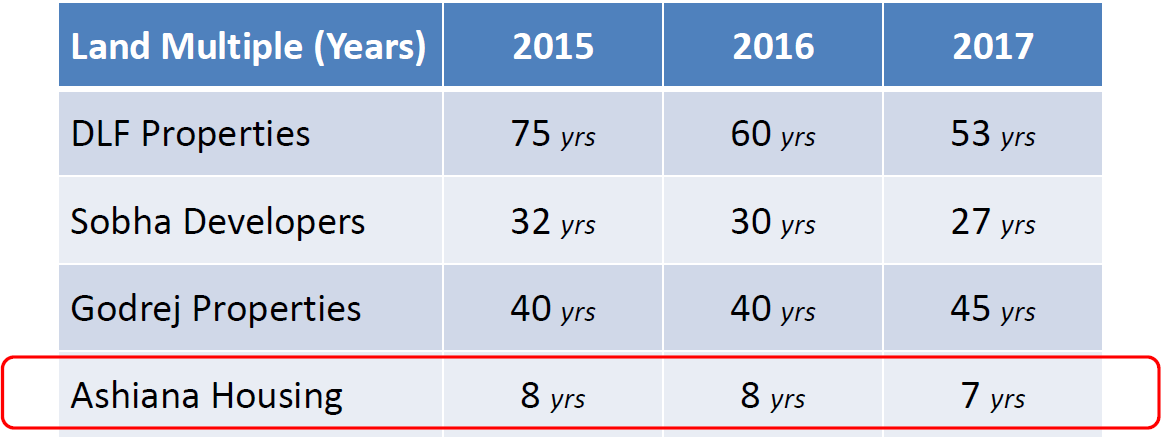
Ashiana Housing vs. Selected Comparables — Land Banks
Source: Amey Kulkarni at Asian Investing Summit 2018.

To measure its progress internally, it uses a metric called a land multiple, which is a total developable land area over equivalent area constructed in the corresponding period. If, for example, Ashiana Housing has the ability to construct, say, one million sq. ft. every year across its multiple projects, it would typically want to have between five to seven million of land inventory so it has enough to grow in the near future but not too much land.

If the pace of construction is similar to what it was in the last trailing year, given the land inventory, how many years will it take a company to construct homes on its entire land? Here’s what the land multiple looks for other industry players. DLF Properties, which is the biggest developer in India, has something like 60 to 70 years of land inventory, while Sobha Developers has around 30 years. Godrej Properties, another reputed builder, has about 40 to 45 years. With Ashiana Housing, it’s 7 to 8 years.

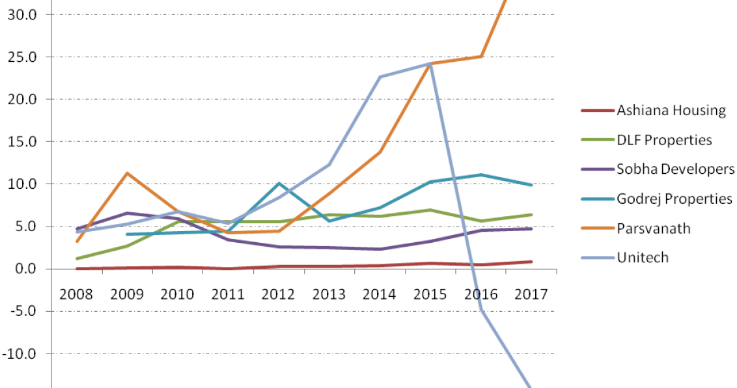
Ashiana does not have capital tied up in land banks, and this has a direct impact on financial leverage and operational flexibility. In studying the debt levels of different companies, I have taken as metric total debt upon EBITDA. For Ashiana Housing, over a 10-year period the total debt upon the EBITDA the company makes every year is a minuscule figure – about 0.1. For most other developers, it is much higher at three to four times, indicating that most of the industry takes a lot of debt to buy and hoard land.

Ashiana Housing vs. Selected Comparables — Debt to EBITDA
Source: Amey Kulkarni at Asian Investing Summit 2018.

What has happened because of this? After the global financial crisis, price appreciation in property stopped and sales velocity tapered off. We can use Unitech as an illustration – it had so much on its plate it started making losses, so EBITDA by total debt turned negative. At companies like Parsvanath, over the last 10 years, total debt by EBITDA has just gone through the roof. This shows excess debt can spiral a company into bankruptcy, which is what happened with Unitech – one of the biggest developers in India before 2008.

Let us now look at who the real estate industry sells to. Buyers can be segmented into two types. One is the end users who will stay in that apartment with their families, and the other are investors with extra money. As in stock markets, investors want to buy into real estate so that six months, one year or five years later, they can sell that property or apartment and make a decent return on their investment.

These two types of buyers prioritize different things. End users would seek amenities for comfortable living, convenience shopping, and hospitals. They would also look for schools nearby because they want their kids to get a good education. End users want a community living; they want to mingle with neighbors and have a good time. Typically, India has joint families, so parents live with their grown-up children and grandparents live with the young kids. People wishing to buy real estate for consumption wants to see whether their parents, who are now in their old age, will be comfortable living there, as well as whether the location of the apartment is convenient for an office commute or the construction is of good quality.

On the other hand, investors would consider things like whether this is a fast-developing locality and if some new highway or a road is being constructed, which will result in appreciation of the property. They would also want a property with exclusive amenities, something no other housing project has in, say, a 5 km or 10 km radius. Investors would look for some new upcoming office complex, which would suddenly increase the value of this property and demand for rental consumption. This type of buyer wants simple, easy payment options, like pay 10% now and 90% on possession.

These are the main differences in what investors and consumers look at. Ashiana Housing chooses not to pitch to the investors. Why? Let’s look at what happens to sales in an up-cycle. When real estate prices are increasing, these cycles last for four to five years, so sales to investors happen very fast in a real estate up-cycle. However, end-user demand tends to be more consistent.

Every sale to a happy customer who stays in an Ashiana property increases word-of-mouth publicity and the brand credibility of the company. This brand reputation continues to positively impact sales and business performance 5, 10, or 15 years down the line. In its brand and marketing communications, Ashiana Housing always targets the end-consumers, telling them they will have a good time living in its project, in its apartment complex. This demand is more consistent and comes from word-of-mouth.

Let’s look at how Ashiana Housing sells to its customers and what the industry does. Typically, the industry uses the help of real estate brokers. That’s because real estate is a project-driven industry, and you want to suddenly ramp up your sales efforts during the launch of some special campaigns or when the real estate project is getting over and you’re not ready for handover.

However, there is a moral hazard associated with using real estate brokers because they are paid commissions and want to sell as fast as possible. Typically, they will promise the customer something that is not available in the project, for example, a certain view or a garden which is probably not going to come up in that project, or the fact that maybe there is no adjacent building that will come up and block the view to the lake, which is, say, one kilometer away from the project.

Instead of a broker-driven model, Ashiana has an in-house sales and marketing team. This ensures greater ownership of customers and helps in selling projects to them in the future. The result is a high proportion of customer referral sales to overall sales due to established brand and high customer satisfaction levels.

Vishal Gupta, one of the promoters of Ashiana Housing, says the following: “Customer touch-point is most crucial. Everything else can be outsourced, but not sales or customer service because every interaction with a customer is an opportunity to further enhance our brand.” He says construction can be outsourced, account keeping can be outsourced, a lot of other things can be outsourced, but any and every interaction with the customer is an opportunity to enhance your brand, so you will never outsource it.

In terms of total sales, what are the referral sales? Referral sales are those which have been done based on word-of-mouth from existing customers. According to the 2013 annual report, over 50% of total sales were through referrals. This illustrates the level of customer satisfaction for Ashiana Housing.

The typical way to incentivize sales is by giving higher commissions when your salespeople achieve higher sales. However, Ashiana Housing’s sales process is different and not incentive-driven. As the company’s MD says, “We have built the sales force in a way that there is no sales incentive in making more sales.”

This is the exact opposite of the common perception of any sales function, where you incentivize for more sales. What Ashiana says is a) we don’t have brokers, so we won’t have third-party people selling our product, and b) we won’t even incentivize our own salespeople to sell more, because, as the MD explains, “If my sales people are missing targets they could misinform or misrepresent to customers, which will hit the very foundation of the trust customers have in the Ashiana brand.”

It also has to look at this from a reputational point of view – how builders cheat, what the reputation of real estate is in India, and how the balance of power is tilted towards the real estate developer because the customer is paying a huge amount upfront to buy the property. In that context, Ashiana Housing wants to maintain the trust the customer has in the brand.

Ashiana Housing — Selected Metrics
Source: Amey Kulkarni at Asian Investing Summit 2018.

We also need to look at how accounting drives management behavior. The revenue recognition policy the entire real estate industry follows is the percentage of completion method. If a real estate project takes about four years from start to finish and we assume – for simplicity – that every year, 25% gets constructed, then the total revenue potential of that project will be spread equally over those four years.

If a company has 15 different projects at different stages of completion, then for the overall financial results declared to the public, it becomes quite difficult to track the performance of the company vis-a-vis each project.

With the percentage completion method, what the company also wants to do is try and increase the profits every year, which is what every company aims for. What does it lead to? Here is a quote from the annual report of one of India’s leading real estate developers: “In accordance with the aforesaid Scheme of Amalgamation, an amount of 137 crores on account of Goodwill on amalgamation has been adjusted from General Reserve and Surplus in the Statement of Profit and Loss instead of amortizing the same in the Statement of Profit and Loss over a period of five years.”

Had the amount been charged to this P&L, the profit for the year would have been lower by 28 crores. The cost and expenses incurred in implementing the scheme have been directly adjusted from the surplus in the P&L account, i.e., the company did an acquisition and suffered a loss. This loss was directly taken to the balance sheet rather than passed through the P&L, so for the next five years, the profits of the company will be shown as higher than what they have been. The loss of 137 crores is directly adjusted from reserves and surplus of the company.

What it is telling the minority shareholders is, we are making great profits and then in the 300-page annual report, in one paragraph on page 179, it is hiding a loss of 137 crores the company suffered when it acquired some other company.

Ashiana recognizes revenue on a project completion basis, i.e., it will toil for four years to construct the project and only when the project is handed over to the customer will it recognize the revenue. The revenue and the profits will be lumpy, and the celebration is only when the project is completed.

Let’s see how this affects management behavior. The MD of Ashiana Housing says in the first paragraph of his annual shareholder letter in 2016, “We had taken Happy Handover as a central theme for last year. The idea was to make the possession process memorable for the customer. So, we are pleased to share that we have achieved a Net Promoter Score of 68% versus our target of 60%.” This KHUSHIMETER, or the Net Promoter Score, is a customer satisfaction number the company achieved.

It’s nothing exceptional; everybody does customer satisfaction surveys. What is typical of Ashiana Housing is that in the shareholders’ letter, right in the first or the second paragraph, the MD wants to share the company is happy handing over so many completed projects to pleased customers.

When we look at the stock, we see it has gone up more than a thousand times in the last 17 years. Ashiana Housing does exactly the opposite of what the industry does. The industry sells through real estate brokers, but not Ashiana Housing. The industry wants to have a large land bank and treats land as a strategic asset. Ashiana Housing says it doesn’t want land above five to seven times its construction execution capability. But the question remains if it is still an investable company? Should we still buy the stock today?

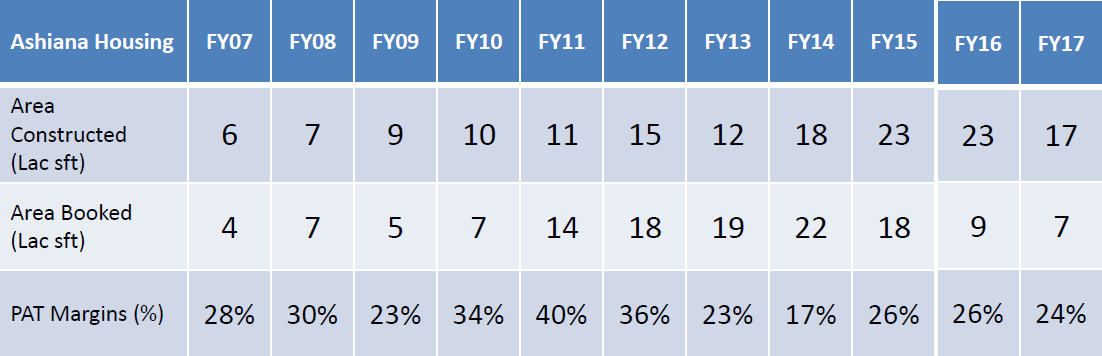
In terms of some financial parameters for Ashiana Housing, we have looked at the area constructed for the last 10 years and the area booked, which is the sales that have happened in the last several years. Every single year from 2007 to 2015, both sales and the area constructed have increased. The PAT margins are between 20% and 30%, i.e., the company is making additional profit from every single square feet of flat or property it has been able to sell.

Over the last three years, sales have tapered off. The real estate industry is in a cyclical downturn and there was, so to say, a deep black swan event – the demonetization of the high currency notes in India, which was done in November 2016. The buyers started expecting real estate prices to fall, and the trade velocity slowed drastically.

This can be seen in the area booked numbers for Ashiana Housing and also for the other developers in the industry. The company keeps making profit for every additional square foot of flat it constructs.

With regard to changes in the industry, the Real Estate (Regulation & Development) Act was approved in 2016, making the industry in India regulated for the first time. One of the main provisions of this act says no sales can be made without getting all the required approvals. It is no longer possible to proceed as before, that is, launch the project, collect the money from the customers, then go for approvals, and move on to construction. Now you first invest in land, obtain the approvals, get the project in place, and only then you can launch it.

The other main provision of this act says 70% of cash flows from the project have to be kept in an escrow account. The money has to be utilized for that particular project. Real estate companies can no longer play the typical game of trying to buy more land from the advances customers have paid.

Another provision says there can be no change in development plan without the consent of customers who have bought the apartments in the real estate project. This used to happen a lot for large township projects where the builder probably has some 100 or 200 acres of land and keeps developing that parcel over, say, 10 years in three to four phases. For phases 1, 2, and 3, the developer will keep saying there is a large cricket stadium, then there is a huge golf course to be constructed, or some 20 acres of green parcel will be there. By the time 7 or 8 years have passed by, the local laws change, urbanization happens, the floor space index changes. The developer can construct more buildings over the same land, and then the development plan itself gets changed. The original buyer who wanted a green lush space suddenly has a concrete jungle.

The likely impact of this real estate bill will include consolidation. Financial muscle power will become more important because now, cash flows from a project will be used only in that particular project. Land and approvals will have to be bought upfront before sales to the customer start. Brand reputation, which already impacts sales velocity, will be even more relevant going into the future. The trade slowdown after the demonetization of 2016 will wipe out many, and that has already happened in the last two years. Typically, land owners or local developers will do a joint venture with a bigger developer that has better repute and a better ability to sell through brand reputation.

What is happening at the company level? Let me quickly read out from the conference call transcript of the third quarter of 2018. One of the investors asked promoter Varun Gupta about the deal with IFC. “Is it to get cheaper debt funding or cheaper equity funding to scale up faster? That is something which I was keen to understand.”

The promoter replied the strategic idea of the deal with International Finance Corporation (IFC) rests on the belief now is a good time to purchase land and get more projects going. “So, whether we’d like to do joint development or to acquire ourselves, the IFC platform gives us the flexibility of doing both the joint development and outright acquisitions. We were not doing outright acquisitions a lot just because they took a lot of capital. Here, the return on capital to IFC is variable dependent on the project performance, with no defined timeline of repayment obligations or defined interest obligations as such. Therefore, what happens is the biggest issue in real estate as such, in terms of capital, is providing capital to purchase land. So, there is an asset liability mismatch that happens because the cash flows from the project are inherently volatile and difficult to estimate as to when they will come or how they will come. What we need is capital that is willing to be sort of patient with the project cash flows. So, if sales happen faster, cash inflow is faster.” What the promoter is saying is the company has tied up with IFC because it is patient capital tolerant to the inherent variability of project cash flows. Given this background of real estate cyclical downturn and the change in regulation, Ashiana Housing is partnering with the right kind of people to get the right nature of capital.

To conclude, let’s look at the valuation of the company. If we take the 5-year average EBITDA, it comes to around 95 crores. The enterprise value (based on market closing prices on 9th March) is about 1,409 crores. The earnings multiple, which is enterprise value over 5-year average EBITDA, comes to about 15.

We have to also remember Ashiana Housing is almost a debt-free company. Currently, it has debt of about 80 crores on its books and the total debt by EBITDA numbers are extremely low.

In summary, this is a high-quality real estate company with a superior business model and debt-to-equity of around 0.1 across business cycles. It operates in a rapidly urbanizing country with 275 million families and favorable structural changes in the industry. In addition, it is focused on cash flow rather than accounting profits and is available at an earnings multiple of 15 at a time when the real estate industry is probably near its cyclical bottom.

The following are excerpts of the Q&A session with Amey Kulkarni:

Q: Is there anything you would prioritize differently in terms of capital allocation or are you satisfied with management’s priorities?

A: This is a family-run business. Three brothers – Vishal, Varun, and Ankur – are now part of the management. Their father started the business. They have always prioritized conservative financial management, taking very low debt and only as much land as they think is necessary to execute in the near future. I don’t see them doing anything differently from what they have done in terms of capital allocation. Their capital allocation skill is one of the key reasons I would want to invest in this company.

Q: Could you tell us what data points you are tracking or someone wanting to invest could track in order to either validate or challenge the thesis?

A: Absolutely. The biggest thing is what sales it does on a yearly basis. We may not track this on a quarterly-quarterly basis but how much sales it can do versus how much construction.

One major risk to a real estate operation is sales not happening. You launch projects, invest in land and then you’re not able to sell. That’s a big problem because cash flow doesn’t come, so one has to track sales.

The second risk is that real estate is a highly localized business. Will the company be able to go to new geographies over a period of three, four, five years? Looking at the history of Ashiana Housing, you can see it entered Bhiwadi – a town 100 km from the Indian capital – in 1991. It has expanded from there, starting initially in Patna, then expanding to Jamshedpur and came to Bhiwadi. In the last 10 years, it has gone to Jodhpur, Jaipur, Pune, Kolkata, and Chennai, which is right across the country. Very few real estate developers are able to do well in multiple cities across the country, and everybody has been trying to be present everywhere. One has to be sensitive to whether the company is able to execute projects and sell in new geographies.

About the instructor:

Amey Kulkarni is an investor in Indian public markets, following a bottom-up investment philosophy. Amey has worked closely with top managements of multi-national corporations in India, including L&T, Jindal Steel, and Siemens for almost a decade in roles in business development, business planning, and project management. At Candor Investing, Amey invests in companies that have the potential to grow five-fold in five years or ten-fold in ten years. Amey invests in companies deriving competitive advantage from unique or innovative business models.
Conoce al Inversor Español Inteligente (Parte III)

May 31, 2018 in MOI Global en Español, MOI Global en Español Podcast

En este episodio de MOI Global en Español Podcast, presentado por MOI Global en Español, Ezra Crangle presenta la última parte de la entrevista a Miguel de Juan Fernández sobre su libro El Inversor Español Inteligente.

Miguel de Juan Fernández es Asesor Principal de Argos Capital, fondo value español que está construido siguiendo el espíritu del partnership de Warren Buffett. Antes de fundar Argos, Miguel trabajó para firmas de banca privada como Morgan Stanley, Banif, Citibank y Barclays Gestión de Patrimonios. Es autor de dos libros: El Lemming que Salió Raro (Eolas Ediciones, 2012) y El Inversor Español Inteligente (Eolas Ediciones, 2016).

MOI Global en Español Podcast está disponible en iVoox , Soundcloud, y iTunes.

Continue reading »

“Nunca invertir en una compañía sin haber hecho un análisis exhaustivo de la misma”

May 30, 2018 in Entrevistas exclusivas, MOI Global en Español

Read in English

Entrevistamos a Juan Huerta de Soto Huarte, analista en Cobas Asset Management. Juan lleva más de cinco años trabajando con Francisco García Paramés, tanto en Bestinver como en Cobas. También fue analista en azValor Asset Management.

MOI Global en Español: Cuéntanos acerca de tu formación y tu trayectoria.

Juan Huerta de Soto: Al terminar el colegio no tenía una vocación clara, por lo que decidí seguir el consejo de mi familia y estudiar Derecho y Administración y Dirección de empresas en la Universidad Complutense de Madrid. A pesar de ser una carrera larga (6 años), me permitió ganar algo más de tiempo para descubrir a lo que me quería dedicar y, por tanto, no especializarme demasiado pronto en un sector concreto. Esto resultó ser un absoluto acierto ya que en un principio yo querría haber estudiado Derecho y quizás no habría descubierto el value investing. Durante los primeros años de universidad me interesé más por las leyes y su aplicación práctica, no obstante, en el tercer año cursé una asignatura de introducción a las finanzas corporativas y a partir de ese momento mi interés se centró en el mundo de la empresa, las finanzas y la economía.

Mi descubrimiento del value investing fue también a raíz de mi familia, a la cual como ya se puede intuir debo gran parte de lo que soy ahora. Más concretamente, fue mi hermano mayor el que me recomendó One up on Wall Street de Peter Lynch para iniciarme en el mundo de la inversión. A pesar de estar cursando una carrera de empresariales no fue hasta que leí el libro de Lynch que empecé a entender lo que era invertir con sensatez y, a partir de ese momento, mi interés intelectual se centró casi por completo en la inversión y la economía. Resulta curioso que mi hermano llegase hasta ese libro gracias a las lecturas recomendadas por Bestinver Asset Management, gestora independiente de reconocido prestigio en España y en la que por aquel entonces estaban trabajando Francisco García Paramés y su equipo, con los cuales años más tardes llegaría a trabajar yo.

Tras la lectura del libro de Lynch empecé a leer el mayor número posible de libros relacionados con el value investing, a ver todas las entrevistas y conferencias en las que saliese el equipo de Bestinver (por el momento casi la única gestora value en España y con diferencia la más importante y exitosa) y a invertir mis pocos ahorros en sus fondos, así como en empresas cotizadas españolas. Mis primeras inversiones en compañías cotizadas me hicieron descubrir mi pasión por el análisis de negocios y fue el último detonante que me hizo darme cuenta de que quería dedicarme profesionalmente al análisis financiero y la inversión.

Aun así, los deseos no lo son todo y por aquel entonces resultaba muy difícil encontrar trabajo en una gestora value en España, principalmente debido a la escasez de compañías con esa particular filosofía de inversión. Por ende, decidí cursar un Máster de Economía Aplicada con especialización en la Escuela Austriaca de Economía en la Universidad Rey Juan Carlos, mientras simultaneaba unas prácticas en el departamento de M&A de un gran banco europeo. El Máster en Economía me aportó una capacidad de pensamiento crítico esencial, lo que los anglosajones definen como “thinking out of the box”, y que a día de hoy me ayuda mucho para tener un pensamiento contrario al mercado. Finalmente, la fortuna me sonrió y en Bestinver abrieron una plaza para analista junior justo cuando yo terminaba mi Máster y mi periodo de prácticas, por lo que sin dudarlo mandé mi CV y me presenté a la ronda de 5 entrevistas como candidato al puesto. Les debí gustar y en septiembre de 2013 empecé a trabajar en la prestigiosa gestora con el equipo de Francisco García Paramés. Tras casi dos años el equipo de inversión tomó la decisión de fundar una gestora independiente, poniendo fin a muchos años de relación con Bestinver. Afortunadamente, decidieron contar conmigo también para dicho proyecto y nada más dejar Bestinver me uní al resto del equipo en Azvalor Asset Management. Fueron buenos años en los que aprendí lo que no está escrito y me pude desarrollar como analista, puliendo mis cualidades e incorporando nuevas. Finalmente, tras otros casi dos años, Francisco García Paramés, que no se había unido a Azvalor debido a impedimentos contractuales, decidió fundar su propia firma de inversiones y fui invitado a formar parte de su proyecto, lo cual acepté. De esto hace ya un año y medio y espero permanecer en este apasionante proyecto lo que me resta de vida profesional.

MOI: ¿Cuál es tu criterio de inversión de Cobas Asset Management? ¿Cómo ha ido evolucionando con el tiempo?

Huerta de Soto: En Cobas no somos dogmáticos, sino más bien lo contrario, tenemos un pensamiento flexible que nos permite invertir siempre y cuando se cumplan una serie de premisas básicas. Cuando digo que no somos dogmáticos me refiero a que no nos encasillamos en un particular estilo de inversión, cosa que es bastante frecuente hoy en día. Es decir, no somos ni cien por cien deep value ni tampoco exclusivamente de la escuela de Buffett y Munger (negocios formidables a precios razonables), sino que invertimos allí donde consideramos que hay valor y el mercado está siendo ineficiente. Por ejemplo, en la actualidad la Bolsa americana y parte de la europea están caras, cercanas a máximos de los últimos veinte años, por lo cual no tenemos ningún problema en buscar oportunidades en otras geografías, como por ejemplo Asia, donde actualmente tenemos invertida una parte sustancial de nuestra cartera.

Otro buen ejemplo serían los sectores cíclicos y en especial las materias primas. Históricamente hemos preferido invertir en negocios con ventajas competitivas claras, con retornos sobre el capital elevados y con cierto poder de fijación de precios, es decir, justo lo contrario a los sectores commodity. No obstante, la expansión del crédito orquestada por los bancos centrales desde la crisis financiera de 2008, junto con las bajadas de tipos de interés a mínimos históricos, han provocado que el dinero de nueva creación buscase una rentabilidad decente, primero en la renta fija creando una burbuja sin precedentes, y posteriormente en determinados sectores de la renta variable, como son las compañías de calidad y las que pagan dividendo. Por ello, consideramos que a día de hoy los buenos negocios tal y como los he definido están bastante caros en general, mientras que determinados sectores como el transporte marítimo de materias primas y el petróleo y gas, entre otros, se encuentran cercanos a mínimos de los últimos diez años. Si se sabe buscar bien y se está dispuesto a hacer un análisis exhaustivo de dichos sectores se pueden encontrar buenas compañías, con un buen equipo gestor, poca deuda y un potencial de revalorización muy alto.

Con estos dos ejemplos he tratado de mostrar la flexibilidad que caracteriza nuestro proceso inversor. Consideramos que un buen inversor tiene que ser capaz de generar valor en cualquier contexto económico y no sólo cuando la Bolsa cae y los mejores negocios se ponen a tiro. Hay que ir allí donde hay una fuerte discrepancia entre valor y precio y eso es lo que tratamos de hacer en todo momento en Cobas.

Respecto a las premisas básicas que queremos que se cumplan, las más importantes son la capacidad de entender el negocio (el famoso círculo de competencia), unas cuentas limpias y un balance saneado, la calidad del equipo gestor y, sobre todo, el precio. Podría decirse que en lo referente al precio sí que somos algo dogmáticos ya que, por norma general, no estamos dispuestos a pagar mucho porque el negocio sea especialmente bueno o el crecimiento esperado alto. Tendemos a pensar que el principal riesgo al que nos vemos sometidos es el riesgo de sobre pagar, que generalmente ocurre cuando se es demasiado generoso en el precio inicial y el margen de seguridad respecto a la valoración no es suficientemente amplio. Por lo demás, si dentro de los criterios especificados encontramos una compañía con barreras de entrada y retornos sobre el capital altos, siempre tendemos a preferirla respecto a otra compañía en igualdad de circunstancias, pero sin ventajas competitivas.

MOI: ¿Cómo genern ideas de inversión?

Huerta de Soto: El proceso de generación de ideas es muy amplio y heterogéneo. No tenemos un método único para encontrar ideas, ni tampoco usamos los famosos screenings tan conocidos en la industria. Gran parte de las ideas provienen del conocimiento que hemos ido acumulando con el paso del tiempo sobre determinados sectores específicos, por lo que la experiencia y los años aportan un valor añadido. Nos gusta mirar sectores que no están de moda y están siendo penalizados por el mercado, para tratar de averiguar si las razones que subyacen a dicho pesimismo están justificadas o, por el contrario, están siendo exageradas. Como bien sabemos el mercado no es tonto, pero sí es irracional a corto plazo y muchas veces castiga sectores en exceso, en especial cuando existe incertidumbre en el medio plazo.

Otras ideas surgen a raíz de conversaciones con compañías, las cuales mencionan competidores, proveedores o clientes que luego resultan ser compañías cotizadas en las que podemos invertir. También encontramos ideas en nuestras frecuentes reuniones con expertos sectoriales y, en menor medida, con analistas financieros de bancos de inversión o casas de análisis independientes.

La lectura en sus distintos formatos ya sea prensa, libros, revistas especializadas o informes sectoriales, también es una buena fuente de ideas.

MOI: ¿Qué tanta importancia le dan al management? ¿Cómo valoran al management? ¿Algún CEO que admires personalmente?

Huerta de Soto: El equipo directivo es muy importante, sobre todo cuando se trata de negocios con pocas o ninguna barrera de entrada. Haciendo uso del símil de Buffett, cuando el caballo es bueno (empresa) y el jockey malo (management), es el caballo el que termina ganando la carrera, pero en el caso de sectores sin barreras de entrada la calidad del jockey es fundamental. Se me ocurre el ejemplo del sector de automoción, ampliamente denostado por muchos value debido a que no ha generado valor históricamente e incluso a llegado a destruirlo según qué momentos. Durante la última década han surgido algunos directivos excepcionales como Sergio Marchionne (FCA), Carlos Ghosn (Renault) y Carlos Tavares (Peugeot), que han conseguido dar un giro radical a sus empresas, mejorando la eficiencia y los resultados desde que casi quiebran tras la crisis financiera y económica. La industria en su conjunto no parece ser la misma que hace diez años: se ha reducido la sobrecapacidad, la competencia irracional está desapareciendo y los retos del futuro se están afrontando. Esto se debe en parte al empuje de los directivos que he mencionado, por lo que todos ellos merecen mi más sincera admiración.

Valorar al management es una tarea difícil porque es necesario tener la capacidad de calar a la gente y saber cuando te están diciendo la verdad y cuando te están mintiendo. Creo que Warren Buffett tiene esta cualidad, pero es uno de los pocos que la tienen y la realidad es que resulta muy difícil, sino imposible, desarrollar dicha cualidad mediante la práctica. Por esta razón hay inversores que directamente prefieren no hablar con el equipo directivo, ya que piensan que su capacidad crítica de decisión se puede ver empañada por el halo de optimismo de las historias que cuentan los directivos.

Sin embargo, creo que existe un punto intermedio entre los dos extremos mencionados: tener un don o no reunirse con el management bajo ninguna circunstancia, que se adquiere con tiempo y paciencia. Si uno se reúne suficientes veces con el management de una compañía, de forma prolongada en el tiempo, mientras que simultáneamente la compañía sigue publicando resultados y aplicando su estrategia, eventualmente es fácil hacerse una composición de lugar entre el discurso del management durante el periodo objeto de análisis y la realidad de los hechos. Si el equipo directivo ha dicho una cosa desde el primer momento y luego los hechos han ido en otra dirección, la compañía ha actuado de forma distinta o simplemente no han reconocido sus errores, se puede ver una clara disonancia entre las palabras y la realidad. Así, mediante un proceso de prueba y error podemos terminar evaluando si el management es bueno y su discurso consistente o más bien todo lo contrario.

MOI: ¿Hablan con el management de la empresa?

Huerta de Soto: Esta pregunta ya ha sido en parte contestada antes, pero la respuesta es sí. A nosotros nos gusta hablar con el management ya que muchas veces se aprenden cosas sobre la compañía que es prácticamente imposible aprender a través de otra fuente. Además, consideramos que es muy útil saber quién está al cargo de nuestras inversiones puesto que nunca adoptamos una posición activista, sino que buscamos una relación de confianza con el equipo gestor. Si el equipo gestor no nos convence, difícilmente invertiremos en esa compañía.

Por supuesto tendremos que analizar nuestras interacciones con el management con escepticismo para no creernos absolutamente todo lo que dicen, ya que es de sobra conocido que los CEOs de las compañías suelen ser excelentes story tellers. Esta es la razón por la cual es de crucial importancia acudir a las reuniones con los deberes bien hechos, es decir, un modelo financiero de la compañía robusto, preferiblemente desarrollado por uno mismo, y un conocimiento amplio del negocio, su historia y el sector en el que se encuentra. Cuanto más sepas como analista/ gestor más difícil será para el management contarte una historia que no se sustenta con hechos reales y, al mismo tiempo, mejor será la imagen que transmitas. Es una relación bilateral y es importante que el CEO también llegue a respetarte como inversor, pues de esa manera será más proclive a contestar a tus preguntas, tendrá mayor accesibilidad y respetará tus opiniones sobe la compañía y el negocio cuando se las des.

MOI: Cuéntanos sobre uno (o un par) de tus mayores errores de inversión. ¿Alguna empresa que te hayas arrepentido de no haber comprado?

Huerta de Soto: Recuerdo dos erros de inversión claros en mi cartera personal: Arcelor Mittal (frabricante de acero a nivel mundial) y Polarcus (compañía de exploración sísmica en el sector de O&G). Arcelor fue un claro ejemplo de inversión realizada a raíz de una recomendación, sin haber hecho yo el trabajo de análisis necesario para saber cuánto valía la compañía. Aunque no perdí mucho en términos absolutos, dicho error ha lastrado la rentabilidad de mi cartera desde un inicio (ya sabemos las reglas de oro de Buffett: la primera no perder dinero y la segunda recordar la primera). El problema con Arcelor no fue la inversión en sí, ya que al cabo de cinco años la acción subió muy por encima de mi precio de compra, sino haberse dejado guiar por una recomendación sin haber realizado mi propio análisis. No haber hecho los deberes me impidió tener una convicción clara sobre el valor de la compañía cuando el precio de la acción se desplomó y al no tener dicho punto de referencia cuando volvió a rebotar vendí la totalidad de mis acciones realizando una pérdida en mi cartera. Lección aprendida: nunca invertir en una compañía sin haber hecho un análisis exhaustivo de la misma y tener claro cuánto vale.

El caso de Polarcus fue un claro ejemplo de compañía cíclica muy endeuda que no pudo hacer frente a sus obligaciones cuando el sector del crudo se desplomó en 2015. En las compañías cíclicas el tiempo juega en tu contra, por lo que si el ciclo bajista dura más de lo esperado normalmente muchas de las compañías acaban desapareciendo. Lección aprendida: si inviertes en compañías cíclicas asegúrate de que tengan poca o ninguna deuda, de manera que puedan aguantar lo suficiente hasta que el ciclo revierta.

Respecto a un error de omisión, me arrepiento de no haber invertido en FCA (Fiat Chrysler Automobiles) a comienzos de 2017 cuando era muy visible que valía el doble del precio de mercado.

MOI: ¿A cuáles de los grandes inversores admiras más y por qué?

Huerta de Soto: Personalmente es difícil mencionar solo dos o tres ya que son muchos los inversores a los que admiro y me han ayudado a crecer como analista e inversor. Sin duda, Warren Buffett y Charlie Munger son unos ejemplos excepcionales y las cartas a los inversores de Berkshire Hathaway son de estudio obligado por las muchas píldoras de sabiduría que contienen. Además, Buffett y Munger no son solo un ejemplo a seguir como inversores, sino también por su particular forma de ver el mundo desde un prisma optimista. Como ya he mencionado, la experiencia es un plus en el mundo de la inversión, principalmente porque permite cometer menos errores. Existen dos formas de aprender sobre los errores: cometiéndolos uno mismo (la manera más dolorosa y menos inteligente) o aprendiendo de los errores de otros (la forma inteligente). En este caso, escuchar y leer todo lo que dicen Buffett y Munger es posiblemente la mejor manera de evitar errores de inversión ya que, gracias a más de 60 años invirtiendo, han visto y han tropezado con todo tipo de piedras por el camino.

Otros inversores a los que admiro son Walter Schloss, Philip Fisher, Peter Lynch y Joel Greenblatt. De todas formas, como ya he dicho hay tantos y tan buenos que es difícil escoger solo unos pocos.

MOI: ¿Algo más que quisieras agregar para nuestros miembros?

Huerta de Soto: Me gustaría mandar un mensaje de ánimo a todos los inversores value que actualmente están atravesando dificultades, ya sea por estar cosechando unas rentabilidades inferiores a las del mercado o por la dificultad a la hora de encontrar ideas de inversión interesantes. Estoy absolutamente convencido de que el value investing sigue siendo la filosofía correcta para generar unos buenos retornos a largo plazo, batiendo al resto del mercado y protegiéndonos del verdadero riesgo, definido como la pérdida permanente del capital.

Nos encontramos en un mercado alcista que ya dura demasiados años y puede parecer que el value investing no es la estrategia adecuada, sobre todo cuando lo comparamos con la rentabilidad cosechada por la bolsa americana o los famosos FAANG. En estos complicados momentos en los que todo parece estar demasiado caro puede existir la tentación de tirar la toalla, dar la espalda a nuestros convencimientos y dejarnos llevar por la masa (ya sea invirtiendo en empresas como Facebook, Netflix o Tesla, o simplemente cerrando nuestros fondos y devolviendo el dinero a nuestros partícipes). Ya son unos cuantos los inversores value de reconocido prestigio que están atravesando momentos difíciles, como por ejemplo Whitney Tilson, el cual recientemente cerró sus fondos, Bill Ackman que lleva unas rentabilidades muy inferiores al mercado los últimos tres años o incluso David Einhorn, que en su más reciente carta a los inversores planteaba la cuestión de si el value investing estaba “muerto” y lo mejor era sucumbir a la tentación de hacer lo mismo que el resto del mercado.

Pues bien, si estos grandes inversores están encontrando dificultades no tengo ninguna duda de que alguno de los lectores se sentirá identificado con lo que aquí estoy mencionando. Ante todo, mi recomendación es aguantar, ser firmes y seguir aplicando aquello que sabemos que es cierto y funciona. Es justo en estos momentos de posible debilidad cuando tenemos que redoblar nuestros esfuerzos y ser fuertes, ya que al igual que no tengo duda en que el value investing funciona, tampoco tengo duda de que el actual ciclo alcista en algún momento revertirá. Por tanto, es necesaria mucha paciencia y carácter, pero el tiempo y los hechos juegan a nuestro favor.

MOI: Muchas gracias Juan, por compartir tu sabiduría y experiencia con nuestros miembros.

Macmahon: Mining Services Company in Successful Turnaround

May 29, 2018 in Asia, Asian Investing Summit, Asian Investing Summit 2018, Asian Investing Summit 2018 Featured, Audio, Deep Value, Equities, Materials, Micro Cap, Small Cap, Special Situations, Transcripts

Steve Johnson of Forager Funds Management presented his in-depth investment thesis on Macmahon Holdings (Australia: MAH) at Asian Investing Summit 2018.

Thesis summary:

Macmahon Holdings is an ASX-listed mining services company with a large and growing business in South East Asia. The stock has rightly been punished for the sins of the past, but the new management team and a solid order book are underappreciated by the market. Based on Steve’s estimates, the shares trade at an enterprise value multiple of 6x 2018E EBIT. Steve expects EBIT to continue growing in 2019 and beyond.

The full session is available exclusively to members of MOI Global.

Members, log in below to access the full session.

Not a member?

Thank you for your interest.  Please note that MOI Global is closed to new members at this time. If you would like to join the waiting list, complete the following form:

About the instructor:

Steve Johnson serves Forager’s Chief Investment Officer. He has a Bachelor of Economics (Econometrics and Finance) from the University of New South Wales and is a CFA® charterholder. He enjoys marathon running in his spare time and lives with his wife in Sydney, Australia. Steve has a monthly column in the Australian Financial Review and regularly appears on Sky Business, the ABC and CNBC.

Emérito Quintana sobre la inversión en inmuebles de calidad

May 28, 2018 in Ideas de inversión, MOI Global en Español

NOTA DEL EDITOR: Esta idea de inversión es obtenida de una carta trimestral a los accionistas de True Value FI.

* * *

En esta sección vamos a explicar AerCap [AER] en detalle, pero también aplica a Air Lease [AL] (empresa también presente en cartera). Air Lease es una empresa similar que cuenta con un equipo gestor igual de bueno, solo que su modelo de negocio es crecer y reinvierte losbeneficios a tasas superiores del 15%, cotiza a 8x veces beneficios de 2018 contra 7x veces beneficios de 2018 de Aercap. La TIR a generar es casi igual y lo que se describe a continuacióndel sector es también aplicable a Air Lease.

El negocio de Aercap es sencillo de explicar. Simplemente compra los aviones comerciales más demandados y los alquila a aerolíneas  alrededor del mundo. En cierta medida funciona como un banco donde el activo en vez de ser hipotecas que producen un 3% de interés son aviones que producen un 12% de interés sobre el valor en libros. Del lado del pasivo, en vez de financiarse con depósitos de clientes lo hace con emisiones de bonos y deuda bancaria a largo plazo.

El sector de la aviación crece al doble de ritmo que el PIB mundial (6% de media), incluso e presenta crecimiento durante las crisis, diferentes factores demográficos y tecnológicos hacen que sea el medio de transporte más seguro, rápido y rentable.

Para beneficio de Aercap, el porcentaje de aviones en leasing frentes a aviones en propiedad de las aerolíneas no ha parado de aumentar siendo ahora casi el 50% de toda la flota mundial.

Continue reading »

Comentarios Sobre la Cartera de Argos Capital

May 25, 2018 in Ideas de inversión, MOI Global en Español

NOTA DEL EDITOR: Estas ideas de inversión presentadas por Miguel de Juan Fernández son obtenidas de la carta a los inversores de Argos Capital FI correspondiente al mes de mayo de 2018.

* * *

A lo largo del mes no hemos realizado operaciones- lo que implica que no hemos incurrido e n costesde compraventa. Algunas empresas han presentado resultados así que vamos a aprovechar paravisitar algunas de ellas. Veamos una de ellas, THE GYM GROUP, cuyos resultados del año pasado han sido más que satisfactorios.

Continue reading »

A Tougher Game, and Perhaps Even a New Game

May 24, 2018 in Commentary, Letters, Wide-Moat Investing Summit, Wide-Moat Investing Summit 2018, Wide-Moat Investing Summit 2018 Featured

This article is authored by MOI Global instructor Dan Sheehan, managing partner of Sheehan Associates and Credit River Value, LP.

Lengthy bull markets, especially when they have spread far and wide, tend to create challenges for our investing approach. For one, it usually becomes increasingly difficult to find new investments selling for prices that I find attractive. And while we may still get adequate returns—from sticking with investments that were bought when prices were more attractive—modest outperformance relative to the indexes, and perhaps keeping pace with Berkshire, is the best we can hope for. Let’s consider a few parameters to see why this is true:

I’d estimate that our current investments—in aggregate and on average—are likely to increase in value by about 8% annually over the next 10 years. And given that my estimate for the S&P 500 and TSX is closer to 6%, this would be no small achievement. Furthermore, an 8% return for the partnership means 7.5% net to you (or at best 7.75%, where the lower allocation applies), so any potential outperformance would be limited. And in the case of Berkshire, which I estimate will average about 9%, we would almost certainly underperform.

(FYI: Since SA’s inception on September 1st of 1999, the S&P 500 and Berkshire have returned 5.9% and 8.7% respectfully, compounded annually and as measured in U.S. dollars.)

The only way we can avoid that fate is to find more rewarding opportunities. The good news is that we tend to bet big, so we don’t need many. But we do need a few, and the last 5 years has been my longest dry spell, by far. Let’s look at how this could impact our results.

First imagine an investing environment where we could, on average, do the following: turn-over what we own every 3 years; buy at 50% of intrinsic value; have what we own increase in value by 8% annually; and then sell at 90% of value. The happy outcome of all those dreams coming true would be a Buffett like return of 31%.

Now let’s envision a world where Buffett groupies (takes one to know one) have spanned the globe, all doing their best to follow his lead. In that end-of-days scenario, opportunities are likely to be much harder to find; and turning our holdings over every 10 years, buying at 66% of value and selling for the same 90% may be the best we could hope for. The outcome, while not terrible, would be a much more pedestrian 11% annualized return, with most of the return (8 out of 11) coming from growth in the value of the businesses. As for my contribution, well, at least the mail wouldn’t pile up as much.

Interestingly, in both instances we are working with the same material (equities providing an 8% tailwind). And while maintaining either one of the two elements (buying at 50 vs 66% of value, or three vs ten year holding periods) increases the returns, the real magic happens when you are lucky enough to get both.

Sadly, today’s world feels a lot more like the latter than the former or when SA got started. Back then, the cohort making the trip to Omaha each year was smaller and for a short time, may have even been shrinking. And while we can always hope for some type of event that brings back the glory days, I fear the odds are no better than those of our Northern PM passing on a photo-op. So we should adjust our expectations to what is likely our new reality: a world where competition has increased, such that an 11% return may be just as much of an accomplishment, as 31% used to be. (Search: The Paradox of Skill by Michael Mauboussin for a better explanation).

This also explains why I have lowered my investment goal—but still, by no means promise—to beating the S&P 500 and TSX by 6% and Berkshire by 3%. If, and that is a big if, we are able to do so and my expectations for their returns are correct, then your net returns would come in at 10.5% and still manage to outperform all three. Wish us luck.

Perhaps a New Game

Value investing, as a discipline, got its start thanks to Ben Graham. His approach focused primarily on buying at large discounts to value, with less regard for the quality of the businesses themselves. Buffett spent several years following Graham’s lead but then, in part based on necessity, he evolved, with quality becoming a much more important factor.

It is this second version, call it value investing 2.0, that we have practiced over the last 18+ years. And unlike Buffett, we have never had to adapt in order to succeed. That may no longer be the case.

Hyped up industries (think pot stocks) or even activities that deserve a less flattering moniker (cryptocurrencies) are nothing new and all just seem a bit dopey to me. But an approach to both running and investing in companies that appears to be working and is growing in popularity, has me feeling, for the first time, out of touch.

Ironically, this approach has managers and investors focusing on building and investing in businesses over the long term—something I have often cheered and said we are trying to do ourselves. But when the hoped for profits are stretched out in to an indefinite future, well that is when my resolve is tested. Yet, some of today’s leading and most beloved companies are pursuing just such an approach. And success spreads, as a number of smaller, less well known firms are following their lead.

In terms of sales and market share many of these firms have been widely successful, as have their shareholders. And in some cases these firms may well establish sustainable, dominant and profitable positions. But as far as I can tell, even if they can, in most cases this is more than baked in to their current stock prices.

On the other hand, it could also be that my skills are outdated and some new way of evaluating companies is required (version 3.0?). For now I am still hopeful, but if it becomes clear the game has indeed passed me by, your money will be returned.

Data, the “New Oil”, Hits an Oil Slick

May 24, 2018 in Commentary, Equities, Ideas, Wide-Moat Investing Summit, Wide-Moat Investing Summit 2018, Wide-Moat Investing Summit 2018 Featured

This article is authored by MOI Global instructor Elliot Turner, managing director of RGA Investment Advisors.

While news of Facebook’s shoddy data practices broke with respect to Cambridge Analytica and the 2016 election, we were patting ourselves on the back for having bought an under-the-radar data company playing an integral role in the online marketing ecosystem. Almost immediately after purchase, our shares in Acxiom were trading higher, until the last day of the quarter when Facebook decided to cut off Acxiom’s data broker as a third-party data provider on Facebook. The stock plummeted and at its worst was down over 40% from the prior week. Nonetheless, our conviction in Acxiom remained steadfast amidst the panic and we have since purchased more shares and dropped our average price accordingly.

This entire situation is one of the more unique and exciting ones we have seen in recent times. Before the Facebook news hit, Acxiom was lifting off on the heels of its intent to sell its legacy business—Acxiom Marketing Solutions—leaving its Connectivity segment (LiveRamp) as a standalone, pureplay growth company in an intriguing industry. Acxiom will surely lose some business from the Facebook change, but the vast majority of the value in this investment comes from the LiveRamp segment—a largely hidden jewel within the broader company. Acxiom acquired LiveRamp in 2014 and has scaled the business rapidly since.

LiveRamp is what is known as a data onboarder. Data onboarders help companies store, manage and use their data in constructive ways. A 2014 FTC report on data brokers defined “onboarding” as follows:

“Onboarding” refers to a process whereby a data broker adds offline data into a cookie (the process of onboarding offline data) to enable advertisers to target consumers virtually anywhere on the Internet. It allows advertisers to use consumers’ offline activities to determine what advertisements to serve them on the Internet.

Onboarding clients either (1) provide data about their customers to a data broker to facilitate the process of finding those consumers on the Internet to deliver targeted advertisements; or (2) use a data broker to identify an audience of consumers who are likely to share particular characteristics and find those consumers on the Internet to deliver advertisements. Three of the data brokers offer an onboarding product.

Onboarding typically includes three steps: (i) segmentation; (ii) matching; and (iii) targeting.[1]

There are elements of this definition that are not entirely accurate and nuances to how onboarding is deployed, but LiveRamp is essentially the only onboarder with robust offline to online capabilities. This being central to the FTC’s definition is demonstrative of how dominant LiveRamp is in the space. Importantly, it’s the kind of industry where network effects are key determinants of customer stickiness and growing value. The more data an onboarder has, the better its match rate will be (LiveRamp’s are the best) and the more use-cases that can be deployed on the platform. LiveRamp boasts a market share over 2x the next largest competitor and importantly, the key competitors including Oracle’s OnRamp (purchased in the $1.2b Datalogix acquisition in 2015) and Neustar are both heavily reliant on LiveRamp as key customers. Essentially, LiveRamp competitors cannot compete without access to LiveRamp itself and the role of competition has been relegated to either white labeling LIveRamp’s pipes or serving specific niches with unique, but not scalable value propositions.

LiveRamp makes money by charging its users subscription fees and tiered pricing depending on use. The majority of revenue comes from usage fees, and as such, the more use-cases LiveRamp can develop, the more it can grow its relevance and revenue base from customers new and old alike. Once the disposition of AMS is complete, LiveRamp will enjoy enhanced financial flexibility to deploy in developing and acquiring tuck-in applications that can expand the capabilities users will have on the platform. A recent example of such a move is the company’s acquisition of Pacific Data Partners to grow the B2B use-cases for LiveRamp.[2]

LiveRamp has been nurtured under smart, strong leadership. Scott Howe, Acxiom’s CEO, came to the company in 2011 from Microsoft, where he was the company’s top ad executive in charge of advertiser and publishing solutions, including Bing. As Howe explains, “The Axiom I walked into four years ago was really a legacy direct-mail database company but had developed some really great assets that could be extended to other channels and can be repurposed for the entire industry, and that’s the transition we’ve been making over time.”[3] Howe’s CFO, Warren Jenson, was an early CFO at Amazon where he is credited with helping lead the company to profitability in the wake of the dot com bust. The management team has been focused and determined in driving shareholder value and has held on to a material equity position in order to position for the upside they ultimately intend to achieve.

While we have adjusted our expectations for the full brunt of the Facebook hit, we think there are very real mitigants to this loss. Companies like General Motors which advertise on Facebook by nature rely on third party data—dealers sell the cars, not GM, so as such, GM needs to stitch together a profile of its own end customers. In the past, Facebook enabled Acxiom’s data to be sold directly on the platform.That will stop in the second half of this calendar year; however,this revenue can be replaced in the following process, by way of example:

  • GM can now buy this data directly from Acxiom.
  • GM can then create its own custom audiences, in its own files
  • GM can upload those newly created customer audiences as “1st party data” for Facebook’s purposes
  • Advertisements can be targeted exactly as they had been on Facebook before

LiveRamp’s revenue run-rate has grown from $16m annualized in Q1 of 2015 (shortly after Acxiom acquired it) to $224m annualized in Q3 of 2018. The average customer spends over $1.7m per year on the platform and revenue retention is at 110%. At the shares’ worst price on Friday, March 30th, we think LiveRamp itself was worth more than the entire company even though the legacy company will do around $130m in EBIT after accounting for the Facebook hit.

If the AMS business fetches 4-5x EBITDA, the company will get between $1 and $1.4 billion in proceeds. Despite the Facebook news, the Acxiom remains intent on selling its AMS business and focusing purely on LiveRamp. Should a sale not materialize (though the company sounds confident it will) they can consider a spinoff instead. One way or another, LiveRamp will come to be independent in the near future. It’s large enough, self-sustainable on its own cash flow generation, and poised to benefit from strategic flexibility and customer relationships that were limited by its corporate parenthood. Assuming AMS fetches the low-end of our expected proceed range, that leaves half of the company’s value to be accounted for by a $224m run-rate business growing at rates upwards of 40%, likely to grow in the mid-30s for the upcoming year, with the potential to reaccelerate growth with the strategic flexibility afforded by being a standalone pure-play. Our bear case on a sum of the parts is that Acxiom is worth $27 per share, base case is $40 per share and bull case is $58 per share. Looking out further, standalone LiveRamp has the potential to capture a large and growing total addressable market and will very likely catch the eye of the well-capitalized behemoths who facilitate online advertising with their software solutions. It’s only a matter of time before this Facebook news is far in the rearview mirror.

Past performance is not necessarily indicative of future results. The views expressed above are those of RGA Investment Advisors LLC (RGA). These views are subject to change at any time based on market and other conditions, and RGA disclaims any responsibility to update such views. Past performance is no guarantee of future results. No forecasts can be guaranteed. These views may not be relied upon as investment advice. The investment process may change over time. The characteristics set forth above are intended as a general illustration of some of the criteria the team considers in selecting securities for the portfolio. Not all investments meet such criteria. In the event that a recommendation for the purchase or sale of any security is presented herein, RGA shall furnish to any person upon request a tabular presentation of:
(i) The total number of shares or other units of the security held by RGA or its investment adviser representatives for its own account or for the account of officers, directors, trustees, partners or affiliates of RGA or for discretionary accounts of RGA or its investment adviser representatives, as maintained for clients. (ii) The price or price range at which the securities listed.

Untapped Pricing Power in a Global Low-Cost Producer

May 24, 2018 in Diary, Letters, Wide-Moat Investing Summit, Wide-Moat Investing Summit 2018, Wide-Moat Investing Summit 2018 Featured

This article is authored by MOI Global instructor Gautam Baid, portfolio manager of Summit Global Investments.

“Within the growth stock model, there’s a sub-position: There are actually businesses that you will find a few times in a lifetime where any manager could raise the return enormously just by raising prices – and yet they haven’t done it. So they have huge untapped pricing power that they’re not using. That is the ultimate no-brainer.” –Charlie Munger

A business that can increase prices at a rate that only offsets inflation is good, but not exceptional. While it is good to identify a business that has consistently raised its prices, it might actually be better to find a business that has not raised its prices in a long time for one reason or another, thus causing its product or service to become underpriced and undervalued to customers. This situation creates a sort of pent-up pricing power that can be released in the form of future real price increases for a certain period of time.

Real pricing power indicates an inefficiently priced product or service. This undervaluation is a source of great potential value as the business begins to price its product or service more efficiently, i.e. raise prices in real terms.

Just like we search for undervalued or mispriced stocks, we should also be on the lookout for undervalued or mispriced products or services which have “untapped” pricing power, as both situations eventually tend to correct themselves. Significant value can be unlocked for the owners in such situations.

Low-cost producers can sell their product or service at a lower margin than competitors and still operate profitably due to the large volume of customers. A good example of a low-cost producer is GEICO, the direct seller of automobile insurance to Americans. GEICO has the lowest operating costs in its industry primarily because it sells directly to its customers instead of hiring insurance agents. Buffett has often described GEICO’s cost advantage over its competitors as a strong moat – “Others may copy our model, but they will be unable to replicate our economics.” The more customers that buy from a low-cost producer, the more its cost advantage moat widens over time, creating a “flywheel” that accelerates as the business grows.

At Wide-Moat Investing Summit 2018, I will be presenting an investment opportunity which is a global low-cost producer with significant untapped pricing power.

I look forward to sharing my thoughts and insights and engaging in collaborative learning with our community.

MOI Global