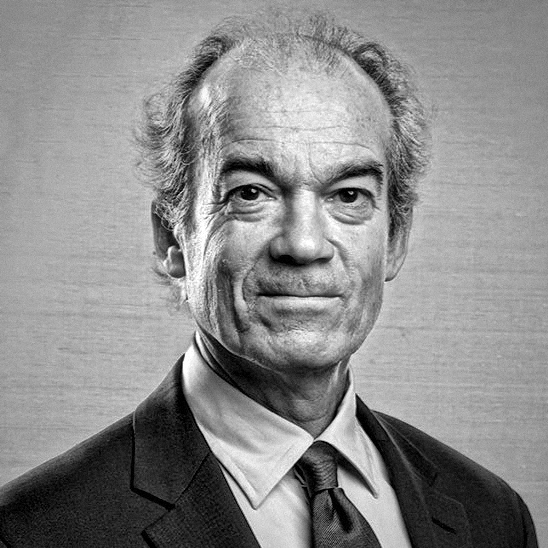
In this interview, Richard shares key insights from his long career as one of the UK’s most celebrated value investors. He argues that true value investing is “in the blood” — a fundamental, curmudgeonly inclination toward the cheap and unloved, rather than just a learned technique.
Richard contrasts the investment world of the 1970s and 80s with today. He recalls a time of information scarcity, when analysts manually plotted index levels from a phone call to Geneva. Today, he argues, the primary job is rationing an overwhelming supply of data. He warns against the “analysis paralysis” and “false comfort” that comes from an overflow of data and complex spreadsheets, suggesting the best ideas can be summarized on the back of an envelope.
He delves into market psychology, explaining how the “madness of crowds” creates absurd valuations and, in turn, fantastic opportunities. He revisits the 1987 crash and the “disastrous mistake” of moving to cash, a lesson in avoiding wholesale asset allocation changes. Throughout the conversation, Richard stresses that investors must work on the “balance of probabilities” rather than seeking illusory certainty.
Alex Gilchrist: Richard Oldfield is one of the UK’s most well-known value investors. After leaving Oxford University and having a long career in the investing world, he founded Oldfield Partners in 2005. He joins us to talk about the second edition of his book, Simple but not Easy, which comes recommended by Howard Marks. Before we get into the interview, could you tell us a bit about that picture right behind you?
Richard Oldfield: It’s a picture painted by my son, Christopher. I don’t know why the subject intrigued him. But older watchers and listeners will recognize that it is the radio ventriloquist, a man called Dennis Pruff, and the dummy, the ventriloquist dummy, is called Archie Andrews. The idea of radio ventriloquism is rather strange, but he was a very successful radio ventriloquist. And Christopher painted a number of pictures of this scene.
Alex: How did you come to be a value investor? You seem to have had an inclination already from a very young age.
Richard: I think the real answer to that is I was born, because I think that value investing is in the blood. I think you can learn to do it better through practice, and also a lot of reading and paying attention to the great masters of value investing like Ben Graham and Warren Buffett. But I think the real answer is that it is in the blood, and it’s very difficult to become a value investor if that isn’t your instinct in the first place.
And I was always—value investors are by nature rather curmudgeonly and mean and attracted to things which are cheap. Things which are cheap, which are not also, not always undervalued, but simply things which are cheap. And then you have to determine whether they’re undervalued or not. So I think from a very early age, I was drawn to that style of investing.
When I began to take an interest in shares, which was unseasonably early, when I was around 15, I started going through lists of share prices in the papers. I was attracted to companies which had low prices. That meant nothing in terms of undervaluation, but that’s where my attraction was. I was attracted to penny shares before I knew they were called penny shares.
And I think my first investment was in a company called Britannia Arrow when I was about 17, because it was after the secondary banking crisis at the beginning of the 1970s when Slater Walker went bust. And it had an insurance subsidiary, which was called Slater Walker Insurance, which changed its name and survived. Perfectly good, robust company in itself. And I was attracted to this company, whose share price was 6 pence, simply because it was 6 pence, reasoning that you could quite easily see 6 pence going to 18 pence. And the worst that could happen was that 6 pence would go to zero. So I thought there was—I wouldn’t have put it in these terms in those days—but there was asymmetric risk.
But it was long before I discovered the means of valuation, the typical ratios: price-to-cash-flow ratios, price-to-earnings ratios, yields, price-to-book value. But as I say, it was always in the blood to be attracted to value investing.
Alex: When you first started, you describe a world which was very different, where even going on a trip to Australia could provide an analytical advantage. How was investing in those days?
Richard: Those were the days not of me, but of my father. My father was a stockbroker who did not at all push me into the world of investing. In fact, I don’t think he very much liked it. It was very much my own impetus to get into the investment world. But it was in his days, in the 1950s and 60s, that you could steal an edge by going to faraway places, going to visit companies.
And I think the story I tell in my book is of a colleague of his in the stockbroking firm that he worked for who was also a great cricketer and was part of the management team for the English cricket team on a tour of Australia, and came back with lots of ideas about gold mining stocks at a very good time to invest in gold mining stocks.
I think by the time I joined the city in 1977, that world had largely changed. But what there was still in ’77 and through into the early 80s was a great shortage of information. In those days, the job of investing, a large part of it was in trying to get information. And it’s completely changed now because I think the job of investing, to a large extent now, is about rationing the supply of information because there’s just so much of it. And it can be completely swamping. It can be a great deterrent to decision-making. You can suffer too easily from analysis paralysis.
But back in those days, I started work when the fax machine had just been invented. And we were still working off telexes which came in. Those were our source of information. To find out what the—it was called the Capital International Index—was doing (now it’s the MSCI, the MSCI World Index), one of my first jobs was drawing graphs which showed the performance of a particular fund which Warburg’s ran, compared with this index. The way I found out what the level of the index was, was to ring up a lady in Geneva who told me the level and I could then plot it on the graph by hand. No way of doing it other than by hand.
So it was very rudimentary, the sourcing of information. And I think that changed fundamentally in the next 20 years or so, when the problem became an excess of information rather than a dearth of information.
Alex: What were the big markers in that change? Maybe you saw a big change around 1990 or ’95?
Richard: There were big technological changes. There was the fax machine, first of all. That seemed a remarkable innovation. And then there was the internet and the arrival of email, and things coming by soft copy rather than being needed to be in hard copy. That made an enormous difference. In those early days, we used to go home with great plastic bags full of research papers, rather than looking at a computer. And the size of the plastic bag limited the amount of information which you could look at.
Alex: Did that create more focus in discussions than now where it’s, where there’s just so much, so much stuff you can reference all the time?
Richard: I think it did. To my mind, one of the great inefficiencies in markets is that the huge proliferation of information, which is completely overwhelming, has made people lose their focus. The use of spreadsheets, which didn’t exist—spreadsheets done by machine did not exist in the late 70s, early 80s. The arrival of Excel was a transformation in itself, but it leads to false comfort because it’s so easy to put assumptions into a spreadsheet, which then produce a row of numbers into the distant future. And as soon as they are in hard print on the machine, they have a credibility which is illusory.
And so I think there is a loss of focus and a loss of objectivity which comes from this overflow of information. The fact that you have 24-hour news, you have Bloomberg pricing continually, you have traders sitting in front of two or three machines, two or three screens. I think that produces an inefficiency.
And those who keep their distance from the frenzy of the city and of Wall Street, where you have thousands of people who come to their desk every day and they focus with huge intensity on what happened yesterday to prices and what’s happening today to earnings announcements. I think there is a premium for those who stand back from that cacophony of noise and are prepared to do nothing very often.
One of the greatest difficulties for an investment manager is to come to their place of work—which of course is now frequently home—but to come to their place of work and not do anything for a whole day. At the end of the day, when you haven’t done anything except read a lot and do some analysis, you might feel your day has been empty. It’s satisfying in a very superficial way to put on an order and to buy or sell something, but it’s very often not the best thing to do. So I think that that change has reduced people’s focus on the real issues which move particular stocks.
Alex: How has the relationship between investors and managers of public firms changed?
Richard: It’s got much more intense. Not necessarily always to the benefit of the investing public or of society or of the economy. For example, I think the IPO of Microsoft was something like 50 pages. Now an IPO has hundreds of pages. Annual reports have got enormous. And there is a lot of useful disclosure, but there’s also a lot which simply has to be waded through, and it’s part of conformance with the governance code.
So the relationship has got much more intense, it’s got much closer. People see, investors see management much more frequently because they’re able to do so remotely rather than going to visit a company. I don’t think that’s necessarily improved investment or, society or the economy.
But I don’t want to give the impression, it would be completely Luddite to give the impression that it was a wonderful old world in which there were a few investors who got a leg up because they went to see the managing director of some company and they were told something that nobody else knew. I’m not suggesting that that was a better world.
That world was replaced in the late 70s, 80s, by a different world in which inside information was illegal, became illegal—I’ve forgotten the date in which it became illegal, but surprisingly late—and on the whole, markets became efficient in one sense in that public information was available to all people at the same time. With the exceptions of insiders who were then not able to deal, who were prohibited from dealing. But on the whole, information became publicly available. That doesn’t mean that everybody made sure that they did have access to it, but it was available to all investors.
So I think that was a marked improvement. I think those days, the days of my father’s day, there was very prevalent inside information and dealing on inside information. And I don’t think one should have any nostalgia for that world, which was also very much an old-school-tie world. The reason that “my word is my bond” worked on the London Stock Exchange was that everybody knew each other. But it was really not a very healthy place. There was a lot of old-school-tie stuff. So it was exclusive in that sense. And there was also a lot of anti-Semitism. It’s not a place for which one should have any nostalgia at all. “My word is my bond” worked because people knew each other, but at a cost of an extremely unequal playing field.
Alex: And maybe something which we still see in some of the venture capital world, which tends to be arguably an insider’s game.
Richard: I don’t know enough about the venture capital world to say knowledgeable things about it. I think the venture capital world and the private equity world are subject to extraordinary excesses. Excesses of valuation, and excesses of, in the private equity world, of leverage. And a very unsuited—private equity world is very unsuited to a lot of the things in which it gets itself involved.
Private equity in the water industry in this country. An investment horizon of five or seven years is absolutely unsuited to long-term infrastructural projects. And of course then capital is not spent, cash is taken out as quickly as possible, and leverage is built up, which then leads to trouble when there’s a problem. Leverage is always the undoing of companies. And I think private equity has been extremely damaging to various industries, the retail industry in this country, the water industry in this country. It’s got away with a hell of a lot, including fees at a level which mean that whatever the pie of total return is, far too large a slice is taken by private equity managers.
Alex: You’ve had a long time as an investor, and you talk a lot about what you call your mistakes or maybe some of the great lessons that you’ve learned. Could you maybe tell us the first which come to your mind?
Richard: The mistakes that come to my mind. I think one of the biggest mistakes, which is not a stock mistake—and we, my firm and my inclinations are all about individual companies and stock picking. But you can’t be in this business without taking an interest in the macro world.
And I think one of the biggest mistakes that has marked the rest of my working life was that in 1987, when the great crash occurred, I was on holiday. And I was summoned back because—I came back, I came back from holiday, I didn’t get summoned back—because there’d been a huge storm on the Friday before the crash, and we had a lot of trees, and a lot of trees had fallen over. Came back a week early, and on the Monday, I was walking amongst these fallen trees when I got a call from the office, and I was head of the US equity team at Mercury at the time, to say that the Dow Jones was down by 500 points.
And I remember my first reaction was to think, what does that matter when all these trees have fallen over? That’s much more important. But anyway, I went back to work the following day. My first inclination had been things are a great deal cheaper, more undervalued than they were before this 500-point fall. But I very quickly became infected by the gloom that there was in the office.
This is, again, something to be said for keeping your distance from the market and not getting caught up in the cacophony of noise that often surrounds the markets that we work in. And I was a member of the strategy team, I wasn’t the decision-maker at all, but the decision-maker at the time decided to go to 40% cash in our global equity portfolios after the crash. And that was a disastrous mistake, which affected the performance of Mercury in the international world for the next five years or so. And it was, so that was a very big lesson to me.
By the time people want to make large, wholesale asset allocation moves, their confidence has only been built up by the fact that other people are thinking much the same too. And it’s very likely that whatever move it is that they’re nervous of has already taken place. And it was also built on a false argument. The argument then was that there would be a wealth effect from the fall in the stock market and therefore the economy would be weak. And because the economy was weak, the stock market would fall. But that is a circular argument. And one should always beware of circular arguments because they can never be true. What it suggests is a spiral down to nothing. If the economy gets weaker and weaker, the stock market gets weaker, that causes the economy to get weaker. There’s no end to it. And clearly, life is not like that. You only need a little tweak in the opposite direction and you have a virtuous spiral. And in fact, it was just false. The economy was not affected by the crash. Consumers continued to spend, and the stock market recovered, as we all know.
So my lesson I draw from that is one, don’t make wholesale asset allocation changes. I think you can tweak a bit. You can put your foot on the brake at certain times, you can put your foot on the accelerator. But trying to make wholesale asset allocation changes doesn’t work.
And I give the two examples, the opposite examples of Jimmy Goldsmith, who did get out just before the crash in ’87, good for him. He was a very lucky guy, Jimmy Goldsmith. There’s a famous story that when his brother’s pharmaceutical company in Paris was on the edge of going bust, Jimmy Goldsmith who worked with his brother thought one Monday morning, I’m just not going to get out of bed because it’s going bust today. I’m going to stay in bed. He got up about noon, and he saw that the papers on the new stand said, “Les banques en grève,” the banks were on strike. And because the banks were on strike, they couldn’t call in their loans from the pharmaceutical company. The company managed to get in some cash over the next few days, and it survived. So he was a very lucky guy.
But then there’s the opposite story of Sir Isaac Newton, who during the South Sea Bubble, decided it was all getting to excess, and he sold. And the market continued to go up in a bubble. And he couldn’t stand the, he couldn’t resist the temptation to go back in. All his friends were making money, went back in. And he lost 20,000 pounds, a lot of money. And he said that he could understand the movement of the planets, but not the madness of men. Which was rather a distancing comment, because it had been his decision to go back in.
So I think that Newton story is a warning that on the whole, don’t make large asset allocation changes. Market timing on a grand scale is extremely difficult. And the other corollary of it is, have faith in equities. Equities, on the whole, will produce good returns over the long term. And if you try to get out and get back in, you have a one-in-four chance of getting it right. On the whole, stay with it.
Alex: It really came across throughout the book, this psychological element behind investing. Maybe a lot of time people are focusing analytically, thinking they can know this stock inside out, better than anyone else, have a more sophisticated, more intelligent viewpoint. But at the end, even Isaac Newton is going to be taken by his animal instincts. Then we all are going to be.
Richard: I’m fascinated by what you call the psychological element. The movement, the madness of crowds, the movement of markets. I’m a great devotee of something called the Investors Intelligence Survey of Advisory Sentiment in the States, which measures the bullish or bearishness of the advisory newsletters. And at extremes, when the newsletters are overwhelmingly bullish, it is a wonderful inverse indicator. When the newsletters are bearish, it is a wonderful inverse indicator. For example, on the 7th of April this year, we were at an extreme of bearishness in the US market. That indicator got it spot on.
So I’m fascinated by the psychological element. And that’s what—in my book, I quote Scott McNealy, who was the head of Sun Microsystems. And he said, sometime after the bubble burst in 2000, he said—I’ve forgotten the figures, I’m doing this from off the top of my head—but the valuation of Sun Microsystems had gone to, let’s say, 30 times revenue. And Scott McNealy said, “What were you thinking?” To justify that multiple, you need to grow revenues by X percent over the next 20 years. You need to grow earnings by Y percent over the next 20 years. Nobody has ever been able to do that. “Why did you price our stock at this level?”
It’s not that the business of Sun Microsystems was necessarily flawed. The problem is in the valuation. And I think that’s so true now, when you see, for example, you see companies that are investing in Bitcoin, who put their treasury cash in Bitcoin. Immediately their stock leaps up by 30% just because they’ve transferred dollars into another currency in the form of Bitcoin. You see companies which make some AI initiative, immediately their stock goes up by 30%.
In 1999, I interviewed Rupert Murdoch, who I was planning to write a book about business leadership, and I’ve never got round to it. But he said to me in December 1999, he said, “I could go out and invest in an internet company tomorrow, a small internet company. The price of News Corp would go up by 15% tomorrow morning.” You’ve got the same phenomenon now, and it’s an absurdity.
It’s not that the businesses, the AI businesses or even Bitcoin, which I don’t begin to understand, it’s not that they’re necessarily bad, but just that the valuation that is being put on these things is absurd. And so you’ve got a wonderful anomaly now, which is so exciting, and I’m thrilled to be back working more than I was a few years ago. You’ve got conglomerates and investment trusts and closed-end funds on very large discounts in traditional businesses. RIT, for example, the Rothschild Investment Trust, is trading at a 28% discount to net asset value. You’ve got companies like Jardine Matheson and Ayala Corporation at huge discounts to their asset values. And on the other hand, you’ve got companies whose only business is to own a great pile of Bitcoin, which are trading at 40 or 50 or 100% premiums to net asset value.
And we have seen this film before. We know that if you have a closed-end company which goes to a whopping great premium, it does not last. And we also know that if you have an investment, a closed-end company which goes to a massive discount, it usually corrects, with better for the share price to rise. Sometimes it corrects by the net asset value turning out to have been hugely misreported and it plummeting. But usually, it corrects by the share price going up. So I think there’s a wonderful bifurcation in markets, and that is fantastic opportunity. And that’s all driven by market psychology.
Alex: It seems in some ways that these cycles are so long that it becomes almost illegal to disagree with them. So five years ago, you could say, “I don’t think Bitcoin’s worth anything.” But today, it’s been there now, it’s 10 years and, you can’t really deny that the great value that’s there. But you…
Richard: I think you can.
Alex: You can, but you’re not, it’s hard to almost in a public space, in a space. There’s so many people who… Another one was, we thought interest rates were going to go on. Low interest rates were going to be a standard thing forever. We learned about the magic money tree, and then, and now it’s changed.
Richard: Yeah. No, I think that you’re so right, that things become completely conventional wisdom, received wisdom, that it’s almost sacrilegious to argue against them. And that’s been true of Bitcoin, where we’ve had people like Christine Lagarde have changed their tune completely about Bitcoin. But they may have been right the first time. I’m just too old to understand it. I don’t understand it. I never will. I don’t have to. I don’t have to be worrying about companies which are involved in some way in Bitcoin. There’s plenty to worry about in the things we are interested in and knowledgeable about, without worrying about things which we don’t understand, can’t understand, and are not knowledgeable.
So I don’t get Bitcoin. It may be, I’m not, I’ve got friends who are very clever people who say that it’s all for real. I still can’t persuade myself that Bitcoin is anything but nothing out of nothing. But nothing will come out of nothing. But let’s leave Bitcoin aside.
Interest rates. That’s a very interesting point. The last 15 years, interest rates have been close to zero. And people have got used to that. But in fact, what we’ve got today is much more normal to somebody of my age. And if you were a Martian and you came and looked at the bond markets around the world today, you would say, “This looks, this makes sense.” We’ve got the UK at the top of the tree. Well, the UK is always worst. Then we’ve got France, they’re usually second worst. Then we’ve got the States, they’re usually pretty bad. And then down at the bottom in terms of bond yields, we’ve got Germany, always fiscally conservative, and Japan. Not so fiscally conservative, but all the same, low bond yields. That all makes sense.
And the levels of bond yields, they make sense too. There’s a real yield of around 2% from most of these bond markets. That’s perfectly normal. That’s just what it should be. But that, in fact, in fact, is a completely novel situation, because as you say, the last 15 years, it’s been 0, 0, 0. And I don’t think that a lot of investors have come to accommodate, have come to recognize that what we’ve got now is normal, and we’ve got to get used to normal, and it has implications.
And also that it’s not a stable equilibrium. It looks as if we’ve got stability at this level. But you have this strange phenomenon in bond markets that most of the time they worry about the level of inflation, and they worry about growth. And then they suddenly flip, and they begin to worry about the level of debt. And then it can go badly wrong. And it could go badly wrong. There are people, very wise people, who are saying that it will go wrong. I’m not convinced myself that it will go wrong in the sense of debt defaults. But it’s not a stable equilibrium. It’s quite a worrying time, I think, in the bond markets.
Alex: And at every point of this, very intelligent theories, like modern macroeconomic theory, become in vogue and support very intelligently that this could go on forever.
Richard: It can’t go on forever. And the interesting thing about quantitative easing and its extreme form, the magic money tree, is that the so-called solution to COVID would not have been possible 15 or 20 years earlier. Two things had happened. One, we had technological development, so that people could do what you and I are doing now. So Zoom arrived on the scene, and that made it possible with COVID to send everybody home. And the second thing that happened was that we discovered during the global financial crisis quantitative easing. And we discovered that central banks could buy immense quantities of treasury bonds and allow the governments to continue to borrow ad infinitum. And that gave us, that gave us the practical means of dealing with COVID in the UK, in almost all countries. But it may have been deeply flawed. Because there isn’t such a thing as a magic money tree. And there’s a, to use a different metaphor, the emperor is not wearing any clothes, not wearing any clothes at all.
Alex: You talk about staying away and trying to keep this in mind. How would you say, you mentioned the survey in terms of bullish and bearish sentiment. What are other clues you try to use to assess where psychologically the world is at?
Richard: I’m not much devoted to technical analysis and to technical indicators, but the two technical indicators that I have always followed closely are the one that I’ve mentioned, the Investors Intelligence Survey, and the other one is a very different one, because the Investors Intelligence Survey is quite short term. It’s the Coppock indicator, which is a very long-term measure of sentiment and changes in, changes at the margin in market sentiment. And that, as I say, it’s a very long-term indicator. It helps to keep you in markets.
There is, as it happens, there’s no such thing as a sell indicator, a genuine sell indicator in Coppock, because Coppock was an Episcopalian in, I think, Texas in the 1920s or 30s, who spent a lot of time with people who were bereaved. And he measured the period that they took to recover, and he formed these indicators, which were based on this recovery from trauma, bereavement, divorce, that type of thing. And produced for the stock markets, buy indicators. And you can’t really have a reverse of bereavement and trauma.
So there was, with Coppock, the true original Coppock, there’s no such thing as a sell indicator. But what Coppock very often does is gives you confidence to buy when you might be doubting. I’m talking in market, overall allocation terms. And gives you confidence to stay in when you might think times are ghastly. And although it’s not time to go, sometimes in life it is time to go, but on the whole, you want to, as I said, have faith in equities and stay with a foot on the brake from time to time, foot on the accelerator at other times. So those are the two. I’ve now forgotten your question. Was it about…
Alex: Just how you assess where the market psychology is, where we’re at in the economic cycle, but also where we’re at in the psychology of people.
Richard: Those are the two technical. And the other thing is just valuation. And valuations do matter. When you get to absurd levels of valuation, it does matter. Absurd in cheapness, absurd in expensiveness. It does matter. So valuation, I’m completely, valuation is what matters to me more than anything about companies and about markets.
Alex: How do you recognize the moments when valuations are very exuberant from very cheap? Is it just anything with a PE under 5 is cheap and everything over 50 is exuberant, or?
Richard: Not far off. I was very lucky, I think, in beginning work in 1977. 1981, I started, or 1982, I started managing funds. And the PE on the American market, which is the one that I specialized in, was under 10. And that’s always been in my mind, my benchmark, that I want to find PEs of businesses which are essentially sound, which do not have a combination of really ferocious operational leverage and financial leverage. But those businesses with PEs of 10. That is a wonderful, if you find those, then they’re wonderful to buy. So that is my benchmark.
And market psychology being what it is, it does produce these extremes of gloom and extremes of enthusiasm, which drive valuations to extremes. And also, the great thing about the world being a big place is it can happen at different times in different places. There was a period which I think ended, when did it end, about 5 or 10 years ago, when it looked as if international diversification didn’t work so much anymore, everything moved together. And then we had, really after the global financial crisis, we began to get the differentiation among markets that there was when I began in the late 70s. And international diversification made sense again. You could have one market going up and another going down.
And even more so, you could have, as you had in 2000 when the bubble burst, the tech bubble burst, you could have sections of a particular market being very strong at the same time as other sections were very weak. In March 2000, you had all the traditional companies in the UK under enormous pressure, and many of them being removed from the FTSE 100 index. By the end of that year, and they were removed because their market caps had fallen, their prices had fallen. By September in that year, just six months later, those same companies were put back in the index because they’d gone up by 25%, while tech companies had collapsed and gone down by 30%, 40%.
So I think you can get, and we’re in a position now, the conditions in markets are such that you can get this big differentiation between sectors and companies which are lowly valued and companies which are and sectors which are highly valued. A couple of years ago, Ben Inker from GMO made a presentation at the London Value Investor conference, which I take part in every year, where he said that statistically, the part of the market which was cheap was deep value. Not value, in the States anyway, not value, but deep value. And that is still true today.
And in fact, at that same London Value Investor conference, at the end of that day when Ben Inker had begun with a top-down statistical analysis at the beginning of the day, David Einhorn of Greenlight talked about what he was seeing. And he said that normally, if he bought a company at five or six times earnings and it went to eight times earnings because somebody bid for it, he would hold on because value was not being properly recognized. But he said in current circumstances, there are so many other opportunities at five or six times earnings that he would sell at eight and move on. I don’t know what he would say now about that. It’s not so true as it was, but I think it’s still broadly true that there is plenty of deep value around.
And it’s mainly outside the States, where until the beginning of this year—and this is why this year has been so exciting, because I think we’ve seen a pivotal moment in, because of the President’s policy, or not so much his policy, but his process—we’ve seen international investment beginning to tickle the interest of American investors for the first time for a long time. For a long time, the US has been the only game in town. And from the beginning of this year, American large institutional investors, from April or so, have begun to look abroad again and to see, and they find as soon as they look, that there are so many companies which are languishing on very attractive valuations.
Alex: Which have been some of the sweetest victories over your investing years?
Richard: There have been lots of good times. I think one of the sweetest moments was in early 2009, where incidentally, there was one of these Investors Intelligence Survey moments, where there was an extreme of bearishness. I was a member of two investment committees at that time, more than two, but on one investment committee, there was a guy who’d been very bearish leading up to 2007-8, absolutely correctly. But in March 2009, he said, “I think we should,”—we’ve reduced in equities—”I think we should reduce to zero in equities. The danger is such that we should go to zero in equities.”
That to me was a real ringing of the bell. When anybody says going to zero in equities, if you’re a long-term investor, you have to question it. And the other was a committee where the managers said, “We have these asset allocation ranges which keep us out of trouble. So we have a range with a low point of percentage in equities when we’re gloomy, but we don’t go lower than that because we don’t want our gloom to become exaggerated. And we have a high point, we don’t want to become overenthusiastic when we’re enthusiastic.” But they said, “The times are now so bad that we think you should go below the low end of your equity range.”
And those two things, to me, really did ring the bell because they’re highly emotional things to say in each case. They’ve departed from pure rationality. And at that time, we owned BHP, which we’d owned for a few months, I think. BHP was the best financially positioned of the mining companies. And we were interested in Rio, but we’d avoided Rio for some time because its balance sheet was not as strong as BHP’s. And then in March 2009, Rio did a, it raised more equity. It also did a deal, in fact, with BHP to sell some assets to BHP, or put into joint venture some assets with BHP. As a result of which, its balance sheet was restored, and we bought Rio then, and it was a great investment for the next two or three years.
I’ll mention something which is, I’ll mention two other things which are, they’re hardly part of the mainstream of what we do, because they’re tiny, one is something I did personally many years ago, and the other is in a small fund where we could invest in small companies, which we can’t in our larger global funds. The thing I did personally was to buy News Corp at three times earnings in 1981. Three times earnings for most companies is absurd. You have to question, when you get a PE of three times, you have to question whether there is something so desperately wrong that the black swan is really going to appear.
So for example, in Russia, where one of my biggest mistakes has been, which was the investment in Yukos years ago, which was appropriated, expropriated by the state, when in recent years valuations have got very low indeed, it’s not because, it’s not, we’re outside the normal boundaries of value investing. They’re as cheap as they are because something terrible is going to happen, namely sanctions and the freezing of assets. So you have to question very low PEs. It may be telling you that real disaster is about to strike. But it should make one pretty interested.
And then the other thing I would mention, which is hardly mainstream talk, but I enjoyed it very much, is in buying Reach, the newspaper company in the UK which owns the Trinity Mirror and Express, which was trading at two times earnings. Now, of course, a hard copy print business, a newspaper business, is in decline, in rapid decline. But when it’s two times earnings, one should look with interest. And they were able to cut—this is some six years or so ago—they were able to cut their costs sufficiently to maintain earnings. Earnings did not decline very sharply for some years. And that stock was selling, as I say, it was obtained two times earnings. It went up by a multiple, I’ve forgotten how many times it went up in a short space of time, a couple of years. But that gives a nice story, but so what?
I tell in my book, a history of howlers. There are plenty of mistakes. And all that the investor can hope to do, if you’re any good, is to be right 55 or 60% of the time. If you look back on 40 years, you’ve been right 55 or 60% of the time, that’s fine. And your record is good. But you will make plenty of howlers. It’s such a humbling business, investing. I think it’s very mellowing. It makes one less dogmatic in judgments about other people, because you are so often wrong. It’s not like accountancy, where you expect all the figures to add up, or being a postman, where you expect to deliver the letters to the right place 99.9% of the time. In investment, you have to expect that somewhere approaching half your decisions will be wrong in relative performance terms. And if you’re lucky, you’ll be right slightly more than 50%.
Alex: Which are the qualities that you like to see and reinforce, or how do you go about reinforcing them in your own investment analysts and managers?
Richard: I think managers, investment managers, have to have, they have to have courage. They have to have common sense. And they have to be capable of having convictions. And they have to have the common sense to realize their convictions will not always be right. I think those are the three greatest virtues. And then I’d add another one, which is patience.
If you’re an equity investor, if you’re a trader, there’s a different skill set entirely. But if you’re an investor in equities, you’ve got to be long-term. And that may require enormous patience. If you’re going to have the guts to be different from everybody else, and as Templeton said, and I think John Maynard Keynes said, you’re not going to succeed as an investor if you are not prepared to be different. You’ve got to be prepared to be unconventional. And that means you’re going to be wrong quite often. And when you’re wrong, you’ll come under huge criticism. So you’ve got to have the guts to do that.
But you’ve also got to have the guts to stay with it for the long term. One of my mentors was a man called Peter Cundill. And he died in 2011. He was a great investor. He had sold his firm in 2006, when he could look back on a 31-year record which was absolutely at the top of the scales. But in 1999, he then had a 25-year record, and he’d underperformed the markets. But he had built a portfolio by the end of ’99 which zoomed with the collapse of the tech bubble and the resurgence of companies which were cheaply valued in the next five years or so. So he had a stellar record over 31 years. But he had the patience in 1999, under extreme pressure, to say, “I think I’ve got what I think should do well. I don’t know when it will do well.” And to stick with it.
And so you’ve got to have, he used to say, patience, patience, patience. And I like the word patience because it has more than one meaning. It means staying the course, but it also means suffering. The Passion of Christ is suffering on the cross. And then passion itself is very important. So to be a successful investor, to be very patient about the long term, to recognize that you’re going to have periods of suffering, and to be passionate about what you do, I think those are the qualities that you need.
Alex: What are some of the traps to avoid?
Richard: I think the most obvious one is entrenchment in your own thought process. You’ve got to be prepared to be flexible. I hope I don’t contradict myself because I’ve just said you’ve got to be patient. But you’ve got to be both patient and flexible. That’s the paradox. That’s the difficult duo to bring off. But you have got to be flexible enough to recognize if things have changed, and the valuation and valuations have changed insufficiently in one direction or another, you’ve got to be flexible enough to recognize that.
And then the second thing, in terms of companies, is to be cautious about companies which combine a lot of operational leverage because they’re cyclical companies, with at the same time a lot of financial leverage. Because you don’t know—I don’t believe in forecasting, you can make projections, but very often they’ll turn out to be wrong. You don’t know when things are going to change. And you therefore got to invest in companies which can withstand hard times and the cycle continuing longer than you think it should. And therefore, the balance sheet is tremendously important, and hence what I was saying earlier about BHP and Rio. We only invested in Rio when we were sure that the balance sheet could see the company through the cycle.
Alex: It sounds in some ways as if an investor should seek to be a judge in a civil case, where you’re looking for the balance of probabilities, rather than a criminal case where you believe you can establish anything beyond a reasonable doubt.
Richard: You are completely right. Completely right. If you, if, something beyond reasonable doubt prevents you, if that’s your yardstick, it prevents you ever finding, ever reaching a verdict. And it’s the recipe for analysis paralysis. You can go on and on and on and look at more issues and raise more questions and never get a complete answer and therefore never act. And I’ve known analysts who are terrifically good at analysis, but are not so good at portfolio management because they can’t reach a decision and act on it. You can only ever work on the balance of probabilities.
Alex: What level of knowledge do you think the investor, depending, if they’re a private investor, maybe more novice, maybe more experienced, a big money investor, what level of knowledge should they seek to understand about a company before investing?
Richard: I think they need to, investors need to understand the history of the company for a start. I think annual reports are surprisingly little used by company researchers. Annual reports tell you a great deal. As I said earlier, they’re too long, but the chief executive’s statement, the chairman’s statement, the financial statements, all those tell you a great deal, and you need to look at the annual report.
You need to understand the competitive landscape. So you need to understand roughly who the competitors are, what they’re doing, how they’re doing it differently, why this company, a client said to me the other day, “What’s your right to exist?” I think that was the way he put it. “Why do you exist? What’s the point of you?” I think you need to understand that with every company that you look at. What’s the point of this company’s existence?
So those are the two areas that I think you need to get comfortable with. But I do not think, and this again goes to analysis paralysis, I do not think you need spreadsheets going out 7 years. In fact, I would say they’re a waste of time because it is so easy to put the wrong assumption in, and that produces then a stream of wrong figures which have a false plausibility. And you can have a tyranny of the spreadsheet. So I’m very wary of long spreadsheets. I think you want to be able to summarize the argument for a company you’re investing in on the back of an envelope. And that will depend on a few key issues. I don’t think you need a comprehensive knowledge of every facet of the company’s business.
Alex: Sometimes companies do well for reasons that we hadn’t thought about, and sometimes they do badly, equally for reasons we hadn’t thought about. How should the investor take the glory and the blame in those cases?
Richard: I’m completely dishonorable about this. I’ve got a friend of mine, Dominic Colvin, who was very successful at Morgan Stanley Asset Management for many years and retired many years ago. He said that he didn’t mind bad performance, what he minded was being wrong. And I’m not a purist, as he is at all. I don’t mind being right for the wrong reason. I’m delighted to be right for the wrong reason. So if you get a nice surprise, which is completely outside the way that you thought about a company in the first place, take it and be grateful, is my attitude.
And it works in the other way. It works when things happen. On a grand scale, it happened in March 2020 with COVID. Things happened which are completely out of the blue. Well, certainly, before January 2020, completely out of the blue, which nobody could reasonably predict. It’s interesting that the risk matrices of companies almost universally did not include the risk of a major pandemic. Funnily enough, in years past, 10 years or so, 15 years ago, they might well have had pandemic in their list when it was fashionable to talk about pandemics because of bird ‘flu. But it had disappeared entirely from risk matrices by March 2020. So these things come out of the blue.
And because they do, you need a portfolio which is diversified. You can achieve adequate diversification with a much more concentrated portfolio than most people have. We have 20 to 25 stocks in our portfolios. And the statistics show that if you aim at diversification, then everything you do beyond 15 stocks has a minute effect on diversification. So you can have a diversified 15-stock portfolio. But having it is important. You don’t want to have everything on one number on the roulette table, or even on one color on the roulette table, because things do happen completely unexpectedly.
And you have to have a portfolio working. You have to have each stock explicable and there for reasons which make sense. But the reasons don’t have to be completely coherent across the portfolio. In fact, they shouldn’t be. Because if they are completely coherent, then effectively you’re betting on one or two themes. You need to have a diversification of themes. And so there might be some stocks which respond well to low interest rates and others which respond badly to low interest rates, for example.
Alex: In the spirit of investors such as Ben Graham, you’ve also got quite a wide range of interests outside investing, and you’re currently working on a book about politics.
Richard: That’s right. I’m writing, I went back to school when I semi-retired a few years ago. And I did a degree last year, and the dissertation was on a very obscure subject, which I’m afraid very few devotees of the Manual of Ideas will have much interest in. But the obscure subject is the relationship between Stanley Baldwin and Winston Churchill. I’m sitting, in fact, in the Churchill Room in my firm, with a great big portrait over here by my son of Churchill, and another fantastically interesting picture, which I won’t go into, but over here of Churchill. Anyway, Churchill was always a great hero, and Stanley Baldwin was his opposite in so many ways, even though they worked very harmoniously together in the 20s when Churchill was Chancellor and Baldwin was Prime Minister. And then Churchill completely dissed Baldwin’s reputation and vilified Baldwin. And I don’t think he deserved it. And so I’m trying, I’m trying to recover the reputation of Stanley Baldwin.
Alex: Richard, thank you so much for joining us today.
Described by the author as “a slightly autobiographical and heavily biased book about investing”, Simple But Not Easy won fans among both professional and private investors alike when first released in 2007. The theme of the book is that investment is simpler than non-professionals think, in that the rudiments can be expressed in ordinary English and picked up by anybody. It is not a science. But investment is also difficult. People on the outside tend to think that anyone on the inside should be able to do better than the market indices. This is not so. Picking the managers who are likely to do better is a challenge. Richard Oldfield begins with a detailed confession of some of his worst mistakes and what they have taught him. He discusses the different types of investment, why fees matter, and the importance of measuring performance properly. He also outlines what to look for (and what not to look for) in an investment manager, when to fire a manager, and how to be a successful client. A cult classic for its candid confessions and sparkling wit, this extended edition of Simple But Not Easy – featuring a new author’s preface and a substantial afterword – remains an indispensable companion for all those interested in the rewarding but enigmatic pursuit of investing.
Richard Oldfield founded Oldfield Partners LLP in 2005, after 9 years as chief executive of a family investment office. Before this, he was director of Mercury Asset Management plc, which he joined in 1977. He was Chairman of the Oxford University investment committee and the first chairman of Oxford University Endowment Management Ltd from 2007-2014. He is now chairman of Shepherd Neame Ltd, and trustee of a number of charities. The second edition of his book “Simple But Not Easy”, a “slightly autobiographical and heavily biased” book about investing, was published by Harriman House in December 2021.