An In-Depth Case Study of Nintendo: Dominant Player in Growing Industry

April 30, 2019 in Case Studies, Document, Equities, Ideas, Information Technology, Letters, Wide Moat

This article by MOI Global instructor Ryan O’Connor is excerpted from a letter of Crossroads Capital, based in Kansas City, Missouri.

We’re proud to report that Nintendo, current heavyweight champ of the console world and 800-ton Godzilla of the increasingly resilient, fast-growing videogame industry, became our largest investment during the tail end of Q4 and early January.

Our thesis is simple: Nintendo offers a unique opportunity to purchase a dominant, wide-moat business undergoing transformative, value-unlocking change. Moreover, this market leader’s unrivaled roster of iconic videogame franchises gives it an overwhelming and durable edge in a high-return industry where intellectual property (IP) is king.

Despite its many successes, Nintendo has long suffered from cyclical volatility in its core videogame console business and massive undermonetization of its beloved game characters. But new leadership turned those pages years ago, setting the stage today for a multi-year run of exponential earnings growth. Yet the company is trading at less than 12 times next year’s consensus earnings – and just 8 times after backing out its roughly $9 billion in cash.

That’s cheap, but we think Nintendo is actually a far greater bargain then it initially appears. “Mr. Market” has become downright delusional about the medium- to long-term trajectory of the company’s increasingly high-Quality earnings. Street estimates will have to come up. Way up. We can’t recall a company of this quality languishing at such an extreme discount to its intrinsic worth.

Members, log in below to access the restricted content.

Not a member?

Thank you for your interest.  Please note that MOI Global is closed to new members at this time. If you would like to join the waiting list, complete the following form:

Disclaimer: Past performance of the financial instruments mentioned in this report should not be taken as an indication or guarantee of future results. The price, value of, and income from, any of the financial instruments mentioned in this report can rise as well as fall and may be affected by changes in economic, financial and political factors. Any projections, market outlooks or estimates in this presentation are forward looking statements and are based upon certain assumptions. Other events that were not taken into account may occur and may significantly affect their returns or performance. Any projections, outlooks, or assumptions should not be construed to be indicative of the actual events that will occur. Future returns are not guaranteed. If a financial instrument is denominated in a currency other than the investor’s home currency, a change in exchange rates may adversely affect the price of, value of, or income derived from that financial instrument. In addition, investors in securities such as ADRs, whose values are affected by the currency of the underlying security, effectively assume currency risk. While the information prepared in this document is believed to be accurate, Crossroads Capital, LLC (the “Investment Manager”) makes no representation or warranty as to the completeness, accuracy or timeliness of such information. The Fund and the Investment Manager expressly disclaim all liability for errors or omissions in, or the misuse or misinterpretation of, any information contained herein. The Investment Manager has no obligation to update any information contained herein, and may make investment decisions that are inconsistent with the views expressed herein. Any holdings of securities discussed herein are under periodic review and are subject to change at any time, without notice. This report does not provide investment recommendations specific to individual investors. As such, the financial instruments discussed in this report may not be suitable for all investors, and investors must make their own investment decisions based upon their specific objectives and financial situation utilizing their own financial advisors as they deem necessary. Investors should consider this report as only a single factor in making an investment decision. All information provided is for informational purposes only and should not be deemed as investment or other professional advice or a recommendation to purchase or sell any specific security. This report, which is being provided on a confidential basis, shall not constitute an offer to sell or the solicitation of any offer to buy limited partnership interests of Crossroads Capital Investment Partners, LP (the “Fund”) which may only be made at the time a qualified offeree receives a confidential private offering memorandum (“CPOM”), which contains important information (including investment objective, policies, risk factors, fees, tax implications and relevant qualifications), and only in those jurisdictions where permitted by law. In the case of any inconsistency between the descriptions or terms in this document and the CPOM, the CPOM shall control. The interests shall not be offered or sold in any jurisdiction in which such offer, solicitation or sale would be unlawful until the requirements of the laws of such jurisdiction have been satisfied. This document is not intended for public use or distribution. All trade names, trademarks, and service marks herein are the property of their respective owners, who retain all proprietary rights over their use. This document is confidential and may not be disseminated or reproduced without the prior written consent of the Investment Manager.

Highlighted Tweet by EdwardOThorp

April 29, 2019 in Twitter

Paratek Pharmaceuticals: Biotech Firm Developing Novel Antibiotics

April 29, 2019 in Equities, Health Care, Ideas, Letters, North America, Small Cap

This article is excerpted from a letter by MOI Global instructor Jim Roumell, portfolio manager of Roumell Asset Management, based in Chevy Chase, Maryland.

RAM investors know our long history with PRTK, a small biotech company focused on developing novel antibiotics in a world desperately in need of them. We originally invested in PRTK in 2014 when its lead drug—omadacycline—was ready to enter its first, of what would ultimately be three, Phase 3 trials. RAM exited two-thirds of its position roughly one year ago at about $27/share (the stock currently trades at about $6/share). At the time of our exit, while FDA approval appeared increasingly likely (and priced-in to the stock), dilutive, albeit necessary, capital raises materially reduced our estimate of the company’s per share intrinsic value.

Recently, we’ve been rebuilding our position in reaction to: 1) Omadacycline (now renamed NUZYRA for commercial purposes) receiving FDA approval with an exceptionally “clean” label and 2) PRTK’s stock price dropping to a value that we find exceptionally compelling. In contrast to our original investment thesis that hinged on FDA approval, today our PRTK investment is predicated on commercialization success. NUZYRA is the first FDA-approved once-daily, IV to oral antibiotic to treat both pneumonia (CABP) and skin infections (ABSSSI) in nearly twenty years. We do not believe PRTK’s drug is another “me-too” antibiotic.

The company’s vision for NUZYRA is clear. From its 12/31/18 10K, “We believe that NUZYRA has the potential to become the primary choice of physicians for use as a broad-spectrum monotherapy antibiotic for ABSSSI, CABP, UTI and other serious community-acquired bacterial infections, where resistance is of concern. We believe NUZYRA will be used in the emergency room, hospital and com- munity care settings. We have designed NUZYRA to provide potential advantages over existing anti- biotics, including activity against resistant bacteria, broad-spectrum antibacterial activity, oral and IV formulations with once-daily dosing, no dosing adjustments for patients on concomitant medications and a generally safe and well tolerated profile.”

To recap the problem: Some twenty-five years ago, pharmaceutical companies pursued a business model of cheap and abundant antibiotics with the intent to “make it up in volume.” Antibiotic usage skyrocketed. Branded drugs eventually went off patent and drug prices dropped even further as generic versions became widely adopted. Pharmaceutical companies pulled back on antibiotic development because the return on investment was no longer economical. Over time, as bug resistance grew, and antibiotic development fell-off, we entered a period of antimicrobial resistance that leading health organizations around the world now regularly describe as being a “crisis.”

Governments, showing increased alarm in recent years, have entered the fray to help spur antibiotic drug development. For example, in 2012, the U.S. Congress passed the Generating Antibiotic Incentives Now (GAIN) Act as part of the Food and Drug Administration Safety and Innovation Act (FDASIA) to encourage the development of new antibiotics. Effectively, the government, on a bipartisan basis, endorsed a price increase for antibiotics, even while fighting to decrease the cost of many other drugs. GAIN was embedded in the FDA Safety and Innovative Act (FDASIA) and passed the House with a vote of 387 to 5 and the Senate by a vote of 92 to 4.

The Pew Foundation’s Antibiotic Resistance Project’s team is credited with providing the leadership to getting the GAIN Act passed. In our discussion with members of Pew’s project team, they indicated that they view GAIN as a “first step” in a broader set of solutions to address the economics of antibiotic development. They shared with us their current efforts working with all stakeholders to create a unified legislative “ask” that they hope to propose to Congress in the near future.

Lord Jim O’Neil, Chair of the Chatham House think tank and former Goldman Sachs chief economist, headed up a British government global review of antimicrobial resistance in 2016. He believes the problem is so severe that he’s recommended government bonus payments of between $1 billion and $1.5 billion for any successful new antibiotic drug. In the book “Super-Bugs—An Arms Race Against Bacteria,” published in 2018, the authors highlighted a variety of market-oriented ideas percolating to reward antibiotic development or warn that it will need to switch to a publicly-financed system.

If the macro industry dynamics aren’t bad enough with plentiful cheap generics and payor pressures, the micro factors are daunting as well. The antibiotic market is very complex. No two antibiotics are the same, patients respond differently, and doctors have to make choices involving these issues as well as considering ease-of-use. Two years ago, two of PRTK’s would-be competitors, Cempra, which was acquired by Melinta (MLNT), and Tetraphase (TTPH), were each valued at $2 billion in the public market. Both companies have been big disappointments, with Cempra failing to get its drug approved by the FDA. Recent “failure to launch” events have cast a pall over the entire antibiotic industry, i.e., when the cops show up, sometimes the innocents get rounded up, too.

Why invest in an emerging antibiotic company with the uphill challenge of differentiating one’s product in a crowded space with pricing pressures? First, for the reasons cited above, there is tremendous disdain for the entire antibiotic space. Achaogen’s (ACHO) announcement to file for bankruptcy protection on April 14th has further cast a dark cloud over the industry. Second, we believe PRTK has the right stuff— a differentiated product designed for a niche market in instances where generics are not appropriate and a AAA-rated management team that knows how to execute.

Evan Loh, MD, PRTK’s President and Chief Operating Officer, and Adam Woodrow, Chief Commercial Officer, launched Tygacil in 2006 while working at Wyeth. Wyeth was subsequently purchased by Pfizer where Evan served as Senior Vice President of Development and Strategic Operations, Worldwide Research and Development from October 2009 to January 2012. Tygacil reached over $400 million in peak sales despite being IV-only and possessing a black-box warning noting increased risk of death such that its use is restricted for situations in which alternative treatments are not suitable. Evan was recently named the new Chairman of the Antimicrobials Working Group (AWG). AWG was founded in 2012 in order to improve the regulatory, investment and commercial environment for emerging infectious disease companies. On April 1, 2019, the American Chemical Society awarded a Heroes of Chemistry Award to the scientific team that worked on NUZYRA (omadacycline) and Seysara (sarecycline). Evan received the same award in 2006 for the development of Tygacil.

One antibiotic industry analysis succinctly summed up the environment’s risks and opportunities: “One of the major areas of debate has centered around the reimbursement for antibiotics in the hospital set- ting. Hospitals face the challenge of a fixed payment system in the diagnosis-related group (DRG) world. Convincing hospitals to put a premium priced drug on their formularies in a fixed-payment environment is a challenge, even if backed by the most solid clinical data. Hospitals, already operating on tight margins, are responsible for any expenses incurred beyond the flat reimbursement rate they currently receive under the longstanding DRG system. Therefore, an oral antibiotic that can shorten the length of hospital stay should have a significant pharmacoeconomic value.” We’re well aware of the fact that PRTK undoubtedly faces reimbursement risk.

In December 2018, Senators Hatch and Casey introduced S. 3787, the Developing an Innovative Strategy for Antimicrobial Resistant Microorganisms (DISARM) Act of 2018. To encourage antibiotic development, DISARM would allow Medicare to offer an add-on payment to inpatient hospitals that use qualifying antibiotics to treat serious or life-threatening infections, effectively by-passing the DRG system. Senator Hatch noted, “Senator Casey and I want to encourage the development of novel drug and biological products that treat these serious and life-threatening infections. Working together with researchers, physicians, hospitals and other healthcare providers, we will find solutions that ensure good stewardship and help overcome economic obstacles to innovate in this area.” Hatch called the situation a health emergency and Casey compared the dearth of antibiotic development to cancer, natural disasters and nuclear threats.

However, policy solutions like the one introduced by Hatch and Casey may be slow in coming. One industry report recently noted, “A sense of urgency within the U.S. government, foundations, the academic and medical community, as well as industry is evident. We detect a greater degree of collaboration among various stakeholders, but we do not yet have conviction that anything meaningful will be implemented in 2019.”

NUZYRA possesses an IV to oral switch mechanism for its pneumonia and skin indications, allowing the patient to go home after only three days. There is also an oral-only dosing schedule for serious skin infections. PRTK strongly believes that its drug will send patients home from the hospital sooner (while lowering the chance of recidivism because of its broad-spectrum capability), thereby saving payors money. NUZYRA received an exceptionally “clean” FDA label (no black box warning and no heightened- risk labeling in the doctor instruction package). NUZYRA, a tetracycline, has a high tolerability profile and an attractive once-daily dosing regimen. It was our clear sense from attending the FDA’s Advisory Committee hearing on NUZYRA in October 2018 that the FDA’s scientists and doctors thought highly of the drug.

We ask ourselves: What’s the probability that a team with as much antibiotic domain knowledge as exists at PRTK would embark on a multi-year journey without having thoroughly thought through all of the industry dynamics and challenges to successfully bring this specific drug—NUZYRA—to market? We think the probability is low; but most importantly, it’s low in relation to the hurdle-rate embedded in today’s share price.

We’ve spoken with many industry experts. One of the most valuable of these experts is an antibiotic clinical investigator and emergency physician who has worked with most of the leading novel antibiotic biotech firms. This investigator told us, “It is a tough road and it’s a crowded space.” Nonetheless, he believes that PRTK’s NUZYRA is a likely winner. According to this individual, “The drug’s IV to oral switch along with being broad-spectrum lends itself to being a popular drug. I do think it’s well priced and with hospitals running out of beds, if they can get a patient out of the hospital a day or two early that’s big. It comes down to having faith in the management team’s ability to execute on its plan. Evan and his team are the strongest team I’ve worked with.” This management team has earned our full respect. Dating back five years, they have met or exceeded every developmental milestone and been savvy capital raisers as well (despite requiring significantly more capital than we originally anticipated).

To be clear, NUZYRA is not a first-line antibiotic. It is designed for particular situations when generics are not appropriate. There are roughly 6.7 million people hospitalized in the United States each year for serious skin and pneumonia infections. PRTK estimates that roughly 13% of these cases are “high-risk” situations that could be well-served by NUZYRA. These patients are often high risk for Clostridium Difficile Infection (C. diff). Importantly, tetracyclines have long been associated with being neutral to protective against the C. diff infection. Not a single case of C. diff was observed in NUZYRA’s Phase 3 pneumonia trial. Other high-risk situations include patients that are allergic to penicillin, taking an SSRI (which often interact badly with traditional antibiotics), or possessing co-morbidity issues like diabetes or vascular disease. High-risk individuals cannot gamble with being mistreated with a failed first-line antibiotic and often must be treated empirically with a broad-spectrum drug like NUZYRA (covering gram positive and negative bugs) because the pathogen is unknown to the prescribing doctor.

PRTK now has 40 salespeople targeting “Early Adopter” healthcare providers in 400 high-value institutions. By the end of 2019, the company expects to have 80 salespeople targeting 800 hospitals. There are an estimated 6,000 hospitals in the United States. The company is projecting a slow revenue ramp with projected sales of $10 to $13 million in 2019. The company strongly believes that the slower “hospital to community” strategy pays off in the long-run by first building brand value inside leading institutions that ultimately leads to acceptance in community settings.

PRTK hopes to capture about 15% of the high-risk population. For example, of the 6.7 million total skin/ pneumonia hospitalizations, roughly 890K (13%) are estimated to be high-risk situations. If PRTK captures 15% of 890K prescriptions, or 133K annual scripts, at $3K for a 10-day course, that equates to $400 million in annual revenue. NUZYRA’s price is in-line with newer branded antibiotics. For example, Melinta’s Vabomere is priced at roughly $5K for a 5-day course, Achaogen’s Zemdri is priced at roughly $4K to $13K for a 4 to 14-day treatment, and Merck’s Dificid costs about $4K for a 10-day course.

Big pharma typically pays 3x+ peak revenue to purchase branded drugs. This equates to about $1.2 billion for PRTK’s NUZYRA, or roughly $24/share on a fully-diluted basis before accounting for additional possible indications. In light of our view of the potential take-out value for PRTK, we find its shares exceptionally compelling at today’s $6/share price. Based on 32 million shares, the company’s market cap is roughly $200 million. The company has approximately 17 million additional shares of potentially dilutive securities if all were converted to common stock. However, most would only be converted at significantly higher prices. The company has about $290 million in cash/investments and $230 million in debt. PRTK smartly issued a 4% coupon, $16/share convert in April 2018. PRTK recently indicated that it is capitalized “beyond the 1st quarter of 2021.” Potential sources of non-dilutive funding options include selling non-U.S. commercial rights for NUZYRA or the non-U.S. rights for Seysera, if needed. Unlike many of its peers, PRTK’s management team opportunistically raised capital and has not been caught flat-footed.

After subtracting out what we believe is a conservative $50 million value for its 10% royalty interest for U.S. Seysera sales, which is now owned by Spanish Almirall, the implied value for NUZYRA is around $100 million. Note, it’s taken roughly $400 million to bring NUZYRA to market and over 10 years of development time. What’s the probability that NUZYRA is not worth 25% of its sunk capital costs after the elimination of 10-plus years of development time in a world desperately in need of new antibiotics?

The above analysis ascribes no potential revenue value to the current Phase 2 trial for a third indication, urinary tract infection, UTI (topline data expected in in the second half of 2019), or the soon-to-be announced Phase 3 trial for an oral-only pneumonia dosing option. One of the biggest unmet needs is an oral antibiotic to treat UTI. PRTK is currently running one oral-only dosing trial for uncomplicated UTI and a separate IV-to-oral dosing schedule for complicated UTI. In fact, the company presented new data in Amsterdam, The Netherlands, on April 15, 2019 at the 29th European Congress of Clinical Microbiology & Infectious Diseases that shows NUZYRA is “highly potent in vitro activity against” urinary tract infections (UTI). Evan Loh, M.D., said, “These data expand the understanding of NUZYRA’s in vitro activity against pathogens responsible for urinary tract infections, where there is a significant unmet need for new oral, broad-spectrum antibiotic agents.”

Moreover, PRTK’s soon-to-be announced oral-only pneumonia Phase 3 trial is a well-positioned option to treat community pneumonia given FDA guidelines that discourages the use of fluoroquinolones, as well as dramatically rising macrolide resistance.

Members, log in below to access the restricted content.

Not a member?

Thank you for your interest.  Please note that MOI Global is closed to new members at this time. If you would like to join the waiting list, complete the following form:

The specific securities identified and described do not represent all of the securities purchased, sold, or recommended for advisory clients, and the reader should not assume that investments in the securities identified and discussed were or will be profitable. The top three securities purchased in the quarter are based on the largest absolute dollar purchases made in the quarter.

Same Concerns, Different Perceptions

April 29, 2019 in Commentary, Equities, Letters

This article is excerpted from a letter by MOI Global instructor Patrick Brennan, portfolio manager of Brennan Asset Management, based in Napa, California.

What a difference three months make. The underlying concerns – weaker economic growth in the US and abroad, an inverted curve with short-term interest rates above longer-term rates, trade concerns, Brexit – have not gone away. But, more dovish comments from the Federal Reserve drastically changed investor sentiment and drove a rally in risk assets during the first part of 2019. We understand that many are used to investment letters which discuss each of these developments at length, but, as stated in multiple past letters, we have little to no ability to successfully forecast future macroeconomic events. Of course, historical records suggest that professional economists also struggle, with total odds of predicting a recession perhaps only marginally better than successfully forecasting that number-one seed Virginia would somehow lose in the first round of the NCAA basketball tournament in 2018 and then manage to win the entire tournament the following year (No comment on our pool results). Uncertainty is the only constant certainty. We will hazard a guess that markets will soon begin worrying that some of the more radical ideas of self-proclaimed socialists (with less discussion about socialism’s historical track record in other parts of the world) could actually become the professed policy of the next president of the United States. The proverbial “wall of worry” might soon include the possibility that a crazy US president could be replaced by an equally crazy populist with far fewer market-friendly policies. We’ll save that happy discussion for another letter.

Cable: We Hate You… We Love You… We…

Moving from the macro to micro, we still see substantial opportunity in several of our names. In our last quarterly letter, we provided a more detailed synopsis of the investment rationale for our largest names, including commentary on why the selling of our various cable names — Charter (CHTR) derivatives LBRDK/GLIBA, Liberty Global (LGI), and Liberty Latin America (LILAK) — was likely overdone. All three groups of cable names rallied for differing reasons during the first part of 2019. So, we again rhetorically ask what has changed? The answer is the same – very little. While there are nuances with each name, we would generally describe all three as regional oligopolies with steady, recurring cash flow. If we simply marked our position to the operating performance of the assets, it would likely look something like a line moving on a 45 degree angle from the bottom left of the page to the top right (with perhaps more variation in the case of LGI). Of course, all three businesses have leverage and are susceptible to broad selling on “risk off” days. Given the size of the holdings, we want to offer a quick comment on the names. In an attempt to keep readers from immediately tearing up this letter, we will limit ourselves to a couple of quick comments – please see our past letters for more details.

CHTR’s stock rerated following strong Q4 results, including a substantial cut in forward capex spending. In December of last year, when the company’s stock was plunging, we thought CHTR would generate substantial free cash flow over the next several years. In February of this year, when the stock was soaring following Q4 results, we thought that…Charter would generate substantial free cash flow over the next several years. Incrementally, the only real new piece of information might be that the initial 5G rollout — the alleged competitive threat to cable and source of substantial angst for many — appears to have gone slightly worse than our already low expectations – please call us if you’d like to discuss this point in more detail. We own CHTR at a discount via LBRDK/GLIBA and anticipate holding the name for several years.

In Q4, LILAK suffered the steepest decline of the various cable names, but the stock has also rallied the strongest. The company reported solid fourth quarter results and announced an acquisition of 87.5 percent of (less hurricane prone) Caribbean cable provider United Telecommunication Services for an implied value of $189 million, implying a roughly 6x pre-synergy 2018 EBITDA multiple. After speaking with the company, we believe the synergies could be substantial. We expect further deals over the coming year. Given the leverage and exposure to LATAM markets, continued volatility is nearly assured. Of course, as discussed in prior letters, lower penetration levels, fragmented markets and the possibility of further deals all likely allow the greatest upside of all the cable names we currently own.

Finally, there is Liberty Global. In past letters, we described how the various binary risks, including Brexit and the regulatory risks associated with the sale of assets to Vodafone (VOD), along with past operational miscues drove LGI to nearly impossibly low implied valuations. Since our last letter, LGI announced a sale of its worst market (Switzerland) – potentially the worst European cable market outside of France – to Sunrise Communications for over 9x our 2019 EBITDA estimate. As previously noted, LGI’s management team deserves criticism for past operational miscues, but we believe they are doing a phenomenal job of arbitraging the amazingly wide gulf between public and private values for European cable assets. As more evidence surfaced that the VOD/Sunrise deals would likely close (if the deals close, LGI will have ~1x net leverage, nearly guaranteeing large repurchases), we increased our already substantial position. While risks remain, the odds of deal closings have risen substantially since the start of the year, a time when we already thought a closing was highly likely. If the deals close as expected, LGI is still far too cheap, given the stability of the business and the prospect of substantial repurchases.

During the first quarter, we began purchasing another emerging market telecom name. Given the recent run in the stock, we were not able to build a full position and therefore we will save a more detailed discussion for another letter.

Investors Backtrack From MKL… Run Away From QRTEA/TSB

We did not avoid every pothole during the first quarter. As investors flocked to cable, they managed to run fast and furiously from two of our other holdings, Qurate Retail Group (QRTEA) and Permanent TSB Group Holdings PLC (TSB), while backtracking from longtime holding Markel (MKL). In past letters, we have described QRTEA as something akin to the ugly stepchild of the Liberty family of companies. Even as the company reported consistent free cash flow, the stock perpetually traded at high free cash flow yields and often at a meaningful discount to structurally challenged brick and mortar retailers. When the company posted a disappointing quarter (Q3 2016, Q1 2018 and now Q4 2018), shares were punished. Without question, the 2018 fourth quarter was disappointing with EBITDA declines across QRTEA, HSN and zulily. Perhaps the quarter finally proved the secular bear thesis? We think the problem with this narrative is that QRTEA also posted record new customer growth and made meaningful progress on turning around HSN. Furthermore, zulily was coming off record results through the first nine months of 2018.

Without a doubt, retailing is a difficult business. The macro outlook in Europe (QRTEA has operations in the UK, Germany and Italy after closing its France division) is more challenging and any shorter- term weakness will inevitably trigger the “Amazon is going to kill this business” reaction. But, QRTEA continues to have a very loyal customer base and converts a large percentage of its EBITDA to free cash flow. Amazingly, the sell-off in QRTEA shares has come as debt levels are at near multi-decade lows and makes the current 16%/21% 2019/2020 free cash flow yields even more amazing. At current levels, investors are assuming QRTEA’s cash flow will decline at a mid-single-digit rate in perpetuity. We suspect the business will ultimately perform far better or – wait for it – actually grow and that the Liberty team will keep repurchasing stock. Assuming another 80 basis points of margin contraction over the next several years in the core QRTEA business, continued declines at HSN (but giving credit for cost synergies) and slowing gains at ZU, we project that the roughly $1.1-$1.4 billion of annual cash flow will allow QRTEA to repurchase 50% of its shares over the next 5 years, assuming the stock rebounds at a 20% CAGR. If we were to keep all assumptions constant but assume the stock stays flat, QRTEA would repurchase roughly 75% (that is not a typo) of outstanding stock. While QRTEA will sell-off on risk-off days or if quarterly results come in shy of expectations, we think the resiliency of the free cash flow is far stronger than implied by current prices.

We described our investment in TSB in our Q3 2018 letter. As a refresher, Ireland had an even greater housing boom and subsequent bust than the United States. The Irish government was forced to essentially nationalize the banking industry, and it continues to be a large equity holder in the largest banks (75 percent in the case of TSB). Irish reserve requirements are among the strictest in all of Europe, and the country has among the slowest/most cumbersome foreclosure processes in all of Europe. Government officials still score political points by castigating banking executives. Sounds attractive, right?!

That knee-jerk negative reaction from reading the last paragraph has been shared by TSB investors thus far in 2019. Unlike QRTEA, there really has not been any specific negative news at TSB. In fact, the loan reduction and capital build have actually been slightly ahead of our original expectations. Instead, the fallout has mostly been external factors – higher capital required than anticipated, a delay in European interest rate expectations and ongoing Brexit concerns. We are acutely aware of the piles of dead bodies (mostly those of value investors) who have invested in European financials, drawn to the flame of cheap valuations and the tantalizing possibility of increased lending/higher interest rates. So why TSB versus all the other beaten down European financial names? In short, we think Ireland’s economy is much stronger than other European countries and its housing market remains red hot. Additionally, TSB is far cheaper than those of other European financials (saying something), but, more importantly, it will likely have the ability to return substantial amounts of capital even if interest rates don’t budge Unheralded CEO Jeremy Masding, who arguably has one of the worst CEO jobs of all time, has done a good job at managing the political backlash after executing multiple non- performing loan sales and he has done this with strict government imposed compensation limits. We believe there will be further sales in 2019 at levels at or above existing marks and that dividends could be approved later in 2019. The government wants to be repaid on its TSB investment and therefore there is a mutual incentive between the government and minority shareholders for payments to begin. Additionally, a highly accretive merger with Ulster – a deal that could conceivably double TSB’s share price – cannot be ruled out. At under 0.3x tangible book value, little has to go right for shares to rerate.

Longtime holding Markel (MKL) reported that its 2018 book value per share shrank 4 percent year- over-year as the company suffered the fallout from write-downs in its Insurance Linked Security (ILS) Business, primarily at CATCo, due to catastrophe-related charges. Furthermore, there was a regulatory investigation into CATCo’s reserve process (unrelated to underwriting at MKL’s core insurance business) which Markel could not discuss in detail as MKL engaged outside counsel to investigate CATCo’s reserve process. As we write this letter, the independent third party found no evidence that CATCo personnel acted in bad faith in setting reserves or making disclosures. Markel devoted a substantial portion of its annual letter to explaining the ILS securities market – think catastrophe bonds/investments which have pressured the traditional reinsurance market. MKL described how this market continues to attract capital and the recent acquisitions/investments (CATCo, Nephila, State National), despite recent setbacks, positioned Markel as a leader in a market that will continue to expand over time. The combination of consistently generating lower cost or negative cost float and honestly reinvesting for the long-term (in existing insurance businesses as well as public and private companies) is a fantastic model that has generated substantial value over time. We believe this will continue to be the case for many years to come.

Finally, with tax returns recently filed, we wanted to share a couple of comments from clients regarding our past letter – comments other than, “There is no shame in keeping letters to under 5 pages, cough, cough.” Some noted that they enjoyed the discussion of The Blackstone Group L.P. (BX) converting to C-Corp. I quickly jumped in, assuming clients were drawing parallels between K1 names and Liberty tracking stocks, how it was wise for BX to remain a partnership and to avoid taxes despite the difficult K1. But, I was quickly stopped (or more accurately told to stop talking) as clients bemoaned, in-between a couple of words that would be less than appropriate to print in a family friendly letter, that “I could care less how much BX pays in taxes – that BX K1 was the worst thing I’ve ever seen in my life. I will do ANYTHING to make that go away.” After personally dealing with BX’s K1, we are more empathetic to the complaints. We remain highly confident that BX will continue raising billions of assets with multi-year lock-up periods and will enjoy the benefit of marketing its positions to model versus marking names like QRTEA, LILAK and TSB on a daily basis like we are forced to do. We also believe that willingly paying more in taxes is rarely, if ever, a good idea. But, after going blind staring at pages of K1 adjustments in the early morning hours, we must concede our tax efficiency comments rang a bit hallow and that earnings volatility is far from the only reason BX trades at a discount. In short, our partners have a point. Of course, this also suggests that the ultimate rerating in BX shares from its recent announcement that it will convert into a C-Corp (no more K1s!) may prove greater than we initially thought.

Disclaimer: BAM’s investment decision making process involves a number of different factors, not just those discussed in this document. The views expressed in this material are subject to ongoing evaluation and could change at any time. Past performance is not indicative of future results, which may vary. The value of investments and the income derived from investments can go down as well as up. It shall not be assumed that recommendations made in the future will be profitable or will equal the performance of the securities mentioned here. While BAM seeks to design a portfolio which reflects appropriate risk and return features, portfolio characteristics may deviate from those of the benchmark. Although BAM follows the same investment strategy for each advisory client with similar investment objectives and financial condition, differences in client holdings are dictated by variations in clients’ investment guidelines and risk tolerances. BAM may continue to hold a certain security in one client account while selling it for another client account when client guidelines or risk tolerances mandate a sale for a particular client. In some cases, consistent with client objectives and risk, BAM may purchase a security for one client while selling it for another. Consistent with specific client objectives and risk tolerance, clients’ trades may be executed at different times and at different prices. Each of these factors influences the overall performance of the investment strategies followed by the Firm. Nothing herein should be construed as a solicitation or offer, or recommendation to buy or sell any security, or as an offer to provide advisory services in any jurisdiction in which such solicitation or offer would be unlawful under the securities laws of such jurisdiction. The material provided herein is for informational purposes only. Before engaging BAM, prospective clients are strongly urged to perform additional due diligence, to ask additional questions of BAM as they deem appropriate, and to discuss any prospective investment with their legal and tax advisers.

How Many Stocks Should You Own in Your Portfolio?

April 29, 2019 in Commentary, Equities, Featured, Letters, Portfolio Management, Risk Management

This article is authored by MOI Global instructor Sean Stannard-Stockton, president and chief investment officer of Ensemble Capital Management, based in Burlingame, California. Visit Ensemble’s Intrinsic Investing website for additional insights.

“Diversification is the only free lunch in investing.” -Harry Markowitz, 1952

“Investors have been so oversold on diversification that fear of having too many eggs in one basket has caused them to put far too little into companies they thoroughly know and far too much in others which they know nothing about.” -Phil Fisher, 1958

The value of diversification is one of the few areas in finance where almost everyone agrees. Diversification is good! We know that diversification is important because we know that we can’t predict the future and so when we make investment decisions about stocks, diversification is critical since we may be entirely wrong about any one stock we pick. But like most things, diversification is best in moderation. Too much of anything can be bad for you and diversification can be taken too far. But the level at which “too far” kicks in is surprising to most people.

This isn’t a new debate. Almost all of the most important topics in investing are timeless in nature and diversification is one of them. The quotes opening this post were penned over 60 years ago. For context it is important to know that Harry Markowitz is the founder of Modern Portfolio Theory and the main inspiration for Eugene Fama who created the Efficient Market Hypothesis, which among other things says that stocks are accurately (i.e. efficiently) priced at all times and thus, there is no systematic way for investors to beat the market. Phil Fisher on the other hand is one of the greatest stock pickers of all time, with an amazing record of out performance, and was a major source of inspiration for Warren Buffett.

Note that Fisher does not say that diversification is bad. He only says that investors have been oversold on diversification. He argues that the fear of owning too few stocks has caused investors to own too many stocks. But what is “too few” or “too many”? What is the right number of stocks for investors to own in their portfolio?

The answer depends on what an investor is trying to achieve.

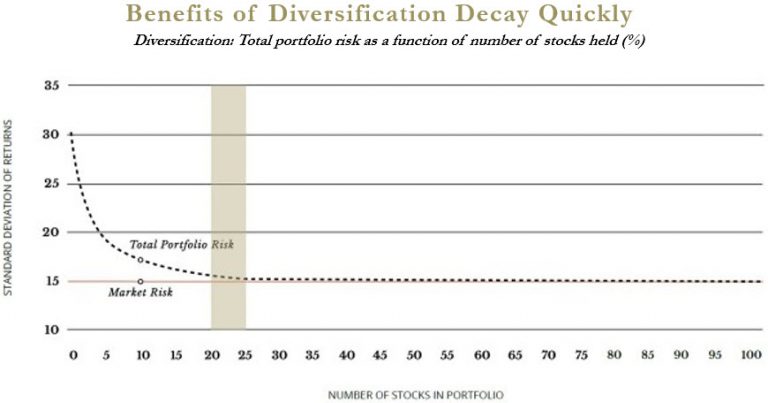
This chart is based on a study discussed in the book A Random Walk Down Wall Street. The book, authored by Burton Malkiel in 1973, popularized the random walk hypothesis crafted by Eugene Fama in 1965. This hypothesis, which is joined at the hip to the efficient market hypothesis, says that stock prices move in an unpredictable manner so investors can’t outperform the market. The data is Malkiel’s, the title is ours.

What Malkiel’s chart shows is that as you add stocks to a portfolio, the volatility of the portfolio declines. This is what diversification is all about. But Malkiel fully acknowledges that even if you own every stock in the world, you can’t get rid of volatility. The best you can do is minimize the volatility of your portfolio down to the level of overall market volatility (labeled as “market risk” on the chart). Obviously, a one stock portfolio is going to be much, much more volatile than the total market. That’s because on any given down, some stocks are up, some are down, and on net, a lot of the individual stock volatility cancels each other out. As you add stocks to your portfolio, you start seeing this same dynamic at play. A 10 stock portfolio is going to be a lot less volatile than a one stock portfolio because even with just 10 stocks, on any given day, some will be up, some will be down and on net a lot of the individual stock volatility cancels each other out, just as we see for a portfolio that owns the entire market.

So if your goal as an investor is to earn market returns, then wide diversification is exactly what you should do.

But what if your goal as an investor is to outperform the market? Well, the only way to outperform the market, is to own a portfolio that is different from the market. What this chart shows (and remember, this data comes from one of the key proponents of efficient market hypothesis, not from someone arguing in favor of investors’ ability to beat the market) is that once you reach about 20-25 stocks in a portfolio you have captured almost all the benefits of diversification.

Now one key assumption behind this chart is that the stocks in the portfolio are selected randomly. If you buy 20-25 oil stocks or bank stocks, you will still see much higher volatility than the market. This is because banks and oil companies have financial performance that is highly correlated to each other. Since they tend to move together as a group, their volatility won’t cancel each other out. But if you are an active investor seeking to outperform with an optimal level of diversification, you can come close to the same result by selecting stocks that are not overly correlated to each other by making sure they serve different end markets and have different business model, etc.

Markowitz, Fama and Malkiel were not seeking to outperform. So for them, there is no cost to adding a 50th or 100th or 300th stock to a portfolio. Each of these lowers volatility and even if the reduction is minuscule, you might as well take it because it doesn’t cost you anything.

But for an active investor, adding names to a portfolio is very costly beyond a certain threshold. As Phil Fisher says, adding too many names to a portfolio leads to investing “far too little into companies [an investor] thoroughly known and far too much in others which they know nothing about.”

Trying to find stocks that you think will outperform the market is hard! The biggest challenge we face at Ensemble is finding enough stocks that we believe strongly will outperform. This is a never ending battle because if we are right and a stock outperforms dramatically, in most cases it becomes less likely to outperform going forward and we become forced to find something new that we believe will outperform in the future. So for active investors, there is a huge cost to adding new names to a portfolio. And there is a huge advantage to be gained by prudently limiting your portfolio to the companies that you “thoroughly know”.

The chart shows that as the number of stocks in a portfolio reaches 20-25 names, the incremental volatility reducing benefits of diversification reach near zero. This is the sweet spot for portfolio size for an active investor seeking to outperform the market. At 20-25 stocks, you’ve captured almost all the benefits of diversification, yet the number of companies you need to “know thoroughly” is still manageable.

To make things simple, let’s assume the S&P 500 is the entire investment universe. If your goal is to earn market returns, you should own all 500 stocks. If your goal is to beat the market, you should own about 20-25 stocks. We’ll relent a bit and agree that some strategies will benefit from owning somewhat more than 20-25 names. So let’s allow for as many as 50 stocks to be part of a strategy designed to beat the market.

But what you should not do, is own a number of stocks in the middle. Owning 150 stocks or 350 stocks dramatically dilutes any ability you might have to beat the market without adding much in the way of diversification because you’ve already captured most of the benefits with your first 25 stocks.

Yet this is exactly what most active managers actually do.

Most active managers, “have been so oversold on diversification that fear of having too many eggs in one basket has caused them to put far too little into companies they thoroughly know and far too much in others which they know nothing about.” Its no wonder that most active managers under perform the market.

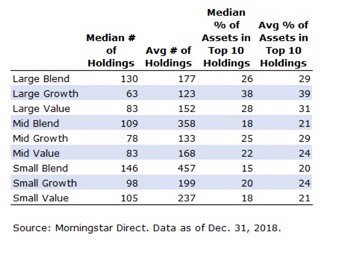
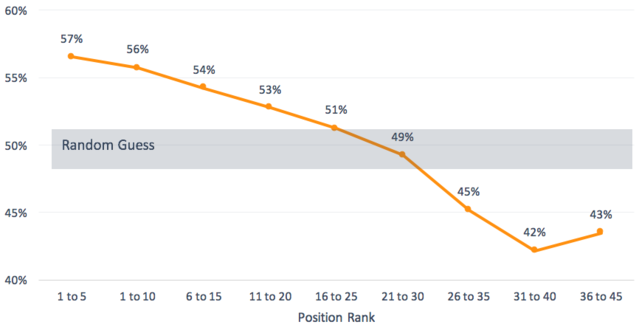
And this isn’t just theory. One of the best papers we’ve seen demonstrating that over diversification is the root of active managers’ under performance comes from Alpha Theory, a firm dedicated to helping active managers refine their portfolio management strategies to maximize performance (disclosure: Ensemble recently became a client of Alpha Theory after realizing how closely their approach mirrored what we have developed on our own). In his white paper titled The Concentration Manifesto, Alpha Theory founder Cameron Hight demonstrates empirically that the top 20-25 stocks in active managers’ portfolios do, in fact, outperform. But as the Morningstar data above shows, these talented stock pickers dilute their advantage by buying another 100-150 stocks that under perform! The chart below from Cameron’s paper shows the likelihood that a stock pick outperforms relative to its ranking in a portfolio.

Source: Alpha Theory

Are there exceptions to our point of view? Sure. One obvious example is quant funds. An index like the S&P 500 is just a simple quant fund. The strategy of the S&P 500 is pretty much just to own the 500 largest companies. It turns out, that’s a surprisingly good strategy. But we fully admit that there is strong evidence that some quantitative investment strategies can produce superior returns not be limiting themselves to companies the manager “knows thoroughly” but instead by creating an algorithm for selecting stocks that is superior to the S&P 500 algorithm. These types of strategies will typically try to capture sources of out performance that are spread across large groups of stocks and thus, they need to own many stocks. But most active managers, the ones that go on CNBC to tell you why they like a particular stock, are seeking company specific sources of out performance and diluting these insights away via excessive diversification is a huge mistake.

So to answer the question that is the title of this post: How Many Stocks Should You Own In Your Portfolio?

If you seek market returns, own everything in the market via index funds. This is a perfectly reasonable approach to investing. If you seek to outperform the market, own 20-25 stocks (or we’ll allow for as many as 50 if you think the additional stocks are really critical to the success of your strategy). But do not end up with a portfolio that is stuck in the middle. Do not dilute whatever out performance generating insights you might have by adding your 100th or 200th best idea. This is a recipe for under performance and you might as well go buy index funds so you can at least earn market returns.

The information contained in this post represents Ensemble Capital Management’s general opinions and should not be construed as personalized or individualized investment, financial, tax, legal, or other advice. No advisor/client relationship is created by your access of this site. Past performance is no guarantee of future results. All investments in securities carry risks, including the risk of losing one’s entire investment. If a security discussed in this blog entry is owned by clients invested in Ensemble Capital’s core equity strategy you will find a disclosure regarding the security held above. If reviewing this blog entry after its original post date, please refer to our current 13F filing or contact us for a current or past copy of such filing. Each quarter we file a 13F report of holdings, which discloses all of our reportable client holdings. Ensemble Capital is a discretionary investment manager and does not make “recommendations” of securities. Nothing contained within this post (including any content we link to or other 3rd party content) constitutes a solicitation, recommendation, endorsement, or offer to buy or sell any securities or other financial instrument. Ensemble Capital employees and related persons may hold positions or other interests in the securities mentioned herein. Employees and related persons trade for their own accounts on the basis of their personal investment goals and financial circumstances.

Marchex: Business Model Transition Is Succeeding

April 29, 2019 in Equities, Ideas, Letters

This post is excerpted from a letter by MOI Global instructor Jim Roumell, partner and portfolio manager of Roumell Asset Management, based in Chevy Chase, Maryland.

Marchex reported Q4 revenue of $23.1 million, up from $21.8 million in the comparable 2017 quarter. FY 2018 revenue was $85.3 million, down from FY 2017 revenue of $90.3 million. MCHX continues to operate on a cash-flow neutral basis. Most important to the MCHX story, analytics revenue was $10.9 million for the fourth quarter, compared to $7.4 million in the comparable 2017 quarter. For the year, analytics revenue was $35.4 million, up from $29.4 million in 2017.

Like RUBI, our MCHX’s investment thesis was that of a turnaround. The consensus view two years ago was a company with a dying lead-generation business. Today, the company has effectively moved its business from an online marketplace business getting paid to generate phone leads for its customers to one analyzing phone calls to help clients strengthen their telephone sales and servicing functions. MCHX, with over $100 million invested in its analytics software platform over the past several years, believes it is the leader in the space providing call analytics services to verticals like auto, healthcare and telecommunications businesses.

Investors have taken note of MCHX’s successful turnaround. Its shares have materially risen over the past several months as the segue to an analytics-focused company came into full view. To further accelerate the company’s leadership in the call-analytics space, MCHX made two purchases in the fourth quarter – privately-held Telemetrics and Callcap. The company spent roughly $35 million in cash (50% of its cash holdings) to purchase these two companies, in addition to issuing shares.

Members, log in below to access the restricted content.

Not a member?

Thank you for your interest.  Please note that MOI Global is closed to new members at this time. If you would like to join the waiting list, complete the following form:

The specific securities identified and described do not represent all of the securities purchased, sold, or recommended and the reader should not assume that investments in the securities identified and discussed were or will be profitable.

Iván Martín sobre Renault

April 29, 2019 in Ideas de inversión, MOI Global en Español

NOTA DEL EDITOR: Esta idea de inversión es obtenida de una carta trimestral de Magallanes Value Investors.

* * *

Las bajas valoraciones actuales de ciertos activos son el fiel reflejo del grado de angustia y pesimismo del inversor. Tomemos por ejemplo el sector del automóvil, uno de los peores en rentabilidad. Es cierto que una ralentización de la economía junto con una subida de tipos llevaría consigo una más que previsible caída en las ventas de coches. Pero mirando las fuertes caídas en el sector, en algunos casos del -50% y superiores, uno se pregunta hasta qué punto la cotización actual no refleja ya una situación así.

No es fácil saberlo, y no olvidemos que el precio de un activo lleva siempre aparejado un factor fundamental y otro psicológico. Cuando este último pesa más que el primero, suelen generarse buenas oportunidades de inversión.

Continue reading »

Thoughts on Church and Dwight’s Acquisition of Flawless

April 26, 2019 in Equities, Ideas, Letters

This article is excerpted from a letter by Peter Mantas and Matthew Castel, general partners of Logos LP, based in Toronto, Canada.

In late March one of our core positions, Church and Dwight Inc. (NYSE: CHD), acquired FLAWLESS Finishing Touch Brand which is the #1 manufacturer of electric razors within the ‘touch-up’ hair removal category for women. CHD purchased the company from Ideavillage for $475 million plus another $425 million if certain targets are met. Ideavillage will assist CHD in selling the product while CHD controls all earnings and cash flows derived. It is estimated that the company will grow revenue by 15% annually over the next 5 years with operating margins in the 30% range, which is well above CHD’s current 23% operating margin. We believe this a textbook acquisition that will be highly beneficial to current shareholders as CHD only paid 11x EBITDA and the newly acquired unit will benefit greatly from CHD’s operating leverage.

We are pleased to see CHD’s management execute diligently on its long-term roadmap and we believe the company can come close to its 10-year total shareholder return (TSR) rate (CHD saw its stock price appreciate by 20.5% on average for the last 10 years) over the long-run. We will remind investors of CHD’s core strategy and why we believe the business will continue to thrive in a world of disruption within the CPG space:

1. CHD is an acquisition platform (some might say “rollup”) focused on acquiring small asset-light personal care/health care brands that: 1) hold dominant (or rapidly growing) market share and; 2) operate in an oligopolistic market with long tailwinds. For example, in 2011 CHD acquired Batiste Dry Shampoo for $64M (which at the time had annual sales of $20M globally). As of 2018, Batiste controlled 63% of the Australian dry shampoo market (~37% globally) and generated nearly $25M in revenue in Australia alone. The list of these kinds of acquisitions is long throughout CHD’s history: in 2016 CHD acquired the #1 and #2 UK, Canadian and South African hemorrhoid care brands for $130M (annual sales of $24M) and the #1 non-drug hair thinning supplement brand for men for $160M (annual sales of $44M). Their formula is quite simple: buy the right business in the right category at the right time and at the right price. Once acquired, CHD will then leverage their operational knowledge from other acquired “power brands” (i.e. OxiClean, Trojan etc.) to fortify or grow market share for that respective brand (i.e. new product innovation, innovative marketing campaigns, introduction of productivity or cost control programs, new distribution channels etc.). This acquisition strategy in search of new power brands coupled with fortifying current power brands through innovation should lead to 2-3% domestic revenue growth over the long run.

2. The second part of CHD’s strategy is to use the cash flows from these power brands into international expansion efforts by exporting, acquiring and developing products for new international markets. The international story is a very long one, as the company previously had a very small international business: international grew 7.8% last year and 9% in Q4 alone, while the export business grew 16%. Recent partnerships in Asia (DKSH in SE Asia and Jahwa in China) will keep this story intact for decades, and we expect the export business to compound at double digits over that timeframe.

3. The final piece of the puzzle for CHD is to use cash flows from their domestic and international businesses to build out the animal productivity business. We are optimistic on animals as a long-term theme, since humans are consuming resources faster than they are replacing them, especially within protein markets. By focusing on probiotics, prebiotics and microbial solutions in the short-term for the swine, cattle and poultry markets, we believe CHD has put the wheels in motion to develop a large animal pharma business which can expand beyond prebiotics and probiotics (picture using the power of microbes for genetic therapy) over the long term.

The CPG space is a highly competitive one that is constantly under siege by private label, newly funded upstarts developing new brand categories and other purely digital e-commerce companies. It is unclear how many of the large CPG brands that had dominant market share in the past will continue to fortify their market position and we cannot say for certain that brands which occupy the “middle of the grocery aisle” today will still be around in the coming decades.

While we continue to monitor the ongoing disruption and competition within all categories of the consumer staples segment, we believe there are a few unique pockets (particularly niche beauty, wellness and quasi-healthcare markets) with specific tailwinds which we think have a fighting chance of growing faster than GDP over the long-term.

MOI Global