Daniel Baldini on Small-Cap Investing in Quality Financial and Other Businesses

January 22, 2019 in Case Studies, Communication Services, Equities, Financials, Full Video, GARP, Interviews, Micro Cap, North America, Small Cap, Transcripts, Wide Moat, YouTube

We are pleased to bring you the following exclusive interview with Daniel Baldini, managing partner of Oberon Asset Management, based in New York City. Dan shares insights into the firm’s investment approach in a conversation with MOI Global contributor and former Barron’s columnist David Englander.

Prior to founding Oberon in 2001, Dan worked as an investment officer for the International Finance Corporation in Washington D.C. Before that, he worked for Electra Investment Trust in London. Dan holds an MBA from Stanford and is a CFA charterholder.

Oberon was established in 2002 and invest in what the firm believes to be good, growing companies trading at a discount to intrinsic value. Dan considers a company to be good when it has shareholder-oriented managers, the ability to earn an attractive return on capital, balanced relationships with customers and suppliers, and some protection from competition deriving from sustainable competitive advantage. Dan generally avoids companies with high leverage.

Many of the companies in which Oberon invests are small in terms of market capitalization. According to the firm, there are several reasons for this: First, there is a greater number of small companies. Second, there is a greater possibility that small companies may be undervalued from time to time. Third, small companies are often associated with higher rates of growth. Finally, small companies are more frequently acquired.

Access Dan’s presentations at MOI Global Online Conferences:

  • Wizz Air: Taking Market Share, Growing Cost Advantage and Earnings
  • HolidayCheck: Growth to Accelerate at Leading German Hotel Review Site
  • School Specialty: Education Business with Hidden Growth Drivers

Members, log in below to access the restricted content.

Not a member?

Thank you for your interest.  Please note that MOI Global is closed to new members at this time. If you would like to join the waiting list, complete the following form:

On Self-Awareness and Business-First vs. Security-First Investors

January 21, 2019 in Equities, Letters

This article is authored by MOI Global instructor Phil Ordway, Managing Principal at Anabatic Investment Partners, based in Chicago, Illinois.

I’d like to begin with an evaluation of our process and overall framework.

Process – Our value-investing framework works over time. It is my job to stay disciplined, especially when it appears not to work in a given time period – 2018 was good example of that idea in practice. I remain focused on our process and I am pleased with its implementation.

Patience – We aim to hold our investments for years, and when companies are performing well we will hold them indefinitely. Two to three years is a starting point for us, and my preference would be to hold investments for 5-10+ years. Our 2018 dollar-weighted turnover remained low at approximately 30%. During the year we made four new investments – two of them were significant while the other two were quite small. One of those small new investments has already been sold, and we also exited three other small investments during the year as we eliminated some marginal performers and concentrated our capital in the investments that most deserved it.[1]

Partnership – We strive to be a true partnership. I’m glad to say that I would be satisfied if our roles were reversed. Applying that “golden rule” keeps us focused on our purpose.

Returns – Our rolling three-year compounded annual return – what I believe is the most insightful measure of our performance – notched a slight improvement over the result reported a year ago. I wrote a year ago that “I cannot predict volatility and there is plenty of reason for worry in the world, but I believe there is attractive value and more than sufficient safety in the portfolio today. The broader market could suffer a decline at any point, but I believe all the companies we own would be more valuable 3-5 years from now.” I reiterate those sentiments today. Without offering a specific forecast for 2019 I am optimistic about our future returns.

******

Our investment opportunity is as good today as it has been in several years. Accordingly, our cash balance is as low as it has been since we launched the predecessor entity in January 2013.[2] Good investments can always get cheaper, of course, and I am not implying a strong view on the near-term direction of the economy or overall market for securities.

I am saying, however, that now is a good time to invest in our style over a multi-year horizon. For the first time since early 2016 I see interesting opportunities in many areas at once. The priority now is allocating between the investments we own to concentrate in very best ideas, raising the “opportunity cost” for everything in our portfolio and all new ideas under consideration.

In 2018 there were plenty of cross-currents – healthy consumers, low unemployment, and modest wage gains versus rising interest rates, trade wars, political instability, increasing levels of public and corporate debt, and inflated expectations for growth. The bullish and bearish arguments both have merit, in my view, and the only wrong conclusion is a strongly held one. There are plenty of reasons for concern, but those concerns have created attractive investing opportunities by way of lower, glass-half-empty asset prices.

Commodity prices were weak in 2018 (the Bloomberg Commodity Index fell 13%), and corporate credit showed some marginal weakness too.[3] Equities got most of the headlines as the Russell 2000 declined 11.0% while the S&P 500 declined 4.4% (both figures include dividends). December was exceptional: over the first 15 ½ trading days of the month, the Russell 2000 declined by more than 17% before recovering some lost ground to finish the month down 12%. By some measures many financial assets just had their worst week, month, quarter, or year since the Global Financial Crisis of 2008-09 (even though conditions now are not even close to those dark days).

The underlying performance of many businesses has been solid, so it’s fair to say that the recent sell-off was a forecast of a significant downturn in business conditions and/or a result of inflated expectations. I have no definitive pronouncements about what will happen in the macro economy or in the broader markets in 2019. There is a range of possibilities, but I don’t think that range has changed very much in recent months. It also helps that our portfolio had a cautious construct – as always – going into the recent meltdown. By combining modest expectations, agnostic and base-rate driven forecasts, and an avoidance of fads we can avoid many of the worst investment mistakes.

Our performance in 2018 was defined by a handful of days, as the price of almost all of our individual investments declined significantly in December.[4] Such dramatic price movements are not typical, but they’re also nothing to get worked up about. Markets fluctuate, and life moves on. The important part is expecting – and preparing for – periods of tanking market prices, and we’ve done just that.

*******

I believe one of an investor’s most important attributes is self-awareness. As a simple exercise I think it would be helpful if everyone made a declaration as a “business-first” investor or a “security-first” investor. A business-first investor considers an entire business on its merits and then looks to see if the securities offer an attractive investment opportunity. A security-first investor considers a security first and the business second (if at all).

Business-first investors care about:

  • the value of the entire business and the likelihood of growth or decline in that value;
  • actual cash flow that is available to the business’s owners, which is the primary numerical input in the valuation process;
  • the reliability and duration of cash flow;
  • the stability of the capital structure;
  • the opportunity to grow and the options for financing that growth;
  • the culture of the organization and the caliber of the people inside the business;
  • and numerous qualities that cannot be quantified.

Security-first investors are focused on:

  • abstract notions of valuation (such as multiples and yields);
  • proxies for cash flow, especially over the next quarter or year;
  • liquidity and the activity of other market participants;
  • statistical and/or technical analysis; and
  • only those things that can be quantified.

There are some areas of overlap between the two groups, but a clear litmus test can be made using the first thought that comes to mind. If I mention an investment in Alaska Airlines, your mind will either jump either to the business or (more likely) to the stock. You are thinking about the cash flow produced by a small fractional ownership in an airplane overhead, or you are thinking about the future direction of a blinking number on the screen in front of you. Just as I think the order of research matters – I start with objective data in regulatory filings and save other people’s opinions for last – I think the order in which investors evaluate businesses and securities can be determinant.

This is not to say that business-first investor should ignore the signals and techniques employed by the security-first camp. As a business-first investor I still need to consider market liquidity, and I use many numbers and analytical techniques that overlap with security-first investors. Even though I’m starting with business-level analysis, I’m trying to apply those insights to take advantage of market opportunities. At a higher level, markets and algorithms are often correct; our job is to ignore the countless times they’re right and find the one opportunity that is interesting. By starting with the business, I find it easier to do that while avoiding mistakes and investing with patience.[5]

I also find it counterproductive for business-first investors to spend too much time thinking – or whining – about the influence of the Federal Reserve or the algorithms or anything else. I want to understand those outside influences, if I can, but only with a dispassionate approach. I have to accept the opportunities as presented and choose to invest or move on. I need to understand the business and generate a reasonable view of its potential path over the next few years, and then I need securities that offer attractive investment returns with room to be wrong. If things don’t line up, I wait for better prices or try to find something else. In neither scenario would it help to focus a lot of time and attention on extraneous influences.

To forestall one of the common responses to this line of thinking, I am not a “macro ostrich” just sticking my head in the sand. I pay close attention to reams of economic data, and I realize that macro factors can swamp fundamentals in certain situations.[6] I want to be aware of the broader macro situation, with a particular focus on our position in various cycles. My ability to generate investable macro insights, however, is limited, and my focus remains on microeconomic details and business analysis.[7] I think businesses are fascinating, dynamic creatures and I want to study them as much as possible. I want to read everything available, talk to employees, and walk in the shoes of customers. As an outside investor I will never achieve complete knowledge of a business, but trying to understand the business as if I owned all of it is the most effective form of business-first research.

We are – and always will be – business-first investors. With that in mind, let’s refocus on a few features of the companies in our portfolio. All of our companies are profitable and generating free cash flow. They have stable, well-capitalized balance sheets. They have strong, adaptable business models. When a recession comes, they will be affected – sales may decline and margins may contract – but these companies will be resilient even in a nasty recession. In fact, a broader pullback in the economy would give them a chance to play offense and use their balance sheets and business advantages to beat their competitors.

I have a limited ability to forecast how security prices will react in a given scenario, but I account that when making and selling investments. Forecasting prices is also less important to our process than being able to identify the companies that can survive and thrive in periods of adversity. The path will not be straight or simple, but our companies are very likely to be bigger and more profitable three, five and 10 years from now. If we can take advantage of temporary blindness to that fact and then sit tight, the reward will be worth the wait.

[1]To give a sample of holding period for our largest investments, we begin investing in each of AWI and OCFC in 2015 and in ALK and SAVE in 2017. We also hold two investments that were originally made in the predecessor entity in 2013. Taking a dollar-weighted approach shows an average current holding period of about 2 ½ years (and rising).
[2] The predecessor entity contributed its securities in-kind to Anabatic Fund, L.P. upon opening in January 2014.
[3]The Bloomberg Commodity Index is a basket of 22 raw materials. https://www.bloomberg.com/quote/BCOM:IND
[4] The goofiness of 2018 might be best summarized by the fact that for the first time I can ever remember I was active in the market on Christmas Eve (apparently the abbreviated session of December 24, 2018 was the worst-ever Christmas Eve for the S&P 500). To put that in context, we executed buy or sell orders on only two to six days each month for a total 48 days during all of 2018. One happy side effect of that relative inactivity is that our gross commissions paid to our broker were less than $900 for the year.

[5]As an aside, I don’t understand the current fad of narrow, compartmentalized “check-the-box” funds. It is crucial to invest only in companies that are within my ability to understand, but if there are a couple of industries and asset classes I understand at a deep level, and I can compare and contrast opportunities across market cycles, isn’t that a superior option to an artificially narrow approach?
[6]The beginning of my career as an investor looking at financial and housing-related companies in April 2007 could not have been a better teacher in that regard. Overwhelming evidence combined with the favorable odds of market prices lead me to establish large short positions in many securities. But just like my macro insights, such opportunities are few and far between.
[7]I also want to make it 100% clear that I have no issue with security-first investors. There is nothing wrong with technical analysis, momentum, relative value, macro strategies, “value trading,” speculation, or anything else. Every investment strategy must be conducted within the bounds of legality and prudence, of course, but I don’t think there’s room for dogma. Unemotional, unsentimental discipline is one of main the reasons certain quantitative strategies are successful.

Disclaimer: Gross Long and Gross Short performance attribution for the month and year-to-date periods is based on internal calculations of gross trading profits and losses (net of trading costs), excluding management fees/incentive allocation, borrowing costs or other fund expenses. Net Return for the month is based on the determination of the fund’s third-party administrator of month-end net asset value for the referenced time period, and is net of all such management fees/incentive allocation, borrowing costs and other fund expenses. Net Return presented above for periods longer than one month represents the geometric average of the monthly net returns during the applicable period, including the Net Return for the month referenced herein. An investor’s individual Net Return for the referenced time period(s) may differ based upon, among other things, date of investment. In the event of any discrepancy between the Net Return contained herein and the information on an investor’s monthly account statement, the information contained in such monthly account statement shall govern. All such calculations are unaudited and subject to further review and change. For purposes of the foregoing, the calculation of Exposure Value includes: (i) for equities, market value, and (ii) for equity options, delta-adjusted notional value.

THE INFORMATION PROVIDED HEREIN IS CONFIDENTIAL AND PROPRIETARY AND IS, AND WILL REMAIN AT ALL TIMES, THE PROPERTY OF ANABATIC INVESTMENT PARTNERS LLC, AS INVESTMENT MANAGER, AND/OR ITS AFFILIATES. THE INFORMATION IS BEING PROVIDED SOLELY TO THE RECIPIENT IN ITS CAPACITY AS AN INVESTOR IN THE FUNDS OR PRODUCTS REFERENCED HEREIN AND FOR INFORMATIONAL PURPOSES ONLY.

THE INFORMATION HEREIN IS NOT INTENDED TO BE A COMPLETE PERFORMANCE PRESENTATION OR ANALYSIS AND IS SUBJECT TO CHANGE. NONE OF ANABATIC INVESTMENT PARTNERS LLC, AS INVESTMENT MANAGER, THE FUNDS OR PRODUCTS REFERRED TO HEREIN OR ANY AFFILIATE, MANAGER, MEMBER, OFFICER, EMPLOYEE OR AGENT OR REPRESENTATIVE THEREOF MAKES ANY REPRESENTATION OR WARRANTY WITH RESPECT TO THE INFORMATION PROVIDED HEREIN. AN INVESTMENT IN ANY FUND OR PRODUCT REFERRED TO HEREIN IS SPECULATIVE AND INVOLVES A HIGH DEGREE OF RISK. THERE CAN BE NO ASSURANCE THAT THE INVESTMENT OBJECTIVE OF ANY SUCH FUND OR PRODUCT WILL BE ACHIEVED. MOREOVER, PAST PERFORMANCE SHOULD NOT BE CONSTRUED AS A GUARANTEE OR AN INDICATOR OF THE FUTURE PERFORMANCE OF ANY FUND OR PRODUCT. AN INVESTMENT IN ANY FUND OR PRODUCT REFERRED TO HEREIN CAN LOSE VALUE. INVESTORS SHOULD CONSULT THEIR OWN PROFESSIONAL ADVISORS AS TO LEGAL, TAX AND OTHER MATTERS RELATING TO AN INVESTMENT IN ANY FUND OR PRODUCT.

THIS IS NOT AN OFFER TO SELL OR SOLICITATION OF AN OFFER TO BUY AN INTEREST IN A FUND OR PRODUCT. ANY SUCH OFFER OR SOLICITATION WILL BE MADE ONLY BY MEANS OF DELIVERY OF A FINAL OFFERING MEMORANDUM, PROSPECTUS OR CIRCULAR RELATING TO SUCH FUND AND ONLY TO QUALIFIED INVESTORS IN THOSE JURISDICTIONS WHERE PERMITTED BY LAW.

ALL FUND OR PRODUCT PERFORMANCE, ATTRIBUTION AND EXPOSURE DATA, STATISTICS, METRICS OR RELATED INFORMATION REFERENCED HEREIN IS ESTIMATED AND APPROXIMATED. SUCH INFORMATION IS LIMITED AND UNAUDITED AND, ACCORDINGLY, DOES NOT PURPORT, NOR IS IT INTENDED, TO BE INDICATIVE OR A PREDICTOR OF ANY SUCH MEASURES IN ANY FUTURE PERIOD AND/OR UNDER DIFFERENT MARKET CONDITIONS. AS A RESULT, THE COMPOSITION, SIZE OF, AND RISKS INHERENT IN AN INVESTMENT IN A FUND OR PRODUCT REFERRED TO HEREIN MAY DIFFER SUBSTANTIALLY FROM THE INFORMATION SET FORTH, OR IMPLIED, HEREIN.

PERFORMANCE DATA IS PRESENTED NET OF APPLICABLE MANAGEMENT FEES AND INCENTIVE FEES/ALLOCATION AND EXPENSES, EXCEPT FOR ATTRIBUTION DATA, TO THE EXTENT REFERENCED HEREIN, OR AS MAY BE OTHERWISE NOTED HEREIN. NET RETURNS, WHERE PRESENTED HEREIN, ASSUME AN INVESTMENT IN THE APPLICABLE FUND OR PRODUCT FOR THE ENTIRE PERIOD REFERENCED. AN INVESTOR’S INDIVIDUAL PERFORMANCE WILL DIFFER BASED UPON, AMONG OTHER THINGS, THE FUND OR PRODUCT IN WHICH SUCH INVESTMENT IS MADE, THE INVESTOR’S “NEW ISSUE” ELIGIBILITY (IF APPLICABLE), AND DATE OF INVESTMENT. IN THE EVENT OF ANY DISCREPANCY BETWEEN THE INFORMATION CONTAINED HEREIN AND THE INFORMATION IN AN INVESTOR’S MONTHLY ACCOUNT STATEMENT IN RESPECT OF THE INVESTOR’S INVESTMENT IN A FUND OR PRODUCT REFERRED TO HEREIN, THE INFORMATION CONTAINED IN THE INVESTOR’S MONTHLY ACCOUNT STATEMENT SHALL GOVERN.

NOTE ON INDEX PERFORMANCE

INDEX PERFORMANCE DATA AND RELATED METRICS, TO THE EXTENT REFERENCED HEREIN, ARE PROVIDED FOR COMPARISON PURPOSES ONLY AND ARE BASED ON (OR DERIVED FROM) DATA PUBLISHED OR PROVIDED BY EXTERNAL SOURCES. THE INDICES, THEIR COMPOSITION AND RELATED DATA GENERALLY ARE OWNED BY AND ARE PROPRIETARY TO THE COMPILER OR PUBLISHER THEREOF. THE SOURCE OF AND AVAILABLE ADDITIONAL INFORMATION REGARDING ANY SUCH INDEX DATA IS AVAILABLE UPON REQUEST.

Lo Mejor de Latticework NYC 2018

January 21, 2019 in Contenido Libre, Miscelánea, MOI Global en Español

NOTA DEL EDITOR: El siguiente texto  es escrito por Jean Philippe Tissot, miembro de MOI Global y gestor de Tissot Ayram Family Partnership.

* * *

Comentarios generales

Fue mi primera vez en Latticework y, sinceramente, no puedo estar más agradecido con MOI por crear un evento tan increíble. El lugar fue excelente, ya que es un espacio perfecto para establecer contactos con los miembros participantes. Además, los dos eventos (el cóctel de bienvenida y el evento principal) brindaron una maravillosa oportunidad para conocerse mejor.

Los anfitriones y los panelistas fueron espectaculares y dado que el número de participantes no superó los 100, pudimos participar activamente y hacer preguntas. En otras palabras, realmente lo aprovechamos. Gracias, MOI.

Comentarios de sabiduría

Sobre el contenido: lo que fue particularmente ilustrativo es el hecho de que los panelistas, especialmente el Sr. [Howard] Marks y el Sr. [Ed] Wachenheim, estuvieron de acuerdo con la importancia de las emociones de las personas al generar alfa. Howard explicó que los ciclos tienen eventos que se causan entre sí en lugar de seguir uno al otro. Explicó que las tendencias son excesivas porque los participantes del mercado son personas y las personas tienen emociones y las emociones impulsan nuestro nivel de optimismo o pesimismo en un momento determinado.

El Sr. Marks enfatizó que la relación entre precio y fundamentales está impulsada por el nivel de optimismo y pesimismo en la mente de las personas y que todos los participantes en el mercado, o seres humanos, son básicamente aversos al riesgo. La combinación de disponibilidad de capital y el nivel de optimismo y aversión al riesgo es lo que básicamente impulsa a los ciclos.

Por otro lado, el Sr. Wachenheim aportó un ejemplo de que el hecho de que estemos vivos hoy en día se debe a la aversión al riesgo de nuestros antepasados cuando se nos presentaban amenazas; ese sistema operativo está conectado directamente en nuestros cerebros. Mencionó que lo que nos ayudó a sobrevivir no nos ayuda a invertir en la actualidad; las habilidades necesarias son diferentes y es por eso que invertir es complicado.

* * *

Desde mi punto de vista personal, es fascinante cómo las mentes más inteligentes de la inversión, como el Sr. Marks, el Sr. Wachenheim y el Sr. [Murray] Stahl, están de acuerdo con la importancia de las emociones de las personas al invertir y cómo pocas personas realmente trabajan en comprender lo que las dirige. Tomé nota y no me detendré tratando de entenderlos para asegurarme de que puedo engañarlos, para asegurarme de que no volanteen al menos a la hora de invertir.

My Investment Thesis on Amerco

January 20, 2019 in Equities, Ideas, Letters

This article is authored by MOI Global instructor Mark Walker, Managing Partner at Tollymore Investment Partners, based in London.

Amerco ticks all the boxes of a reinvestment moat, stewarded by excellent long-term business owners and capital allocators, and trading at a modest multiple of normal earnings power. The DIY moving market was essentially created with the founding by Leonard and Anna Shoen of Amerco in 1945. Today 40% of movers in North America are DIY vs. professional moving companies. Shoen spent decades signing up land-owner franchisees across North America, developing a network across the country which allowed users to collect vehicles in one location and drop off at another, facilitating ‘inter-city’ house moves.

U-Haul, the brand behind Amerco, has made the most of its first mover advantage by aggressively expanding its network of franchised moving service locations. Each additional location increases the value of existing locations by enabling more convenient pick up and drop off logistics for an increasing number of moving routes. This should increase the steady state asset utilisation of the business. Franchisees are attracted by the number of U-Haul customers; customers are attracted by the convenience of franchise locations. This virtuous circle drives market share and revenue growth, which has been reinvested in more locations and vehicles, making U-Haul’s dominance increasingly difficult to replicate. Today U-Haul as eight times as many locations as its nearest competitor, and four times as many trucks. Management has clearly identified the source of the moat for this business and has continually reinvested capital in widening it over time. This network advantage limits the ability to add supply in the ‘one-way’, inter-city moving market.

Trucks are necessary for moving but people move infrequently; these characteristics lend themselves to a rental business model. Moving depends on idiosyncratic factors such as the need to upsize, downsize, get divorced, get married, move jobs, attend and leave college etc. The need for more affordable housing is a significant reason for moving, likely a countercyclical driver of volumes. If humans live in houses, regardless of how those houses are financed, and if changing life circumstances cause them to move homes several times through their lifetimes, none of these drivers of demand is set to change materially long into the future. It is very possible, however, that Amerco captures an increasing share of the total costs incurred in making these moves.

Another example of management directing capital to widening the business’s unfair advantage is the development of MovingHelp.com. Movinghelp.com is a platform bringing together supply of and demand for moving labour. As the number of providers of labour grows, the more users are attracted by greater availability. The accumulation of independent reviews also creates stickier supply and encourages better customer service, increasing demand.

The U-Haul brand is well-recognised and ubiquitous; there are 65% more U-Haul locations in the North American network (20k) than there are Starbucks coffee shops (12k). The orange and white livery and U-Haul logos adorn its 100k trucks, 80k trailers, 20k truck rental nodes and 1,100 storage locations, serving as a free mobile and ubiquitous advertising machine.

Since its inception U-Haul has grown its dominance in DIY moving. Several competitors have tried to enter or grow in the space, but none has succeeded in denting U-Haul’s market share. The industry has consolidated down to three main players today: U-Haul, Budget Truck Rental and Penske Truck Rental. Budget generates 15% of the revenue of U-Haul with a truck fleet one quarter the size and has been retrenching. highlighting the economies of scale in the industry and U-Haul’s network advantage.

The other major use of the company’s operating cash flow has been the purchase and greenfield development of self-storage facilities. Like truck rental, self-storage is a commodity offering. The site acquisition and build costs are low, lowering barriers to entry. Hence there are many players in a fragmented industry. As fixed costs are high there may also be the temptation to cut prices to fill capacity. However, once tenants are secured, switching costs are high and so rent increases can be imposed.

This, coupled with low maintenance costs and high operating leverage, mean that returns can ramp up quickly. Amerco can use its U-Haul brand and ability to hook truck customers into the sales channel via its website to lower self-storage customer acquisition costs. This potentially lowers Amerco’s self-storage breakeven price and occupancy vs. peers.

I think several factors suggest that the company’s capital can be deployed at high incremental returns: a wider economic moat, industry consolidation, capital reinvestment into very high margin self-storage services, operating leverage, and declining labour intensity as technology lowers the cost of generating business.

Multiple avenues for earnings’ growth suggest that owner earnings’ reinvestment rates can continue to remain high for a long time:

  • Continued share take in the self-moving market (less than half of the total moving market). Truck rental is subscale for existing players. Budget has been scaling back its fleet and Penske, the nearest competitor, has 10% of the number of locations U-Haul has. The overall moving market is c. $15bn (U-Haul is less than one quarter of this).
  • Encroaching into the professional moving market (>50% of the market), which a fragmented, and therefore largely local, industry. There are 7k companies represented by the American Moving and Storage Association alone, representing 14k locations across the US. Half of these businesses employ fewer than five people. The sustainability of the professional moving segment seems threatened by the scale of U-Haul’s network, provision of moving helpers through Moving Help, and the potential introduction of autonomous vehicles. The investments into Moving Help could be a significant enabler of this.
  • Finally, the self-storage industry is twice the size of the moving industry, c. $30bn. This is a fragmented market in which there are synergies with the moving business. Given these two factors, it is possible that certain storage assets are worth more to Amerco than other bidders. Amerco can rebrand the acquired facility with the ubiquitous U-Haul logo and link it to its online reservation system, immediately connecting the assets to Amerco’s large customer base. None of Amerco’s competitors, either in the self-storage or the moving space, can exploit this synergy to the same extent.

Since we initially acquired shares in February 2017 for $370 per share, the stock has fallen 9%, materially lagging the market over the last two years. There have been several short-term pressures on Amerco’s profitability over this period. There has been some pressure on operating profit margins due to the acceleration of truck and self-storage asset expansion and the tweaks to the company’s depreciation policies to front load tax-deductible depreciation ahead of the corporation tax reductions. The fleet increased 10% yoy in 2018 but management expects this to be roughly flat in FY19 as truck acquisition slows and used truck sales pick up. EBITDA margins however continue to improve.

Asset utilisation has been constrained by low occupancy rates on self-storage assets and lower truck fleet utilisation. However, self-storage square footage has increased 50% over the last three years and the CFO on the call stated that revenue per square foot continues to rise 3-4% yoy and the average occupancy on units older than three years is 84%, vs. 39% for units younger than three years. Given lofty self-storage market prices, UHAL has been focused on a build vs. buy growth strategy, with its associated larger drag on average occupancy. Finally, a collapse in used truck disposal profits was due to an effort to slow down sales and maximise the depreciable asset base ahead of the corporation tax rate change, and poor execution in underwriting the sale of waiver insurance, incurring elevated repair costs in getting vehicles into a sellable condition. The elevated disposal profits are something we highlighted in our original research and normalised for in the owner earnings calculation.

Listening to Amerco’s investor conference calls is instructive. Some comments from participants on recent calls reflect a level of frustration at the long-term horizon of management’s capital allocation choices, pleading for the installation of a regular dividend and buyback. I disagree. A dividend should be the last thing this company is doing, and despite the stock failing to remotely keep pace with the market’s rally over the last few years, a buy back would shrink an already small free float. My sense is that management is making capital allocation decisions that are designed to maximise the total future economic value of the business. I don’t care whether this is realised later vs. sooner, if the company’s investments are returning more than our opportunity cost of investing. With the company’s widening moving and storage network advantage and a CEO who is paid < $1mn per year but whose family owns most of the business, I think this is likely to be the case.

Over the last 12 reported months of business operations Amerco generated operating cash flow of almost $1bn. Amerco’s enterprise value is less than 9x this number. With capex of over $1.7bn Amerco is currently generating FCF of c. -$700mn. Adjusting for c. $1.1bn of growth capex, maintenance FCF = +$4-500mn, a 6-8% yield to the market cap for a business with evidence of high cash reinvestment rates and high incremental returns on capital.

Disclaimer: The contents of this document are communicated by, and the property of, Tollymore Investment Partners LLP. Tollymore Investment Partners LLP is an appointed representative of Eschler Asset Management LLP which is authorised and regulated by the Financial Conduct Authority (“FCA”). The information and opinions contained in this document are subject to updating and verification and may be subject to amendment. No representation, warranty, or undertaking, express or limited, is given as to the accuracy or completeness of the information or opinions contained in this document by Tollymore Investment Partners LLP or its directors. No liability is accepted by such persons for the accuracy or completeness of any information or opinions. As such, no reliance may be placed for any purpose on the information and opinions contained in this document. The information contained in this document is strictly confidential. The value of investments and any income generated may go down as well as up and is not guaranteed. Past performance is not necessarily a guide to future performance.

What Cannabis and Crypto Have in Common

January 20, 2019 in Letters

This article is excerpted from a letter by Alain Robitaille, portfolio manager of Robitaille Group at Desjardins in Quebec, Canada.

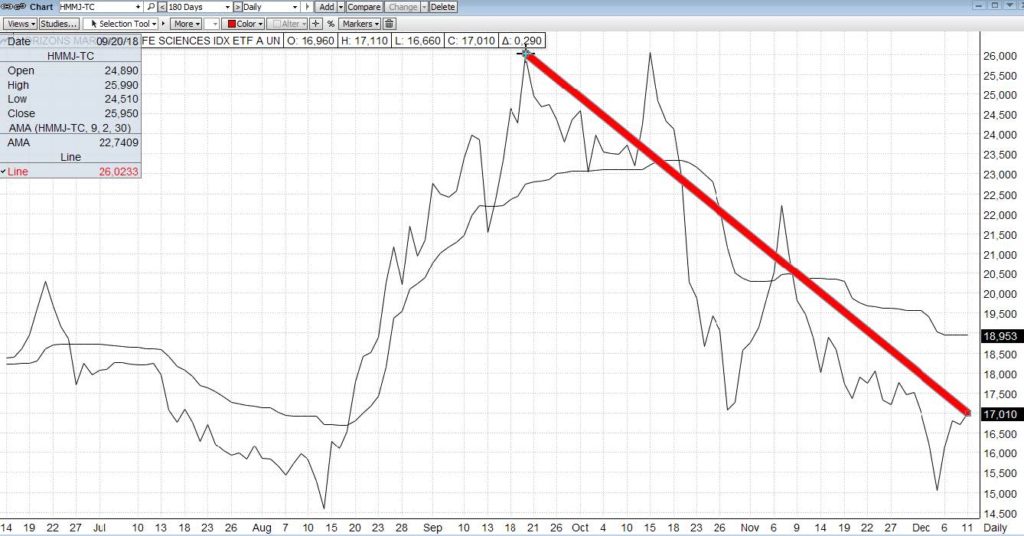
Far be it from me to take the credit for an accurate prediction. But I had to think back to the irony of the call (which I wrote about in my last letter) I had received from the representative of a cannabis company. I had mentioned at that time that we were not going to invest in it even though it is a very popular sector, since the companies people are talking about are not showing any profit. I also emphasized that, sooner or later, reason would prevail. In other words, profits need to rise for a valuation to rise. Below is a graph, which, since our last financial letter, represents a Canadian index of cannabis producers (in red).

As you can see, the decline is about 31%. I wouldn’t buy any of it today either, for it still doesn’t offer what we’re looking for.

I also thought about their business model, which was imposed by the government, and I have to confess that I’m puzzled by it. Since the product was legalized and is now sold “relatively freely,” why not let producers grow it freely in the most efficient way, i.e., by letting it grow in fields just like tobacco? The savings would be substantial, and the prices offered, or profitability, would be even higher. This will probably be the case one day, after a huge amount of capital has been wasted to grow a plant inside a fortress…

Source: MarketQ.

I could also talk to you about cryptocurrencies, which, in my opinion, are certainly not a type of investment. The reasoning is the same: When it comes to the stock market, the euphoria for an asset class can reach heights that defy the laws of gravity. Often, there’s an appreciation and an increase in volume, which attracts speculators, a little like a pyramid scheme. The ending never quite lives up to the rest of the story…

The stock market, turning every which way

As is the case every time the market suffers a major decline, investors become increasingly volatile, nervous and emotional. I always like to say that investors are always okay with the long term as long as the short term is doing well, something I’m reminded of every time there’s a decline. So, what’s happening? A trade war, an election for the U.S. Congress, fears about rate hikes or an economic slowdown…In fact, almost the same kinds of stories we’ve been hearing since 2009. Far be it for me to think of announcing that the market is going to grow non-stop over the next 50 years. However, I still believe that no one can predict the future. No one can time the market in such a way that they sell at the right time and buy at the right time. I regularly hear investors say—incorrectly—that the very rich and the big investors time the market. If I believe those that I follow regularly (Buffett, Gates, Icahn, etc.), it’s not like that at all. In fact, the very wealthy who succeeded by investing all have one thing in common: They practically never negotiate!

Time and compound returns are the best friends to have on the road to greater wealth. The turnover rate of the investments by Buffett (5%), Gates (5%) and Icahn (3%) is nearly 0% per year (Source: MOI Global). In Canada, we talk about the three richest people in the world who made their fortune by way of informed investment decisions and by being patient.

People regularly ask me the following question: Am I worried about the recent drop? My answer is always the same: The only thing that worries me in a stock market decline is the reaction of investors. In my opinion, as always, each decline offers me a chance to improve our portfolio and future performance. How? By buying securities in the companies that interest us at the lowest possible price. And then? Patience.

In fact, always remember that the decline in a share price on the stock market does not reflect the real loss in the value of the company that we’re holding. It’s the quarterly financial results that allow us to determine the value our companies and decide whether to hang on to them or not. The stock market could be open one day per quarter and we would still be able to achieve our long-term objective. Unfortunately, the 24-hour news channels would find that time passes very slowly!

That being said, the average valuation on the stock market is currently approximately 15 times profit, and the historical average is 16.1 times (Source: Value Line). Therefore, the stock market is not as costly as the historical average. According to the figures I saw recently, the profit of S&P 500 companies in the last quarter rose nearly 25%, of which 7% was attributable to the tax cuts. Therefore, we’re talking here about fairly strong growth. The economy is running hot, the unemployment rate is very low, wages are rising, and interest rates remain very low. From my perspective as a shareholder in several high-quality companies, the time is ripe to earn profits. And then? Patience!

“Investing in stocks is not easy, but it should not be painful. Plain and simple, it requires work and an understanding that stock prices tend to follow company earnings over time.” —Peter Lynch, foreword to Big Money Thinks Small, by Joel Tillinghast

Interesting reading for you and your children

I just finished reading the book The Millionaire Next Door by Thomas J. Stanley and William D. Danko. This book dates back to 1996. I admit that I hesitated to read it for fear it would be a book of “recipes for becoming rich.” Far from it. In fact, it’s really the dissection of a group of millionaires based on their level of over- or under-accumulation. The most interesting section—which, on its own, makes the book worth reading—is, by far, the one about the children of millionaires. The way they talk to them about money, help young children financially until adulthood, definitely has a major impact on their tendency not only to save, but also to become independent and succeed on their own. A hint? The chapter in question is titled “Economic Outpatient Care.” According to the authors, significant financial help leads to financial dependence…

Disclaimer: The results shown are before management fees. This data reflects past performance and is not indicative of future returns. This publication may contain statistical data cited from third-party sources believed to be reliable, but Desjardins Securities does not represent that any such third-party statistical information is accurate or complete, and it should not be relied on as such. Alain Robitaille and Fanie Ouellet are registered as portfolio managers with self-regulatory organizations. In accordance with Investment Industry Regulatory Organization of Canada (IIROC) Rule 1300, they are authorized to make investment decisions and provide advice on securities for managed accounts. With the exception of Alain Robitaille and Fanie Ouellet, no member of the Robitaille Group may exercise any discretionary authority with respect to a client’s account, approve discretionary orders for a managed account or participate in the formulation of investment decisions made on behalf of the holder of the managed account or advice for a managed account. Each of the Desjardins Securities advisors named on the front page of this document or at the beginning of any section of this same document hereby confirms that the recommendations and opinions expressed accurately reflect the personal opinions of the advisors with respect to the company and the securities discussed in this document, as well as any other company or security monitored by the advisor that is mentioned in this document. Desjardins Securities may have published opinions that are different from or even run counter to those expressed in this document. These opinions reflect the different perspectives, assumptions and analytical methods of the advisors who expressed them.

Escalation Is Not the Way

January 19, 2019 in John's Blog

The consumption economy is delivering. New movies, new series, new toys, new apps — everything seems to be churned out at an increasing pace, and the quality is often impressive.

I notice it in kids’ movies. In an attempt to minimize the time my children (6, 10, 12) watch mindless stuff on TV, but in an acknowledgment that I am too weak/indecisive/lazy to stop them from watching altogether, I occasionally look for highly rated movies. Rotten Tomatoes is a great resource.

Some of the movies my kids have watched as a result — and I have listened to in the background — seem really good: Isle of Dogs, Song of the Sea, The Secret of Kells, Up, Wreck-It Ralph, to name a few.

The “stuff” we can consume these days is truly impressive.

Yet, people seem more stressed, less happy.

Why?

I’ve experimented with diets in the past, and those experiments seem to offer an answer. After not eating for a while, the next meal tastes better. It doesn’t matter what it is — it simply tastes better than that same thing would taste on a full or half-full stomach.

This may apply to the other stuff we consume as well. If you watch a good movie every day or every week, no movie will leave a lasting impression. If you buy new shoes all the time, the next pair will not have as big of an impact.

The problem is that those who can afford virtually anything they desire instinctively — and almost automatically — exercise that power, producing a pattern of diminishing utility.

This is perhaps why a minority of people with above-average buying power consciously build “nothing” into their lives — to accentuate the next thing.

Meditation may be such a “nothing”. A week-long Vipassana treat may be an even bigger “nothing”. Intermittent fasting is a sixteen-hour daily “nothing”. Watching movies only in the movie theater creates another “nothing”.

Instead of escalating consumption, perhaps we need to create more nothings.

MOI Global