Ageas: 200-Year Old Belgian Insurer with Presence in Europe and Asia

October 29, 2024 in Audio, Diary, Discover Great Ideas Podcast, Equities, Europe, European Investing Summit 2024, European Investing Summit 2024 Featured, Ideas, Member Podcasts, Transcripts

Roshan Padamadan of Luminance Capital presented his investment thesis on Ageas (Belgium: ABS) at European Investing Summit 2024.

The full session is available exclusively to members of MOI Global.

Members, log in below to access the full session.

Not a member?

Thank you for your interest.  Please note that MOI Global is closed to new members at this time. If you would like to join the waiting list, complete the following form:

About the instructor:

Roshan Padamadan is Chairman at Luminance Capital. He is a global investor and splits his time between New York, Singapore and India. Previously, he served as COO, Risk and Compliance officer at Sixteenth Street Capital, based in Singapore. His erstwhile Luminance Global Fund had a global unconstrained investment strategy, looking at special situations and deep value. Prior to launching Luminance in 2013, Roshan also spent more than seven years with the HSBC Group, including more than three years with HSBC Asset Management, as a Product Specialist. He worked for the highly commended Offshore Indian Equity team which ran US$5+ billion from Singapore, including a US$100+ million award-winning India hedge fund. Roshan has earned an MBA in Management from Indian Institute of Management, Ahmedabad. He holds the CFA, FRM and CAIA charters and speaks over five languages.

SDI Group: High-ROTCE UK Serial Acquirer of Scientific Instruments

October 29, 2024 in Audio, Diary, Discover Great Ideas Podcast, Equities, Europe, European Investing Summit 2024, European Investing Summit 2024 Featured, Ideas, Member Podcasts, Transcripts

Nils Herzing of Shareholder Value Beteiligungen AG presented his investment thesis on SDI Group (UK: SDI) at European Investing Summit 2024.

Thesis summary:

SDI, founded in 1984 and AIM-listed in 2008, is a micro-cap UK serial acquirer of manufacturers of scientific instruments and components. The company operates through 14 subsidiaries. These are high-margin businesses with medium-wide moats. The operating businesses are largely independent of the economic cycle due to life sciences end-markets.

The group typically acquires small businesses with EBIT of roughly £1 million for 5-6x EV/EBIT. Since 2014, SDI has acquired 17 companies for an average multiple of 5.5x. Going forward, SDI plans to acquire 1-2 companies per year, and with this aims to grow revenue inorganically by 10% per annum.

The opportunity exists due to the recent departure of Mike Creedon, missteps in their recent M&A transactions, which were conducted by Mike, as well as the fade-out of profitable COVID-19 revenue.

The full session is available exclusively to members of MOI Global.

Members, log in below to access the full session.

Not a member?

Thank you for your interest.  Please note that MOI Global is closed to new members at this time. If you would like to join the waiting list, complete the following form:
About the instructor:

Nils Herzing is an Executive at Shareholder Value Beteiligungen AG (SVB), a long-term oriented, publicly traded value investment vehicle. Prior to joining SVB, Nils was Partner and first employee at Active Ownership Capital (AOC). Before that, he was the manager of a Family Office located in Regensburg, Germany. In 2013, he graduated with a B.A. in Management, Philosophy & Art. In the same year he founded the Herzing Value Investment GmbH. Afterwards, he earned an MSc in Finance from the EBS Business School and EDHEC Business School during which he passed the first two levels of the CFA Program. Since 2016, he has been a CFA Charterholder. In 2017, Nils co-founded ForkOn GmbH, the first vendor neutral SaaS forklift fleet management solution. From 2018 until 2022, he has severed as a board member of the supervisory board of PBKM (Polski Bank Komórek Macierzystych) S.A. and Vita 34 AG.

Energean: Owner-Operated, Shrewd Capital Allocator in Natural Gas E&P

October 29, 2024 in Audio, Diary, Discover Great Ideas Podcast, Equities, Europe, European Investing Summit 2024, European Investing Summit 2024 Featured, Ideas, Member Podcasts, Transcripts

Gokul Raj Ponnuraj of Bavaria Industries Group presented his investment thesis on Energean (UK: ENOG) at European Investing Summit 2024.

Thesis summary:

Energean is run by a solid owner-operator who has demonstrated smart capital allocation (three value-accretive mergers and acquisitions), along with solid operational execution (development of a large gas field to production).

The company’s core asset generates gas at a very low cost and has a 17-year production runway, supplying to a region with attractive supply-demand dynamics. Unlike several other oil and gas firms, Energean has limited volatility to the commodity price due to fixed long-term contracts.

The recent war in Israel provides an attractive entry point, offering a 10+% regular dividend yield. The firm is also expected to announce a special dividend of 10% and could return 50+% of its market cap over the next four years.

The recent market quotation may offer a 15+% IRR opportunity with idiosyncratic risks.

The full session is available exclusively to members of MOI Global.

Members, log in below to access the full session.

Not a member?

Thank you for your interest.  Please note that MOI Global is closed to new members at this time. If you would like to join the waiting list, complete the following form:
About the instructor:

Gokul Raj Ponnuraj is a value investor with a focus on small and mid-cap compounders and spin-off’s with a bias towards emerging markets. He has been investing in the Indian markets since 2006 and in global markets since 2017. Gokul Raj manages the public equities portfolio at Bavaria Industries Group. The firm uses its balance sheet assets (permanent capital) to invest in opportunities with an attractive risk-reward trade off. Gokul Raj holds a Master in Finance degree from London Business School and a CFA charterholder.

Zumtobel: Attractively Valued Global Provider of Professional Lighting

October 29, 2024 in Audio, Diary, Discover Great Ideas Podcast, Equities, Europe, European Investing Summit 2024, European Investing Summit 2024 Featured, Ideas, Member Podcasts, Transcripts

Brian Chingono of Verdad presented his investment thesis on European equities and Zumtobel Group (Austria: ZAG) at European Investing Summit 2024.

The full session is available exclusively to members of MOI Global.

Members, log in below to access the full session.

Not a member?

Thank you for your interest.  Please note that MOI Global is closed to new members at this time. If you would like to join the waiting list, complete the following form:
About the instructor:

Brian Chingono serves as Partner, Director of Quantitative Research, and Europe Portfolio Manager at Verdad, a highly regarded global asset management firm. He worked at Dimensional Fund Advisors and Credit Suisse before joining Verdad. Brian earned an AB from Harvard College and an MBA with honors from the University of Chicago Booth School of Business. As a graduate student, Brian co-authored two research papers related to Verdad’s investment strategy: Leveraged Small Value Equities and Forecasting Debt Paydown Among Leveraged Equities.

Upcoming Event: Aswath Damodaran Valuation Seminar and Retreat

October 28, 2024 in Diary

Editor’s note: Alex Gilchrist is supporting the organization of this wonderful event. MOI Global has no control over the contents of the seminar, nor does MOI Global receive any compensation for recommending this event.

This exclusive two-day seminar, presented by Arc and MOI Global and led by Professor Aswath Damodaran, on the picturesque island of Mouchão in the medieval town of Tomar in Portugal, will be an immersive event that will explore key valuation concepts such as estimating cash flows, growth rates, and discount rates, using real-world companies to address common challenges.

The program is crafted to provide value for both senior and junior participants alike, ensuring that all attendees—regardless of experience—can deepen their understanding of these foundational concepts.

Overview by Aswath Damodaran:

You may ask if this is for senior people or juniors. I just say that all valuation is basic and what people take out of it will vary depending on whether they are junior or senior. In short, this is designed for a very broad and diverse audience.

There are as many models for valuing stocks and businesses as there are analysts doing valuations. The differences across these models are often emphasized and the common elements are generally ignored. In this two-day seminar, I will start with the estimation issues and basics of intrinsic valuation, talking about the big picture perspective that must be brought to the estimation of cash flows, growth rates and discount rates. I will use real companies as lab experiments to bring home the estimation questions that have to be dealt with in valuation. Once I have the foundation laid, I will launch into an assessment of the loose ends in valuation and talk about valuing control, synergy and cross holdings in companies. Then, we will move on to what I term the dark side of valuation, valuing difficult-to-value companies across sectors (intangible assets, cyclical and financial service companies) and across the life cycle (small private, young growth, mature transition and declining/distressed companies). In the last part of the session, we will cover the use and misuse of multiples in relative valuation.

The objective of the training is to provide the fundamentals of each approach to valuation, together with limitations and caveats on the use of each, as well as extended examples of the application of each. At the end of the seminar, participants should be able to:

  • Value any kind of firm in any market, using discounted cash flow models (small and large, private and public)
  • Value a firm using multiples and comparable firms,
  • Analyze and critique the use of multiples in valuation,
  • Value “problem” firms, such as financially troubled firms and start up firms,
  • Estimate the effect on value of a restructuring a firm 

The first day of the seminar will establish the fundamentals of discounted cash flow valuation, with a special emphasis on the estimation issues that come up when estimating discount rates, cash flows and expected growth. It will look at the choices in terms of DCF models and how to pick the right model to value a specific firm. In addition, we will use the basic structure of the discounted cash flow model to take a comprehensive look at how to enhance firm value. In addition, we will focus on a myriad of estimation questions related to cash flows, discount rates and growth rates. We will end the day by looking at the terminal value in DCF valuation: how best to estimate it and common errors made in computation.

The second day’s discussion will begin with an analysis of what we call the loose ends in valuation – how to deal with cash, cross holdings and other assets, what the value of control, synergy and liquidity are and how best to deal with employee and management equity and option grants. It will also then extend into the discussion of difficult to value companies. The last part of the day will be dedicated to relative valuation. A range of multiples that are used currently in valuation, from earnings multiples (such as PE, Value/EBIT, Value/EBITDA) to sales multiples (Revenue/Sales, Price/Sales), will be discussed and compared. The relationship between multiples and discounted cash flow models will be explored, and the notion of a “comparable” firm will be examined. (What is a comparable firm? How do you adjust for differences in growth, risk and cash flow capabilities across firms, when estimating multiples?) Finally, the special difficulties associated with comparing multiples across time, and across markets, will be highlighted.

Download the brochure.

Click here to sign up.

(Click “Reserve – Invitation Only”. Use password “aswath”. Under Referral Code, enter “MOI Global”.)

Editor’s note: Alex Gilchrist is supporting the organization of this wonderful event. MOI Global has no control over the contents of the seminar, nor does MOI Global receive any compensation for recommending this event.

Marc Garrigasait sobre Medikit

October 28, 2024 in Ideas de inversión, MOI Global en Español

NOTA DEL EDITOR: La siguiente idea de inversión es obtenida de una carta trimestral del fondo Japan Deep Value Fund.

* * *

Medikit Co, la empresa de material médico en la que somos accionistas desde 2017, realizó en diciembre de 2023 una recompra de más del 11% de sus propias acciones. Esta operación sigue un patrón que hemos observado en múltiples ocasiones. A raíz de la jubilación o fallecimiento del presidente de la compañía y máximo accionista, que suele ser además de la familia fundadora, se ven con la obligación moral de devolver parte de su paquete accionarial al resto de accionistas.

Miembros, inicien sesión abajo para acceder al contenido restringido.

¿No eres miembro?

Gracias por tu interés. Ten en cuenta que MOI Global está cerrado para nuevos miembros en este momento. Si deseas unirte a la lista de espera para miembros hispanos, completa el siguiente formulario:


Una buena empresa no siempre es buena inversión

October 25, 2024 in Miscelánea, MOI Global en Español

NOTA DEL EDITOR: El siguiente texto es obtenido de una carta trimestral de los fondos de Bestinver.

* * *

Una buena compañía no tiene por qué ser una buena inversión. Habrán oído muchas veces decir eso de que hay que diferenciar las empresas, que pueden ser estupendas, de sus acciones, que pueden no serlo tanto. ¿El motivo? La valoración.

Una compañía se considera extraordinaria si tiene un negocio en el que es capaz de reinvertir grandes cantidades de capital de manera rentable durante un largo periodo de tiempo. La mezcla de reinversión, rentabilidad y tiempo es la que hace que sus beneficios puedan crecer de manera compuesta. Sin embargo, estos no siempre se transforman en una mayor riqueza para sus accionistas. Si su valoración es demasiado alta, puede canibalizar todo el valor que genere la compañía por muy buena que sea.

Miembros, inicien sesión abajo para acceder al contenido restringido.

¿No eres miembro?

Gracias por tu interés. Ten en cuenta que MOI Global está cerrado para nuevos miembros en este momento. Si deseas unirte a la lista de espera para miembros hispanos, completa el siguiente formulario:


Leveraging Tech and Know-How — A Treatise on European Growth

October 22, 2024 in Diary, Equities, European Investing Summit

This article is authored by MOI Global instructor Roshan Padamadan, chairman at Luminance Capital, based in Singapore.

Roshan is an instructor at European Investing Summit 2024.

Many decades back, India had a moniker for its rate of growth called the Hindu rate of growth: Coined by an Indian economist, Raj Krishna, in 1978, it was meant to denote the 3-4% growth rate seen by India in the 1960s-1980s. It was not a compliment. Peers, other former colonies in Asia, were booming. E.g. Singapore moved from a port city-state with no natural resources, and a barely educated populace to a First World nation, within about 30 years. The moniker conveyed a level of fatalism and contentment, as if India chose, or was forcibly choosing a low level of growth to ensure its socialist policies were effective. India was under a heavily constrained regime where every business activity was subject to licenses and quotas, called the License Raj.

Country/Region 1960s 1970s 1980s
Hong Kong 9.0% 8.5% 7.5%
Singapore 9.5% 8.8% 7.7%
South Korea 8.6% 9.5% 9.0%
Taiwan 9.6% 10.0% 8.5%
India 3.5% 2.9% 5.6%

Source: IMF

Followers of India know that India broke out in 1991, with the dismantling of the License Raj. India joined the WTO in 1995.

Coming to the present moment, India is considered to be one of the beacons of global growth, growing when others are slowing. Perhaps it is the story of the hare and the tortoise. India has made itself a global leader in a couple of areas – software services and generic pharma products. In other areas, it wants to get better, but the result is not yet clear. India now makes 14% of Apple’s iPhones, a significant shift for a country not hitherto known for global manufacturing prowess. Can India become a major manufacturing hub? It might – especially if it imports tech and know-how in the early years.

India’s other export – Indian-origin CEOs – sadly do not count to India’s GDP. Several of the top Tech companies have Indian origin CEOs – Microsoft, Google, Adobe, IBM, etc.. Looking at the broader Fortune 500, the percentage is still significant, at ~30%.

Looking at expected growth rates for the next two decades:

Country 2024-2033 2034-2043
India 6.3% 5.5%
China 4.0% 3.5%
USA 1.4% 1.2%
EU 1.5% 1.3%
Eurozone 1.4% 1.2%

Source: IMF, World Bank

Looking at these World Bank and IMF forecasts, it appears that the Developed World is looking at a much lower rate than even half the Hindu rate of growth. What does this mean for investing? Should one only invest (only) in high growth economies?

Factors of Growth

Growth comes primarily from two factors: population growth, and growth in productivity.

India is at the top of this list of expected fertility rates for the next 2 decades. Europe is not far behind the USA.

Country 2024-2033 2034-2043
India 2.0 1.8
China 1.2 1.3
USA 1.7 1.6
EU 1.5 1.4
Eurozone 1.4 1.3

Source: UN Data

But there is one key difference: the USA has much higher net immigration rates. Most or all the Indian-origin CEOs made their mark in the USA, not in Europe.

Country/Region 2024-2034 2034-2043
India 0.8% 0.5%
China -0.2% -0.5%
USA 0.6% 0.5%
EU 0.1% 0.0%
Eurozone 0.1% 0.0%

Source: UN Data

China’s population is shrinking, the effects of the one-child policy coming home to roost. Europe has zero population growth in the decade of 2034-2044, per the UN.

On productivity: As the population becomes more efficient, GDP grows. E.g. An intern learns mail merge, and can send out an email to 50 people in five minutes, instead of 50 minutes, that’s an increase in productivity, which will flow through over time to higher revenues for his or her firm. Do this across the population, and you have GDP growth. Look at countries like Luxembourg which punch way above its weight. Denmark and Netherlands are good examples too. Ireland is skewed due to its tax haven status, and both Switzerland and Luxembourg are boosted by large wealth management practices.

Rank Country GDP per Capita (USD) Resource Rich
1 Luxembourg $131,380 No
2 Ireland $106,060 No
3 Switzerland $105,670 No
4 Norway $94,660 Yes
5 Iceland $84,590 Yes
6 Denmark $68,900 No
7 Netherlands $63,750 No
8 San Marino $59,410 No
9 Austria $59,230 No
10 Sweden $58,530 No

Source: IMF, 2024

Some analysts like to look at how productive a company is, looking for over, say, USD 200,000 per person per year as a thumb rule. I know a startup CEO who uses this metric to see if he is being efficient with his workforce. He lives in Dubai, his HQ is in California, and his main development team is in Bangalore. Where is Europe in his world view? He is looking at a pure tech company in Europe that owns patents, which he can leverage.

This is perhaps the key to Europe’s future growth: leveraging its advantages in tech and know-how. Know-how is a bit softer than pure tech –- it is the combined knowledge of a workforce, built up through experience.

Europe is rich in culture and heritage. So many of the current inventions came from the Renaissance. While it’s possible that they were invented before –- China claims to have invented/discovered almost the same things a few hundred years earlier — Europe still should get credit for (re)inventing and (re)discovering on a first-principles basis.

Region Invention Year Details
China 868 AD The earliest known printed text, the Diamond Sutra, was created using woodblock printing during the Tang Dynasty.
Europe 1450 AD Johannes Gutenberg invented the movable-type printing press, revolutionizing printing in Europe, bringing the Bible to the masses

Source: History.com

Follow the Growth

European companies can take their know-how around the world and grow – there. Follow the growth, could be a mantra for the coming years. This is possibly one of the few ways to prosper in a low-growth environment, where local EU rules rival the Indian License Raj, and total fertility rates are falling.

French entrepreneurship visas for example have circular rules – one already needs to be a long-term resident before they apply for a permission to have an entrepreneur visa. This rules out non-residents moving there to start a business. Take Ageas SA, as an example of an European company embracing global growth. It is an almost unknown Belgian insurance company, carved out from the former Fortis group. Its market cap is around EUR 8.8bn (a lucky number, by Chinese measures, where the number 8 sounds like the word for prosperity).

Ageas makes ~50% of its revenues from Asia. More than 2 decades back, it made a prescient investment in China. It has an almost 25% stake in China Taiping, China’s 5th largest insurer. This now provides about 30% of group revenues. And another 20% comes from South East Asia, in a tie up with Maybank, under the brand Etiqa. Ageas is in 14 countries, and it does not particularly care to roll out its name – it is agnostic to financial investments; or operating with a local partner’s name; or going to market with a new brand name/ JV brand (e.g. Etiqa). This is a good example of leveraging know-how, bringing product knowledge, and risk management expertise to the table.

This imported growth makes Ageas stand out, like a giant among dwarves, as low population growth and low productivity growth hamper Europe’s chances of increasing its standard of living substantially in the decades to come. Ageas pays a nice dividend (~7%+) and has enough cash flow to buy back stock at a decent clip (~1.7% of market cap)

Europe has not had a tech wonder at the level of Apple, Facebook, etc.. We need to reflect on why that is the case, because the average education level is very high. The French are known for amazing math skills, the Finns regularly top test scores, and the Germans abound in PhDs.

My observations are twofold: (1) Language barriers fragment the market, both in terms of labour markets and consumer markets. (2) The nation state is still very powerful, and nationalist sentiments prevent consolidation, and economies of scale.

Recently, while in Paris, I bought a Red Bull intended (originally) for the Swedish market. No one could figure out the flavour written on the can – skogsbärssmak – until I used Google Translate (an American invention). Even Andrea Orcel (CEO, Unicredit) may have struggled to solve that one- and he speaks 5 European languages. The distribution for Red Bull Limited Editions was inconsistent, I never knew what flavours I would get in what shop, and it was a bit of treasure hunt. Imagine the job of the Reb Bull supply chain manager – he/she has to decide how many cans to print in each language, for each flavour – English, French, German, Italian, Swedish, etc. And if they remain unsold, they have to be diverted to another country, where perhaps no one can read the labels.

UniCredit’s (from Italy) move to buy Commerzbank (in Germany) may well get shot down, as the German establishment does not want an Italian bank buy one of its own. For a non-European, it appears to be one European bank buying another. Arguably, a non-German buyer will probably result in lower job cuts, and lower overlap, than if the buyer was another German bank. A common market is a true single market only if consolidation is not blocked on national lines. With the rare exception of Airbus, we do not see many European champions, only national champions.

The Rise of Artificial Intelligence

Revolutions are great levelers. Can Europe use the AI revolution to increase productivity while enjoying a high quality of life? Software stacks can be rewritten much more easily and a lot of reinvention is going to happen. Young upstart companies can pop up anywhere. Given Europe’s high latent talent pool, perhaps a new Terravision can arise. Terravision was a young team from Berlin that came up with a product that was later contentiously replicated by Google Earth (Netflix has a show).

The revolution is that AI means that a 5-person team can probably make a product that would have required 20-200 people to make in the old paradigm. Usually software development involves many teams working together – product , software, UX/UI design, testing, etc. AI is increasingly being used in technical product design, and it can write code – that can work right from the first run.

Which software stacks would get rewritten first? Simple, niche vertical software? Or complex expensive and expansive software, with a whole new design paradigm. Or somewhere in between?

Klarna, the flexible payments company, headquartered in Stockholm, sent shivers down the software world when it announced in mid-September 2024 that it will exit the use of Salesforce (arguably the world’s most widely used CRM) and Workday, a leading limited-scope ERP system, focusing on HR and Financials.

Having been an ERP implementation specialist, I have seen how it works across many different modules, and the interconnection points are many for a highly sophisticated system such as SAP, or Oracle 11i/12, where it can integrate manufacturing, shipping, financials and HR, and so on. It took me 2-3 months of full days of training to get Oracle ERP certified.

Comparatively, the workflows of Salesforce is simple. I have used far cheaper versions than Salesforce and enjoyed high productivity. (Hat tip to Nimble CRM).

Workday primarily has a 2-module focus, Financials and Human Resources, with the latter being the traditional core base. Having worked extensively on Workday Financials, and being a classically trained ERP specialist with Oracle 11i and SAP Financials expertise, I can say that workday Financials makes the use accept several shortcomings and live with it. I am not surprised that someone is saying they are willing to reinvent it.

Now it is a different matter if Klarna will find it worthwhile to invest the time and effort to use it purely in house. But I do believe it is open season for a competitor of Salesforce or Workday to launch an attack, with a simpler stack, reinvent the software and offer a cheaper version, because it now costs way less to build new software.

Europe has a high level of technical and technological knowledge and if it is tapped well, Europe can continue to squeeze productivity gains. Don’t give up on the next tech wonder coming from Europe– just do not surprised if they launch their product in the USA, due to (relatively) simpler regulations.

For now, some of the largest market cap companies in Europe sell fashion to the Chinese – e.g. LVMH, Hermes. That’s not very sustainable over a period of the next few decades. The look-up-to-the-West is a very delicate balance and the 4000-year-old (Chinese) culture can easily turn away from the LVMH/Chanel/Dior/Hermes preference it currently shows. That fashion sense alone perhaps is not going to save Europe. That demand is fickle, especially if tensions flare up over issues such as Taiwan – e.g. the Chinese can easily boycott French product if France sides with the USA in any issue involving Taiwan, for example. Homegrown Chinese brands are growing, and it’s a matter of time before China creates its own super luxury brands. Did you know that the luxury all-inclusive vacation you spent at Club Med, you were enjoying the services of a Chinese conglomerate? I met Fosun Group in Shanghai. They have 10 listed entities within the group, and make about half their money from outside China.

China’s rise as a great power was visible at the Paris Olympics, tying the US with 40 gold medals. At the Tokyo Olympics, China was just one medal short of the US (38 vs. 39 gold). To see the ascendancy of a nation, compare this to the dominance USA had in Rio (2016) : USA 46 gold medals, vs. Great Britain 27 and China 26.

Rounding up my treatise on European growth, I believe Europe’s companies should study AI closely to see what can be done, and what could be done to them. AI is levelling the playing field and Europe’s companies need to innovate or partner up or risk falling by the wayside.

European companies should embrace growth, and go to where growth is booming- figure out ways to get exposure to India and China and others economies in Asia. Asians work much harder than Europeans – words for death from overwork exist in Japanese (karoshi), Chinese (guolaosi) and Korean (gwarosa), while such terms are not common in European languages.

If you can’t beat them, join them. This could be a good motto for Europe in the coming decades. The technological lead over the last 500 years is now narrowing. Europe is now afraid of China’s cars. They are just better value-for-money and we saw the unthinkable news that Volkswagen is considering job cuts at its home base, Wolfsburg. Perhaps one way for Europe to participate in Asian growth is to ally with it. Bring its technology to Asia – and also be willing to import it when Asian companies are at a better level. I went to test drive a BYD, and was surprised to find a café inside the car showroom. They had a full menu, and I enjoyed an excellent craft beer – after my drive.

Stellantis is the new name for the merger of the former Fiat Chrysler and the Peugeot group. This entity now owns Fiat, Jeep, Maserati, Alfa Romeo, etc.. Stellantis is making a multi-platform bet, embracing a way to make ICE, EV and hybrid cards on the same production line. Such a technology-agnostic approach may serve it well, as it simplifies all its over 20 types of cars to a 5-platform model. Apart from this, the most interesting part of Stellantis is its 20 % ownership of Leapmotor, a Chinese EV maker. And the rights to market Leapmotor outside China. The DNA to think innovatively and to enter into such a partnership is my definition for how Europe should diversify and grow. Whether the partnership succeeds or not is not the topic – I am pointing out that such cross-country partnerships may be the key, to not just survive, but prosper.

I would happily retire in Europe and enjoy the beauty and the culture. But if I seek growth, I look for ties to Asia and the U.S., and an eye on AI.

I may or may not have positions in any of the stocks mentioned, and may be recommending buy or sell actions to certain clients, where I have considered their overall risk profile. Nothing here should be considered a buy or sell recommendation. Please work with your advisor for a balanced portfolio.

Members, log in below to access the restricted content.

Not a member?

Thank you for your interest.  Please note that MOI Global is closed to new members at this time. If you would like to join the waiting list, complete the following form:
Beltrán Palazuelo sobre Semapa

October 21, 2024 in Ideas de inversión, MOI Global en Español

NOTA DEL EDITOR: Esta idea de inversión es obtenida de una carta trimestral del fondo DLTV Europe.

* * *

Semapa [ELI: SEM] es una empresa fundada por Pedro Queiroz Pereira en 1990. La historia de Semapa, principalmente está ligada, a la compra de participaciones mayoritarias de la cementera Secil en el año 1994 y la papelera integrada Navigator (antigua Portucel) en el año 2004.

Desde el año 1995 hasta el año 2023 el valor en libros ha pasado de 95 m eur hasta los 1,471 m eur. La rentabilidad media sobre recursos propios (ROE) desde el 1995 ha sido del 29.7% y el ROE medio desde el 2018 ha sido del 21.17%. Además, desde 1995 ha pagado 956.1m eur en dividendos. Con este conjunto de datos podemos afirmar que Semapa ha generado un extraordinario valor en las pasadas décadas. Ahora la pregunta importante es si va a seguir generando valor a tasas atractivas en el futuro.

Procederemos a nombrar los activos principales de Semapa: 70% Navigator, Secil, ETSA, Triangle´s Cycling Equipments, además de un conjunto de participaciones en fondos de venture capital. El activo principal de Semapa es el 70% que tiene en Navigator. A precios de mercado (3.86 eur acción), la participación vale 1921m eur (82.6% del GAV de Semapa, si valoramos el resto de los activos con descuentos de entre el -35-50% respecto a valor en libros por un ejercicio de extremo conservadurismo, aunque las otras participadas tengan buenos retornos sobre sus valores en libros). Con estas cifras restándole los 200 m aprox de deuda neta con recurso, el valor de Semapa serían 2098.3 m euros (30.92 euros).

Actualmente, Semapa cotiza a 14.84 eur por acción, teniendo una capitalización bursátil de 1,006m eur. (0.68x Valor en Libros). En 2023 ganó 244 m euros (PER 4.1x) y podemos afirmar con contundencia que en el resto de la década ganará al menos 200 millones anuales.

Con este conjunto de cifras Semapa cotiza con un descuento del -52% respecto a una valoración sumamente conservadora. Además, esta debería aumentar a unos 200 m de euros anualmente.

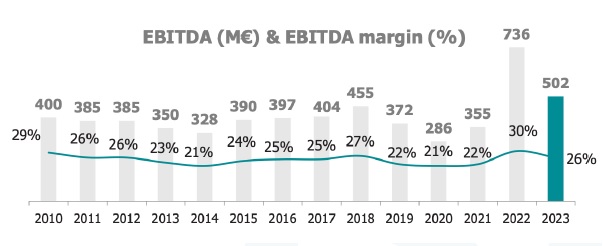
Navigator, la principal participada de Semapa, es un productor de papel integrado con pulpa, productor de tissue, generador de energía y propietario y gestor de activos forestales, que hacen que su integración sea total. Desde que entra uno de sus activos industriales en producción en el año 2010 (Setúbal) la generación de resultados y dividendos han sido extremadamente estables.

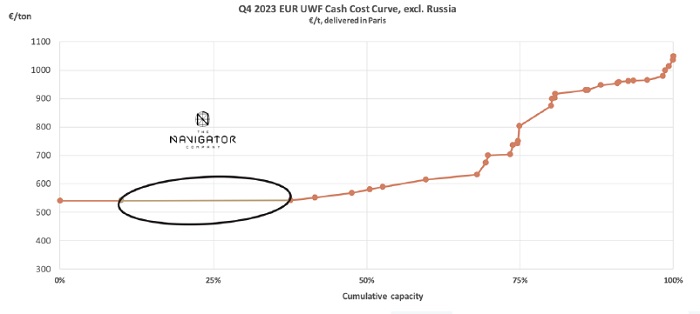
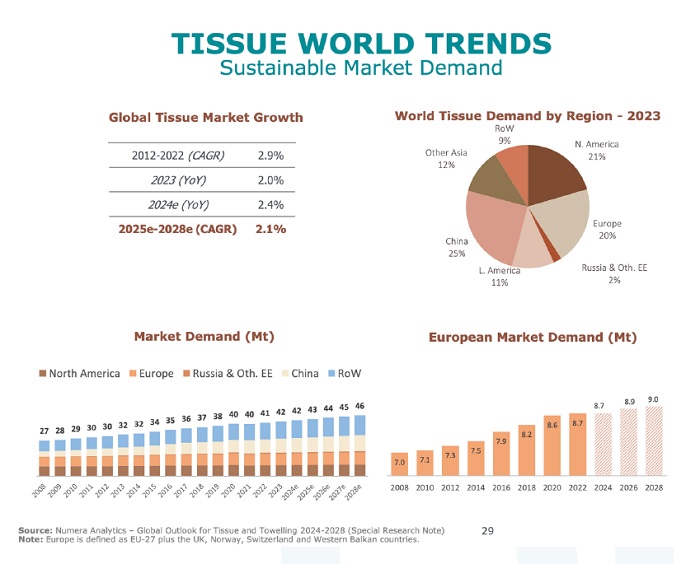
La gran incógnita que tiene los inversores con Navigator es que la demanda de UWF (Uncoated Wood Free) paper, su principal producto, está en declive. Desde el 2013 lleva reduciéndose a una tasa del -2% anual. Sin embargo, debido a la escala de los activos de Navigator, al grado de integración y a que posee marcas premium, le ha permitido sacar mejores márgenes que nadie. Eso se traduce en un mejor precio de venta de sus productos y un menor coste de producción. Pero un factor que no tienen en cuenta los inversores es que Navigator también está presente en Tissue donde la demanda crece a un 2.1% anual, y además tiene la posibilidad de convertir parte de su capacidad de UWF en ciertos papeles de packaging (ya lo está haciendo).

Desde el 2010 (que abrió la planta de Setúbal) hasta 2023, Navigator ha tenido un ROE medio del 17%, y un ROCE medio del 13%. Eso se traduce en unos beneficios netos medios de 210.3 m eur y unos dividendos en este periodo de 200 m eur anuales. En el año 2023 ganó 274m eur (PE 10x) y capitaliza a 2750 m eur., con unos beneficios netos estimados de entre 270-300 millones y dividendos de entre 200-250 millones anuales. En síntesis, Navigator es una empresa que no tiene mucho crecimiento, pero es extremadamente recurrente, además sus retornos sobre capital empleado y sobre recurso propios son muy atractivos. Con estos dos análisis podemos afirmar que Semapa posee negocios magníficos y tiene un robusto balance (200 millones de deuda con recurso contra activos de 2,300 millones). Sin embargo, su infravaloración se deriva de:

a. Sodim (Familia Queiroz Pereira) posee el 82% de Semapa y después de sus 2 OPA´s de 2015 y 2021 el mercado cree que harán otra que no recoja todo el valor de Semapa. b. Baja liquidez de Semapa, negocia alrededor de 0.5m eur diariamente. c. No tiene política de dividendos definida (el tamaño del dividendo se decide en base a factores subjetivos). d. Riesgo de mala alocación de capital futura por parte de Semapa. e. Baja transparencia con respecto a las nuevas inversiones que está realizando. f. Un gobierno corporativo mejorable.

Estamos en contacto con Semapa, sugiriendo que cambios tiene que implementar para que el precio al que cotiza se acerque al valor real. También estaremos muy encima empujando que el gobierno corporativo mejore.

Debido a nuestra incertidumbre de si estos cambios se implementarán, somos muy conservadores a la hora de hacer nuestras valoraciones. Asumimos un -50% de descuento sobre el valor estimado lo que se traduciría en un valor objetivo a 2030 de 1,699.1m eur (dividendos incluidos), que es igual a 24.32 euros por acción (potencial del 65.44% en 6.5 años, que equivale a un 10% de TIR). En caso contrario, sino cotizase con descuento su precio objetivo en el año 2030 sería de 48.64 euros (+230.8% de potencial).

El contenido de este sitio web no es una oferta de venta ni la solicitud de una oferta para comprar ningún tipo de valor en ninguna jurisdicción. El contenido se distribuye solo con fines informativos y no debe interpretarse como un consejo de inversión o una recomendación para vender o comprar cualquier valor u otro tipo de inversión, o emprender cualquier estrategia de inversión. No hay garantías, expresas o implícitas, en cuanto a la exactitud, integridad o resultados obtenidos de cualquier información establecida en este sitio web. Los directivos, ejecutivos, empleados, y/o autores contribuyentes de BeyondProxy pueden tener cargos y pueden, de vez en cuando, realizar compras o ventas de los valores u otras inversiones discutidas o evaluadas en este sitio web.


From the Archives: Michael Melby on Small- and Micro-Cap Value Investing

October 20, 2024 in Deep Value, Equities, Full Video, GARP, Idea Appraisal, Idea Generation, Interviews, Jockey Stocks, Micro Cap, North America, Portfolio Management, Small Cap, Special Situations, YouTube

We are pleased to share a timeless interview with Michael Melby of Gate City Capital Management.

The following video is sourced from the MOI Global archives.

Members, log in below to access the restricted content.

Not a member?

Thank you for your interest.  Please note that MOI Global is closed to new members at this time. If you would like to join the waiting list, complete the following form:

MOI Global