El futuro incierto del mercado de vehículos eléctricos

October 18, 2024 in Industrias, MOI Global en Español

NOTA DEL EDITOR: Este texto es obtenido de una carta mensual de NAO Sustainable Asset Management.

* * *

Desde hace varios años, casi todas las noticias que escuchamos acerca del sector de la automoción vienen relacionadas con la adaptación de la infraestructura productiva a las nuevas tecnologías de motor eléctrico. En pocos años, las compañías fabricantes de automóviles, tanto de consumo como de uso comercial, han tenido que acometer importantes desembolsos para renovar su oferta de vehículos con la idea de abandonar, llegado el momento, la manufactura en motores de combustión interna (que emplean carburantes de origen fósil y derivados) para volcarse en los diseños basados en motores híbridos y eléctricos. Nombres como Volkswagen, Mercedes, BMW y Stellantis constituyen, en este orden, las compañías que más capital han destinado hasta la fecha para cumplir con los compromisos exigidos por el regulador europeo (probablemente, el más exigente a día de hoy) y alinear su actividad con el Green Deal y sus normativas análogas en el resto del mundo. La cifra de desembolsos destinados por las principales empresas del sector hacia este tipo de proyectos durante los últimos 10 años ya supera el agregado de 300.000 millones de euros. Un montante canalizado hacia cuestiones diversas pero todas relacionadas con el VE, como por ejemplo la construcción de plantas de producción y ensamblaje de VE, el desarrollo de nuevos motores híbridos y eléctricos, el montaje de estaciones de carga para el repostaje, y el desarrollo y manufactura de diversas tecnologías de batería.

Miembros, inicien sesión abajo para acceder al contenido restringido.

¿No eres miembro?

Gracias por tu interés. Ten en cuenta que MOI Global está cerrado para nuevos miembros en este momento. Si deseas unirte a la lista de espera para miembros hispanos, completa el siguiente formulario:


Reseña: En Bolsa, Invierta en Valor

October 16, 2024 in Contenido Libre, Miscelánea, MOI Global en Español

La inversión en valor: no se trata de un gusto adquirido. O te gusta de inmediato o no -está en tu ADN o no-…

—Jean-Marie Eveillard

Jean-Marie Eveillard es uno de los super inversores más destacados del mundo. Francés de nacimiento, Jean-Marie tuvo un track record de 15.8% anual frente a 13.7% del S&P 500 durante el periodo que estuvo al frente del First Eagle Global Fund, de 1979 a 2004. Actualmente como asesor sénior en First Eagle, en 2017 publicó lo que se puede considerar su autobiografía, En Bolsa, Invierta en Valor. Publicado por Valor Editions, a través de 143 páginas Jean explica desde su punto de vista y experiencia lo que es en realidad el value investing.

Continue reading »

The Great Rotation: Rethinking US and International Equity Allocations

October 14, 2024 in Diary, Equities, European Investing Summit, Letters

This article is authored by MOI Global instructor Brian Chingono, partner and director of quantitative research at Verdad Advisers, based in New York.

Brian is an instructor at European Investing Summit 2024.

After a stellar 15-year run of robust earnings growth, US stocks have appreciated so much that they now represent 70% of developed market allocations, according to popular indices like the MSCI All Country World Index (ACWI).

As American earnings growth has outpaced international peers over the past 15 years, US stocks have returned 13.4% annualized, more than doubling the 5.9% annualized return of developed international stocks.

But with more than a quarter of total US market capitalization being attributable to just six technology stocks today, it’s worth questioning whether hyper-concentration in yesterday’s winners will be a winning strategy in the years ahead.

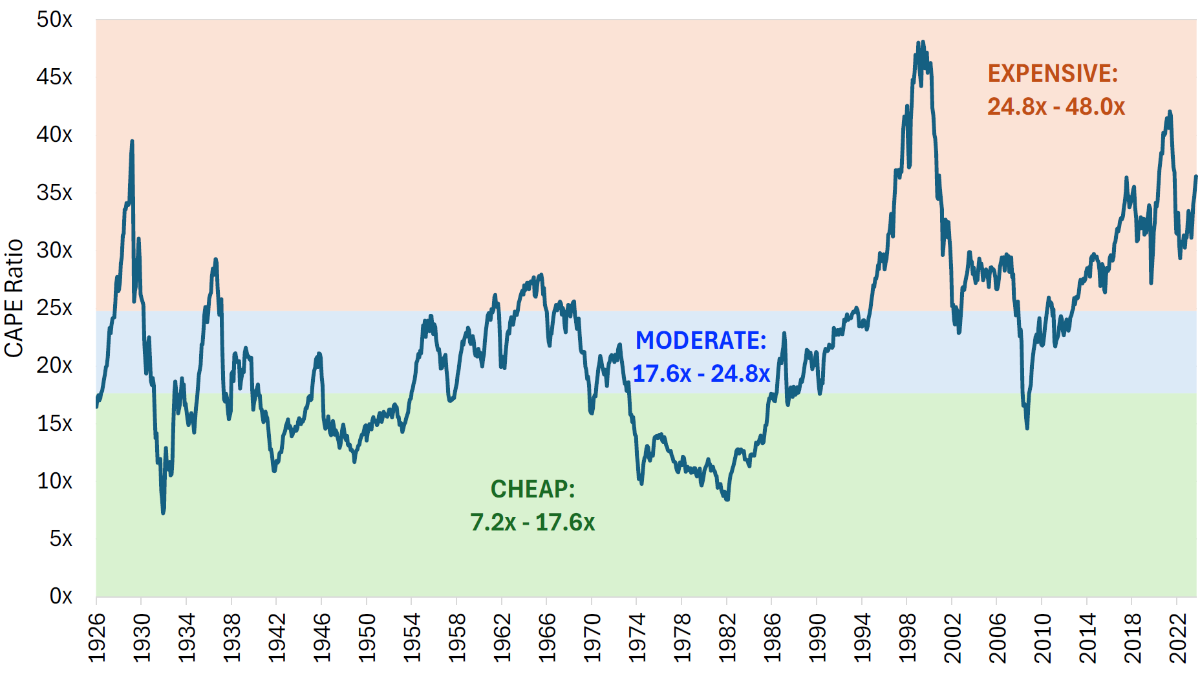
To start, it’s worth noting that the US stock market’s magnificent run over the past 15 years has resulted in a cyclically adjusted PE ratio (CAPE) of 36x today, a valuation level that is firmly within expensive territory by historical standards. In the figure below, we grouped historical values of the United States’ CAPE ratio into three categories with an equal number of monthly observations. Each category is highlighted as a backdrop to the time series of US market valuations since 1926.

Figure 1: United States CAPE Ratio (1926–2024)

Source: Robert Shiller’s website.

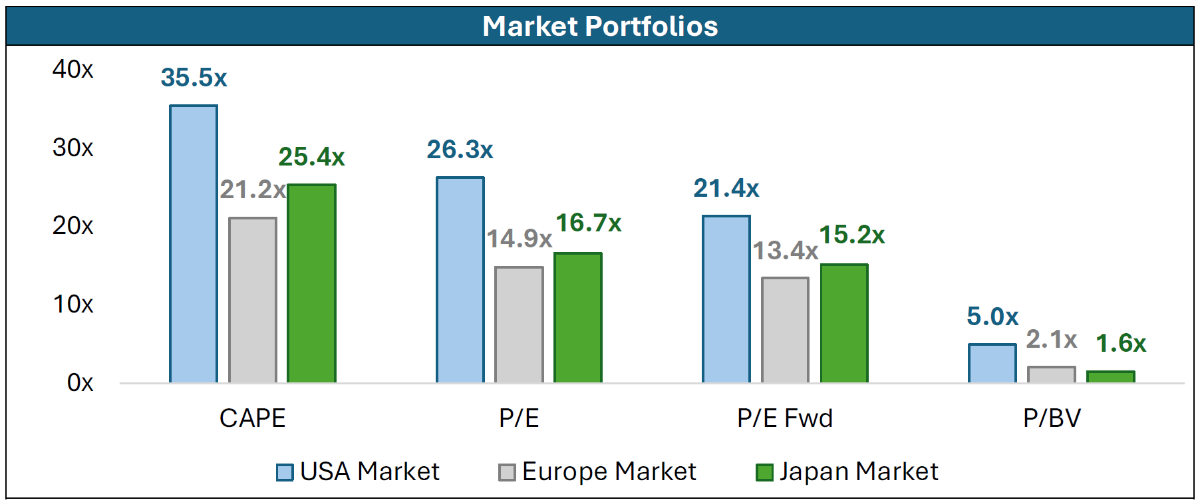
While the US market trades at an expensive valuation of 36x CAPE today, international markets are more moderately priced, with the European market trading at 21x CAPE and the Japanese market valued at 25x CAPE as of June 30, 2024. As a forward-looking measure, the CAPE ratio has a negative relationship with expected returns, as shown in the figure below, with higher CAPE valuations being associated with lower returns over the next decade.

Figure 2: Global 10-Year Returns vs CAPE Ratio (US: 1926–2024), (Int’l: 1975–2024)
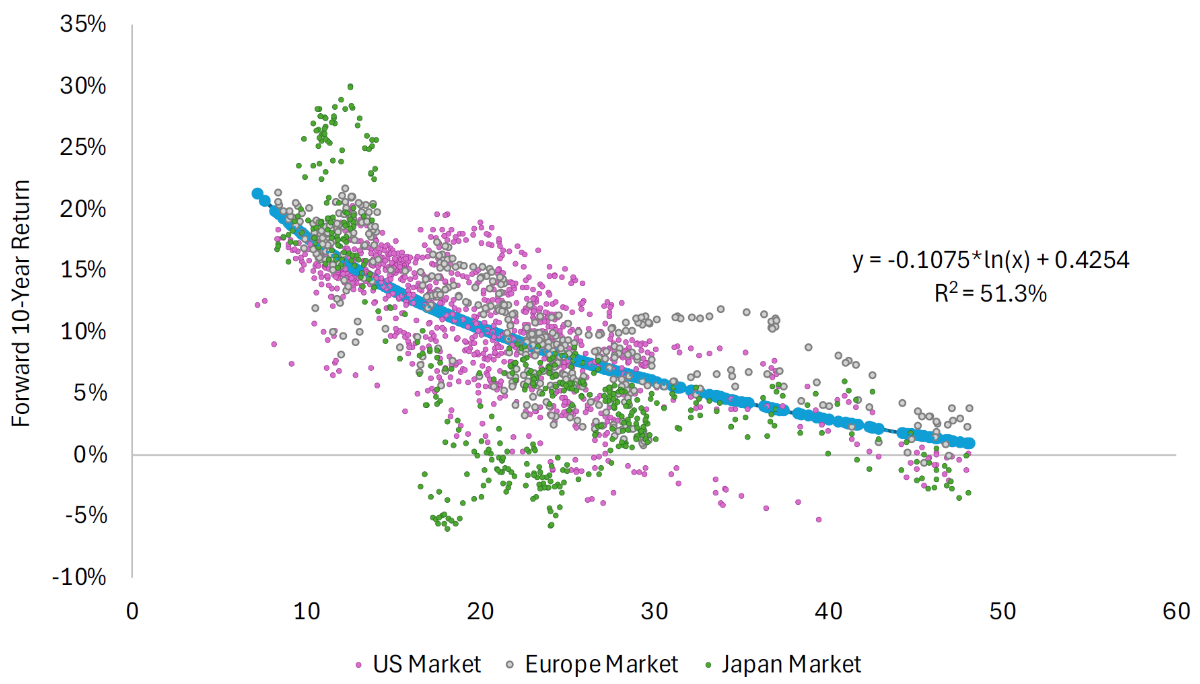
Source: Robert Shiller’s website and Ken French’s website. The regression function applies to the US market.

In addition to lowering expected returns, the expensive valuations in the US may also increase idiosyncratic risk in a portfolio through hyper-concentration in the biggest winners of the past decade. Consider a seemingly diversified index like the ACWI benchmark, which contains more than 2,750 large- and mid-cap stocks from around the world. This global index mechanically allocates two-thirds of capital to the United States, and within its developed market allocation, the United States has a weighting of almost 70%.

Figure 3: MSCI ACWI Allocations (June 30, 2024)
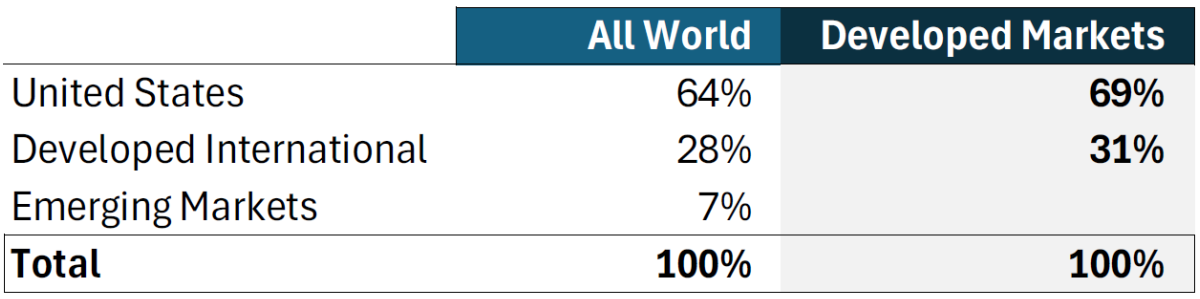
Source: MSCI.

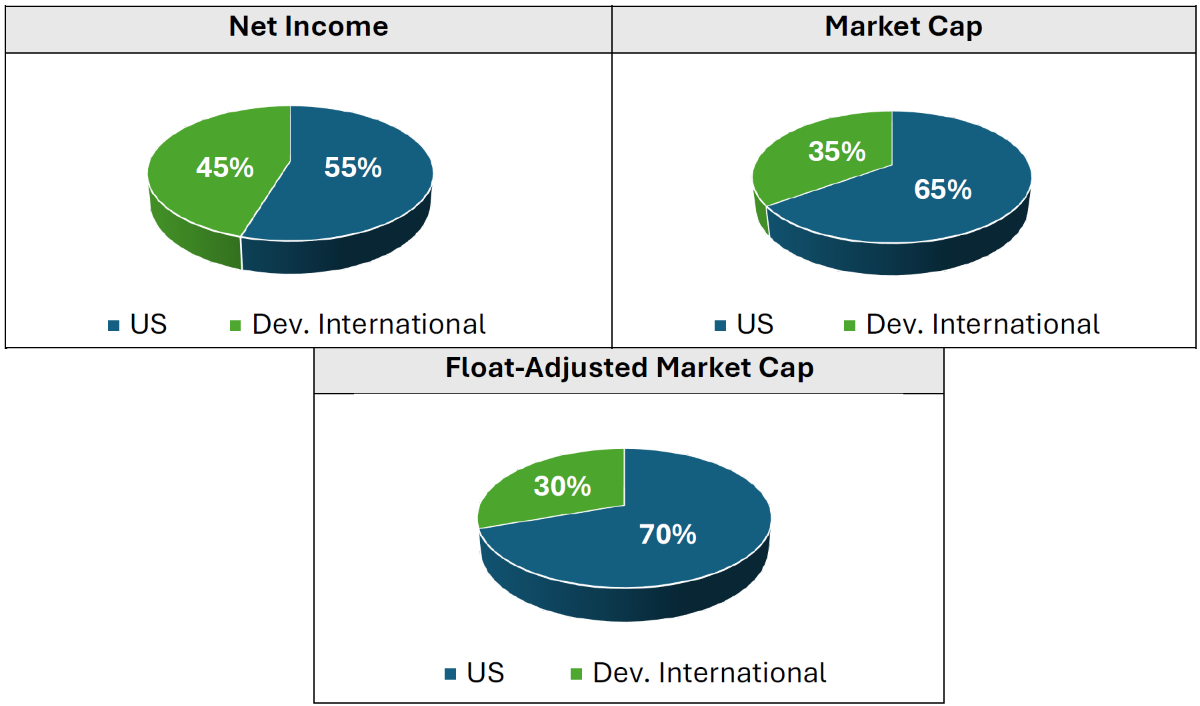
To understand why a 70% US allocation may not be the optimal choice for a typical investor in developed markets, it’s important to trace how the ACWI Index arrived at this allocation in the first place. At a fundamental level, equity ownership entitles investors to a portion of companies’ future net income. If we start at this elementary level and sort all developed-market stocks by the net income they generated over the past 12 months, we find that 55% of net income was generated by US firms and 45% was generated by firms in developed international markets. So if an investor were to allocate capital according to where income is being generated today, they would have 55% of their developed equity capital in the US and 45% allocated to international markets.

But financial markets are forward looking. So, in addition to considering trailing earnings, market participants also account for growth expectations when setting prices. Because growth expectations are higher in the US relative to international regions, aggregate market capitalization is significantly larger in the United States. Therefore, based on relative growth expectations, the US allocation within a developed market portfolio increases by 10 percentage points to 65% when companies are sorted by market capitalization.

An implicit assumption behind this market-weighted approach is that analysts are accurate in forecasting earnings growth. But empirical evidence suggests that, on average, analyst forecasts are no better than nominal GDP estimates when forecasting earnings growth over long-term horizons.

Figure 4: Developed Market Allocations by Weighting Methodology (July 2024)
Source: S&P Capital IQ.

Beyond the doubtful accuracy of long-term growth forecasts, commercial indices further orient investors toward questionable allocations by focusing on float-adjusted market capitalization. This means more weight is given to stocks that have a higher proportion of shares available to trade freely on the stock exchange, as opposed to the strategic ownership stakes held by founders and other company insiders. The reason commercial indices prioritize free float is because they are designed for deploying capital at massive scale, especially for the likes of Vanguard and BlackRock. And it also happens to be the case that US firms tend to have a higher proportion of free float relative to their international peers in Europe and Japan. Therefore, the free-float adjustment further exacerbates the bias toward high-expectation US stocks, raising the US allocation by 5 percentage points to a 70% weight when developed market stocks are sorted by float-adjusted market cap.

Fortunately, there are other benchmarks available to investors who are skeptical of lofty growth expectations and aren’t massive enough to be comparable to State Street. For example, investors could start by setting their regional weights according to net income generation (i.e., 55% weight in the US and 45% in developed international markets). Notably, this starting point offers more balanced allocations while still acknowledging the principal role of the United States as an economic engine.

By setting regional weights according to net income, rather than float-adjusted market cap, investors would also benefit from capturing more attractive valuations in international regions. As shown in the chart below, international markets trade at a substantial discount to the US, across multiple measures of value. And within the cheapest segment of each market, valuations are especially attractive internationally, with P/E ratios averaging around 10–13x and Price/Book ratios averaging around 1.1–1.4x across all levels of capitalization.

Figure 5: Global Valuations (July 2024)
Source: S&P Capital IQ.

We believe more balanced allocations across regions would enable investors to increase expected returns within their equity portfolios. Based on current levels of the CAPE ratio, the Nobel laureate economist Robert Shiller estimates that nominal expected returns over the next decade are around 5.2% in the US market, compared to 6.7% in the European market and 6.8% in the Japanese market.

While the US market has dominated over the past decade, an encore may not necessarily follow over the next decade. Growth narratives that previously seemed inevitable can quickly change when faced with reality. For example, consider how the “magnificent seven” has recently shrunk to the “magnificent six,” with Tesla down 14% year-to-date as expectations for electric vehicle growth have moderated. Only 12 months ago, auto industry forecasts by S&P Global were projecting 38% annual growth in EV production in 2024. But in July of 2024, that same forecast was slashed by more than half to 14% growth. Perhaps more concerning for those who bet on EV growth, there are indications that hybrids may play a larger role in the energy transition than previously anticipated, with many car manufacturers announcing new hybrid models and some moving toward flexible architectures that would continue their production of internal combustion vehicles indefinitely, alongside hybrids and EVs. Cars that are at least partially powered by fossil fuels may not become obsolete at all.

If this downward revision in growth expectations could occur among EVs, which are subsidized (and in some cases mandated), we believe a similar reality check could occur with current expectations for artificial intelligence. Relative to the US, international markets are less exposed to the AI expectation frenzy. So when considering a benchmark for their global developed equity portfolio, investors may be well served by balanced allocations that are based on net income generation, with around 55% weight in the US and 45% internationally.

Disclaimers: This does not constitute an offer, solicitation or recommendation to sell or an offer to buy any securities, investment products or investment advisory services. This information generated by the charts, tables, and graphs presented herein is for general informational and general comparative purposes only. This document may contain forward-looking statements that are based on our current beliefs and assumptions and on information currently available that we believe to be reasonable, however, such statements necessarily involve risks, uncertainties and assumptions, and investors may not put undue reliance on any of these statements. References to indices or benchmarks herein are for informational and general comparative purposes only. Indexes are unmanaged and have no fees or expenses. An investment cannot be made directly in an index. The information in this presentation is not intended to provide, and should not be relied upon for, accounting, legal, or tax advice or investment recommendations. Each recipient should consult its own tax, legal, accounting, financial, or other advisors about the issues discussed herein.

Members, log in below to access the restricted content.

Not a member?

Thank you for your interest.  Please note that MOI Global is closed to new members at this time. If you would like to join the waiting list, complete the following form:

The Market for Obesity Drugs, and Some Thoughts on Wegovy

October 14, 2024 in Diary, Equities, European Investing Summit, Letters

This article is authored by MOI Global instructor Stuart Mitchell, investment manager at S. W. Mitchell Capital, based in London.

Stuart is an instructor at European Investing Summit 2024.

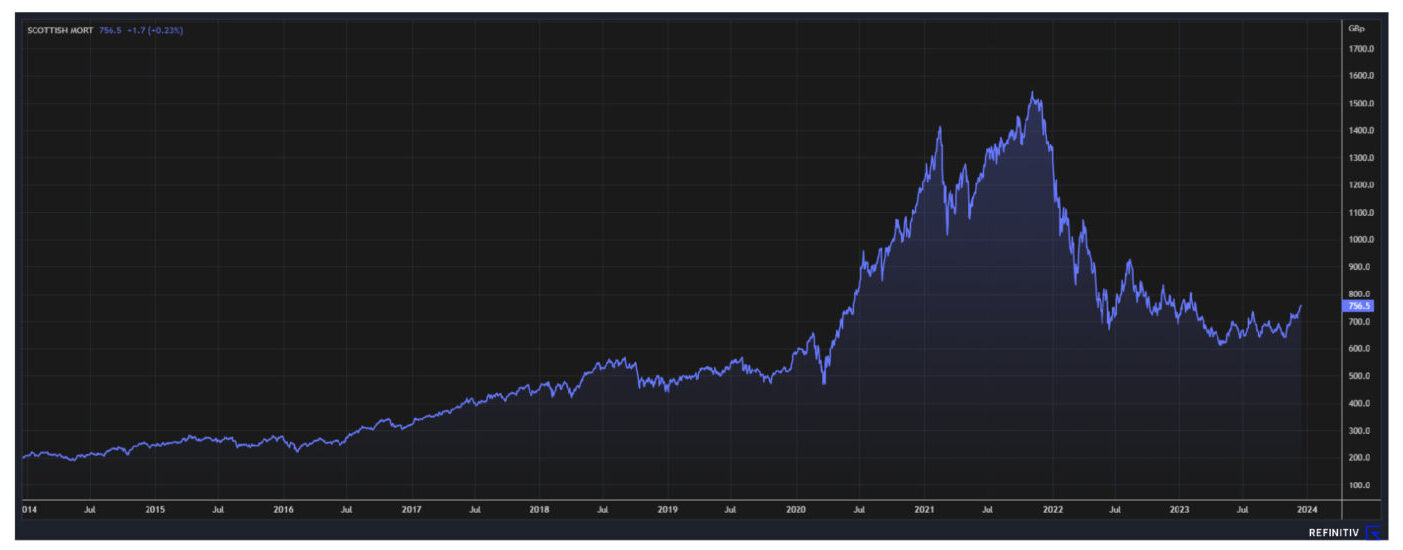
Over the last ten years markets have been characterised by unusually low interest rates and all sorts of resulting distortions in capital markets. In the equity world, the dash to speculative technology and growth-at-any-price has led to an extraordinary boom and bust of fund managers like Cathie Wood and Baillie Gifford.

The Scottish Mortgage Trust share price

Source: Refinitiv

But even now, seventeen months into a tightening cycle, investors continue to be lured into new bubbles dreaming that they have found another Nvidia.

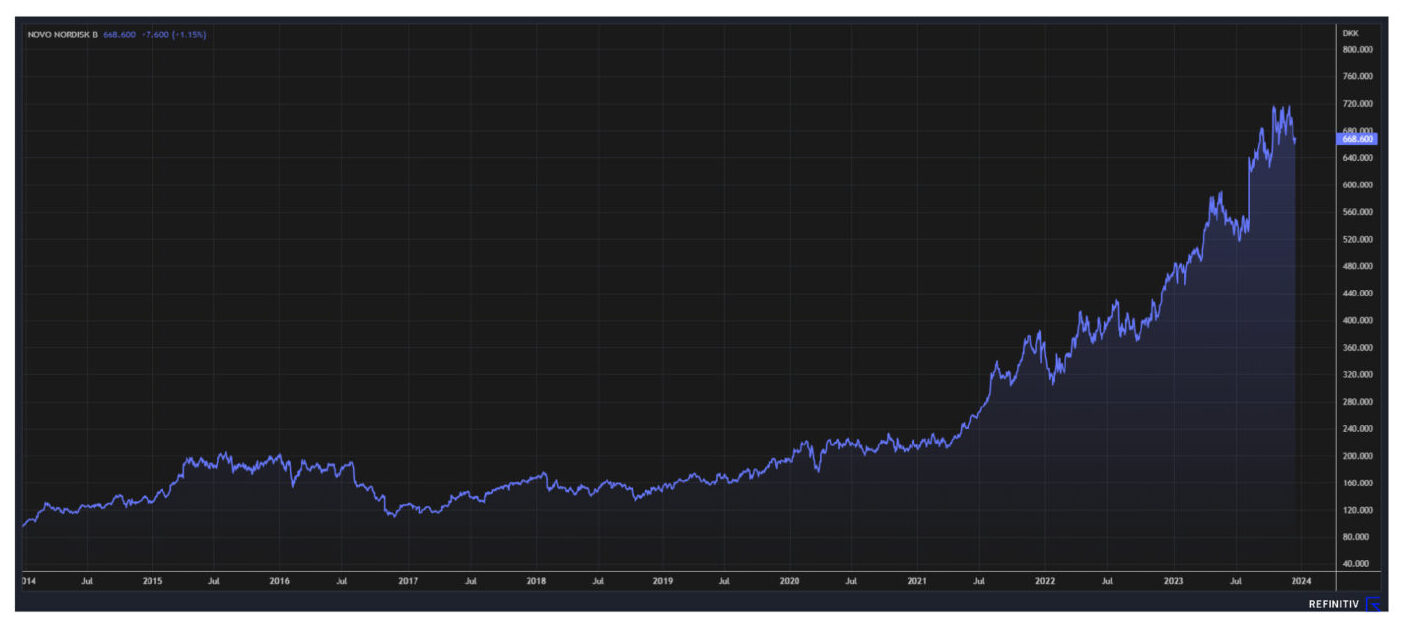
One such bubble may well be Novo Nordisk. The share price has risen by almost three times over the past two years driven by expectations for their anti-obesity drug Wegovy.

Novo Nordisk share price

Source: Refinitiv

So what is Wegovy? Wegovy is the weight loss brand name for Semaglutide that was originally developed by Novo to treat type 2 diabetes in 2012.

Wegovy is a glucogen-like peptide-1 receptor agonist (GLP-1) that mimics the incretin glucagen-like peptide-1 to increase the production of insulin and lower blood sugar levels. The effect is to lower appetite and slow down the process of digestion in the stomach. The STEP1 trial published in 2022, ‘revealed an average 14.9% reduction in bodyweight from baseline during 68 weeks of treatment with semaglutide 2.4 mg plus a lifestyle intervention, compared with just a 2.4% reduction in the placebo plus lifestyle intervention group.’

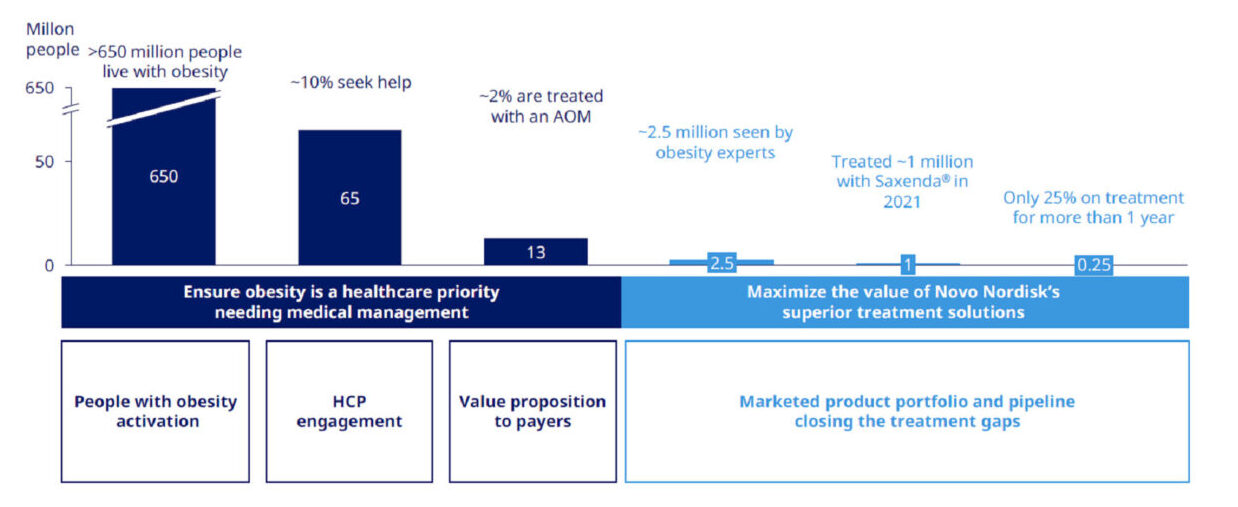
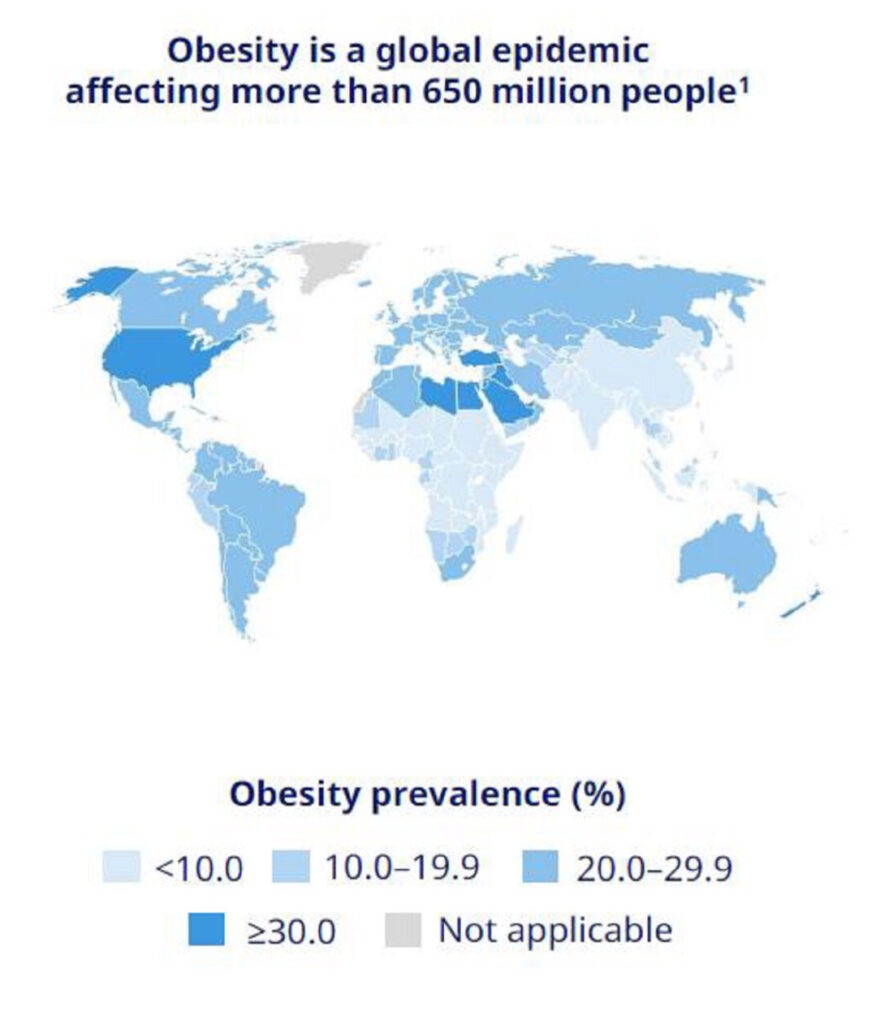
With so many obese people in the world the opportunity for the drug appears to be very significant.

Source: Handelsbanken

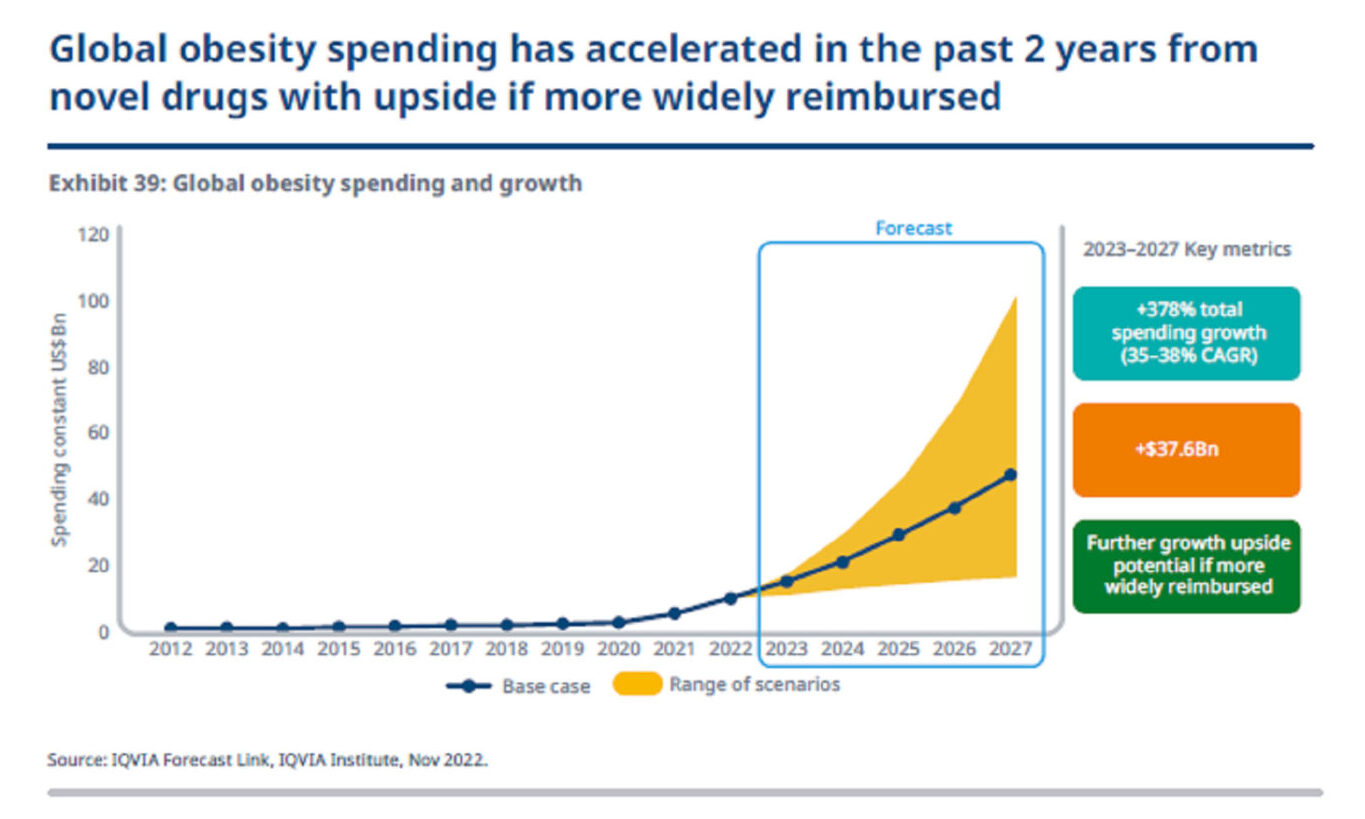
The consensus for analysts is that GLP-1 sales will reach $100 billion by 2031 and that Novo will command a 45% market share.

But is this realistic? We are sceptical for a number of reasons.

Let’s us just try to use our common sense for a moment…

1/ Are we really going to prescribe $100 billion of drugs for conditions that can be largely remedied by eating less and doing more exercise.

2/ And is it likely that the GLP-1 market is going to be two-thirds the size of the $164 billion cancer industry. A disease that kills and can’t be cured by eating less and exercising more…

3/ Looking at it another way, the world’s largest selling drug in 2022 was HUMIRA with $21.6 billion sales. HUMIRA is a monoclonal antibody used to treat all sorts of miserable conditions such as rheumatoid arthritis, ankylosing spondylitis and Crohn’s disease. Can it really be correct that Novo’s GLP-1 sales will be almost twice large.

4/ Many say that it will reduce the incidence of heart disease and lead to significant cuts in heart related healthcare spending. The problem, however, is that once you stop taking Wegovy you rapidly put the weight back on. At $1,350 per month (US list price) are you really going to take Wegovy for life and suffer all the side-effects (more anon…). And at best maybe you delay by a few years the incidence of heart disease. But that cohort may well become susceptible to the more-expensive-to-treat cancer as they live longer?

But the enthusiasts among you will say that I am just a fat-denier?

Well let’s go into the detail…

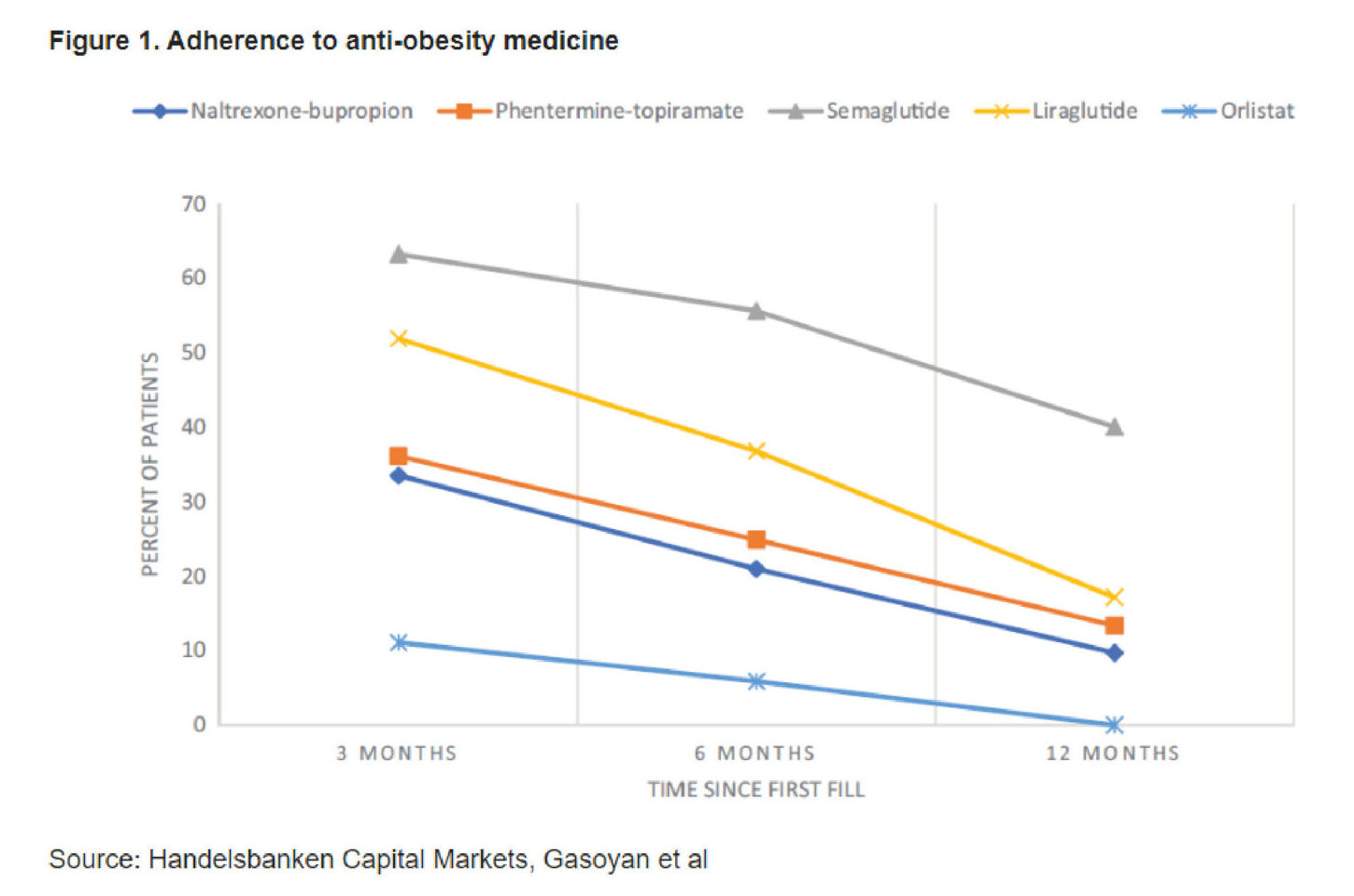
5/ And this is important. Novo Nordisk say that patients are most likely to take the drug for four years. Independent research suggests something very different. A recently published Obesity Society study into ‘Early-and later-stage persistence with antiobesity medications’ link found that only 19% of patients remained on treatment after one year. Wegovy had the highest one-year persistence but still only 40% remained on the treatment after one year. Novo has said that they will present stay time data for Wegovy sometime in 2024…

6/ As we mentioned, most analysts expect Novo to have a 45% market share of the GLP-1 market (67% of expected 2028 Novo sales). But at the last count, there are currently 74 drugs in development…So many that Johnson and Johnson’s CEO, Joaquin Duato, said that ‘it’s too crowded for us’.

7/ But even if the market was to remain dominated by Novo and Lily, the Lily molecule seems to be more effective. A recent study into the ‘Comparative Effectiveness of Semaglutide and Tirzepatide for Weight Loss in Adults with Overweight and Obesity in the US’ link showed that the Lily drug was ‘significantly more likely to achieve 5%, 10% and 15% weight loss and experience larger reductions in weight at 3, 6, and 12 months’.

Source: Handelsbanken

8/ An this is where it gets interesting. Did you know that 75% of all anti-obesity drug users are women? So we may well be looking at a market that is somewhat smaller than thought. Have a look at the BBC documentary The Skinny Jab Uncovered link. You may be surprised to learn that Semaglutide is freely available at knock-down prices in beauty salons across the country. There are even Tiktokers who sell it?! Have a look at the Forbes article link.

9/ So that leads us to the question of pricing. Budget Semaglutide seems to be freely available at an 80% or so discount to prescribed Wegovy. This must somehow undermine the price of the drug? In addition, The Inflation Reduction Act gives the power to the US government to negotiate prices for the largest Medicare drugs from 2026. But before then a ‘maximum fair price’ will be set for Wegovy in February 2024 which some analysts believe could lead to a greater than 25% price reduction.

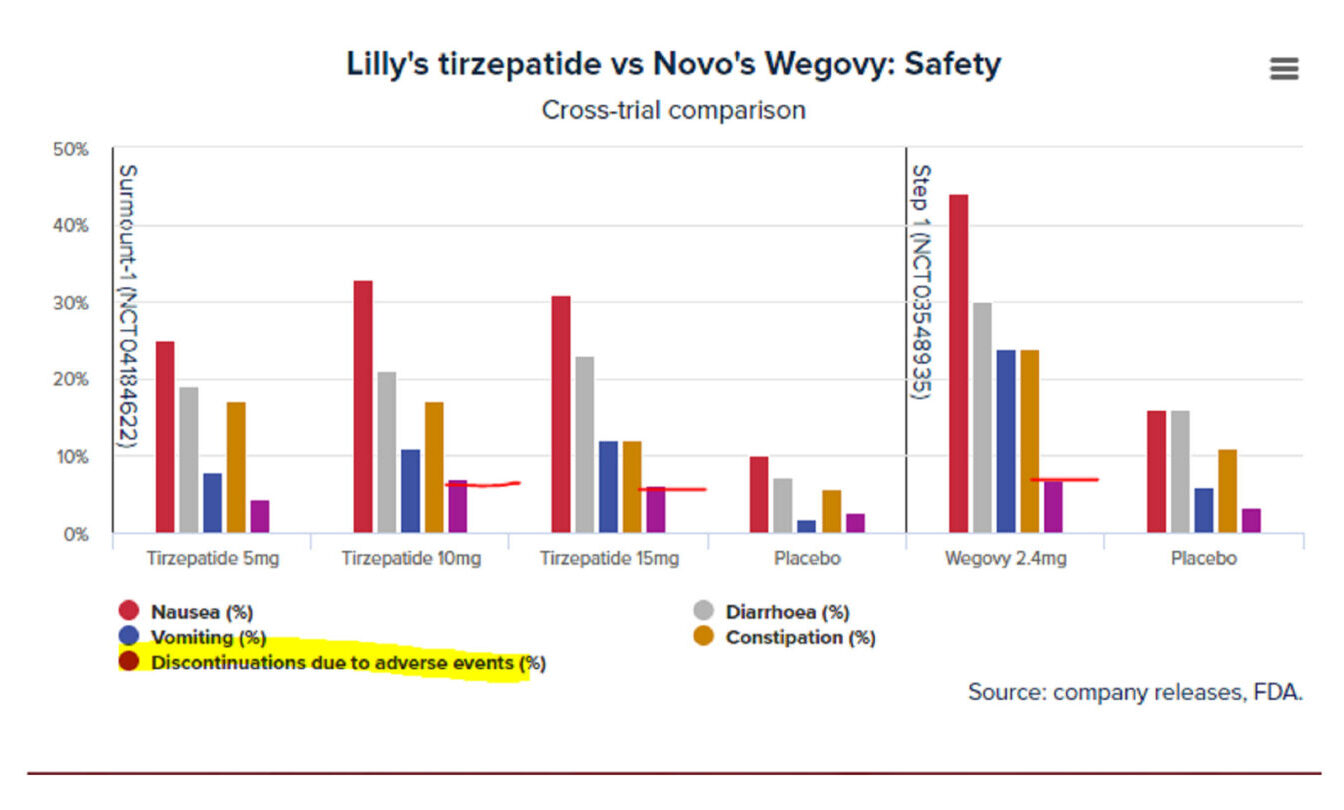
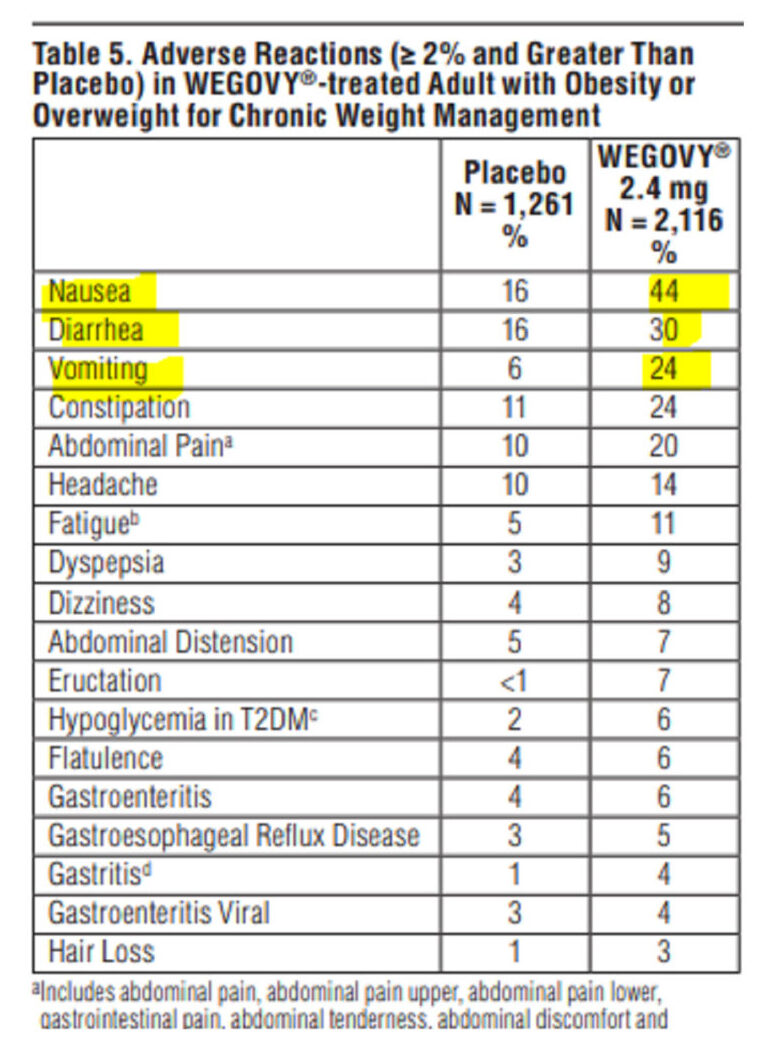
10/ And we haven’t got to the side-effects yet. Wegovy and other GLP-1’s are linked to nausea, vomiting and diarrhoea.

Source: Handelsbanken

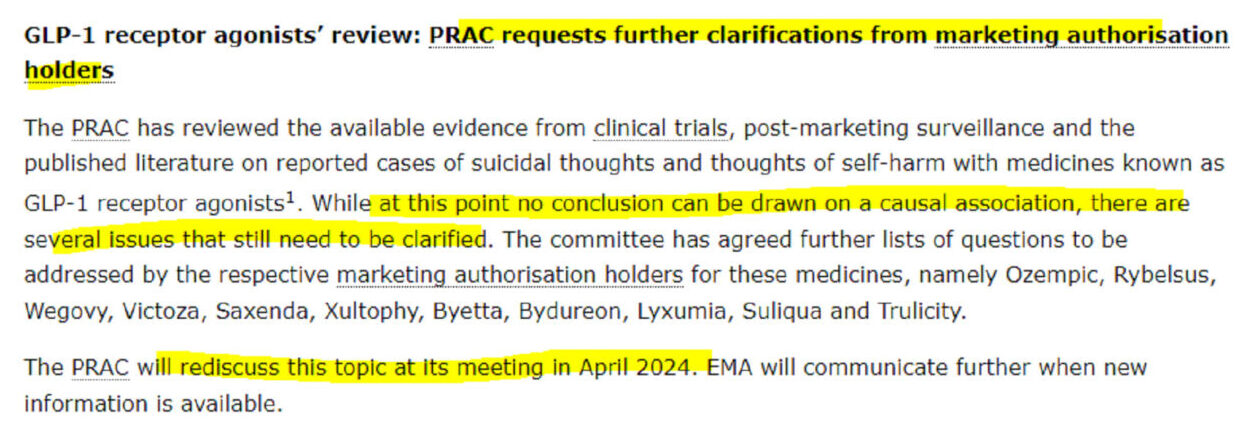
There may also be a risk of thyroid cancer and suicidal thoughts. The FDA has received 265 reports of suicidal behaviour from patients taking GLP-1’s since 2010.

Source: Handelsbanken

11/ So how big will the GLP-1 drug market really be? The modelling is fiendishly complex but for all the reasons that we discussed the market is likely to be a lot smaller than consensus forecasts of $100 billion sales. A leading in life science consulting IQVIA, estimated that the market could be worth anything between $17 billion and $100 billion.

Source: Handelsbanken

Let’s say that stay rates are a year (not four), that Novo end up with say a 10% market share, that the cohort is predominantly female and that pricing is lower than expected…Then hey-presto Semaglutide could end up as $5-10 billion blockbuster. Still a big drug but not the $47 billion mega-drug that many expect.

Members, log in below to access the restricted content.

Not a member?

Thank you for your interest.  Please note that MOI Global is closed to new members at this time. If you would like to join the waiting list, complete the following form:
Disclaimers: This does not constitute an offer, solicitation or recommendation to sell or an offer to buy any securities, investment products or investment advisory services. This information generated by the charts, tables, and graphs presented herein is for general informational and general comparative purposes only. This document may contain forward-looking statements that are based on our current beliefs and assumptions and on information currently available that we believe to be reasonable, however, such statements necessarily involve risks, uncertainties and assumptions, and investors may not put undue reliance on any of these statements. References to indices or benchmarks herein are for informational and general comparative purposes only. Indexes are unmanaged and have no fees or expenses. An investment cannot be made directly in an index. The information in this presentation is not intended to provide, and should not be relied upon for, accounting, legal, or tax advice or investment recommendations. Each recipient should consult its own tax, legal, accounting, financial, or other advisors about the issues discussed herein.

Tesis de Inversión en Atkore

October 14, 2024 in Ideas de inversión, MOI Global en Español

NOTA DEL EDITOR: La siguiente idea de inversión es obtenida de una carta trimestral de BrightGate Focus.

* * *

Atkore [NYSE: ATKR], con sede en Illinois, es una empresa dedicada a la fabricación y distribución de una amplia gama de productos, incluyendo conductos metálicos y no metálicos, sistemas de gestión de cables, tuberías y soluciones de protección contra incendios. Los mercados finales de Atkore están relacionados mayoritariamente con la industria de la construcción no residencial (aunque también cuenta con exposición a los mercados residenciales), con exposición a sectores tan variados como la construcción, la industria, la energía y el transporte.

Miembros, inicien sesión abajo para acceder al contenido restringido.

¿No eres miembro?

Gracias por tu interés. Ten en cuenta que MOI Global está cerrado para nuevos miembros en este momento. Si deseas unirte a la lista de espera para miembros hispanos, completa el siguiente formulario:


El impacto de la valoración en la bolsa

October 11, 2024 in Miscelánea, MOI Global en Español

NOTA DEL EDITOR: El siguiente texto es obtenido de una carta trimestral de los fondos de Bestinver.

* * *

Los múltiplos de valoración son abreviaturas utilizadas por los inversores para estimar el valor de una compañía en relación con sus resultados financieros. Piense en el más famoso de todos, el PER, una medida que indica cuánto están dispuestos a pagar los inversores por los beneficios que genera una empresa. Se calcula dividiendo su valor en el mercado (un precio que debería reflejar el valor presente de los resultados que va a obtener el negocio en el futuro), entre los beneficios que la empresa genera hoy. No hace falta ser un lince para darse cuenta de que el PER compara un numerador que representa el largo plazo con un denominador que considera sólo el corto plazo.

Miembros, inicien sesión abajo para acceder al contenido restringido.

¿No eres miembro?

Gracias por tu interés. Ten en cuenta que MOI Global está cerrado para nuevos miembros en este momento. Si deseas unirte a la lista de espera para miembros hispanos, completa el siguiente formulario:


El éxito de NVIDIA

October 7, 2024 in Ideas de inversión, MOI Global en Español

NOTA DEL EDITOR: La siguiente idea de inversión es obtenida de una carta semestral a los inversores de Buy & Hold Gestión de Activos.

* * *

Parece claro que la revolución de la IA es principalmente un enorme éxito para Nvidia [NASDAQ: NVDA], cuyo CEO, Jensen Huang, había estado pronosticándola desde hace una década. La IA es posible por la enorme reducción en el coste de computación generado por las GPU (tarjetas/unidades de procesamiento gráfico) en las que esta compañía fue pionera y es actualmente la líder indiscutible. Al contrario que las CPU (tarjetas/unidades de procesamiento central), que constituyen la inteligencia de los sistemas de computación y realizan tareas secuenciales, las GPU permiten el tratamiento en paralelo de una gran cantidad de cálculos sencillos. Las GPU originalmente se utilizaron para la gestión de los píxeles que forman las imágenes en la industria de los videojuegos, pero posteriormente se ha demostrado que son muy útiles aplicadas a la mejora de la computación con fines estadísticos e inductivos, es decir, para la búsqueda de patrones predictivos de IA.

Miembros, inicien sesión abajo para acceder al contenido restringido.

¿No eres miembro?

Gracias por tu interés. Ten en cuenta que MOI Global está cerrado para nuevos miembros en este momento. Si deseas unirte a la lista de espera para miembros hispanos, completa el siguiente formulario:


The Challenge of Choosing a Company for a Multi-Decade Investment

October 4, 2024 in Diary, Equities, European Investing Summit, Letters

This article is authored by MOI Global instructor Ole Soeberg, founder of Nordic Investment Partners, based in Copenhagen.

Ole is an instructor at European Investing Summit 2024.

Looking at companies that have been winners over the past 10, 20 or 80 years it’s easy to see what have driven their performance. Identifying outperforming businesses for coming generations is much more difficult than finding potential winners for the next 5 to 10 years.

Long-term investing is very challenging

In early September 2024, I was reading a September 1944 issue of the New York Times. In the Business section, I came across a news brief about PepsiCola Company announcing a 2-for-1 stock split. After the split, PepsiCola would have 7.5 million shares outstanding. On that September day in 1944, PepsiCola had a market cap of $112 million. Fast forward 80 years to 2024, and Pepsi has a market cap of $233 billion and 1.35 billion shares outstanding. The annualized CAGR, excluding dividends, has been 10% since 1944. In hindsight, it’s easy to see that PepsiCola was a good investment.

However, the 1944 NYSE list was full of companies that no longer exist or have merged into other companies listed today. So, how do you find a company that will not only be around 80 years from now but also grow in value by 10% or more per year?

Which company would you invest in today and keep for generations?

Which company would you buy shares in today (2024) to hold and pass on to future generations, who would then reap the financial benefits of your foresight 80 years from now?

It’s really hard to predict which businesses will thrive over such a long-time span, as the average company tends to last only a few decades. In my valuation work, I only project 20 years forward and do not use terminal value after 20 years, as I believe corporate destiny (long-tailed terminal value periods) is arbitrary.

You can approach this by being rational and focusing on core essentials like housing, food, and other necessities, as they will continue to be in demand 80 years from now. A good housing location in a politically stable country will likely remain in high demand, but will it achieve a 10% CAGR like Pepsi?

Most investors have a horizon of just a few years and monitor fundamental performance and valuation along the way. Holding on for 80 years is outside the comfort and competence zone for most.

Current use of earth resources is not sustainable

A future oriented energy company could be worth holding for 80 years. I believe humans usage of planet Earth need to become more aligned to the sustainable use of our planet. And burning 300-400 million years old plants and biomass that have been in the ground under pressure and heat to become oil & gas in the current period is not a solid road into the next centuries.

Hence, we need to change our energy sourcing from fossil fuels to new sources. Solar, wind, hydro and nuclear all serves that path well and my pitch for MOI Global 2024 is Vestas, the global leader in wind turbines.

Energy sourcing is someday likely to come from fusion – same process as the Sun – and subsequently make current renewable energy sources obsolete. It is however still many years out, so for the next 10-20 years current renewable energy sources should be good.

Back to the mindset of most investors and the 80-year challenge. I would not bet Vestas Wind Systems is around a few years after fusion power or some other more potent power source becomes a reality.

Vestas: Self-help margin recovery story with a tailwind

Vestas is the idea I will present at European Investing Summit 2014, hosted by MOI Global.

Vestas is the world leader in wind power turbines and focused on Europe and North American markets. Due to an order book that did not appropriately incorporate higher costs for steel, transports etc, Vestas profitability plummeted as they had to shoulder the cost increases. All new contracts/order are made with better profitability and hence Vestas earnings are very likely to increase significantly in the coming years.

Vestas can probably work fine for the next 10-20 years as power from low carbon sources replace traditional fossil fuels, but its not a 80 year investment pitch.

Members, log in below to access the restricted content.

Not a member?

Thank you for your interest.  Please note that MOI Global is closed to new members at this time. If you would like to join the waiting list, complete the following form:
El Distanciamiento Económico Entre Estados Unidos y Europa

October 4, 2024 in Miscelánea, MOI Global en Español

NOTA DEL EDITOR: Este texto es obtenido de una carta trimestral a los inversores de Magallanes Value Investors.

* * *

Son múltiples las evidencias del distanciamiento entre dos de las mayores potencias económicas mundiales durante los últimos años, EEUU y Europa. Con una población similar de 330 millones de habitantes los americanos frente a 440 los europeos, y unos tamaños de riqueza casi idénticos en 2007, alrededor de 14,5 billones de dólares de PIB, hoy 16 años después, la economía norteamericana ha casi doblado su tamaño hasta los 27,5 billones frente a una Europa que consigue un exiguo 25% acumulado durante dicho período.

Obviamente los mercados financieros se han hecho eco. La buena marcha de la bolsa americana frente a la europea ha sido una constante año tras año, llegando a niveles realmente sorprendentes. Entre una de tantas anécdotas, el fabricante norteamericano de chips NVIDIA alcanzó los 3,3 billones de dólares de tamaño bursátil, superando el valor de todas las empresas cotizadas en Alemania, Francia y Reino Unido.

Miembros, inicien sesión abajo para acceder al contenido restringido.

¿No eres miembro?

Gracias por tu interés. Ten en cuenta que MOI Global está cerrado para nuevos miembros en este momento. Si deseas unirte a la lista de espera para miembros hispanos, completa el siguiente formulario:


Ted Seides Shares Insights from His Book, Private Equity Deals

October 2, 2024 in Audio, Full Video, Interviews, Podcast, Private Equity, Transcripts

We had the pleasure of speaking with Ted Seides, author of Private Equity Deals: Case Studies of Dealmaking from Capital Allocators.

Members, log in below to access the restricted content.

Not a member?

Thank you for your interest.  Please note that MOI Global is closed to new members at this time. If you would like to join the waiting list, complete the following form:
About the book:

Over the past 20 years, the private equity industry went from a cottage industry to a powerful juggernaut that touches every corner of the global economy. Totalling $5 trillion of investments, private equity constitutes an important investment allocation for public and corporate pension funds, university endowments, non-profit foundations, hospitals, insurance companies, families, and sovereign wealth funds worldwide. There’s no more important sector of institutional portfolios or the global economy to understand than private equity. Private equity owned businesses are everywhere around us and touch every aspect of our daily lives. In Private Equity Deals, Ted Seides gives you an insight to the conversations that typically happen behind the closed doors of institutional investors and private equity managers. Through a series of case studies across different types of private equity transactions, Private Equity Deals shares the dynamics of deal making, companies, and ownership that make private equity a force in the world.

About the author:

Ted Seides, CFA is the founder of Capital Allocators, an ecosystem that includes podcasts, gatherings, and advisory. Ted launched the Capital Allocators podcast in 2017. The show reached 20MM downloads as of August 2024 and has been recognized as the top institutional investing podcast. Alongside the podcast, Ted created Capital Allocators Summits with friend and industry veteran Rahul Moodgal to bring together industry leaders to connect and learn. He developed Capital Allocators University to teach senior professionals non-investment disciplines that are essential to investment success. He also advises managers on business strategy and allocators on investment strategy. In March 2021, Ted published his second book, Capital Allocators: How the world’s elite money managers lead and invest that distills key lessons from the first 150 episodes of the podcast. In October 2022, he was honored as Citizen of the Year at With Intelligence’s inaugural Allocator Prizes.

From 2002 to 2015, Ted was co-founder of Protégé Partners LLC and served as President and Co-Chief Investment Officer. Protégé was a leading multibillion-dollar alternative investment firm that invested in and seeded small hedge funds. In 2010, Larry Kochard and Cathleen Rittereiser profiled Ted in the book Top Hedge Fund Investors. In 2016, Ted authored his first book, So You Want to Start a Hedge Fund: Lessons for Managers and Allocators, to share lessons from his experience. Ted began his career from 1992-1997 under the tutelage of David Swensen at the Yale University Investments Office. During his five years at Yale, Ted focused on external public equity managers and internal fixed income portfolio management. Following business school, he spent two years investing directly in public and private equity at three of Yale’s managers, Brahman Capital, Stonebridge Partners, and J.H. Whitney & Company. With aspirations to demonstrate the benefits of hedge funds on institutional portfolios to a broad audience, Ted made a non-profitable wager with Warren Buffett that pitted the 10-year performance of the S&P 500 against a selection of five hedge fund of funds from 2008-2017. Ted writes a blog called What Ted’s Thinking and previously wrote columns for Institutional Investor, CFA Institute’s Enterprising Investor, the late Peter L. Bernstein’s Economics and Portfolio Strategy. He is a member of the Advisory Council for the Alliance for Decision Education and a participant in the Hero’s Journey Foundation. Ted previously served as Trustee and member of the investment committee at the Wenner-Gren Foundation, Trustee and head of the Programming Committee for the Greenwich Roundtable, and an Advisory Board member of Citizen Schools-New York.

Ted graduated Cum Laude from Yale University and received an MBA from Harvard Business School.

The content of this website is not an offer to sell or the solicitation of an offer to buy any security. The content is distributed for informational purposes only and should not be construed as investment advice or a recommendation to sell or buy any security or other investment, or undertake any investment strategy. There are no warranties, expressed or implied, as to the accuracy, completeness, or results obtained from any information set forth on this website. BeyondProxy’s officers, directors, employees, and/or contributing authors may have positions in and may, from time to time, make purchases or sales of the securities or other investments discussed or evaluated herein.

MOI Global