Register for LIVE Sessions at Best Ideas 2019

January 7, 2019 in Diary

Best Ideas 2019 consists of more than a dozen live sessions and more than seventy sessions recorded in recent days. The live sessions take place on Thursday, January 10 and Friday, January 11.

Live sessions are typically available for replay within 24 hours. All session recordings and materials remain accessible to members for an unlimited time.

Members, log in below to access the restricted content.

Not a member?

Thank you for your interest.  Please note that MOI Global is closed to new members at this time. If you would like to join the waiting list, complete the following form:

return to main conference area

Best Ideas 2019 — Agenda

January 7, 2019 in Diary

Best Ideas 2019 consists of more than a dozen live sessions and more than seventy sessions that have been recorded in recent days. The live sessions take place on Thursday, January 10 and Friday, January 11. The recorded sessions will be released on January 10-12 based on the agenda below.

register for live sessions return to conference

(The times shown are based on Eastern Standard Time — New York.)

Members, log in below to access the restricted content.

Not a member?

Thank you for your interest.  Please note that MOI Global is closed to new members at this time. If you would like to join the waiting list, complete the following form:

Fernando Bernad sobre invertir en renta variable

January 7, 2019 in Miscelánea, MOI Global en Español

NOTA DEL EDITOR: Este texto es obtenido de una carta trimestral de azValor Asset Management.

* * *

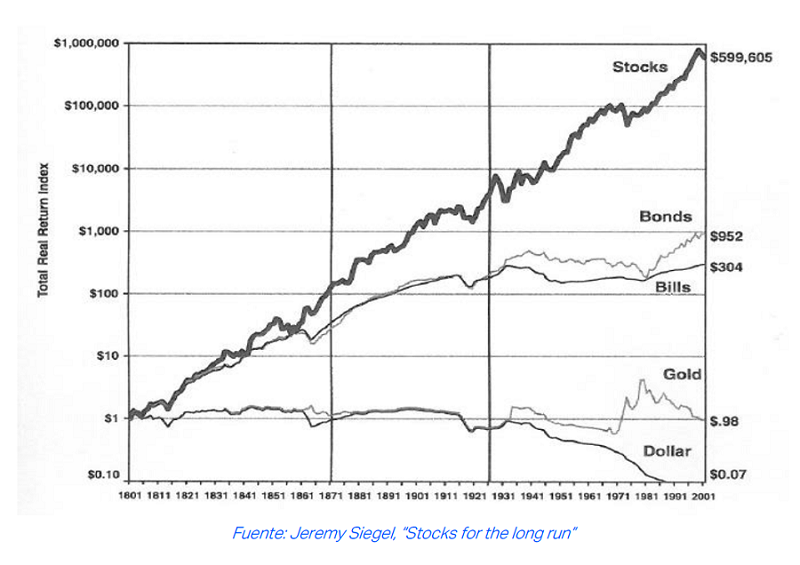
Desde Azvalor siempre hemos defendido la renta variable como la mejor clase de activos para capitalizar el ahorro a largo plazo. Esto resulta fácil de comprender para cualquier observador de su trayectoria. Como bien documenta y explica el libro de Jeremy Siegel, Stocks for the long run, la bolsa ha generado históricamente una rentabilidad acumulada muy superior al resto de activos. Además, esto se verifica casi para cualquier período a largo plazo que hubiéramos elegido durante los últimos 200 años. El siguiente gráfico es realmente claro en este sentido (rentabilidad real acumulada de las diferentes clases de activos en EE.UU.).

A pesar de ello, la renta variable “brilla por su ausencia” en el patrimonio de la mayoría de los ciudadanos. En España, por ejemplo, supone un exiguo 2,8% del ahorro total neto. Incluso si nos referimos solo al patrimonio financiero (muchos ciudadanos no tienen una gran capacidad de ahorro más allá del necesario para adquirir el activo por excelencia, el inmobiliario, la vivienda), su peso es un mero 8%, una fracción de lo que suele dedicarse al saldo en cuenta corriente o a títulos de renta fija, activos que se han demostrado claramente inferiores. En otros países las proporciones cambian, pero la idea esencialmente se repite.

Cabe preguntarse, entonces, ¿por qué es esto así? ¿Qué reticencia suscita la renta variable al ahorrador medio?

Creo que la clave reside en la “dificultad” que entraña invertir en renta variable. Esta dificultad no consiste en que exige conocimientos y gran dedicación, pues siempre se puede delegar en un profesional de la inversión (lo que aconsejo) o invertir en un vehículo de gestión pasiva que replique la rentabilidad de un índice. En mi opinión, la naturaleza de dicha dificultad es más de corte emocional. Efectivamente, para recoger los atractivos frutos que ofrece exige del ahorrador algo a cambio, que “ponga algo encima de la mesa”. Ocurre que la naturaleza del mercado es que esos frutos “se hacen rogar” y ponen a prueba constantemente los nervios y el carácter del inversor. Piénsese que, aunque la rentabilidad a largo plazo es indiscutiblemente positiva y superior a otras alternativas, el día a día se podría decir que es todo lo contrario. Como bien demostró el estudio de un reputado matemático y gestor de hedge funds, Robert Frey, en los últimos 180 años el mercado más importante del mundo, la bolsa de EEUU, está un 75% del tiempo en pérdidas desde su anterior máximo. Incluso si quisiéramos trazar una línea imaginaria al período de posguerra mundial, el resultado no mejora mucho. Desde 1950 el 66% del tiempo se encuentra en pérdidas. Y un 50% del tiempo se encuentra en pérdidas del 5%. Lo que es aún más doloroso, un 40% del tiempo se encuentra un 20% por debajo de su anterior máximo (en el siguiente gráfico se reflejan dichos datos, donde las áreas rojas representan caídas desde los anteriores máximos). A la luz de la evidencia, estoy de acuerdo con Frey cuando dice que el inversor en renta variable se encuentra la mayor parte del tiempo en un estado de “arrepentimiento”. Insisto en que lo anterior no contradice la idea de que la rentabilidad a largo plazo es claramente positiva. Los datos son los mismos.

Continue reading »

Banking in Eastern Europe

January 6, 2019 in Best Ideas 2019, Equities, Europe, Financials, Ideas

This article is authored by MOI Global instructor Steve Gorelik, Portfolio Manager at Firebird Management, based in New York.

In his book Value Investing: From Graham to Buffett and Beyond, Bruce Greenwald described the evolution of value investing from “net-net” asset-based analysis to a focus on franchise value and moats, a strategy popularized by Warren Buffett. Over the years, value investors as a group became more comfortable with paying for growth especially in companies with visible competitive advantages. The shift towards quality investing has accelerated in the last few years as many old economy companies did not adapt to a changing competitive landscape and therefore became value traps.

As the thinking of fundamentals-focused investors has evolved, a new holy grail has emerged – the “ Cheap Compounder.” Who wouldn’t want to own a company that grows earnings by reinvesting capital into its business at high incremental returns while also trading at a reasonable price? Unfortunately, in the age of near zero interest rates, these investments became as rare as non-tech unicorns. With that said, there is one area of the market where cheap compounders can be found in relative abundance allowing discerning investors to generate excess returns over time – Eastern European Banks.

Due to concerns about the impact of rising interest rates and other bank-specific events, a number of high quality financial institutions in the region have become much cheaper despite strong earnings growth and positive economic outlooks. At current prices, which are near the bottom of historical P/E and P/B ranges, the implied rate of return is 15-30%. Investing in banks can be frightening due to the leverage built into the business model, but the information below can help investors take advantage of this opportunity.

At Firebird Management, we have been investing in Eastern European banks for over twenty years with varying degrees of success. Despite a few setbacks, bank investments account for a significant portion of our long-term return and typically represent the largest sector exposure in our regional portfolios. The banks that turn out to be good investments generate value for years by compounding and reinvesting capital at attractive rates. We believe there are a few fundamental reasons for their success:

Growth – Many of the Eastern European countries are structurally underbanked with banking assets to GDP well below Western European levels. It is not unusual to see loan growth of 10- 20% due to high single digit nominal GDP growth which is compounded by the narrowing of the banking asset gap relative to the developed world. For example, in the country of Georgia, loans to GDP rose from 20% in 2006 to 57% in 2017, at an average growth rate of 23%.

Simple Business Models – Unlike Western institutions, high quality Eastern European banks generate earnings from simple lending and fee income, rather than derivative trading or excessive risk taking. They operate in an environment with net interest margins high enough to be the primary source of income, leading to double digit ROEs. In 2017, Russia’s largest bank, Sberbank, derived 71% of its revenues from net interest income. For JP Morgan, it was only 48%.

Accommodative Competitive Landscape – Prior to 2008, investing in Eastern European banks was an almost certain source of profitable growth for Western European institutions. As a result of acquisitions, Scandinavian, Italian, and Austrian banks currently control as much as 90% market share in the Czech Republic, the Baltic states, and elsewhere in the region. The Global Financial Crisis of 2008 exposed issues in the domestic balance sheets of the parent banks which forced them to repatriate cash and leave their Eastern European subsidiaries to fend for themselves. Locally owned SME lenders like Banca Transilvania in Romania and Siauliu Bankas in Lithuania used this opportunity to grow into the void opened by foreign banks withdrawing from the market. Since 2015, Western European institutions have started cautiously growing their books, but loan approval powers remain at the head offices in Stockholm or Vienna, keeping the banks at a disadvantage to local players who can provide faster decisions and better customer service.

Members, log in below to access the restricted content.

Not a member?

Thank you for your interest.  Please note that MOI Global is closed to new members at this time. If you would like to join the waiting list, complete the following form:

Best Ideas 2019 Preview: QAD Inc.

January 6, 2019 in Equities

This article is authored by MOI Global instructor Michael Morosi, Equity Portfolio Manager at MAPFRE AM, based in Madrid, Spain.

When most people think of the technology sector, often the first thoughts that come to mind are of the select few mega-cap companies that have impacted nearly every aspect of modern life. Or perhaps they think of the precursors of these giants, conjuring the image of two computer science geeks developing an innovative gadget in their parents’ garage. Alternatively, they may envision the modern incarnation of would-be CEOs pitching their hot startup idea to any venture capital investor who will listen. Underlying each of these examples is the assumption that technology and disruption are synonymous with exponential growth and sky-high valuations. However, often overlooked is the fact that the core technologies upon which today´s innovations are built have been around for over half of a century. Further, there are many segments of the technology sector that are in a decidedly more mature phase of their lifecycle. Often, the stable, cash-flowing companies that inhabit this part of the market are cast aside by investors in constant pursuit of the next Amazon. This dynamic can create very compelling investment opportunities for value-oriented investors.

MAPFRE AM’s Behavioral Fund, which seeks to generate long-term outperformance by exploiting persistent investor biases, recently invested in one such technology company. QAD, Inc. is a software firm that embodies both the qualities of an established company with a sizeable installed base of largely recurring customers and a nimble, fast-growing organization that is gaining share from larger, less responsive competitors.

Company Overview

QAD, Inc. is a Santa Barbara, California-based provider of enterprise resource planning (ERP) software to clients in six focused industry verticals – automotive, customer products, food and beverage, high-tech, industrial products and life sciences. ERP software is mission-critical technology that integrates all of a company’s business processes, including product planning, development, manufacturing, sales, and marketing, into a single database, application, and user interface.

QAD is a niche player in the $40 billion global market for ERP software, which is dominated by industry-agnostic players like SAP and Oracle. QAD targets global small- and medium-cap companies that have complex operations spanning multiple geographies and that value high-touch service and a flexible, industry-specific offering that SAP and Oracle cannot deliver. 70% of its customers are headquartered in the United States, but less than 50% of the company’s revenues come from the US because of the global nature of the operations of its 2,000 customers worldwide. Reference clients include automotive suppliers like Lear Corp and Adient plc, industrial concerns like Illinois Tool Works and Watts Water Technologies, and specialty chemical companies like Saft Groupe and Solvay SA.

QAD targets $330 million revenue in 2018 (+9% y/y), with a 30% contribution from subscription revenue, 25% from professional services, and 45% from legacy maintenance and license revenue. The company’s revenue growth is primarily driven by subscription revenue, which increased 36% y/y through the first three quarters of 2018. QAD generates low-50s gross margins, mid-single digit net income margins, and $20 million in annual free cash flow. The company’s market capitalization is approximately $800 million.

Investment Thesis

There are three pillars to MAPFRE AM’s investment thesis for QAD, Inc.: the company’s relentless focus on serving customers in its attractive niche market, ongoing subscription model transition, and long-term management orientation.

Product-Market Fit

QAD has carved out an attractive niche within the massive global ERP software market. It competes head-to-head with SAP and Oracle, as well as a host of smaller competitors, and wins based on industry fit and product features, speed-to-benefit, and cost. QAD’s industry vertical – even sub-vertical – orientation allows it to design and deliver products that are highly specified for the needs of its customers. The company is responsive to customer needs and invests continually in new functionality to stay ahead of slower moving competition.

Consistent with its nimble size – the company has 1,850 employees compared to SAP’s 95,000 – QAD also offers its customers attractive speed-to-benefit, with flexible deployments that avoid many of the pitfalls of the dreaded “ERP migration” that have caused the premature departure of many CIOs. The company’s purpose-built application architecture is structurally lower cost than the legacy ERP providers, allowing QAD to pass along the savings to their customers.

Further, the company continues to build on its unique customer offer through the next generation of its platform, Channel Islands, which was made generally available to all of its customers in September. Channel Islands increases the flexibility of QAD’s architecture and improves the user experience through a new interface built on HTML5, allowing customers to access the application from any device at anytime.

Subscription Model Transition

One of the biggest trends in technology over the past decade has been the movement from on-premise data infrastructure to cloud data infrastructure. Under the on-premise model, companies incurred significant costs for purchasing and maintaining large capacity of data servers and storage. When adopting a cloud model, companies are able to move from hosting and managing all of their data internally to outsourcing both the capex and maintenance to a third-party. Cloud service providers are able to capitalize on economies of scale to deliver better service at a lower cost, while guaranteeing effectively 100% uptime through redundancies and backup.

The business model of cloud service is entirely different, as well. The on-premise model involved selling enterprise software on a perpetual license basis, including a large one-time payment to purchase and deploy the software along with a much smaller ongoing maintenance package. On the other hand, cloud service is provided strictly on a recurring subscription basis. Customers typically sign contracts for a 3-5 year term, resulting in as much as a 4x increase in annual recurring revenue. This model results in a higher value, more predictable revenue stream, especially for companies offering products with very low churn rates, like QAD.

Software-as-a-Subscription (“SaaS”) transition stories have been a highly profitable investment thesis throughout this shift in the industry, as companies often saw their valuation re-rate from 2-3x to 6-10x revenue. Given the mission-critical nature of ERP software, this segment is the last of the major software categories to migrate to the cloud. However, now that companies have experienced the cost savings, reliability, and security in migrating lower-risk functions to the cloud like customer relationship management (CRM) and human resources management (HRM), Chief Information Officers at large- and mid-sized companies are ready to make the switch with ERP.

QAD’s subscription revenues have grown at a 37% five-year CAGR and are responsible for the re-acceleration of the company’s overall revenue growth. At the same time, after initially suffering from under-absorption of data center capacity, the company is just now achieving the scale necessary to deliver profitability in-line with other SaaS companies. Subscription gross margins have expanded over 20 points in the past five years, including eight points in the most recent quarter, increasing from 56% in 3Q17 to 64% in 3Q18.

Despite the material contribution of the subscription business to recent results, only 15% of customers have transitioned to the cloud model. We believe subscription revenues can maintain a 20-30% annual growth rate, and eventually the vast majority of the company’s revenue will come from its subscription business. While QAD’s revenue multiple has expanded from 1x to 2x over the past four years, when compared with SaaS peers in the 5-10x range, this re-rating trend has a way to go.

Long-Term Management Orientation

QAD was founded in 1979 and has been led by Karl and Pam Lopker, a husband and wife team of business and technology leaders. Sadly, Mr. Lopker, who was also a co-founder of highly successful consumer brand Deckers Outdoor Corporation, passed away earlier this year, though his outstanding leadership and impact on the company’s culture and the broader ERP industry endures. Mrs. Lopker, who has been instrumental in leading the company’s cloud transition and Channel Islands initiative, has assumed the sole CEO role. QAD’s founder-managed ethos has played a key role in the company’s go-to-market success and unified company culture. Attending a QAD user conference provides one insight into the strong community and devotion to the product of both QAD and its loyal customer base.

Additionally, Mrs. Lopker holds 5.6 million Class A shares and 2.4 million Class B shares, representing over 40% of the economic interest and 65% of the voting rights in QAD. While the long-term interests of shareholders are clearly aligned with management, the dual-class shareholding structure does imply management retains the voting rights to block any potential acquisition offer.

Valuation

QAD’s ongoing transition to a cloud company remains under-appreciated by investors. The relatively limited float and sell-side coverage contribute to the exceptional value opportunity. Our approach to valuing QAD is comprised of four components: high-growth subscription business, net present value of high-margin legacy license software cash flow, net cash, and hidden asset value.

Members, log in below to access the restricted content.

Not a member?

Thank you for your interest.  Please note that MOI Global is closed to new members at this time. If you would like to join the waiting list, complete the following form:

On Backing Extraordinary Founders Early

January 6, 2019 in Best Ideas 2019, Equities, Ideas

This Best Ideas 2019 preview is authored by MOI Global instructor Artem Fokin, Portfolio Manager at Caro-Kann Capital, based in the San Francisco Bay Area.

Artem will speak at Best Ideas 2019, LIVE on January 11 at 12:00 PM ET.

Imagine that you have a time machine that enabled you to return to 1995 where you met a 48-year old Stephen Schwarzman who co-founded Blackstone ten years earlier. Mr. Schwarzman offered you the opportunity to buy shares in Blackstone at 15x LTM earnings. Imagine further that you had your checkbook with you on this imaginary journey, you liked Mr. Schwarzman, and invested money into privately-held Blackstone (i.e., the management company, not the private equity fund).

How well would have you done on this investment? While we do not know for sure because Blackstone was a privately-held enterprise back then, we do have a few useful tidbits of information.

First, in 1998, AIG bought a 7% stake in Blackstone for $150 million. Thus, the implied valuation was $2.14 billion[1]. We do not know what this valuation meant in terms of multiple of earnings or free cash flow but I suspect that it was more than 15x which is the multiple Mr. Schwarzman offered you.

Given that you traveled back to 1995, you would have probably got a lower valuation than AIG got. Let’s call it $1.75 billion.

Second, Blackstone had a market cap of ~$35.9 billion as of December 14, 2018.

That would mean that your investment has returned more than twenty times your money and compounded at ~14% during a 23-year period[2].

* * *

If you are feeling sad because you do not have a time machine and just missed out on a potentially life-changing meeting with Mr. Schwarzman and a great investment, please do not.

At Best Ideas 2019, I will present a company led by two extraordinary founders, which appears destined to dominate the industry that reminds me of private equity 25 or 30 years ago. The company can compound intrinsic value at a 25%+ rate for many years to come.

Members, log in below to access the restricted content.

Not a member?

Thank you for your interest.  Please note that MOI Global is closed to new members at this time. If you would like to join the waiting list, complete the following form:

[1] A.I.G. Will Put $1.35 Billion Into Blackstone. New York Times, July 31, 1998.
[2] Please note that this exercise is inherently imprecise, and I am ignoring any dilution that has most likely occurred during this 23-year period. While imprecise, the exercise still illustrates the key point well.

Tom Gayner in Wide-Ranging Conversation During Visit to India

January 5, 2019 in Curated, Full Video, Interviews, The Manual of Ideas, Transcripts, YouTube

MOI Global members Tom Gayner, co-CEO of Markel Corporation, and Saurabh Madaan, Managing Director, visited India in October 2018.

The CFA Society of India hosted them for an evening of conversation, which also featured Navneet Munot, President of the CFA Society and Chief Investment Officer of SBI Funds Management; Saurabh Mukherjea, Author of Coffee Can Investing; and Sanjay Bakshi, Professor at MDI Gurgaon.

Perspectives on Margin of Safety

January 5, 2019 in Best Ideas 2019, Equities, Letters

This article is authored by MOI Global instructor Fernando Pina, a Founding Partner of LIS Capital, based in Brazil.

The margin of safety concept, although being as old as the proper art of investing itself, was only formally introduced in the 1930s by Ben Graham and David Dodd, in their renowned book Security Analysis. To put it briefly, the authors argue that the secret of a sound investment is the very existence of the margin of safety, defined as the existence of a significant positive difference between the estimated value of an asset by a diligent investor and its market price. Thus, the investor would protect himself against the loss of capital in case of unfavorable future outcome and errors of estimation of the fair value.

The practice though, as often is the case, proves itself much more complex and intricate than theory suggests. The estimation of the fair value of a company is not a trivial task in the sense that it depends on the evaluation, often times subjective, of a series of quantitative and qualitative variables. The latter are sometimes difficult or even impossible to measure, but they are of no less importance in determining the fair value. For instance, governance issues cannot be worked in a spreadsheet, but represent a real problem in that they can lead to value erosion from minority shareholder’s hands, and therefore lead to permanent losses of capital. Margin of safety, therefore, is far from being an absolute concept; on the contrary, it must be seen from different angles. At LIS, we work with margin of safety concept in two basic different ways, depending on the quality traits of the company at hand.

As a rule, under normal market conditions, good companies, those with strong barriers to entry, well managed and oriented to shareholder value generation are usually overvalued by the market. Whereas companies we conveniently call “second-tier” — business models without obvious competitive advantages but low and controlled risks — may be priced much below the value that a private investor would be willing to pay or sometimes less than its asset replacement value.

We believe that good investment opportunities exist in both cases, but certainly each involves different types of risks and therefore require different approaches. Searching for margin of safety indistinctly may not be of much validity and worse still can lead to poor investment decisions. That is why we have developed different ways of assessing margin of safety, which we believe to be of enormous value since the opportunities the market presents us with vary greatly in nature and quality depending on the economic cycle and the general mood of the market.

Members, log in below to access the restricted content.

Not a member?

Thank you for your interest.  Please note that MOI Global is closed to new members at this time. If you would like to join the waiting list, complete the following form:

Best Ideas 2019 Preview: PDF Solutions

January 5, 2019 in Best Ideas 2019, Equities, Ideas

This article is authored by MOI Global instructor John Barr, Portfolio Manager at Needham Funds, based in New York.

The Needham Funds’ mission is to create wealth for long-term investors. I believe that the market inefficiently values the prospects of some companies beyond a 1-2 year time frame. There is opportunity to generate alpha over a multi-year period by investing in small-cap equities that are going through investment periods. A new product or distribution strategy may have a significant impact on a small company and it may require patience for the desired results to show in a company’s financials. I look for companies that have continuing investment opportunities and may create wealth over the long-term.

The financial results of a small-cap company may not follow the orderly pattern that Wall Street prefers. Consequently, stock prices of these companies may suffer during periods of investment. Sometimes small-cap companies, like PDF Solutions, Inc. (PDFS) described below, can take several years to create value. In the end, if a company creates a product or service that major customers care about, it may also create value for shareholders. I believe that finding companies making promising investments and holding them in the portfolio as long as they continue to have investment and growth opportunities is a path to long-term wealth creation.

Needham Funds’ portfolios offer the opportunity to be a financial partner with great entrepreneurs. Our investments represent partial ownership of businesses that provide value to customers, invest in new products, employ people, and may generate cash for their shareholders.

Investment Criteria

I look to make investments in companies with great management teams, which to me generally includes founders, family, or long-tenured managers. I also look for high return on capital, or the potential for a high return, and the opportunity for the company to grow 5-10 times larger.

I look for companies available at an attractive valuation that may be in an investment stage, operating near break-even, and below potential operating margin. The company’s investments may be in operating expenses or capital equipment to open a new office, expand capacity or bring a new product to market. The level of investment can be measured by looking at a company’s potential operating margin and its current level, or by comparing capex spending with the historical level of depreciation and amortization. Patience is required for companies still in investment mode that have yet to show financial results.

When I purchase a new investment, I believe that financial results could come as soon as 6-12 months. However, investment periods may last longer than expected while the companies are making progress behind the scenes.

PDF Solutions, Inc.

The company supplies Software-as-a-Service and other products and services to help improve manufacturing yield for semiconductor manufacturing companies. New semiconductor manufacturing processes enable lower power semiconductors, which make for longer battery life on devices such as iPhones. As of December 14, 2018, PDFS has a stock price near $9 per share , a market cap of near $300 million, about $100 million of cash and annual revenue of near $100 million. It went public in 2001.

The Upside Opportunity

PDF has been investing in its Design For Inspection (DFI) and Exensio Big Data Analytics offerings for the last five years. Exensio has grown to an annual run-rate of about $40 million of revenue and is growing at about 30% per year. Exensio is used by approximately 200 design, manufacturing and test companies throughout the semiconductor ecosystem. It brings PDF a diversified customer base. Design For Inspection has been in use at an initial customer, which I believe to be a leading edge semiconductor manufacturing company.

These two offerings have the potential to substantially increase the size of the company. At $200 million of revenue, PDF could earn $1.50 to $2.00 per share after tax, which could result in a $20 to $30 stock price. Of course, there is risk in these newer products and revenue, earnings and stock price appreciation may not happen.

The Downside Risk

Cash, Gain Share and Exensio could be worth $8-10 per share and provide downside protection for investors.

PDF has cash of $3 per share. Additionally, the company has $50-60 million of “Gain Share yield ramp royalties” expected over the next few years, which could be worth another $1.50 to $1.80 per share. As a SaaS business with recurring revenues, Exensio could be valued at 3-5x revenues or about $3.50 to $6 per share. These elements total $8-10 per share. The next step in the commercialization of Design For Inspection has taken over a year longer than expected. Should PDF’s lead customer not come to terms on a next order, this part of the business might not have much value in the short-term.

Additionally there is an activist investor involved with PDF. VIEX Capital Advisors recently disclosed a 6% stake in PDF. Should PDF fail to execute on its business plan, we believe VIEX might push for sale of the company or structural changes to realize value.

When Might the Value in PDF Be Recognized?

I believe that PDF could announce a Design For Inspection order in the next quarter or two. Such an announcement might be a short-term catalyst for the stock. However, the longer-term question and the path to a $20-30 stock price might then become, “How large is the market for DFI?”

PDF Solutions’ Design-for Inspection offering

Design-for-Inspection (DFI) is sold to semiconductor design and manufacturing companies to determine whether leading edge semiconductors can be manufactured and operated at a new level of reliability. As semiconductors become the brains of autonomous vehicles, chip failures become unacceptable. During its July 27, 2018 conference call, PDF mentioned that John Chen of NVIDIA Corporation (NVDA) was the keynote speaker at PDF’s User Meeting. This is the first confirmation that NVIDIA, a leader in autonomous vehicle processors, computer graphics and artificial intelligence, is interested in DFI.

Today, semiconductor manufacturing companies use light-based inspection systems to find problem areas on semiconductors. Today’s most advanced semiconductors have feature sizes that are about 20 atoms, and these features are very difficult to see with light. DFI software inserts billions of tiny test instruments on a semiconductor wafer. The wafer can then be analyzed electrically by a PDF-designed electron-beam microscope, called an eProbe. DFI may perform 10 billion electrical measurements on a single wafer, which produces a great deal of data. PDF’s Exensio Big Data Analytics software is then used for analysis. DFI allows a manufacturing engineer to inspect a wafer to “detect the undetectable.”

PDF does not sell the eProbe as a machine. Rather, PDF’s business model is to provide the eProbe, the Exensio platform and Software -as-a-Service, which might result in recurring revenue for PDF.

In May 2016, PDF announced that it had received orders for several DFI systems. These orders were received earlier than expected and led the market to anticipate commercial progress in 2017 and 2018. However, the progress in 2017 and 2018 was behind the scenes. PDF made progress with some advanced technical capabilities, including the Gen-2 eProbe 250 DFI tool, which could allow DFI to be used on a production line, rather than in a development or test lab. TheGen-2 eProbe 250 provides an order of magnitude faster performance than the Gen-1 eProbe 150. The eProbe 150 was designed to be used in research applications, but the first customers found it so valuable that they placed those orders in May 2016.

Can PDF be a much larger company?

DFI’s available market can be estimated by looking at the optical and e-beam inspection markets which total $1.4 billion and some portion of the process control market which is $5 billion. With less than $100 million of revenue, success with DFI has potential to be a significant contributor to PDF.

Profitability and Return on Capital

In 2017, PDF reported a GAAP loss of $1.3 million on revenue of $102 million. PDF has been hurt by its reliance on its Integrated Yield Ramp services and the related GainShare royalties. This revenue stream has been in decline since 2016. In 2014, Global Foundries, Samsung and IBM were 79% of revenue. In 2018, Global Foundries should be the only 10% customer and I don’t expect additional IYR contract revenue from Global Foundries in 2019, although some could happen. From 2012 to 2015, PDF had cumulative operating margins of 25%. I believe this margin is possible in the future.

Management – Founders Motivated to Create Long-Term Value

PDF Solutions was founded in 1991. Dr. John Kibarian, CEO and Co-founder, has served as CEO since 2000 and a Director since 1992. Dr. Kimon Michaels, Vice President and Co-Founder has served as a Director since 1995. I believe they are out to solve significant problems for their customers and to build a business for the long-term. Dr. Kibarian owns approximately 8% and Dr. Michaels 5% of the company.

I got to know the company when it was private and I was a sell-side analyst at Robertson Stephens. Co-founders John Kibarian, CEO, and Kimon Michaels, VP Products, already had a decade of researching and commercializing technology to analyze semiconductor designs for manufacturability. Robertson Stephens led PDF Solutions’ IPO in July 2001 and I was one of the analysts to follow the company.

Dr. Kibarian’s view of stock options and bonuses shows a manager looking to build a business, not maximize his short-term compensation. “In part due to his request, which is based on a desire to conserve cash for other purposes, including funding the business and compensating other employees, Dr. Kibarian did not receive an increase to his base salary or annual bonus for many years … As a significant stockholder, Dr. Kibarian’s interests are already strongly aligned with the interests of our other stockholders.” (May 29, 2018 Proxy)

Members, log in below to access the restricted content.

Not a member?

Thank you for your interest.  Please note that MOI Global is closed to new members at this time. If you would like to join the waiting list, complete the following form:

MOI Global