Best Ideas 2019 Preview: NRC Group

December 31, 2018 in Best Ideas 2019, Equities, Ideas

This article is authored by MOI Global instructor Eric Gomberg, founder of Dane Capital Management, based in New York.

Dane Capital Management runs a long-biased, long-term oriented, concentrated value/special situations strategy. We attempt to identify significantly mispriced securities with an asymmetric risk/reward profile. A significant portion of our research efforts are focused on SPACs, which we believe are underfollowed and prone to mispricings.

“How old would you be if you didn’t know how old you are?” –Satchel Paige, Hall of Fame Pitcher

At Dane Capital we often ask ourselves a stock market equivalent to the above quote: “What price do we think a stock would be trading at if we didn’t know the price?”

As investors, and as human beings prone to biases, we often look at stock prices or a trading multiple and use that as a jumping off point for rationalizing why a stock trades where it trades. In behavioral economics this concept is known as anchoring or the anchoring effect, in which an individual takes an initial piece of information and overweights it in his decision making process.

We find that with stocks, investors frequently take an initial piece of information and based on that information (stock price, EV multiple, etc.) create a narrative to justify that stock price. After all, if one believes in efficient markets, then the stock price should reflect all available information regarding the company that one’s analyzing.

While we believe that markets are efficient over time, in the short-term, in our view, stocks can be significantly mispriced. It is our job as analysts to avoid the temptation to creative a narrative to justify a stock price, but instead to take all available information regarding fundamentals, industry dynamics, comparable multiples, etc., to create our own narrative, and in so doing, come up with an appropriate estimate regarding a company’s fair value. If we didn’t know what the price of the stock was, what do we think it would be?

In speaking with the managements of several of the companies in which we have positions, many have noted that a favorite question among investors that they meet is, “why is your stock so cheap?” Sometimes there are justifiable reasons (although we certainly believe that is not the case with our holdings), but other times there are reasons that are largely unjustified. Yet, investors still often have a hard time separating the price and multiple they see in the market from what the fundamentals would suggest as fair value. Admittedly, cynicism is often rewarded, and many cheap stock are cheap for good reason.

While Dane Capital has no aversion to owning great or very good companies that can be bought at reasonable prices and which have the potential to compound over time, our primary focus, as described above, is on trying to identify severe mispricings – those occasions where a stock price is detached from its fundamental value. In this process, we also ask ourselves: “why does this mispricing exist?” and “what do we understand that the market is missing?”

A reasonable question is where to look for such opportunities because we believe most stocks do trade in a range near where they ought to. Searching for such opportunities can be a lengthy and grueling process – and usually is. Uncovered/underfollowed small-caps or micro-caps represent one area. Historically, another fruitful area has been in spin-offs, where one often finds a spin-co which may be too small for its historic owner to own, resulting in forced selling, or its exclusion from an index, also resulting in forced selling, or it simply being ignored by the market, as an orphaned company with no research coverage.

At Dane Capital we have spent a disproportionate amount of time researching SPACs. As opposed to conventional IPOs where there is typically a lengthy roadshow and thorough price discovery SPACs all start around $10 and could be worth $2 and could be worth $20 (or something in the middle). There is generally little initial sell-side or buy-side research and they tend to be widely ignored – often for several quarters. There are often peculiar trading patterns post SPAC merger closing, resulting in a compelling investment opportunity.

In our upcoming Best Ideas 2019 presentation, we will discuss NRC Group (NRCG), which participates in the emergency/waste services industry (standby services, emergency services, and waste disposal). It a business that we really like because virtually all of its revenue is annually recurring and non-discretionary across thousands of customers, providing a high level of visibility.

Members, log in below to access the restricted content.

Not a member?

Thank you for your interest.  Please note that MOI Global is closed to new members at this time. If you would like to join the waiting list, complete the following form:

Highlighted Tweet by podcastnotes

December 30, 2018 in Twitter

Process Improvement via Factor Awareness

December 29, 2018 in Best Ideas 2019, Equities, Ideas

This article is authored by MOI Global instructor Kyle Mowery, Managing Partner of GrizzlyRock Capital, based in Chicago, Illinois.

Many investors of all types and styles were relieved to see 2018 finally come to a close. Growth and momentum investors trumpeting “quality” and “compounder” companies generally performed well through Labor Day, but the party came to a screeching halt once October rolled around. Long-only value investors went about their business quietly, but some long-short managers (including several very high profile managers) struggled mightily with many funds closing during the year. Even top quantitative managers slogged through quixotic markets.

Yet, 2018 is but a single year. For some managers, one year is a lengthy time frame while other managers view 365 days as far too short to accurately assess performance. The key for managers is to be brutally honest when assessing the most appropriate time frame and, more importantly, understanding their clients’ time frame. When these diverge, questions arise at exactly the wrong times and ultimately deteriorate client return. A successful balance is required between the manager and client to operate within an agreed upon time frame (as opposed to the manager’s “ideal” time frame) and the role of the client is to keep the goal posts consistent.

Our firm manages a long short value fund with low net exposure to market indices. We assess businesses for investment by looking at intrinsic value out three to five years yet, like most hedge funds, we report performance monthly and communicate with clients quarterly. Accordingly, most investors judge us monthly and quarterly as we assemble these periods into long-term performance. Even though we are value investors and take an intermediate-term time horizon of three to five years, the reality is we will be overly praised for solid quarters and overly blamed for poor quarters.

Accordingly, we apply our intermediate and long-term value investing methodology with an understanding that path dependency matters. A six-foot person can drown in a river that is on average 3 feet deep if they cannot handle the depths. While a somewhat pithy quote, many investors have let their clients down and/or gone out of business by failing to realize this critical point.

Over the seven years we have been operating our firm, the drivers of this quarterly path dependency have evolved. Accordingly, in June 2018 GrizzlyRock completed a multi-quarter process improvement project implementing style factor analysis and forwarded a white paper on the topic.

The following are key excerpts:

To accomplish GrizzlyRock’s mission statement of compounding capital over lengthy time periods, in 2012 we launched an effective and replicable strategy: value investing. Based on multiple academic and practitioner studies referenced in this paper, value as a strategy (both as a long / short and long only) has performed well over multi-decade periods. In fact, a May 2018 J.P. Morgan report claims “value stands out as the only style with positive average information coefficient for all factors over the past ~35 years.” Delving further into GrizzlyRock’s value investing methodology, we focus on free cash flow (“FCF”) generation as our primarily research lens. Our focus is well placed: historical studies indicate high free cash flow yield is an all-weather value factor performing well in all phases of the business cycle.

This project is a natural evolution of our investment process in a changing landscape. Fundamental business analysis as the core of GrizzlyRock’s process will remain firmly intact. Our expectation of driving Fund performance in unique securities also will not change. After completing this project, we conclude the following:

  • GrizzlyRock’s focus on high free cash flow generation relative to current valuation is a proven historical performance generator. We will continue to focus our long portfolio research on companies that generate significant free cash flow to earn the premium over time. Since GrizzlyRock’s inception, the free cash flow factor has not performed commensurately to some factors (such as low volatility). Based on over three decades of data, we expect the free cash flow factor to mean revert and perform over time.
  • Regularly quantify and track portfolio factor exposure. Awareness is the first step in integrating style factor analysis into our regular portfolio and risk management processes.
  • Factor performance is difficult to time as most factors show low persistence (i.e. consistency) quarter to quarter.
  • Short-term portfolio volatility due to factor contributions can be mitigated by investing in a portfolio of securities containing various factor exposures. While not attempting to run a “factor neutral” portfolio, we seek to mitigate portfolio level factor exposure.

As active managers, our core focus will always remain on the identification of and investment in drastically mispriced securities while managing risk to avoid permanent capital losses. However, continual improvement is vital for long-term success in an ever-evolving capital market. The outcome of our factor project has led to the following improvements:

  • Leverage technology to regularly review factor exposures at the following levels: overall portfolio, long and short portfolios, and individual positions.
  • Given the ability to track factor exposures down to the position level, GrizzlyRock pragmatically incorporates factor exposures into position sizing.

Members, log in below to access the restricted content.

Not a member?

Thank you for your interest.  Please note that MOI Global is closed to new members at this time. If you would like to join the waiting list, complete the following form:

Reading Fiction

December 28, 2018 in John's Blog

I often think about reading fiction. I know I would enjoy it, but it feels like a luxury. There is so much to do, so many self-imposed deadlines to meet, so much to learn that is directly applicable to the tasks at hand.

Usually, I end my daydream by relegating it to the lower half of the priority list (I never seem to get to the “lower half”). I keep telling myself, when I truly retire, I’ll read fiction all day long. Maybe I’ll even write something.

Yet, the thought keeps surfacing, unsatisfied with having been pushed into the background to be revived in some indefinite future.

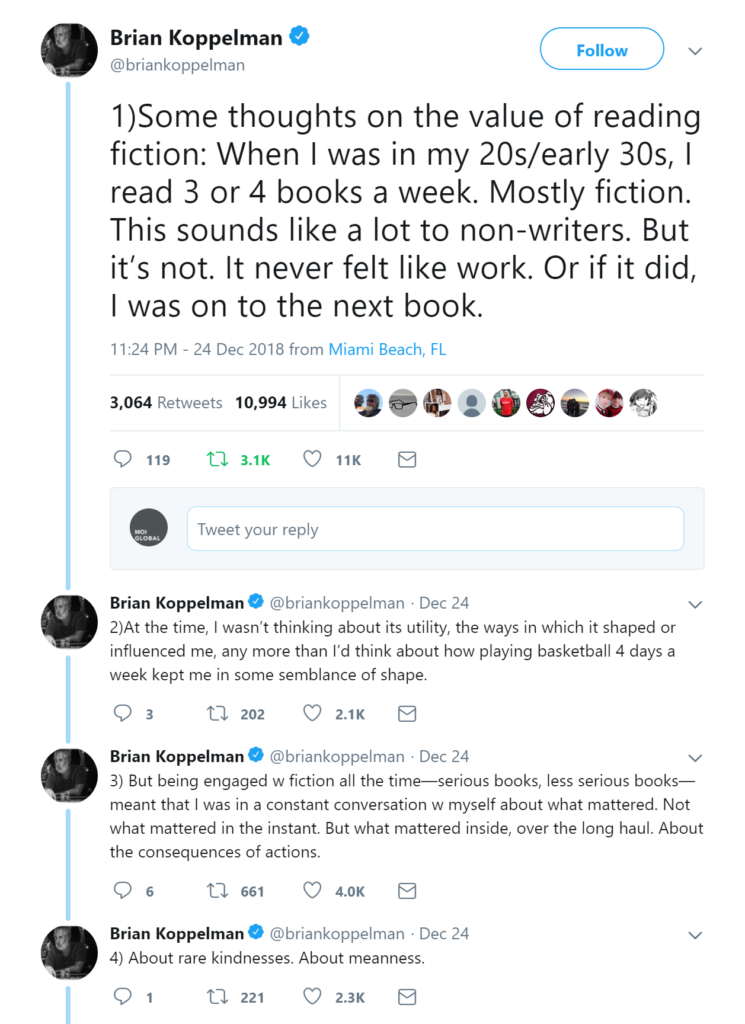
The other day I came across this Twitter thread:

I feel like I have to do it. Perhaps allocate a specific time of day, perhaps commit to reading one book of fiction per month — or even per year. I need to get started. I can ignore this thought no more.

What thought have you been ignoring for too long?

True Value sobre KLX Energy

December 28, 2018 in Ideas de inversión, MOI Global en Español

NOTA DEL EDITOR: Esta idea de inversión es obtenida de una carta trimestral a los accionistas de True Value FI.

* * *

KLX Energy Services [KLXI] era una empresa con dos divisiones, una de aviación que suponía un 80% de la empresa y que ha sido vendida a Boeing [BA] y la otra de servicios en el sector de oil&gas que supone un 20%. Dado que el comprador Boeing no tenía ningún interés en el sector del petróleo la directiva decidió hacer este spinoff a la vez que se producía la venta del otro negocio. El equipo directivo detrás de KLX Energy tiene uno de los mejores track records de la industria. El señor Amin Khoury fundó B/E Aerospace hace más de 30 años y bajo su tutela de crecimiento orgánico y sobre todo por fusiones y adquisiciones pasó de 3m$ en ventas y un solo producto a una empresa con 3.500m$ en ventas, culminando con la venta de su división KLX Aerospace por 3.200M$. La spinoff presenta muchas características deseables.

Primero el negocio de KLX Energy, no tiene nada que ver con el principal de la empresa, esto provoca venta forzada de fondo u etf’s. El tamaño de KLX es mucho más pequeño que el de la empresa padre, esto también crea un precio atractivo. Tercero, La división de Energía de KLX comenzó en 2013 su andadura por iniciativa de Amin que venía un mercado potencial muy grande y que podía ser perfecto para crecer por adquisiciones.
Continue reading »

Highlights from the Robotti & Company Annual Meeting

December 26, 2018 in Best Ideas 2019, Equities, Letters

On November 12, 2108 Robotti & Company Advisors, LLC hosted its annual investor meeting at the Yale Club in New York City. The highlights below, delivered by MOI Global instructor Bob Robotti, have been edited for clarity.

October was an interesting month and I believe that it presented an opportunity for all of us today. We owned cheap stocks before that and I would say today that they are significantly cheaper. We will talk a little bit about that tonight and try to convey our current thoughts to you. What I will also point out is that today, as always, we are investing alongside you. And that’s a key concept of our investment process – our capital is invested alongside yours.

This is the perfect place to start out since it is November… October stunk! A majority of the companies we are invested in are cyclical. The reason we invest in cyclical businesses is that we attempt to invest in periods of weakness which provides us with a number of advantages. One is that well-run companies going through a cyclical period of difficulty often find themselves in a position to improve their competitive situation – improving the earnings power of the business. Another advantage is that when cyclical businesses go through difficult times their valuations frequently become heavily discounted, so the price that we can pay for the business is significantly discounted to what the normalized earnings power of the business is.

Opportunities in the North American Housing Industry

We think there continues to be a large opportunity in the homebuilding business. Our favorable view on housing originally began in 2009, post the financial crisis, when we invested in a number of companies in the industry. Initially, our thesis was that we were buying businesses at very discounted levels compared to their recurring capabilities. We believed that the homebuilding business wasn’t going away and there would be eventually be a recovery in the industry.

Today, I would say things are somewhat different. We are now in the midst of a significant recovery. When we first invested, we thought our companies would make a lot of money and today that has actually played out in the economics of the businesses which have improved dramatically. Today we think that valuations based on current earnings are as interesting as the business prospects. So now, valuations are modest based on current earnings and the businesses are still growing and improving.

Linear Bias in a Non-Linear World

Investing in cyclical businesses can be an excellent opportunity because when a recovery begins its progression is almost never a straight-line direction. Inevitably the process is two steps forward, three steps forward, one step back, and one and a half steps back. Additional opportunities emerge when the recovery hits an inevitable rough-patch and short-term investors quickly conclude “it’s all over.” So for businesses that you invested in, you often have an opportunity to leverage your understanding about the company and its opportunities to reinvest again as the situation gets repriced.

There are a lot of data points out there on the homebuilding business. And you need to look at all of them because all of them are relevant. At various times, however, the market will hyper-focus in on certain data points and will either get overly excited or, more recently, run for the door. The situation has been exacerbated as more capital flows into ETFs and quantitative investing. These are accelerants to the euphoria or the dismal view that often characterize cyclical businesses and their valuations.

Multiple Opportunities in the Cycle

Investing in cyclical businesses provides a number of other opportunities. In the downturn companies can improve their competitive positions. Scale became important and in, in this case, is an actual differentiator. So, opportunities arise throughout recoveries for Builders FirstSource – this is what happened.

Opportunities can often come in the form of consolidation. Builders FirstSource was a company that had a $650 million market cap and was able to acquire the largest competitor in its business. This consolidation process provided Builders FirstSource with a cost savings of roughly $100 million. For a $650 million market cap company to have the opportunity to make an acquisition that improves its combined earnings by $100 million on an annualized basis – that is very significant.

The other thing that happens in today’s world of low interest rates is that there’s clearly an appetite for yield. We think the one riskiest markets out there today is the fixed income market and the high yield market in particular. Yet, if you are an equity investor like Builders FirstSource, this created an opportunity because they were able to finance the acquisition almost solely with high yield debt. Now the interest rate was still reasonably high, it wasn’t so cheap but more importantly the covenants are extremely light. So therefore, the debt is relatively benign. With relatively limited equity dilution, Builders FirstSource was able to significantly improve the earnings power of the business. The integration has gone well. They have also paid down debt since they generate a lot of free cash and the debt level has gone from roughly 7.8 times debt-to- EBITDA down to maybe 3.5 times at the end of the year.

Today, our investments in the homebuilding industry are really are predicated upon the Three D’s:

(1) Discounted valuations,

(2) De-risked situations, and

(3) Downside protection.

Discounted valuation – Today Builders FirstSource trades at probably seven times trailing, seven times forward earnings. More importantly, the company has indicated its mid-cycle earnings power is between $3.00 and $3.50 a share. Based on our research, we think that mid-cycle earnings will be closer to $4.00 to $4.50 a share. Today the stock is around $11. It was $22 at the beginning of the year. So the market has clearly fallen out of love with it and rushed to the door.

It is a de-risked situation. Today the balance sheet continues to improve, and free cash flow generation is significant. The financial stability of the company is a very important safety factor.

Lastly, we believe there is Downside protection. Homebuilding has recovered from 450,000 single-family homes annually. The 50-year normalized average number of single-family homes built in America is 1.1 million. Contrast that with the number of households in America which have increased from 60 million households to 120 million households over the same period. We are still 30% – 40% below what has historically been a mid-cycle level, so the downside, we think, is relatively modest. Even if there is a pull back, business risk is moderated given the level of activity today.

Differentiated Businesses in Cyclical Industries

The recent headwinds that everybody has identified in the homebuilding business are labor shortages and low availability of homes. Builders FirstSource offers component manufacturing processes that address these issues by reducing cycle time, reducing labor costs and reducing labor experience requirements. Therefore, we think that Builders FirstSource has solutions that will help address both the labor and affordability issues. In the meantime, the component manufacturing segment is a much better margin business. So Builders FirstSource has improved margin potential, high returns on capital and solutions to help the industry solve some of the problems.

The Energy Industry Hits Reset

We view the opportunities in front of us in energy as very significant and clear. If we look back to 2013-2014, large capital projects in the energy business were not economic. Costs had increased significantly, and many projects were uneconomic by the time they were completed. There were issues with delays and cost overruns among other things. As a result, the industry started to pull back on capital spending in the beginning of 2014.

Then at the end of 2014 oil prices went into free fall. Since then, of course, oil prices have improved and gone from lows of $20 back up to $80, before trailing back at $70. What’s important is not only prices of the commodity, it’s also the cost structure of the business.

Costs had expanded dramatically which narrowed the funnel of projects that could make it out of discoveries and get developed while being economic. That funnel became so tight that in 2014 the industry started to retract. Today that funnel has gotten extremely wide because the cost structure has dramatically changed. Some of this is temporary, some of this semi-temporary and some of this is permanent. So what you really have is an inventory of 5, 10 or 15 years of discoveries that had been blocked because of cost inflation and now suddenly look very economic.

Today, there are many projects that are economic at $40 oil. There are projects offshore that are economic even at $30 oil. So, the project inventory of economic opportunities is significant. What you also need is someone with the capability and the willingness to spend the money. The Majors are in a very different situation today versus 2013 – filling their coffers, looking at improved cash flows going forward but also watching production profiles decline. Now that all of these pieces have come together, we are starting to see increasing opportunities.

Subsea 7 is an investment that we have held for a long time. We know its management very well. They have constant dialogue with the majors in terms of multibillion-dollar projects. The inventory of projects is rising and now progressing from tie-ins and brownfield activity. We think that in the next year a significant flood of new opportunities will come forward. So that’s the backdrop for why we think the opportunity set in energy is strong.

Consolidation – A Cyclical Opportunity

In energy, we have two different types of investments. Subsea 7, which is a great business that was opportunistic in the downturn and is recovering, represents one type. Tidewater is different. It went into the downturn with a balance sheet that was poorly structured. As a result, the company went through a major restructuring last year that wiped out all the debt.

Today the company has $450 million of cash and $450 million of debt – zero net-debt. Everybody else in the industry is over-levered. Tidewater is now managing the process of combining with another company, Gulfmark, which went through a similar restructuring process. The merger is expected to go through on Thursday. Dan and I have met with the CEO and one of the board members of Gulfmark and talked about the deal its attributes.

The combination will create the largest company in the business. The company will also be left with a clean balance sheet at a time when every other competitor is extremely levered. With zero debt to service, Tidewater will have a tremendous advantage as its competitors struggle with debt burdens. We think this should force more assets to become available and that will enable Tidewater / Gulfmark to opportunistically acquire cheap assets.

Although this is a cyclical business, at some point, new equipment needs to be put into the field. You know that no one’s going to build a new piece of equipment until it makes economic sense to do that. Day rates have gone from $6,000 a day to $12,000 a day. To build new vessel you need something like $32,000 a day. Profitability is dramatic from here.

There’s also some concern over the 200 vessels that have been completed that are still sitting in the shipyard. We estimate that half of these vessels will never come out of the yards in China. We think that a fraction of the other half will end up coming out of the shipyard and will likely be purchased by an opportunistic buyer who will only be able to use them for a limited number of mandates from a narrow customer base. Most likely, these boats will not be competitive in many of the world’s markets.

You already see the path to realization of the opportunity for significantly higher earnings. Today Tidewater has an enterprise value of roughly $1 billion. The replacement cost its vessels is closer to $3 billion. We think the earnings power potential of the business is dramatic, it’s in the process of recovering and even if we are wrong its balance sheet will allow them to be a survivor while competitors continue to disappear. So, the question isn’t whether we win, the question is whether the outcome is now or a little bit later. We think it’s more likely now than later.

Plenty of Values Elsewhere, Too

Of course, I talk about housing and I talk about energy, but more than 50% of the separate account portfolio is not in housing or in energy. There are securities from many industries that are really important and somehow I get focused on certain topics and I go on my rants.

So, the portfolio is a lot more. Finning and Toromont are two Canadian Caterpillar dealers that we think are very compelling. RadNet is a medical service company that is in a good position. Westlake Chemical is a large chemical company that has a 70% shareholder family (who have proven to be great capital allocators) and a very discounted valuation. Western Digital is leading manufacturer of data storage solutions with strong free cash flows and a mid- to low-single digit PE multiple.

Members, log in below to access the restricted content.

Not a member?

Thank you for your interest.  Please note that MOI Global is closed to new members at this time. If you would like to join the waiting list, complete the following form:

The transcript of the Robotti & Company, Incorporated Annual Meeting held on November 12, 2018 should be read in conjunction with the following disclosures: The information, data and opinions contained in the transcript referenced above (“Transcript”) are for illustration and discussion purposes only and are not intended to be a recommendation, or an offer to sell, or a solicitation of any offer to open or buy, as applicable, a separate account or an investment in a private fund managed by Robotti & Company Advisors, LLC (“Robotti Advisors”). Any such offer or solicitation will be made only by means of delivery of a presentation, offering memorandum, account agreement, or other document or agreement relating to such investment and only to suitable investors in those jurisdictions where permitted by law. Furthermore, the Transcript should not be construed or used as investment, tax, ERISA or legal advice. The Transcript is provided “as is” and is provided without any warranty of any kind, either express or implied. Robotti Advisors does not warrant the accuracy of the information, data and opinions provided therein and expressly disclaims any warranties of merchantability or fitness for a particular purpose. Robotti Advisors will not be liable for any direct, special, indirect or consequential damages, even if expressly advised of the possibility of such damages, arising out of or in connection with the use of the transcript. The Transcript should not be relied upon in substitution of personalized investment advice. The Transcript is furnished as of the date shown and the views of the participants therein are subject to change and to updating without notice. No representation is made with respect to the Transcript’s accuracy, completeness or timeliness and it may not be relied upon for the purposes of entering into any transaction. The Transcript is not intended to be a complete performance presentation or analysis of any security, transaction or outcome discussed therein. None of Robotti Advisors, as investment adviser to the accounts or private funds, or any affiliate, manager, member, officer, employee or agent or representative thereof makes any representation or warranty with respect to the information, data or opinions provided therein. References to past holdings of a separately managed account or private fund and matters of related historic fact must be seen in context (as would have been apparent to investors in such account or fund) and are not intended to refer directly or indirectly to specific past recommendations of Robotti Advisors. Any reference to a past specific holding or outcome is not intended as representative. Certain statements in the Transcript, including but not limited to (a) statements of things that “are well known” to be the case (other examples include: “In hindsight people often say, “I should have known better,” and “more often than not, they did”), (b) statements with the phrase “always”, and (c) certain similar statements, are not intended to represent absolute literal fact, but rather represent certain colloquialisms/mannerisms expressed by select market participants. Investment results are subject to risks that include, among others, adverse or unanticipated market developments, issuer default, general and specific economic conditions, management execution risks, exchange rates and illiquidity. Past performance is not indicative of future results. The investment advisory services and specific recommendations Robotti Advisors provides to separately managed accounts and private fund clients and their results may differ materially. This disparity is due to various reasons including, differing investment objectives, investment amounts, investment timelines and strategies among clients. The Transcript is confidential and proprietary and is, and will remain at all times, the property of Robotti Advisors, as investment adviser, and/or its affiliates. The Transcript is being provided for informational purposes only. A copy of Robotti Advisors’ Form ADV, Part 2 is available upon request. Additional information about Robotti Advisors is also available on the SEC’s website at www.adviserinfo.sec.gov.

These Thought Pieces Support Our Sense of Caution

December 26, 2018 in Best Ideas 2019, Best Ideas Conference, Commentary, Equities, Letters, Macro

This article is authored by MOI Global instructor Ben Claremon, Principal and Portfolio Manager at Cove Street Capital, based in El Segundo, California.

We don’t spend a lot of time going out of our way to get ideas from other people. This is especially true when it comes to individual securities. We don’t read a lot of sell side research; we don’t talk to analysts; and we certainly don’t buy a stock simply because some hedge fund guy buys a stake and presents a well-articulated investment premise.

It is not because we are arrogant. We are most certainly open to other people’s views of our companies and, in fact, we follow an internal research process that ensures divergent opinions are heard. But, in general, we would rather do our own research, come to our own conclusions, and then test our hypotheses in every way possible.

One exception to the above-mentioned “rule” is that from time to time we will read high level pieces about market valuation and long-term macroeconomic drivers. For the most part, we are in the weeds focusing on Business, Value, and People. But, at times we believe it pays to stick our heads above the tall grass and try to take the pulse of the market. What we see—looking from the bottom-up—is that stocks appear expensive, as multiples in a number of industries have expanded meaningfully.

In a lot of cases it even occurs to us that investors haven’t seen a true down cycle in certain industries for so long that they have virtually forgotten that cyclicality is ever-present. A good way to lose a lot of money is to pay a high multiple of peak earnings because you thought the industry wasn’t cyclical any longer. Time will tell if people are indeed overestimating the stability of valuation multiples and cash flows, but we recently read a couple of interesting thought pieces that indicate our general sense of caution is warranted.

The first is from Jim Paulsen of the Leuthold Group. What intrigued us about the piece is that Jim and his colleagues have tried to create a metric that is like a factory’s capacity utilization but that measures the stock market.

For those who don’t spend all of their days reading about manufacturing businesses, capacity utilization simply represents the percentage of your total production capacity that you are currently using. If your factory can make 1,000 widgets a month and you are making 800, then your utilization rate is 80%. And then once you get to 100%, you can’t generate incremental growth. Nothing too fancy.

The Leuthold model is a little more complicated in that the authors combine a number of factors—including P/E multiples, Treasury rates, and the unemployment rate—to try to determine how close we are to full capacity in the S&P 500. In other words, they are trying to measure just how much more return we can squeeze out of the market. I will skip the gory details and get to the punchline: the market is just a touch below the record high utilization set in late 2017.

Now, Paulsen admits that this is not a timing tool but points out that bull markets usually start when capacity utilization is low and market tops coincide with high utilization rates. Most importantly:

Members, log in below to access the restricted content.

Not a member?

Thank you for your interest.  Please note that MOI Global is closed to new members at this time. If you would like to join the waiting list, complete the following form:

The opinions expressed herein are those of Cove Street Capital, LLC (CSC) and are subject to change without notice. Past performance is not a guarantee or indicator of future results. Consider the investment objectives, risks and expenses before investing. You should not consider the information in this letter as a recommendation to buy or sell any particular security and should not be considered as investment advice of any kind. You should not assume that any of the securities discussed in this report are or will be profitable, or that recommendations we make in the future will be profitable or equal the performance of the securities listed in this letter. Recommendations made during the past twelve months are available upon request. These securities may not be in an account’s portfolio by the time this report is received, or may have been repurchased for an account’s portfolio. These securities do not represent an entire account’s portfolio and may represent only a small percentage of the account’s portfolio. Partners, employees or their family members may have a position in securities mentioned herein.

Best Ideas 2019 Preview: Viper Energy

December 26, 2018 in Best Ideas 2019, Equities, Ideas

This article is authored by MOI Global instructor James Davolos, Vice President and Portfolio Manager at Horizon Kinetics, based in New York.

The investment experience of shareholders in commodity based operating companies over the past decade has been dismal, as evidenced by nearly 1500 basis points of annual underperformance of the VankEck Vectors Gold Miners ETF, and nearly 800 basis points of annual underperformance of the Energy Select Sector SPDR Fund relative to the S&P 500 Index. This is in spite of materially higher gold and silver prices compared to a decade ago, and marginally higher oil prices. This has been the result of various factors, namely a lack of industry discipline on capital spending, inevitably oversupplying markets during periods of strong commodity pricing, resulting in low returns on invested capital.

Despite the broader industry malaise, certain businesses within the precious metals industry have returned 14% and 17% respectively over this time period, outperforming both the sector and S&P 500 Index. The companies are gold and silver focused royalty companies, Wheaton Precious Metals Corp (WPM) and Franco-Nevada Corp (FNV). These companies primarily earn royalty streams in the form of discounted purchase agreements for future mine production, in exchange for capital that is used to bring projects into operation.

The unique structure of the transactions is a product of mining operations, whereby an undeveloped mine requires substantial capital investment prior to generating cash flow. However due to capital market hesitation to finance these projects with equity, and burdensome cash interest payments on traditional financing, royalty companies provide a necessary element of mine financing.

In recent years Franco-Nevada has expanded beyond its precious metals core operations, and purchased oil and gas royalties, primarily in the Permian Basin (Texas) and Anadarko Basin (Oklahoma). Unlike precious metals royalties which are primarily used as a financing mechanism, oil and gas royalties are an element of land/mineral ownership, whereby exploration and production companies generally agree to pay a fixed amount of production to land owners in addition to an agreed upon lease payment.

For example, a lease in a prime portion of the Delaware Basin in Texas might command an upfront operating lease payment of $50,000/acre plus 20-25% of oil and gas production paid to the land owner. While gold and silver royalties have been a fixture of the market for decades, and proven to generate excellent risk adjusted returns, energy royalties are currently predominantly owned by private owners.

Historically the only public oil and gas “royalty” companies have been organized as slowing declining trusts, that truly represent minority working interests in an operating lease, with no active management of the assets, hence zero growth potential beyond organic production. These include Permian Basin Trust (PBT), Sandridge Permian Trust (PER), San Juan Basin Royalty Trust (SJT) and BP Prudhoe Bay Royalty Trust (PBT).

These vehicles have largely been valued predicated on a current yield basis, with no value assigned to non-producing acreage or terminal value. This is a function of the nature of these “run-off” structures, which must be distinguished from new market entrants and the precious metals peers.

Viper Energy Partners (VNOM) was taken public in early 2014 by its parent company Diamondback Energy (FANG) in order to monetize a substantial royalty position in the Midland Basin on acreage owned and operated by Diamondback. The transaction facilitated an independent valuation for royalty acreage, which requires minimal working capital, as compared to highly capital intensive operated acreage. The parent company (FANG) benefits through maintaining a sizable stake in Viper Energy.

In contrast to most public energy “royalty” companies at the time, Viper was the first growth oriented company, which has been facilitated by drop down transactions with the parent company. Since this time, the company has expanded beyond sponsored transactions from the parent and acquired assets from 3rd parties.

As a result, total royalty acreage has grown on an order magnitude of 4.4x since the IPO while distributions per unit production growth has exceeded this growth rate. The outsized growth is a function of the accretive acquisition strategy; the market places a far higher multiple of currently producing acreage as compared to non-producing acreage.

Furthermore, Viper and peer companies have been disciplined to limit acquisitions to cash flow accretive. This has resulted in an accretive acquisition mechanism whereby the company can purchase acreage at over a 50% discount to the implied value of its acreage. A critical variable to this compounding mechanism is capital structure; historically the company has only utilized short-term debt in the form of a revolving credit facility to close acquisitions.

Subsequently, the company issues shares to pay down the revolver. To the extent that the company can issue shares at a materials premium to the acquired acreage, the transactions are highly accretive on a cash flow and NAV basis.

Based on trailing distributions, Viper currently trades at a forward distribution yield of approximately 8%. While declines in oil prices will impact this rate in the short-term, we expect organic production growth and hub basis differentials to mitigate the impact over the next year. As an example, indicative operators on Viper acreage suggest over 20% production growth targeted annually over the next five years.

Further, a large portion of current production is subjected to Midland hub differentials, which have been realizing pricing at over a $10 discount to Cushing hub prices recently due to limited pipeline infrastructure. Projects currently under construction are expected to alleviate this congestion by the third quarter of 2019, with most new pipes delivering product to the Gulf coast.

Consequently, gulf pricing is Brent-linked, as opposed to WTI-linked, due to export nature of the product, which currently commands an $8 premium to WTI Cushing. Thus, within 9 months, Viper is likely to experience 20% organic production growth and over a $15 positive shift in differentials as they can realize Gulf pricing.

The market is highly inefficient with regard to oil and gas royalties for a variety of factors. Primarily, the energy sector weighting in the S&P 500 Index has fallen to approximately 6% compared to a peak in 2009 of over 14%. This, combined with increased allocations to passive investment vehicles, has resulted in a dearth of fundamental investment in the sector.

A lack of capital distribution at upstream operators has disenchanted many long-term investors, while negative returns in midstream energy MLPs result in similar valuation applied to royalty yield oriented investments.

We believe that a fundamental, discounted cash flow derived valuation for Viper assets delivers a share price between 50% and 100% higher than current levels depending on spot energy pricing. The market is focused on current yield, while assigned no value to the substantial undeveloped acreage or future accretive growth pipeline.

Finally, Viper Energy chose to convert to a taxable entity effective May 9, 2018. We believe that this will encourage investment in the company and facilitate greater NAV growth, as opposed to simply yield distributions. Viper is in a unique positions to further consolidate the highly fragmented private mineral/royalty market, and multiple private companies seeking public offerings are likely to drive incremental capital into the space.

Members, log in below to access the restricted content.

Not a member?

Thank you for your interest.  Please note that MOI Global is closed to new members at this time. If you would like to join the waiting list, complete the following form:

La infravaloración de las empresas japonesas

December 21, 2018 in Miscelánea, MOI Global en Español

NOTA DEL EDITOR: Este texto es un extracto de una carta del fondo Japan Deep Value Fund.

* * *

El universo de empresas cotizadas en Japón continúa creciendo cada año demostrando un vigor sorprendente. En el mercado norteamericano en cambio, el número total de empresas cotizadas va decreciendo. A mediados de los años 90, más de 8.000 compañías cotizaban en las diversas bolsas norteamericanas. A finales de 2017 tan solo eran 3.618, cifra ya inferior al número de empresas japonesas cotizadas actualmente, que crecen a un ritmo anual de unas 50 a 100 nuevas compañías. No parece que vayan a escasear las oportunidades en los próximos años.
Continue reading »

MOI Global