Finding Asymmetry in Credit Investing

January 2, 2019 in Best Ideas 2019, Equities, Ideas

This article is authored by MOI Global instructor Saurabh Sud, Portfolio Manager at T. Rowe Price, based in Baltimore, Maryland.

As credit investors, we recognize that corporate bonds and preferred equity shares, bought at around par, offer inherently different payoff profiles to those available from ordinary shares. While common equity investors can hope to earn two-times or three-times or more on their investment, the only advantage of investing corporate bonds or preferred equity is the income yield – and it comes with the risk of losing a substantial part of the principal.

The good news is that the downside risk of credit investing can be mitigated by adopting either a high-quality focused strategy or an asymmetric profile-focused strategy. The challenge for a credit investor is to strike the right balance between the two and a good research platform can help navigate that.

A defensive credit investor may focus on high-quality companies with a wide business ‘moat’ (i.e., a substantial competitive advantage over their competitors) that have strong asset and cash flow coverage, and management teams with solid capital allocation track-records. A challenge with this approach is that the rest of the credit market is likely to be looking for the same types of businesses. This, combined with the fact that cash flows are contractual and defined for corporate bonds, mean that it is more difficult for credit investors to differentiate themselves than equity investors.

For example, HCA Healthcare’s stock has generated compounded investor returns of ~21.9% annually since 2011 (at which rate it would take 3.5 years to double the initial investment). However, HCA’s 5.625% 2028 unsecured corporate bond currently yields around 5.75% (at which rate it would take around 12.5 years to double the initial outlay – which is the best return possible from holding the security until maturity).

Through our Global Fundamental Research Platform, we at T Rowe Price can find many high-quality ideas that are differentiated from those of the market. However, another challenge of focusing solely on high quality companies is that near-term returns are likely to be dominated by macro factors such as interest-rates rather than fundamentals, especially for longer-dated corporate bonds that are bought near par.

Thus, to make truly exceptional equity-like returns in credit markets, a credit investor therefore needs to be very patient – in other words, to be what Benjamin Graham defines in his seminal book The Intelligent Investor as an ‘enterprising investor’. Paraphrasing Graham, an enterprising investor is one focused on asymmetric payoffs who is willing to put in the analytical work that is required to achieve them, thereby mitigating downside risks. And while Graham did not believe in market timing, he gave important clues about the market’s opportunity set and his definition of bargain prices for high-yield bonds and preferred securities. He writes:

Members, log in below to access the restricted content.

Not a member?

Thank you for your interest.  Please note that MOI Global is closed to new members at this time. If you would like to join the waiting list, complete the following form:

This material has been prepared for investment professionals only and should not be relied upon by retail investors. The specific securities identified and described above are shown for illustrative purposes only and do not necessarily represent securities purchased or sold by T. Rowe Price. All figures are US Dollars. This information is not intended to be a recommendation to take any particular investment action and is subject to change. No assumptions should be made that the securities identified and discussed above were or will be profitable. This material is being furnished for general informational purposes only. The material does not constitute or undertake to give advice of any nature, including fiduciary investment advice, and prospective investors are recommended to seek independent legal, financial and tax advice before making any investment decision. T. Rowe Price group of companies including T. Rowe Price Associates, Inc. and/or its affiliates receive revenue from T. Rowe Price investment products and services. Past performance is not a reliable indicator of future performance. The value of an investment and any income from it can go down as well as up. investors may get back less than the amount invested. The material has not been reviewed by any regulatory authority in any jurisdiction. Information and opinions presented have been obtained or derived from sources believed to be reliable and current; however, we cannot guarantee the sources accuracy or completeness. There is no guarantee that any forecasts made will come to pass. This material has been prepared for informational purposes only. The views and opinions stated in this commentary are those of the portfolio managers listed as of the date indicated. These views and opinions are subject to change based on market or other conditions and may differ from those of other T. Rowe Price associates. Actual market and investment results may differ materially from expectations. Under no circumstances should the material, in whole or in part, be copied or redistributed without consent from T. Rowe Price. The material is not intended for use by persons in jurisdictions which prohibit or restrict the distribution of the material and in certain countries the material is provided upon specific request. It is not intended for distribution to retail investors in any jurisdiction.
Highlighted Tweet by GosaliaRishi

January 2, 2019 in Twitter

The Value of Turning Over More Rocks

January 2, 2019 in Best Ideas 2019, Equities, Ideas

This article is authored by MOI Global instructor John Carraux, Managing Partner and Portfolio Manager of Punch & Associates Investment Management, based in Minneapolis, Minnesota.

“The person that turns over the most rocks wins the game. And that’s always been my philosophy.” –Peter Lynch

Not long ago, several members of our research team took a scenic road trip down the Mississippi River to visit a small-cap company in Iowa. The company is a good-sized manufacturer with a gleaming new headquarters right on the banks of the river. As we do with many companies we are seriously researching, we had a full afternoon of meetings scheduled with the senior executives of the company, followed by a plant tour of a nearby division.

After the usual introductions and pleasantries with the CEO and CFO, we casually asked how often they hosted meetings with investors like us. “You’re the first to come visit us in five years!” was their reply. When we hear that from a company, it tends to get us excited. It’s also not that unusual.

We get excited about unknown companies in the same way that a beachcomber might get excited when his metal detector starts beeping over a clump of sand. The beeping alone doesn’t tell us what lies beneath; it could be a dime or a diamond bracelet. The simple fact that we are one of the few to take notice is significant. Taking notice of companies that are unknown, under-researched, and hard to find (the nearest airport was three hours away) isn’t all that unusual for us because those are exactly the types of opportunities we seek. Information is a valuable commodity in in- vesting, and the scarcer it is the more valuable it becomes. We believe that performing due diligence research that others are unwilling or unable to perform is a real competitive advantage.

Investors who make the time and effort to find, research, and invest in lesser-known companies—those who turn over more rocks, as Peter Lynch would say—gain insights into three critical areas that we think are significant drivers of value and, therefore, investor returns over time:

1. Corporate Strategy
2. Competition
3. Culture

Doing the hard work of traveling to companies, interviewing management teams, and touring facilities isn’t easy, but we believe that the unique insights that such activities usually render to the intrepid investor can translate into attractive returns over time.

Corporate Strategy

When doing due diligence on a public company, many investors start by perusing the publicly-available regulatory documents of a company. These filings (Annual Reports, Quarterly Reports, Prospectuses, and the like) offer excellent information, and plenty of it. It isn’t unusual for a Fortune 500 company’s Annual Report to run several hundred pages long.

What quickly becomes apparent when reading these voluminous filings, however, is that much of it is written by two categories of authors: accountants and lawyers. There is usually an abundance of accounting arcana, and what qualitative descriptions there are of the company’s operations, reporting segments, and risk factors tend to be heavily redacted as if they were sterilized to be only as descriptive as required by law. Understandably, it makes little sense for a company to go overboard on explaining the nuances of its business and strategy in a public government filing that is accessible by customers, competitors, and the like. Excessive transparency could ultimately be detrimental to the company.

Investors, however, do need to know these nuances to make intelligent, rational judgments about the strength of the company and the sensibility of its strategy. We’ve found that the best way to gather these insights is through direct, face-to-face management interviews.

Management interviews should ultimately yield answers to two important questions: does the company have a cohesive strategy? And does that strategy truly differentiate the company from its competitors?

Amazingly, some companies do not have cohesive, sensible strategies. Quite simply, they lack an overarching vision for their enterprise, as well as the framework to translate vision into action. Especially among smaller companies, there can be a tendency to simply do business the way it’s always been done, or to seemingly run the company for the benefit of management’s lifestyle, or to lack serious directors or shareholders who are willing and able to hold the company accountable. We believe, that over time, this is surely a recipe for investment disaster.

Most of the time, though, serious companies have taken the time and effort to thoughtfully articulate where they want their company to be in the future and what the roadmap for getting there looks like. The articulation of this vision, and more importantly, the operating philosophy animating it, is critical to investment success.

Is management aggressive, willing to pursue a win-at-all-costs fight for market share? Or are they more conservative and tactical, picking battles where the odds of success are stacked in their favor? Is their attention to the opportunities before them more scattershot, or focused? Do they prioritize ethical business practices, or is regulatory compliance of secondary concern? How do they think about creating value for shareholders over time, and what are the metrics used to gauge this progress?

These are the questions whose answers often cannot be found in public filings. For those companies who do not command much attention from Wall Street, the answers to these import- ant questions must be ferreted out by investors willing to engage companies on their own terms.

Competition

Corporate strategy only makes sense when viewed through the prism of competition. A company’s ability to generate and sustain returns on capital is largely determined by the structure of the industry or industries in which it chooses to operate. The difference between a concentrated, monopolistic industry and a fragmented commodity one is enormous. Engaging a management team on the issues of competition can produce extraordinary in- sights for investors into both the quality of the company itself, as well as the quality of its competitors.

Whether a CEO respects, fears, or ignores a competitor can also be revealing. More than a few times, we have walked away from meeting with a management team more impressed with one of their competitors than the company itself.

Members, log in below to access the restricted content.

Not a member?

Thank you for your interest.  Please note that MOI Global is closed to new members at this time. If you would like to join the waiting list, complete the following form:

Punch & Associates is registered as an investment adviser with the U.S. Securities and Exchange Commission. Registration as an investment adviser does not imply a certain level of skill or training.. This information is confidential, and is intended for the exclusive use of the recipient receiving it directly from Punch & Associates. This information is not to be reproduced or re-circulated, and is for discussion purposes only. Further, this information is not an advertisement and is not intended for public use or distribution. The information is provided as of the date of delivery or such other date as stated herein, is condensed and is subject to change without notice. Information regarding market returns and market outlooks is based on the research, analysis and opinions of Punch & Associates, which are speculative in nature, may not come to pass, and are not intended to predict the future performance of any specific investment or any specific strategy. This document does not, and does not purport to, discuss all of the risks associated with any specific investment or the use of any strategy employed by Punch & Associates.

A Real-Time Case Study: Equinix

January 1, 2019 in Best Ideas 2019, Best Ideas Conference, Equities, Ideas, Letters

This article is authored by MOI Global instructor Elliot Turner, Managing Director of RGA Investment Advisors, based in New York.

We are excited about one of our new additions, for how we think this purchase elucidates our philosophy, process and discipline—Equinix, Inc (Nasdaq: EQIX).

We first learned of Equinix years ago and as many were wont to do, we dismissed the stock as merely another data center marketing itself for having recurring revenue while the primary asset depreciated rapidly and required constant replenishment. Slowly our view became more informed as we spoke with various investors and industry participants. The key factor that influenced our desire to truly dig in on in this company was the suggestion to read Tubes: A Journey to the Center of the Internet by Andrew Blum, in late 2015. We featured this as one of the “Best books we read” in our year-end 2016 commentary.[1] The central thesis of Tubes is that despite the Internet appearing rather abstract and terms like “the cloud” seemingly implying the Internet itself exists in the air, the entire edifice is built on a highly tangible, physical infrastructure that is essential to global connectivity.

Blum offered some of the following background on Equinix:

  • “Adelson relied on a crucial hunch about how the structure of the Internet would evolve: networks would need to interconnect at multiple scales. They had to not only occupy the same building but the same building in several different places around the world.”[2]
  • “The “ix” in Equinix indicated an “Internet exchange”; the “equi,” their intent of being neutral and not competing with their customers.”[3]
  • “Adelson loved that idea: that an engineer responsible for a global network would feel at home in Equinix facilities everywhere. There are about one hundred Equinix locations around the world and all of them carefully adhere to brand standards, the better to be easily navigable by those nomads in endless global pursuit of their bits. Ostensibly, Equinix rents space to house machines, not people; but Adelson’s strikingly humanist insight was that the people still matter more. An Equinix building is designed for machines, but the customer is a person, and a particular kind of person at that. Accordingly, an Equinix data center is designed to look the way a data center should look, only more so: like something out of The Matrix. “If you brought a sophisticated customer into the data center and they saw how clean and pretty the place looked—and slick and cyberrific and awesome—it closed deals,” said Adelson.”[4]
  • “The rationale for an Internet exchange is straightforward, and not very different from the founding principle of MAE-East: get your packets to their destination as directly and cheaply as possible, by increasing the number of possible paths.”[5]
  • “The two most used criteria are the amount of traffic passing through the exchange (both the peak at a given instant, or on average), and the number of networks that connect across it. In the United States, exchanges tend to be smaller; mainly because Equinix has been so successful in allowing networks to connect directly to each other. The big IXs, in contrast, rely on a centralized machine, or “switching fabric.””[6]

Following our intrigue, we did considerable work on Equinix. Our model suggested the price was fair and offered some upside, though not quite enough. Meanwhile the stock headed higher with hardly a pullback. As this happened, we remained current on the business and kept updating our thesis accordingly. We developed this hope that given Equinix’s prominence in REIT indices (it’s structured as a REIT) it would hit a growth hiccup concurrent with an uptick in rates and a yield-induced panic in yield sensitive sectors. As luck would have it, the confluence of negativity struck Equinix in the first quarter of this year, with investors in yield-sensitive stocks running for the exits. Equinix investors started fearing a slowdown in the long-term growth rate of the company due to “hyperscale” providers building more of their own infrastructure and comments alongside their first quarter earnings report that suggested indigestion of the Verizon assets acquired in Miami.

Members, log in below to access the restricted content.

Not a member?

Thank you for your interest.  Please note that MOI Global is closed to new members at this time. If you would like to join the waiting list, complete the following form:

Past performance is not necessarily indicative of future results. The views expressed above are those of RGA Investment Advisors LLC (RGA). These views are subject to change at any time based on market and other conditions, and RGA disclaims any responsibility to update such views. Past performance is no guarantee of future results. No forecasts can be guaranteed. These views may not be relied upon as investment advice. The investment process may change over time. The characteristics set forth above are intended as a general illustration of some of the criteria the team considers in selecting securities for the portfolio. Not all investments meet such criteria. In the event that a recommendation for the purchase or sale of any security is presented herein, RGA shall furnish to any person upon request a tabular presentation of:
(i) The total number of shares or other units of the security held by RGA or its investment adviser representatives for its own account or for the account of officers, directors, trustees, partners or affiliates of RGA or for discretionary accounts of RGA or its investment adviser representatives, as maintained for clients. (ii) The price or price range at which the securities listed.

Highlighted Tweet by DevinHaran

January 1, 2019 in Twitter

On Valuing Great Businesses

January 1, 2019 in Best Ideas 2019, Equities

This article is authored by MOI Global instructor Ashish Kila, Director at Perfect Group, based in New Delhi, India.

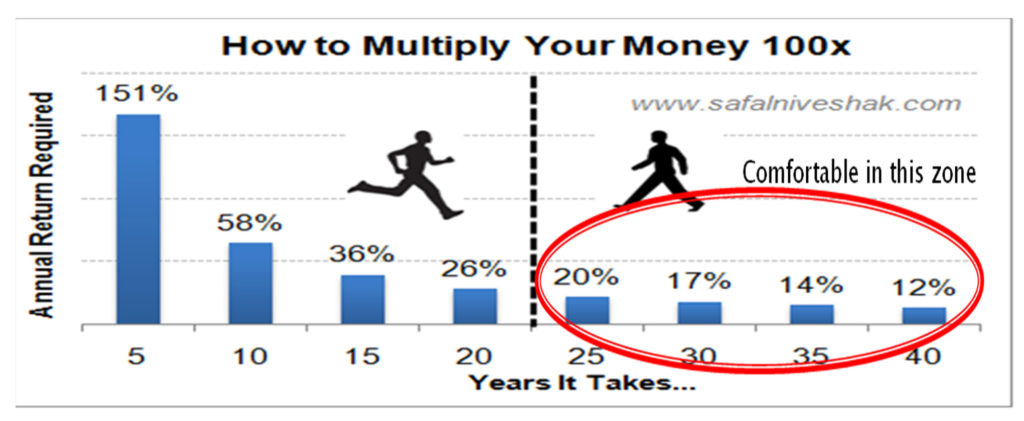
Over time we have shifted our focus to studying great businesses. There is less stress per unit of return and you don’t suffer reinvestment risk. There are other benefits like power of compounding, freedom to pursue other business, family and personal interests. Ultimately it all boils down to the hurdle rate. See the picture below – which basically says ‘why to run & fall in risk when you can walk your way to financial independence.’

Earlier we used to run screeners for cheapness (e.g. IFB Industries) and try to understand if the business is sound. But now we start with great business models (e.g. Info Edge (India) Ltd.) and look for reasonable returns in the long term. Margin of safety is more in quality than in price and mistakes tend to be more of opportunity cost rather than loss of capital.

Owning Equity V/s Running Own Business

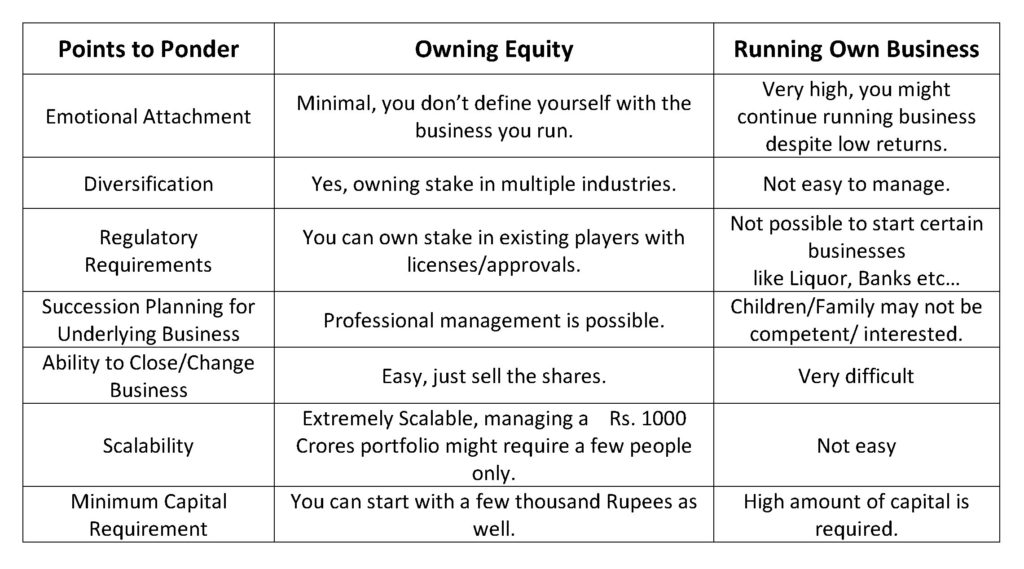
Our rationale behind the thought process is that owning equity is like owning a business where a hired CEO is working for us and will quarterly report to us by con-calls and/or investor presentations. Also owning equity has many benefits over running own business, which are described in the table here:

In owning equity, we get another benefit which is the potential to multiply the scarce resource of “Time”. As Tim Ferris says, “Be neither the boss nor employee, but the owner. To own the trains, and have someone else ensure they run on time.” Meaning owners of business are not limited by the amount of time they put in the business. The best doctor also can’t work for more than 15-16 hours a day. But in business we can multiply man hours by delegating, because here a hired CEO is working for us and we don’t need to manage business every day and night.

Why the need to think differently for valuing great stocks?

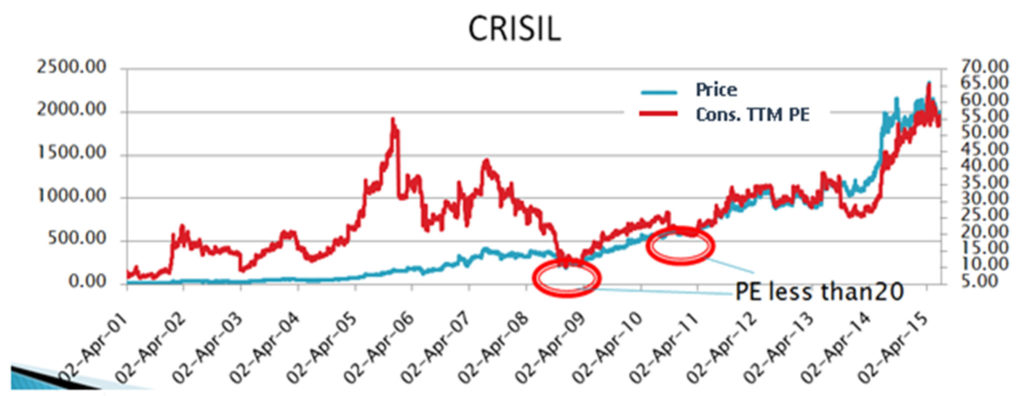
For expensive stocks valuations in the near term one can wait for some opportunities as temporary underperformance corrects the stock but when you wait there is a chance you might miss the stock. Look at CRISIL chart below, in last 10 yrs it gave 2 brief opportunities to accumulate below a trailing PE of <20.

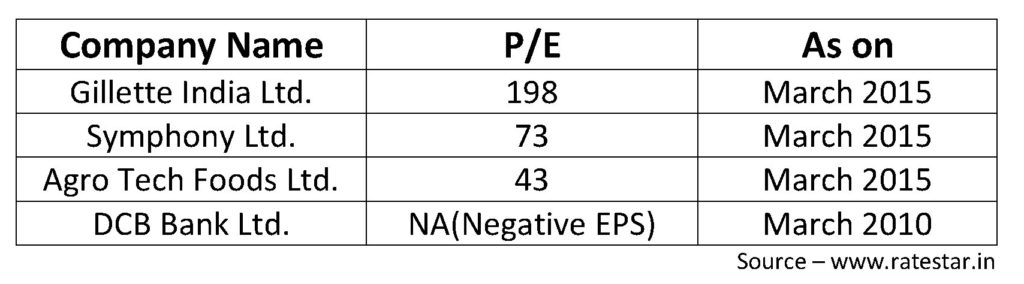
To explain why standard valuation matrix is not the best measure to value such great businesses, we take some examples below:

I. Use of P/E multiple: In the given example if we look at P/E multiple then we might not invest in any of the companies above because they all look so expensive and we might miss a great business like DCB Bank.

II. Not using P/E multiple: If we don’t look at P/E and we say that I buy all great businesses, then we might end up buying Gillette also which is extremely overvalued (will discuss more on it later).

Solution to such problems:

There are 3 aspects:

I. Moats: How durable and wide the moats are?
II. Size: Small size in relation to the addressable size.
III. Limited downside: When no earnings are there.

Let us discuss all of them below:

I. Durable Moats: It is important to judge the depth and longevity or durability of moat and if the moat shrinks and disappears, a buy and hold strategy will not save you. In a nutshell, can you visualize whether company’s product/services shall be in demand 10/20yrs down the line & can we think that despite competition, company has some competitive advantage vis-à-vis others to serve that demand?

II. Size: Small size in relation to the addressable size: Let us take two examples here:-

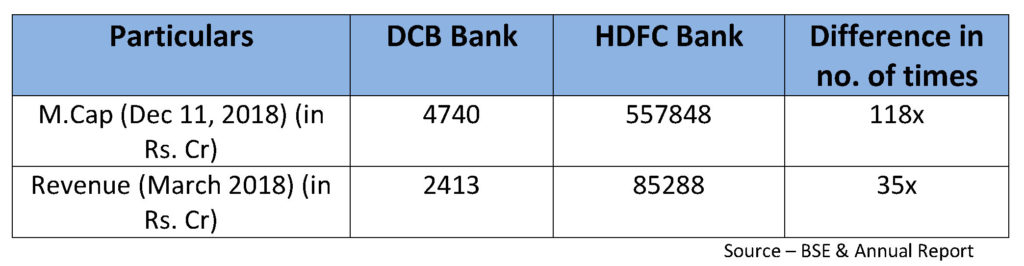
A) – comparing two private banks; the leader in that space ‘HDFC Bank’ is less than 10% of total advances whereas ‘DCB Bank’ is not even a fraction of HDFC Bank.

HDFC bank a 100 times larger in size can grow its loan book at 20%, one can clearly see that DCB Bank has just scratched the surface in the Banking Industry and can continue doubling its Balance Sheet every 3-4 years for a long time.

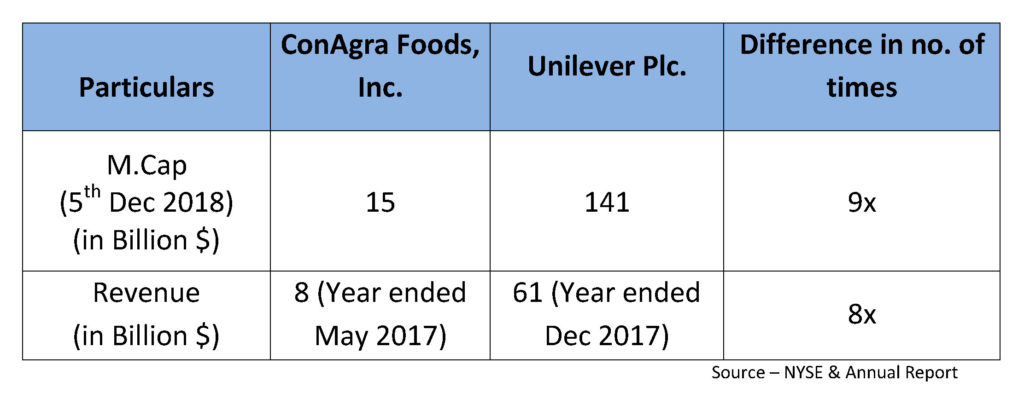
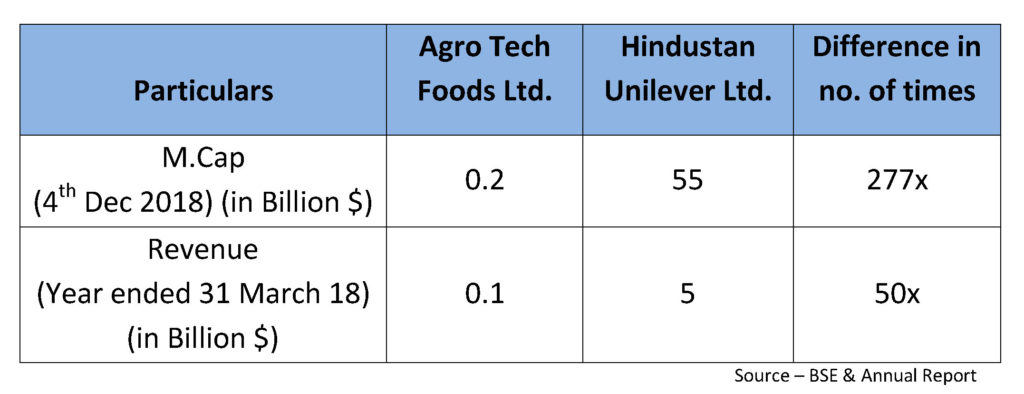
B) – Let us compare two multinational companies – ConAgra Foods Inc. and Unilever Plc.

Now let’s compare their Indian Subsidiaries – AgroTech Foods and HUL, One can clearly see that AgroTech has just scratched the surface in India.

The difference in the size of their parents compared to the Indian subsidiaries is low and it shows the potential opportunity for AgroTech Foods in India.

We take another example of Gillette and for simplicity sake we just focus on Blades and Shaving segment which accounts for all the profit of the company currently and add back the capex done in the oral care segment.

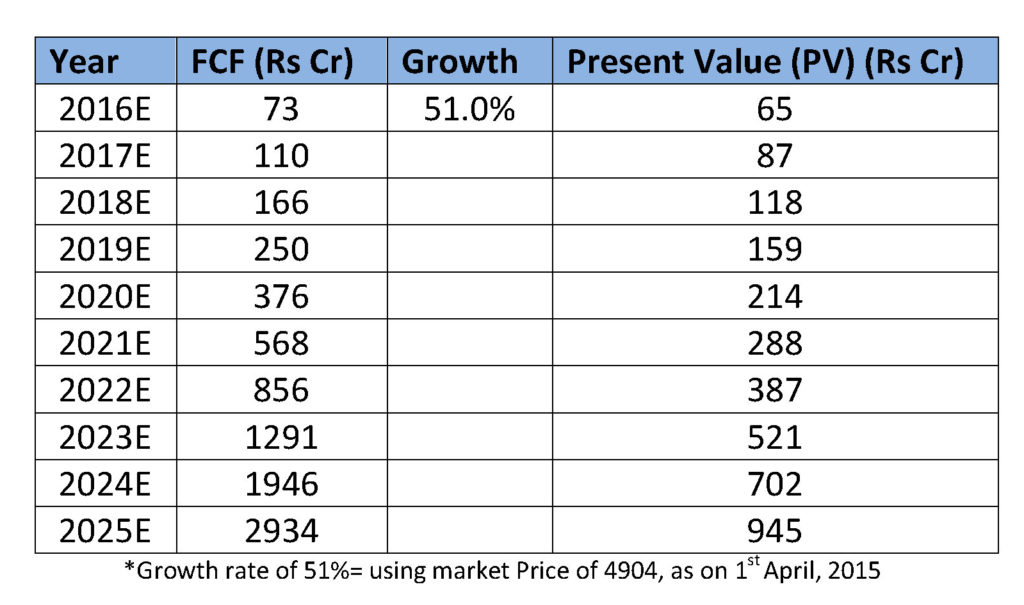
We then use Reverse DCF on it i.e. what is the growth rate in Free Cash Flow (FCF) implied by the market in the current valuation of the company.

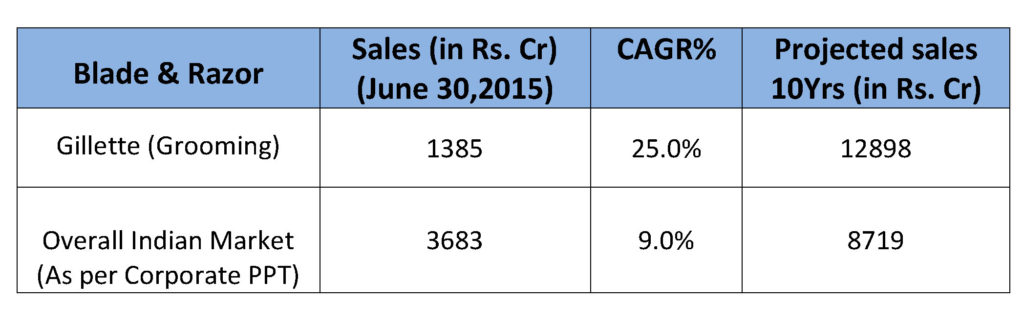
Under reasonable assumptions of Terminal Growth Rate of 4% & Discount Rate of 12%, we get to know that implied growth rate of FCF for Gillette is about 51%. And if FCF of Gillette has to grow by 51% then its sales should grow by at least 25-30%. And if it grows by 25% what happens is given below in the table, Gillette becomes even bigger than market size, which is impossible. So this framework, kind of gives a ceiling to the valuations for a company.

In a nutshell, to summarize the framework for a great business we see:

Members, log in below to access the restricted content.

Not a member?

Thank you for your interest.  Please note that MOI Global is closed to new members at this time. If you would like to join the waiting list, complete the following form:

Disclaimer: We are not SEBI registered analysts. This is an educational post only and not a stock recommendation. Any stocks discussed in this letter are for illustrative purposes only. The content of this letter is not an offer to sell or the solicitation of an offer to buy any security in any jurisdiction. The content is distributed for informational purposes only and should not be construed as investment advice or a recommendation to sell or buy any security or other investment, or undertake any investment strategy. There are no warranties, expressed or implied, as to the accuracy, completeness, or results obtained from any information set forth in this letter. Perfect Group’s officers, directors, employees, principals and/or contributing authors may have positions in and may, from time to time, make purchases or sales of the securities or other investments discussed or evaluated in this letter.

Why Hold Cash?

January 1, 2019 in Best Ideas 2019, Equities, Ideas

This article is authored by MOI Global instructor Gary Mishuris, Chief Investment Officer of Silver Ring Value Partners, based in Boston.

In the article, Gary answers the investor question, “Why hold any cash in the portfolio when you can invest it and then sell those investments when you find more attractive opportunities? Are you implicitly waiting for a broad market selloff to present you with sufficiently attractive opportunities in managing the portfolio in this way?”

I am not waiting for a broad market selloff to deploy capital. That would be top-down market timing, something that I have no competence in and also something that few have succeeded in. I am waiting for individual company-specific mispricings for companies of sufficient quality that I understand well. What could provide such opportunities? Typically it is one or more of: short-term disappointing results, neglect, forced selling or the market misunderstanding the implication of business developments on long-term intrinsic value. It is true that it would be helpful if the market environment were more balanced between greed and fear rather than skewed towards greed as it is now. However, that doesn’t mean that I need a broad sell-off, just an environment that is less skewed towards pervasive optimism.

The second question is why not deploy the capital in stocks in the meantime that are fairly valued or just slightly undervalued, and then sell them when the opportunities that I am searching for manifest themselves? The reason I don’t do that is two-fold. First of all, buying companies without sufficient margin of safety can lead to significant permanent capital impairment. My approach intentionally accepts that in order to minimize the chances of significant permanent capital loss I need to give up some upside. I believe this is a better risk/reward proposition than aiming for maximum returns possible and exposing our capital to a significant chance of loss.

Second, while I have no reason to believe that the placeholder investments are correlated with potential future opportunities, I simply have no idea where the prices of long-term investments will be in the short-term. So to rely on being able to liquidate these purchases at good prices in order to redeploy that capital into opportunities that become available would be speculative. One of my competitive advantages is my long-term time horizon, which allows me to never be a forced seller of securities, and on the contrary to take advantage of irrational forced selling of others. If I were to change my approach to be fully invested even in the absence of sufficiently attractive opportunities, I would not only be imperiling our capital but also putting myself in a position where my ability to execute my strategy will be at the mercy of short-term market movements.

Members, log in below to access the restricted content.

Not a member?

Thank you for your interest.  Please note that MOI Global is closed to new members at this time. If you would like to join the waiting list, complete the following form:

The Power of Incentives

December 31, 2018 in John's Blog

Charlie Munger said it best:

“I think I’ve been in the top 5% of my age cohort all my life in understanding the power of incentives, and all my life I’ve underestimated it. Never a year passes that I don’t get some surprise that pushes my limit a little farther.”

Well, here’s a surprise.

In short, a modern skyscraper may be in danger of collapsing. No, not in North Korea or Russia, but in Sidney, Australia.

If that can happen in this day and age in a democracy with elaborate building and safety regulations, think about what else can happen — and is happening, often unnoticed by the uninterested observer.

Overrated: laws, regulations, morals, conscience.

Underrated: incentives.

MOI Global