George Kurian of RARE Infrastructure presented his in-depth investment thesis on Bharti Infratel (India: BHIN) at Asian Investing Summit 2018.
Thesis summary:
Bharti Infratel is the second-largest wireless tower company in India. The investment case is a classic example of time horizon arbitrage. While the market seems focused on the ongoing carrier consolidation, it ignores the normalized earnings power of the company.
Over the next couple of years, Infratel could become the second-fastest growing tower company in the world on an EBITDA basis, yet the it was recently priced at the lowest EV/EBITDA tower multiple in the peer group.
Moreover, with many companies safely levered in the mid-single digit net debt-to-EBITDA multiple range, Infratel has a net cash balance sheet. It also owns 42% of the largest tower company in India, Indus, and has a right of first refusal to buy the remainder of Indus. The board of Infratel has asked management to evaluate the Indus acquisition, which, if done at reasonable terms, could improve the growth prospects of Infratel, provide synergies, and lower the weighted-average cost of capital.
Infratel could be the classic “double play” for long-term investors due to a potential uplift in earnings and valuation multiples.
The full session is available exclusively to members of MOI Global.
Members, log in below to access the full session.
Not a member?
Thank you for your interest. Please note that MOI Global is closed to new members at this time. If you would like to join the waiting list, complete the following form:
About the instructor:
George Kurian, CFA, is a Portfolio Manager at RARE Infrastructure in Sydney, Australia, and has over 18 years of Investment and Finance experience. The fund he works for, RARE Emerging Markets Fund, has been ranked by the London based Citywire as the second best performing Global Emerging Markets fund in the world over a four year period between London and Rio Olympics. George has published several articles including ‘Darwin’s Power and Porter’s missing Force’, where he showed how a multi-disciplinary framework could extend the traditional Value investing philosophy. Prior to joining RARE in 2010, George was an Investment Analyst with Tradition Capital Management in NJ, US. He has also worked with Citigroup Investment Research in New York City, Aviva plc in the UK, and has also worked in several states in India. He is also fluent in three languages. George holds an MBA in Finance and Investment management from Duke University’s Fuqua school of Business, NC, US. While at Duke, one of his investment ideas was voted by an NYC hedge fund as top five from all Universities in United States. He is also a CFA charterholder.
Jamie Dimon's 2017 annual letter is a great read, just like his previous ones. These letters are a great education for anyone wanting to learn about banking and financial services industry.https://t.co/cMRSndcGM5
Ashok Kinha of Athamus Venture Management discussed capital market vs. business investments in Asia at Asian Investing Summit 2018.
The full session is available exclusively to members of MOI Global.
Members, log in below to access the full session.
Not a member?
Thank you for your interest. Please note that MOI Global is closed to new members at this time. If you would like to join the waiting list, complete the following form:
About the instructor:
Ashok Kinha serves as Chairman of Athamus Venture Management, a private equity and venture capital firm. Ashok has been instrumental in the management of funds, fund managers, and real estate developers for the last sixteen years. Ashok chaired the risk functions in his last assignment with Azure Capital, in addition to heading legal and compliance functions. Previously, Ashok worked with fund managers like ICICI Venture and IREO, a U.S.-based real estate fund. He has also represented or worked at companies like Knight & Marshall of Singapore, Ascendas, and Unitech Limited.
KB Kee of presented his in-depth investment theses on Hosokawa Micron (Taiwan: 6277) and Tocalo (Tokyo: 8035) at Asian Investing Summit 2018.
Thesis summary:
Hosokawa Micron is the global leader in powder and particle processing equipment and high-performance plastics thin-film blowing manufacturing equipment, with clients in the pharma, cosmetics, food and beverage, auto, and other industries. Hosokawa has a strong reputation for world-class technology and advanced technical capabilities. Hosokawa has five R&D centers and eight test centers, enabling it to launch new products that meet customer needs quickly.
Since current CEO Yoshio Hosokawa took over in 2014 to rationalize the business, financial performance has improved significantly. Yoshio has made difficult decisions, such as divesting the loss-making confectionery equipment segment in 2015. CFROA (operating cash flow divided by assets) of 13% is one of the best in the industry (Alfa Laval 8%, GEA 5%, John Bean 8%, IDEX 13%, Marel 14%).
Yet, the market quotation of EV/CFO of 6x, EV/EBIT of 8x, and EV/EBITDA of 7x represents a discount to comparable companies. Hosokawa implemented shareholder-friendly actions in 2017, including a share buyback. Hosokawa has the potential to grow operating profits by 50-80% in the next 3-5 years to $70-83m, and spur an upward valuation re-rating based on EV/EBIT 15x towards a 95-134% rise in market cap from its present $534m to cross $1.04-1.25bn in the next 3-5 years, or a share price of JPY 13,800 to 16,600 from its present JPY 7,090.
No thesis summary is available for Tocalo.
The full session is available exclusively to members of MOI Global.
Members, log in below to access the full session.
Not a member?
Thank you for your interest. Please note that MOI Global is closed to new members at this time. If you would like to join the waiting list, complete the following form:
About the instructor:
Koon Boon (KB) is the Chief Investment Officer of Hidden Champions Fund where he was responsible for the sustainable growth and outperformance of listed Asian equity investments in the Hidden Champions Fund. KB is an internationally featured investor rooted in the principles of value investing for over a decade as a fund manager and analyst in the Asian capital markets who started his career at a boutique hedge fund in Singapore where he was with the firm since 2002 and was also part of the core investment committee in significantly outperforming the index in the 10-year-plus-old flagship Asian fund. He was also the portfolio manager for Asia-Pacific equities at Korea’s largest mutual fund company. KB was also the Managing Editor of the Moat Report Asia, a research service focused exclusively on highlighting undervalued wide-moat businesses in Asia. Paid subscribers to the Moat Report Asia from North America, Europe, the Oceania and Asia include professional value investors with over $20 billion in asset under management in equities, some of the world’s biggest secretive global hedge fund giants, hidden billionaires and savvy private individual investors who are lifelong learners in the art of value investing. interval. KB was also a faculty (accounting) at SMU teaching accounting courses and had pioneered the course on Accounting Fraud in Asia, an official module in the undergraduate curriculum. KB is also honored and grateful to be able to have the opportunity to be invited by Singapore’s financial regulator Monetary Authority of Singapore (MAS) to present to their top management team about implementing a world’s first fact-based forward-looking fraud detection framework to bring about benefits for the capital markets in Singapore and for the public and investment community.
Deepak Kapur of Tapaks Capital Management presented his in-depth investment thesis on GMR Infrastructure (India BSE/NSE: GMRINFRA) at Asian Investing Summit 2018.
Thesis summary:
GMR Infrastructure is a play on India’s fast-growing airport sector. It is one of the largest infrastructure companies in India, owning and operating assets in the following segments: energy (power plants and coal mines), transportation (airports and highways), and property development (commercial property and special investment regions for industrial development).
The thesis is based primarily on the growing value of GMR’s cash-generating airport and allied businesses, growing at 15+% (aero revenues are based on assured return on equity, and non-aero business has reasonable operating leverage). GMR is the largest private sector airport operator in India. It owns and operates the Delhi International Airport as well as the Hyderabad International Airport under the public-private partnership model. It recently also won the mandate to build and operate a greenfield airport at Goa. Apart from India, GMR has airport development and operating interests in the Philippines and Greece.
In the last few years, the energy and highway businesses have been a drag, as their leveraged balance sheets and suboptimal operations led to large losses and increasing debt. The suboptimal performance was due to issues such as inadequate fuel supply for power plants, lack of long-term power purchase agreements from buyers, lack of environmental clearances leading to stuck projects, excess capacity in the industry, poor realizations, and inadequate toll collections.
The stock has languished in a narrow band for the last six years and is down 85% from its 2007-2009 peak during the infrastructure craze in India. However, asset monetization (sold a stake in its energy business), fund raising (QIP and rights issues), refinancing as well as debt restructuring and asset disposal initiatives of recent years, supported by a pick-up in the economy, have lent some stability to the balance sheet. The worst times seem to be behind the company. Looking ahead, GMR aims to sell the highway projects, restructure its energy operations, and shift the growth focus to airport, property, and EPC businesses.
The complexity of the operations and holding structure, the negativity surrounding the debt on balance sheet, certain regulatory issues, and various ongoing litigations have kept the valuation depressed. The recent market cap of INR 106 billion represents at least a 40-50% discount to underlying value and provides reasonable downside protection for the long-term investor, even after considering dilution risk. An unpleasant regulatory surprise for the airport business remains the biggest risk to the investment thesis.
The full session is available exclusively to members of MOI Global.
Members, log in below to access the full session.
Not a member?
Thank you for your interest. Please note that MOI Global is closed to new members at this time. If you would like to join the waiting list, complete the following form:
About the instructor:
Deepak Kapur is an investor and educator based in Chennai, India. He has over 15 years of experience in the secondary equity markets of India. In the past, he managed equity portfolios for individuals but currently manages only proprietary funds. He focuses on the mid and small-cap space in the secondary equity markets of India. He is value conscious and his preferred style is to hunt for opportunities in businesses that are currently out of favor in the market. He is a visiting lecturer at the Indian Institute of Management, Indore, where he has been teaching a course on Business Valuation since the last eleven years. He earned his Bachelors in Chemical Engineering and Master’s in Biological Sciences from the Birla Institute of Technology and Science, Pilani, and completed his MBA from Indian Institute of Management, Indore. He is an avid surfer, yoga practitioner and loves reading. His subjects of interest include; history, brain sciences, empirical psychology, financial markets, entrepreneurship, health and nutrition.
Anish Jobalia presented his in-depth investment thesis on KARUR VYSYA BANK (NSE: KARURVYSYA) at Asian Investing Summit 2018.
Thesis summary:
Karur Vysya Bank, based in South India, is a regional bank that started its journey in 1916 in Karur, a textile town in Tamil Nadu. KVB primarily started as a small and medium enterprise (SME) bank. It continues to position itself as a comprehensive player that caters to the needs of SME customers. KVB’s core philosophy of nurturing customers through times “thick and thin” has earned it respect over its hundred-year existence, resulting into a sticky customer base.
The bank has traditionally enjoyed a high average ROA profile of ~1.7%, as observed from 1999 to 2013. ROA has recently shrunk to 0.6% due to high credit costs resulting from exposure to chunky corporate loans.
There has been a management change with the hiring of P. Seshadri, a highly competent CEO. IIM Bangalore alumnus Seshadri is a senior banker with 25+ years of experience at Citibank. In a recent clean-up drive, Seshadri increased the watchlist of stressed assets from INR 650 crores to INR 1200 crores. According to management, this is the tail end of reserving for stressed assets. The bank’s strategy going forward is to granulize the portfolio by shunning large-ticket corporate lending and focusing on low-ticket SME, retail loans, and corporate loans. The incremental slippage ratio and provisions are expected to come down. Credit costs should revert to their long-term average of ~1% across all cycles.
KVB has historically traded at 1-2x price to adjusted book value on a forward basis. It recently traded at INR 100, a multiple of ~1.3x.
The full session is available exclusively to members of MOI Global.
Members, log in below to access the full session.
Not a member?
Thank you for your interest. Please note that MOI Global is closed to new members at this time. If you would like to join the waiting list, complete the following form:
About the instructor:
Anish Jobalia was previously associated as a Research Analyst with Jeetay Investments Pvt Ltd, a Mumbai based portfolio management firm with assets under management exceeding US$ 100 mn. Anish worked at Jeetay for nearly 6 years and was principally responsible for identifying, analysing, and executing investments in line with the fund’s value-focused investment strategy. He played an instrumental role in driving the institutionalization of the research process at Jeetay. Anish regularly interacts with CXO level management of listed companies to assess investment opportunities and to understand industry health. He presently manages his own portfolio and is looking to raise funds from investors. Anish completed his Bachelors in Engineering (Electronics and Telecommunication) from Mumbai University in 2007, following which, his passion for equity research led him to pursue an MBA in Accounting and Finance from University of Technology, Sydney.
Ravi Dharamshi of ValueQuest Investment Advisors discussed the opportunity in small finance banks in India at Asian Investing Summit 2018. Ravi presented an industry analysis rather than specific investment ideas.
Thesis summary:
Small finance banks in India (SFBs): The largest financial inclusion program in the world has brought 300+ million people under the formal banking system in a short period of time. The business models of SFBs are broad-based, with entry into verticals such as micro, small and medium enterprises. Housing finance lends sustainability. Growth prospects in microfinance have improved after the crisis caused by de-monetization. SFBs also benefit from value migrating away from PSU banks as they struggle with bad loans. SFB models combine the profitability of the NBFC model (ROA of 2+%) and the regulatory protection of the banking model. SFBs’ access to low-cost funds has increased, and borrowing rates have come down from 11-12% to ~8%. Over the next 2-3 years, Ravi expects SFBs to grow at a CAGR of 25+%, with ROA of 1.5+% and ROE of 15%. SFBs are evolving to combine stable business models with long profit runways. Industry participants include AU Small Finance Bank (NSE: AUBANK), Ujjivan Financial Services (NSE: UJJIVAN), and Equitas Holdings (NSE: EQUITAS). Unlisted players that may go public over the next 18-24 months include Suryoday Small Finance Bank, Janalakshmi, and ESAF Small Finance Bank.
The full session is available exclusively to members of MOI Global.
Members, log in below to access the full session.
Not a member?
Thank you for your interest. Please note that MOI Global is closed to new members at this time. If you would like to join the waiting list, complete the following form:
About the instructor:
Ravi Dharamshi has an MBA in Finance from McCallum Business School, US. He returned from the US after a brief internship stint at Salomon Smith Barney. He has been associated with the Indian stock markets for over 13 years. After graduating, he worked his way up through the stock market business, spending four years at RARE Enterprises, where he was involved with research, private equity deals and value creation activities before moving to ValueQuest and taking charge of research. With an enviable track record in stock picking and his ability to take bold calls, he has been instrumental in generating outsized investment returns. Ravi currently heads Investment Strategy and Research at ValueQuest and has proven to be an able leader. He is constantly focused on generating research ideas to maximize investment returns.
Mehul Bhatt of OysterRock Capital presented his in-depth investment thesis on Majesco Limited (NSE: MAJESCO) at Asian Investing Summit 2018.
Thesis summary:
Majesco serves the insurance vertical. It develops insurance software and has a well-received cloud platform. Majesco was a part of Mastek prior to a de-merger. The company offers end-to-end implementation and support, unlike some competitors who rely on systems integrators. Insurers depend on technology but their core IT systems are aging rapidly, causing problems. Insurers spend roughly $25 billion annually on IT products, platforms, and services. Majesco’s product suite includes a cloud offering, big data, and analytics.
While revenue is still modest at $122 million (2017), the company has made inroads into the insurance space and is recognized by Gartner as a top three player in insurance-related IT products, alongside DuckCreek and Guidewire.
Mehul views Majesco’s deal with IBM and MetLife as a “game changer”. Majesco has announced a five-year partnership with IBM to jointly offer a cognitive, cloud-based platform to insurance carriers. MetLife has joined the collaboration, paving the way for product innovation.
Mehul believes that Majesco’s recent market quotation understates value. Most of the investments in insurance products have been made upfront, and Majesco spends $15-20 million annually on R&D. The enterprise is attractively valued at less than 2x FY17 revenue (peer Guidewire trades at ~10x).
Mehul Bhatt serves as Founder and Managing Partner of OysterRock Capital, a value-oriented investment firm. Previously, Mehul headed equity fund management for the portfolio management services business of HSBC Asset Management in India. Before that, he worked with Credit Suisse India Asset Management, where he managed discretionary equity and fixed income capital on the wealth management platform in India. Mehul is a mechanical engineer and a management graduate from the Indian School of Business.
Jiro Yasu and Patrick Rial of Varecs Partners presented their in-depth investment thesis on CRE Inc. (Tokyo: 3458) at Asian Investing Summit 2018.
Thesis summary:
CRE Inc. is a real estate company that develops and manages distribution warehouses. It is one of largest managers of such facilities in Japan. It develops a couple of warehouses per year and sells them off to its own REIT. It also gets the contract to manage them.
Revenues for the development business can be lumpy, depending on how many warehouses are developed and sold each year. On the other hand, the growing property management and REIT management businesses are recurring and quite stable.
Jiro and Patrick expect the market quotation to improve in the coming years as the weight of the recurring businesses grows. Japan needs more cutting-edge, large warehouses because many of the existing warehouses are aging and small. Many companies can cut logistics costs by moving to newer, larger warehouses. Also, the growth of e-commerce should provide stable demand growth for such warehouses.
At the recent share price, CRE’s market cap is 23 billion yen and enterprise value is 28 billion yen. A couple of warehouses are sitting on the balance sheet (will be sold this fiscal year). The sale proceeds and equity holdings explain most of the enterprise value, with little value assigned to the recurring revenue businesses.
The following transcript has been edited for space and clarity.
We have been honored to participate in these presentations since 2013, and we love to pitch ideas here. Some people have found our ideas interesting and contacted us, and we enjoy meeting those people globally. Let me start with some follow-ups on our past ideas before I move on to our new idea, which is a company called CRE.
Background
Our firm, VARECS Partners, is a Tokyo-based independent investment adviser. We started the business almost 12 years ago as a value investing firm. Value investing resembles a large tent – we have been trying out many different types, but we are narrowing down our focus these days.
Our strategy involves investing in undervalued Japanese equities. Typically, we focus on family-controlled businesses, and we prefer ones with high margin, modest growth, and a stable revenue stream. That’s where we are focused these days. We are long-term investors: our average holding is over five years. We have about 25 holdings in our portfolio at present, and maybe a quarter of them we have owned for over 10 years.
Our assets have grown a bit lately, and today we manage about $250 million. My family, which has a long history of running a brokerage business in Japan, exited a couple of years ago but invested about $20 million in that fund.
Our team is quite small – it’s Patrick Rial, Yosuke Yano, and myself.
Recap of Past Ideas
Since 2013, we have made four presentations. We first talked about two Japanese animation companies – Toei and Sotsu. We sold out of Toei in December 2015, but the share price has doubled since then, so it was too early to exit. We kept Sotsu, but this one has been struggling a bit. The share price has appreciated 80% since we made the presentation, and the company has animation rights, but it has had a tough time coming up with new hits. As a result, profit has grown only modestly in the last few years. The owner didn’t like the results and made a management change, so we are hoping for some progress at the company from now on. At present, 50% of Sotsu’s market cap is in cash, and it trades at only 5.4x EBIT.
In 2015, we presented a company called EM Systems. Its share price has performed well, more than tripling since the presentation. This is a software company providing software for dispensing pharmacies in Japan. It has the largest market share (30%) and has been enjoying margin improvement for the last two years, with operating margin doubling in three years.
EM Systems also has an immense property in Osaka. It still owns the building, which is fully occupied. We estimate the value of the building to be almost half of the current market cap.
Excluding the cash and property, the company is trading at around 6.5x EBIT, so this is still a cheap valuation for a highly profitable software company. Most of the revenues are of the recurring kind. Some similar companies overseas tend to trade at far higher multiples, so we are still keeping this as one of our largest holdings.
EM Systems is working on a major software upgrade and has partnered with some venture firms specializing in artificial intelligence. It has also started working with NEC, a huge Japanese software company.
In 2016, we made a presentation on an agrochemical company called Agro Kanesho. The share price has been performing well, appreciating 160% since then. Three years ago, the thesis was simple. The company has a lot of net cash on its balance sheet, so it is traded at almost no enterprise value. It has just started the development of three new products, and its R&D expenses have doubled, which has put some pressure on the operating margins. For this reason, the share price went down, and enterprise value became almost nothing.
We thought the high level of R&D would continue for some time, but if we were lucky, we’d have new products. Even if the company could not bring anything to market or failed in the development, it was okay because margins would come back as R&D cost went down.
Since 2016, the company has finished the development of one product. It gave up on another one and continues work on a third, so R&D costs have started declining this year, and we have noticed some margin improvement.
The company has bought land in Yamaguchi prefecture and is building a new factory, spending $40 million. The share price has appreciated a lot, but 50% of the market cap is still in cash, and it’s trading at 8.5x EBIT. This is still an attractive business to own for a long time, and we are keeping it as our core holding.
In 2017, we talked about a company called Amuse. This is a management company which has contracts with about 400 Japanese artists such as singers, rock bands, and actors. The share price did okay, appreciating by about 23%. Earlier in 2018, it traded as high as ¥4,000, but the share price has since corrected about 30%.
Amuse had quite a difficult year in 2017. One of its actors was involved in a scandal, and the company had to cover some costs for a movie. In addition, the vocalist of one of its major bands lost his voice, so they had to cancel some live events, and some new albums were delayed. As a result, the company missed its profit guidance, and the share price corrected from the high.
However, we still like the business and hope next year will be a good one for Amuse. The company will celebrate its 45th anniversary and is planning a lot of events for the occasion. Net cash makes up 40% of the market cap, and Amuse is trading at 7x LTM EBIT. We still have high hopes for the company and are keeping it.
Investment Thesis on CRE
CRE is listed on the Tokyo Stock Exchange under the code 3458. This is a real estate company focusing on logistic assets and is almost like a full-service company. Everything it does is related to logistics and warehouses: it develops warehouses, provides master-lease services for smaller warehouses owned by individuals, manages a public REIT, and offers other services related to warehouses.
The company is trading at ¥1,800 per share, and its market cap is a little over $200 million. It has used some debt, so its net debt is ¥5.7 billion, or about $54 million, which includes some debt for new developments. When it finishes development and sells the warehouse, it tends to pay down the debt right away.
CRE has two major investments: it owns a REIT and also has an investment in a service company specializing in the clean-up of contaminated land. The enterprise value is a ¥22.6 billion, traded at 4.2x EBIT and 6.3x price-to-earnings, both for the last 12 months.
This company has a good risk-reward profile. We always seek some downside protection. In the case of CRE, properties under development and investments sitting on its balance sheet represent almost 80% of the market cap plus net debt. We are paying ¥22 billion today, but almost $180 million or so is covered by assets. We see a 60% upside potential from here.
When speaking of growth prospects and valuation improvement potential, it should be noted we are a little behind in Japan in terms of the e-commerce penetration, lagging the United States and other countries. We believe this penetration will continue and will bring robust demand for warehouses in the future.
The company is also building a recurring revenue business, mostly the asset management business for their own REIT. The multiple will improve over the years as the recurring revenue stabilizes and profit grows.
Unlike most other Japanese companies, CRE is an excellent capital allocator. It has a great track record of acquisitions and a unique shareholder return program, which we like.
CRE was established in 2009, after the financial crisis. The owner set up a shell company and bought bankrupt warehouse operators.
The founding family still controls about 51%. Kenedix, another real estate company in Japan, has 14.7% and our fund owns about 9% of the company. Only 13% is owned by foreign investors. By the way, we are counted as a foreign investor because our funds are offshore. Excluding us, only 4% is owned by foreign investors at this point. The company went public about 2015, so it’s still new in the market.
If you look at the key members of the management team, you’ll see the chairman is 44 years old, while the president and the head of the REIT business are both 43. In other words, CRE is a company run by quite younger generation people who are also well-connected.
I’ve known the chairman, Mr Yamashita, since we were six years old; we grew up together. His family is famous in Japan – his grandfather was the first president of a Japanese quasi-government-owned oil exploration company. The family controls an extensive portfolio of real estate assets in Japan, so he’s well-connected to both real estate markets and financial institutions. This is a somewhat unique company because Japanese companies are mostly run by old people.
CRE went public on April 20, 2015. Before the IPO, I told my friend, chairman Yamashita, it was a stupid idea to go public because the share price moves every day and the CEOs of public companies sometimes get a call from angry shareholders. He would have to deal with many things he may not want to deal with. Still, he said he wanted to take the company public and ignored my advice. Right after IPO, the share price declined by almost 50%, and he called me up, saying maybe I was right. But it was too late, so he asked me to help realize some value.
We bought our shares in October 2015 almost at the lowest point, and we were able to buy some stock from the Yamashita family. The share price has been gradually recovering from the low and is now trading close to the IPO price.
The business model of CRE centers on providing a full range of services related to logistics real estate. These include development, leasing, master-leasing, property management, and REIT management. Every time CRE develops large warehouses, it sells them to its own J-REIT. As time goes by, it tends to develop about three to four new warehouses every year, so the AUM of J-REIT will grow over the years.
The company focuses on logistics and provides a full range of services. It prefers an asset-light business, so it doesn’t want to own the asset and sells them to the REIT. It is focusing on building recurring revenue.
In terms of development, the company is pretty much focused on its own projects, which comprise mid- to large-sized warehouses. In the past, it worked with some individuals, mostly farmers. In Japan, the farmers have been shrinking the farmland due to government guidance so they use the available land and ask CRE to build warehouses. Then CRE provides a master-lease service to such individuals or owners. These days, however, there aren’t many of them.
CRE also provides a property management service. Besides managing the warehouses owned by its REIT, it also buys warehouses owned by other REITs or real estate companies. By providing this service, it can learn which tenants are moving and what new warehouse a client wants. It gets a good deal flow and information by providing such services to many warehouses.
CRE Logistics REIT is a public REIT run by CRE REIT Advisors, which is a wholly owned subsidiary. Kenedix, which owns 15% of CRE, bought the stake in 2017 because it wanted to help the company smooth the IPO of the REIT. The REIT went public in February 2018.
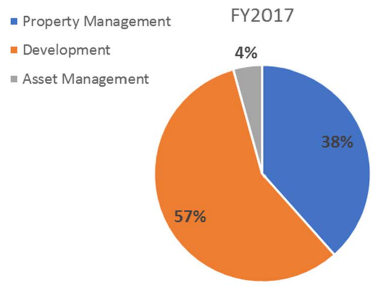
In terms of revenue, property management was about 40% of the total in fiscal 2017 and accounted for 27% of the operating profit.
CRE Inc. — Revenue Mix
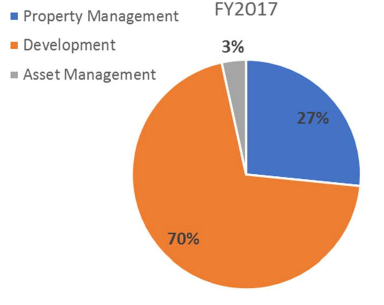
CRE Inc. — Breakdown of Operating Profit
Source: Jiro Yasu and Patrick Rial at Asian Investing Summit 2018.
Development revenue has been growing: it was only ¥7.8 billion in 2015 but almost tripled to ¥23 billion in 2017. The segment reported operating profit of ¥4.2 billion, and development contributed 70% of total operating profit in 2017.
CRE has the capacity to develop maybe three to four warehouses every year, but revenue could be quite lumpy because it depends on the size and location of a warehouse. The 2018 guidance has only ¥13 billion of revenue and operating profit of ¥800 million from development. That’s why the company is trying to build more recurring revenue, which will come from property and asset management.
We expect development revenue and property to be lumpy in the coming years, but the property management and asset management businesses will become a larger part of the company.
Regarding the balance sheet, CRE was quite levered a few years ago. But as earnings grew, the equity ratio improved a lot, and the company now has a significantly better balance sheet.
Speaking of property management, it provides property management services to the assets owned by its REIT and other entities. This part of the business has been growing, and another thing is the more steady revenue, but this is a master-lease service for individual owners.
In terms of area, property management is larger, but the profit from master-lease is way bigger. This business can pay all the fixed costs of the company. It has been keeping a high utilization rate of the master-lease assets.
CRE has been highly disciplined. It tends to focus on lower-risk projects, avoiding large warehouses as it associates them with higher risk. Also, it knows who could be the tenants for some of its new developments and tries to get pre-commitments.
Over the last few years, floorspace has been growing, but 2018 could be a slower year for the company. Still, it does have a good pipeline. It has also announced another land acquisition, which is quite large-scale and could increase the total floorspace of the pipeline by maybe 30%.
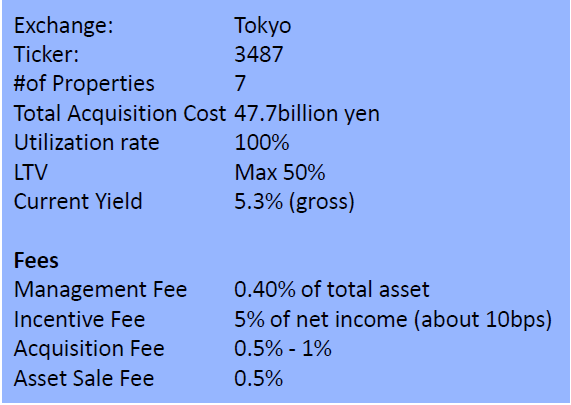
CRE Inc. — Overview of CRE Logistics REIT
Source: Jiro Yasu and Patrick Rial at Asian Investing Summit 2018.
Regarding the asset management business, CRE Logistics REIT currently has AUM of ¥96.6 billion. This number includes non-REIT assets. Long term, the company aims to grow AUM to ¥500 billion, which is almost $5 billion. It sounds as if it has a pipeline to build it to a billion dollars in a couple of years. Through our funds, we also own about 2% of CRE REIT because we believe the quality of the assets is quite high and the yield is attractive.
CRE Logistics REIT charges a management fee of 40 basis points (bps). There is an incentive fee of 5% of net income, which is about 10 bps. Also, when it buys and sells assets, it gets the acquisition and sale fees. When it buys assets from CRE, the acquisition fee is only 50 bps but 1% if it buys assets from other companies.
Assuming maybe 20% turnover, it can make another 10 bps from those fees, so the company will probably make about 60 bps from those assets. If it gets to a billion dollar AUM, it can make $6 million or so from this business.
There’s a virtuous cycle here. The company develops the warehouses that will drive AUM growth, and as the assets grow, it can easily issue shares for REITs, so that will give it money to buy more. By having a public REIT, the company’s capacity to do larger developments has improved.
When you compare it to other public REITs in Japan, you see CRE has maintained a highly disciplined approach to developments. It has mostly focused on the Tokyo area so far and has avoided super large-sized deals, perceiving higher risk in them. It has also been using leverage prudently.
The market cap is just ¥26 billion because the company went public only recently and is still the smallest of its peers. Currently, the REIT has seven properties, 94% of which are located in the Tokyo area, which is the highest proportion among peers. Some competitors have significant exposure to super large warehouses (over 100,000 square meters), but CRE has none of those. All seven properties are quite new, and the tenants have longer-term contracts, which makes us believe these are high-quality assets.
The yield is 5.3%, which is high and has to do with the fact the company is still new and small. Considering the quality of the assets, 5.3% is a highly attractive yield in Japan.
Let’s consider the growth opportunities in Japan. E-commerce penetration in the country is only 5.4% at this point, or about 2.7% behind the level in the United States. We expect e-commerce in Japan to grow: it’s ¥15 trillion now, and some research companies expect ¥20 trillion by 2020. As e-commerce grows, more warehouses will be needed, which will create robust demand for new facilities.
In terms of capital allocation, we consider CRE one of the few companies thinking about capital allocation logically. Yamashita set up his company in 2009 to acquire bankrupt businesses. In 2010, he only paid a ¥500 million to buy the master-lease and property management business of Commercial RE. This business now makes about ¥1.5 billion in operating profit.
In 2011, the company acquired another master-lease business, Tenko-Souken, which operates mainly in Kanagawa prefecture (next to Tokyo). Three years later, CRE acquired an investment advisory business called Strategic Partners KK. Today, that’s CRE REIT Advisors, which is the advisory manager of CRE’s own public REIT.
In 2015, the company bought a 20% stake in Enbio Holdings, which specializes in utilizing contaminated land. It paid about ¥800 per share, and Enbio is now trading at around ¥2,000, so it has more than doubled since the acquisition.
When my friend asked for help right after the IPO and the 50% drop in the share price, one area we focused on was the shareholder return program. The company has a stable business and a lumpy business, so we told the management simply paying a 30% dividend was not such a great idea. That’s because one year it has a solid profit and the next year a small one, so it would have to cut the dividend, which is not that good.
We want the company to grow its dividend every year. We also know its stable business will grow over the years, so the dividend policy is paying 50% of profits from recurring businesses (master-lease and asset management).
Also, I thought the company could do buybacks. There’s an opportunity for CRE to do this wisely because many people in Japan focus on short-term earnings. With this company, a large part of its profit currently comes from development. One year may be great, but the next could be a slow year, and it can see negative growth in operating profit and the share price may go down. The company can take advantage of this profit lumpiness and do the buyback when earnings and the share price are low.
It did some buybacks, using cash from development business to buy its own shares when the price was low. Since 2018 is quite a slow year, the company announced a ¥1 billion buyback program alongside its guidance – ¥1 billion is about 4.7% of the shares outstanding.
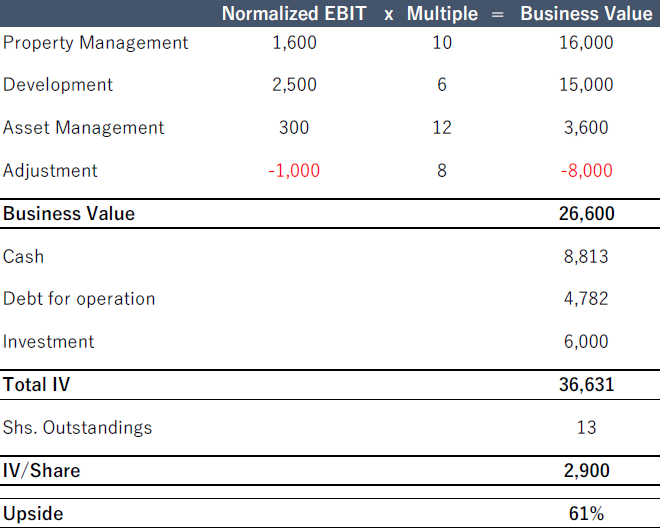
CRE Inc. — Intrinsic Value (yen in millions, except per share data)
Source: Jiro Yasu and Patrick Rial at Asian Investing Summit 2018.
With regard to intrinsic value calculation, we usually look at the deals in a similar industry. GLP was bought out in 2017, and there was previously a larger merger between AMB Property and ProLogis. These are quite high multiples because these companies not only develop warehouses but also own them and are structured as a REIT. An EBITDA multiple of 33 means 3% yield or something like that, so we can’t use this multiple to value CRE.
Asset management firms are a little easier to understand. There are some deals of independent asset managers bought out by larger groups. We see people paying over 10x EBITDA for some asset management businesses. This is the multiple we used to value CRE’s asset management business.
We applied 10x EBIT for property management, 6x EBIT for development (because of the lumpiness), and 12x EBIT for asset management. We also excluded the debt, which is only associated with the warehouse development and not used for business operation. We used normalized EBIT. CRE expects the development business to make only ¥ 100 million in 2018, but the company made over ¥4 billion in operating profit in 2017, so we cut in the middle and then used ¥2.5 billion as normalized EBIT for the business.
We came up with the business value of ¥26.6 billion. The company has cash and debt in investments and divided by shares outstanding, we see ¥2,900 as the intrinsic value and calculate a 61% upside.
Value per share will grow over the years as the AUM of J-REIT grow.
We have owned shares in the company since 2015, and it has good growth prospects. We hope the quality of earnings and the multiple will improve over the years.
The following are excerpts of the Q&A session with Jiro Yasu and Patrick Rial:
Q: Could you perhaps provide a longer-term perspective on this business in terms of how you see it evolving over a decade or two? How big can it potentially become due to the virtuous cycle existing between CRE and the REIT business?
A: The company has a good pipeline to grow AUM to a billion dollars. Its actual goal is $5 billion. Then the company can make about 60 bps. This amount, $5 billion, is the size of competitors like GLP and LaSalle.
We are conservative thinkers but consider $1 billion almost sure and don’t see $5 billion as impossible. I don’t know how quick it can achieve that level, but we hope it can happen in 10 years or so. The company will continue to develop about three to four warehouses every year, so maybe those revenues could be anywhere from $150 million to $300 million. It also recently acquired two plots of land, and one of them could become a $200 million-plus warehouse.
Since it has a large public REIT, the company should have more capacity to do more developments, so the virtuous cycle could accelerate over the years.
Q: Could you elaborate a bit more on the nature of the customer contracts they have? Are the warehouses highly customized for those customers, and for how many years are those warehouses typically contracted to the same customers?
A: Contracts can be 5 to 10 years, so quite long. In terms of customization, it all depends on the tenants, but CRE tries to build warehouse anybody can use. It tries to minimize customization, but the client sometimes wants better customization. That’s the negotiation it has to do. With pre-commitment deals, it usually does deeper customization and seeks longer contracts. This is a trade-off of sorts. If it customizes more, it will seek longer contracts. If there isn’t much customization needed, it will be happy with shorter contracts, so it’s a flexible negotiation.
Q: On the REIT itself, what is CRE’s ownership there?
A: CRE currently owns about 15% of J-REIT, which is a little over $30 million.
Q: What risk is top of mind for you regarding your long-term thesis here?
A: Warehouses have been great assets for many people. When they find a good location, the competition can become quite stiff, and CRE may have to pay a higher price to acquire the land. If it becomes too aggressive, it could lose money on new developments – it happened with some other firms. We like CRE because it is highly disciplined. It doesn’t mind saying no if it doesn’t see at least 15% gross margin based on a conservative estimate of rents.
However, its competitors could get quite aggressive, and because CRE is a disciplined investor, it might have a tough time finding new land. If it cannot buy new land, it cannot do a development and revenues can go down.
Still, we don’t want it to become too aggressive. That’s why its relationship with Enbio Holdings is important – Enbio has good technology to clean up dirty, contaminated land cheaper, and this will give CRE some advantage when bidding for new land. Also, CRE has strong relationships with many clients and tends to get pre-commitment from tenants. With pre-commitments in place, it can be aggressive on price and more likely to win the land. But there’s clearly the risk of stiff competition among warehouse developers because they have to compete with far bigger firms like GLP or LaSalle.
About the instructors:
Jiro Yasu has more than 15 years of investment experience in the Japanese equity markets including at Varecs Partners, First Eagle Investment Management and Daiwa Securities America. As the Representative Director of Varecs Partners, Jiro spearheads the investment firm’s efforts to identify mid-sized listed Japanese companies where corporate value can be realized for all stakeholders by working together with management. Jiro holds a BA in economics with a specialty in econometrics from Keio University.
Patrick Rial joined VARECS Partners in 2015 as Senior Analyst. He joined from J.P. Morgan Securities Japan where he worked in equity strategy and small cap research. Prior to J.P. Morgan, he was a product manager at Morgan Stanley MUFG Securities. Mr. Rial began his career as a financial journalist covering Japanese equity markets. He has been a CFA charterholder since 2011. He holds a BA in economics and history from Georgetown University.
NOTA DEL EDITOR: Estas ideas de inversión presentadas son obtenidas de una carta de Solventis EOS.
* * *
Durante este mes hemos aprovechado para realizar algunas compras y ventas que detallamos a continuación:
En el apartado de ventas, hemos deshecho nuestra posición en la farmacéutica suiza Roche y hemos comprado la inglesa Reckitt Benckiser. Aunque el nombre no les pueda resultar familiar, está más presente en nuestro día a día de lo que podríamos imaginar. Cuenta con marcas tan reconocidas como Cillit Bang, Air Wick, Veet o Finish que vende en los cinco continentes. En bolsa, Reckitt Benckiser ha experimentado una caída del 17% este año y un 30% desde junio de 2017 debido, fundamentalmente, a un crecimiento menor del esperado. Nuestra tesis es que gozará de un crecimiento similar al PIB mundial gracias a que se trata de una empresa global, que lidia tanto en países ricos con deflación como en países pobres con hiperinflación. Si a esto le añadimos que es marca líder en cada segmento donde opera, que la rentabilidad por flujo de caja es igual al 6,5%, que el PER promedio de los últimos 10 años ha sido de 20x y que hoy día cotiza a un PER estimado de 14,7x, nos hace estar tranquilos con la inversión.