La oportunidad en Infineon Technologies

January 5, 2024 in Ideas de inversión, MOI Global en Español

NOTA DEL EDITOR: Esta idea de inversión es obtenida de una carta de NAO Sustainable Asset Management.

* * *

Infineon Technologies AG [ETR: IFX], con sede en Alemania, se erige como un líder en el sector de semiconductores a nivel global. La compañía se ha especializado en microelectrónica de alta complejidad, ocupando posiciones de liderazgo en mercados clave como la automoción, las energías renovables y el Internet de las Cosas (IoT). Su enfoque estratégico en la integración vertical de la cadena de valor, desde el diseño hasta la producción, le otorga una ventaja competitiva única, permitiéndole responder con agilidad y precisión a las demandas del mercado. Este líder de la industria se encuentra en una posición envidiable para capitalizar las tendencias emergentes que están configurando el futuro tecnológico.

Miembros, inicien sesión abajo para acceder al contenido restringido.

¿No eres miembro?

Gracias por tu interés. Ten en cuenta que MOI Global está cerrado para nuevos miembros en este momento. Si deseas unirte a la lista de espera para miembros hispanos, completa el siguiente formulario:


La oportunidad en Jost Werke

January 1, 2024 in Ideas de inversión, MOI Global en Español

NOTA DEL EDITOR: Esta idea de inversión es obtenida de una carta a los inversores de Valentum Asset Management.

* * *

Jost Werke [XETR: JST] es ya un clásico para Valentum, FI, desde que lo descubrimos hace 4 años. Esta empresa alemana hace partes fundamentales de camiones, destacando la “quinta rueda”, que es la unión de la parte delantera (el camión en sí) con la parte trasera (Trailer) del camión. Jost Werke es líder mundial en sus principales productos, siendo el único competidor global, la también alemana SAF Holland.

Miembros, inicien sesión abajo para acceder al contenido restringido.

¿No eres miembro?

Gracias por tu interés. Ten en cuenta que MOI Global está cerrado para nuevos miembros en este momento. Si deseas unirte a la lista de espera para miembros hispanos, completa el siguiente formulario:


Bestinver sobre Philips

December 29, 2023 in Ideas de inversión, MOI Global en Español

NOTA DEL EDITOR: La siguiente idea de inversión es obtenida de una carta trimestral de los fondos de Bestinver.

* * *

En Bestinver Internacional aspiramos a comprar negocios fabulosos a buenos precios. Incluso negocios dignos a precios extraordinarios. Pero esto, desafortunadamente, solo es posible cuando las cosas no van bien. Ocurre, por ejemplo, en momentos de crisis en los que los inversores se preocupan en exceso por la economía. También cuando tienen dudas sobre la rentabilidad a largo plazo de un negocio o desconfían de la solvencia del equipo gestor de una compañía.
En este tipo de circunstancias, el mercado proyecta los acontecimientos del presente de forma permanente en el futuro. A veces tiene sentido que así sea, pero la mayoría de las veces es justo lo contrario. Cuando estas dudas no están bien fundamentadas, el pesimismo lleva al precio de las acciones por debajo de su valor real y nos permite comprarlas baratas. Creemos que nuestra inversión en Philips [AMS: PHIA] se ajusta perfectamente al patrón que les acabamos de describir.

Miembros, inicien sesión abajo para acceder al contenido restringido.

¿No eres miembro?

Gracias por tu interés. Ten en cuenta que MOI Global está cerrado para nuevos miembros en este momento. Si deseas unirte a la lista de espera para miembros hispanos, completa el siguiente formulario:


The India Story: Krish Mehta on the Long-Term Investment Case

December 27, 2023 in Equities, Letters

This article is authored by MOI Global instructor Krish Mehta, investment analyst at Enam Holdings, based in Mumbai, India.

Krish is an instructor at Best Ideas 2024.

Much has been written and spoken about India’s ascent as an emerging economy and about the Indian stock market over the past few months. However, if we assess the fundamental drivers for India to become a $10 trillion economy by 2030, there is a lot of merit to the attention the country is drawing currently.

With a per capita income of $2600 slated to go to $4000 by 2028 (as per IMF), and favorable demographics with a median age of 28[1], supported by a strong fiscal position, India seems to have all the structural drivers in place.

While the argument can be made that the structural factors have always been in India’s favor, what is different this time?

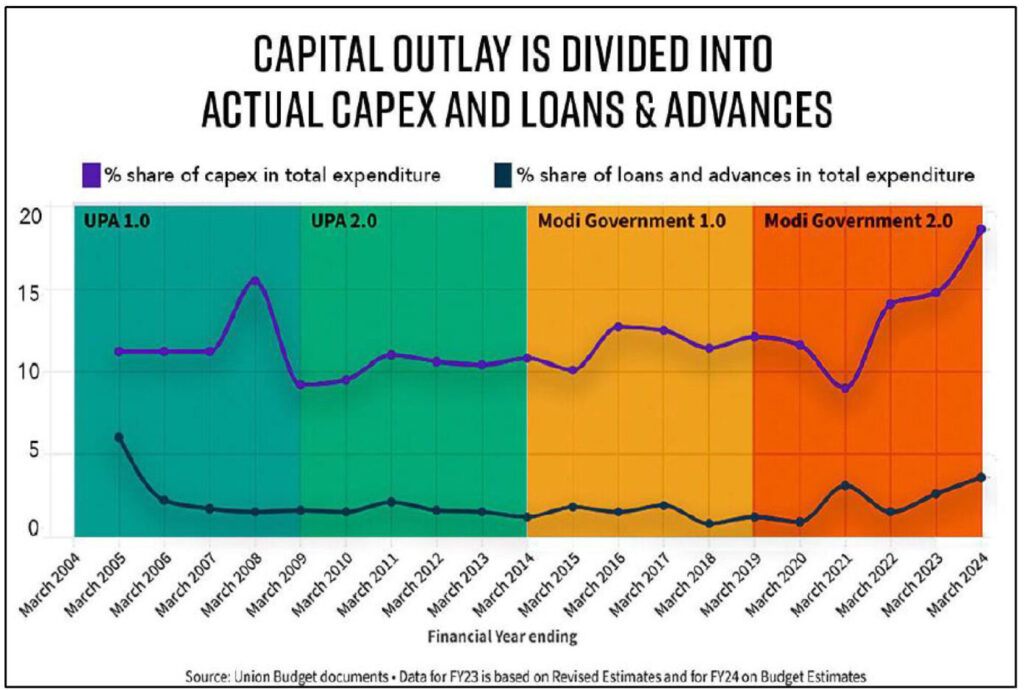
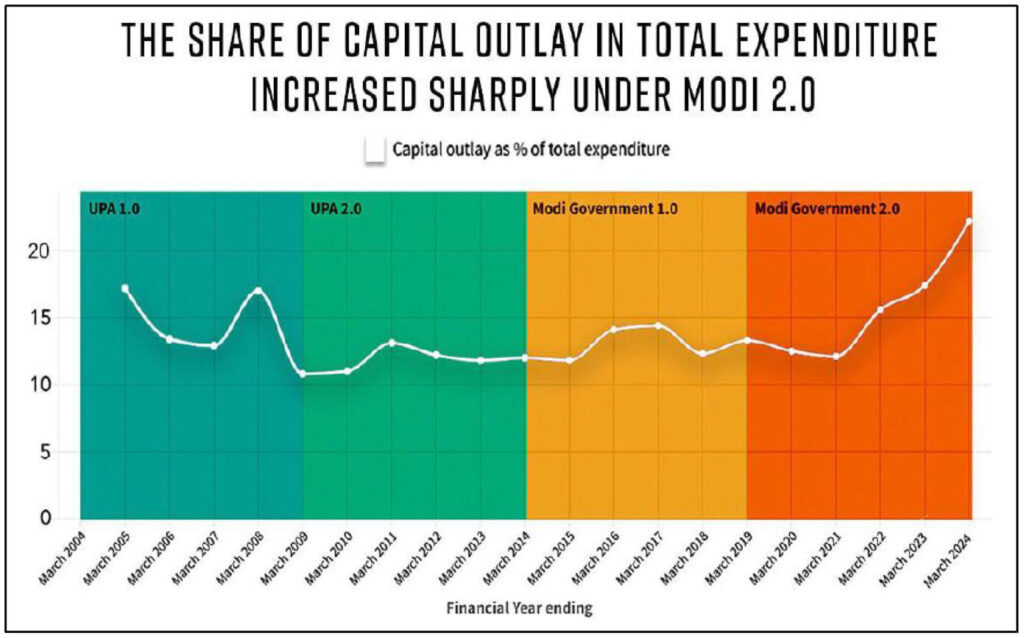
There are several factors that have dramatically changed from the past, which are part of the evolution in a developing economy. Firstly, there has been a strong government push on capex and a reduction in wasteful expenditure. Analyzing the data over the past four political regimes in India spanning two decades, the data shows the increasing focus on capex and infrastructure (as seen below).

[2]

[3]

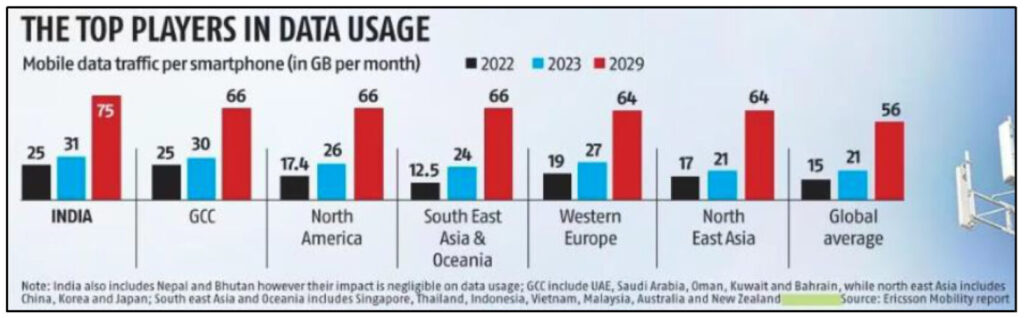
Given this capex push and focus on infrastructure, the government is translating policy goals into action. Infrastructural development and bridging the gap between rural and urban India is a key foundational pillar for the path to $10 trillion. Moreover, every Indian has been given a unique digital identity through Aadhar. With the linkage between Aadhar and new bank accounts particularly for new to bank customers, India has seen a rapid adoption of digital payments and efficient transfer of government subsidies to the target beneficiaries. Today, India has over a billion mobile phone users and consumes the highest mobile data per smartphone user in the world (as seen below).

[4]

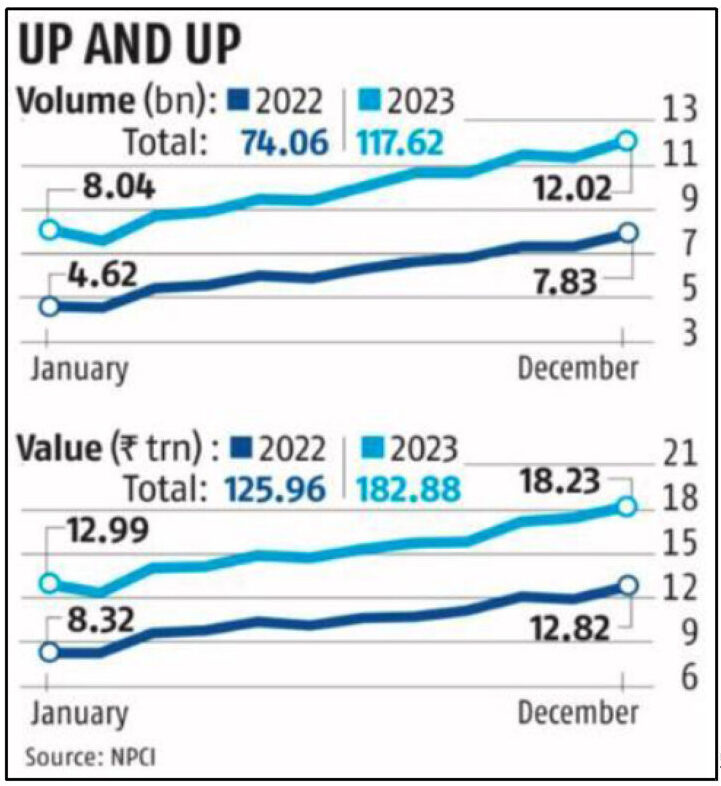
The widespread digital adoption in India is evidenced by the success of UPI (as seen below).

[5]

With GDP per capita forecasted to rise from $2600 to $4,000 by 2028, credit growth will be central to India’s economic growth. The banking sector will be critical for India’s incremental growth ambitions in the coming decades and is poised to take off.

If the economy were to grow at 7-8% p.a. in real terms and 11-12% in nominal terms, credit growth will be in the mid to high teens for sustainable and well-rounded economic growth.

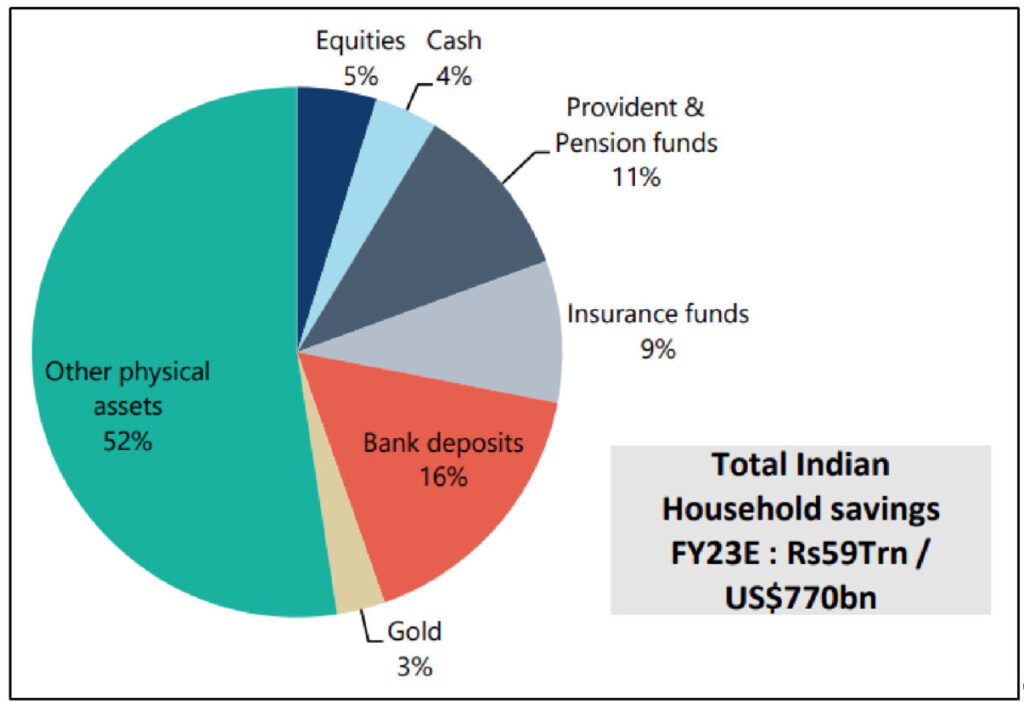
[6]

The table above shows the household assets in India by asset class. Given the low level of financial assets compared to physical assets, there is tremendous room for the financialization to go up in India. The financialization trend will be driven by bank deposits, insurance funds, pension funds and equity investments. As this share goes up with incremental household savings being invested in financial assets, banks will play a fundamental role and grow at a multiplier of nominal GDP growth (mid to high teens).

While viewing the market share dynamics, the high market share of public sector banks in the economy’s banking system (65%), leaves plenty of room for efficient private banks to gain market share and grow their businesses. One such private bank that has been the best-in-class lender for over two decades is HDFC Bank. Post the merger with HDFC Limited (it’s parent mortgage entity), the bank has a behemoth balance sheet of $300 billion and a market capitalization of $150 billion.

Having produced best in class growth (20%), ROA (2%), ROE (20%) and having maintained a highly conservative risk framework since inception, HDFC Bank is best placed to capitalize on the ongoing economic growth India is witnessing and will witness in the coming decades. It will play a central role in India’s growth ambitions, as validated by RBI’s classification of the bank as a Domestic Systemically Important Bank.


[1] World Population Prospects (WPP)
[2] https://theprint.in/economy/rising-capex-share-falling-subsidy-burden-how-modi-govts-spending-priorities-differ-from-upas/1896931/
[3] https://theprint.in/economy/rising-capex-share-falling-subsidy-burden-how-modi-govts-spending-priorities-differ-from-upas/1896931/
[4] Ericsson Mobility Report 2023
[5] NPCI
[6] RBI, AMFI, Jefferies

La capacidad de nuestro cerebro para detectar patrones

December 27, 2023 in Miscelánea, MOI Global en Español

NOTA DEL EDITOR: El siguiente texto escrito por Javier Ruiz, CFA, es un extracto de una carta trimestral de Horos Asset Management.

* * *

Nuestro cerebro es una máquina perfectamente engrasada a la hora de reconocer y procesar patrones. De hecho, algunos investigadores califican esta capacidad como la base de todo aquello que distingue al cerebro humano del de otras especies, como la inteligencia, la imaginación o el lenguaje.1 Este atributo resultó esencial para nuestra supervivencia y evolución como individuos y especie, jugando un papel fundamental en la propia selección natural del ser humano. Démonos cuenta de que nuestros antepasados tenían más posibilidades de sobrevivir si reaccionaban escondiéndose ante el sonido de una rama rompiéndose, independientemente de si la causa provenía de un depredador al pisarla o del viento agitando la copa de un árbol. Convendrá el lector que, en este tipo de lides, pasa a segundo plano el clásico enfrentamiento entre correlación y causalidad. Sin embargo, como se ha demostrado en otros ámbitos (como en el de la salud), nuestro cerebro sigue cableado para funcionar en un entorno mucho más hostil, donde la incertidumbre te podía matar, que el de una sociedad moderna. Esto lo lleva a utilizar su manual de supervivencia en situaciones inciertas en las que no lo necesita o, lo que es peor, donde hace más mal que bien. El problema radica en que nuestro cerebro no está tan bien diseñado para detectar si un patrón es o no correcto (evolutivamente, como hemos visto, esto tiene su razón de ser), lo que nos puede inducir a tomar decisiones en base a falsas creencias:

Nuestros cerebros son un motor de creencias: máquinas evolucionadas de reconocimiento de patrones que conectan los puntos y encuentran significado en los patrones que creemos ver en la naturaleza. Desafortunadamente (…) no contamos con un detector de errores que module esta máquina de reconocimiento de patrones.2


Miembros, inicien sesión abajo para acceder al contenido restringido.

¿No eres miembro?

Gracias por tu interés. Ten en cuenta que MOI Global está cerrado para nuevos miembros en este momento. Si deseas unirte a la lista de espera para miembros hispanos, completa el siguiente formulario:


Best Ideas 2024 Preview: Lollapalooza of Scale, Consolidation, and Growth

December 26, 2023 in Best Ideas Conference, Letters

This article is authored by MOI Global instructor Keith Smith, fund manager at Bonhoeffer Fund, based in Rochester, New York.

Keith is an instructor at Best Ideas 2024.

What are the characteristics of a good investment theme? First, the investments that are a part of the theme must generate an adequate expected return. In today’s interest rate environment, where an investor can obtain low teens expected returns from well underwritten first lien debt on a growing capital light firm, the expected returns need to be at least in the mid to high teens. Positive equity returns are generated from two sources:

1) from growth in underlying firm cash flows as a result of being internally re-invested, shares being repurchased or paid out as dividends, and

2) the increase in the cash flow valuation multiple the market applies to the cash flows.

The more predictable source is through growth as changes in cash flow multiples reflect the speculative element of market pricing. Therefore, in searching for higher expected returns, growth should carry most if not all the load. Lower multiples provide a margin of safety against multiple contraction and should not be relied upon to generate most of the return. If multiple expansion occurs, it is a bonus.

Another characteristic of a good investment theme is that it should be applicable to multiple industries and have generated excess returns in the past. Consolidation is one such theme. Over the past few years, a number of industries have gone through consolidation with economics of the leading firms in the industry getting better with time. In many cases, the valuation of these consolidating firms are based upon their historical performance and not their improving current and future performance. Thus, there is a lag associated with valuation multiple appreciation as well as cash flow appreciation. This can lead to a favorable situation where both cash flows and multiples increase at the same time. Three examples of the growth/consolidation theme are found in our subject companies (North American Construction, The Ashtead Group and Builders FirstSource).

Consolidation and organic growth are important sources of scale for many businesses. Evidence of scale is seen in higher margins and higher asset turns over time. Scale occurs primarily at either a local level (as in retailing businesses) or on a national level (as in consumer durables or staples). As a firm grows, bureaucracy can dilute the positive effects of scale. Scale can also enhance larger players’ moats, as the larger firms can afford technology to improve productivity, reduce bureaucracy and provide less costly and more timely products and services.

Consolidation can occur geographically or functionally along a value chain. If done geographically and if more synergies are realized locally than nationally, cluster or customer density are important. Generally, fragmented markets are consolidated via both organic growth (gaining market share) and consolidation. Depending upon the difficulty, cost and timing of gaining market share and the price of an M&A targets, many times M&A is a better approach to consolidation than organic growth.

An interesting question is where in the consolidation life cycle does it make sense to invest? In the emerging portion of the life cycle (the top firm have less than 1% of market share), many of the economies of scale and synergies are not reflected in the financials of the firm so the valuations are typically lower and potential for growth is higher. Specialization can create favorable economics in the emerging portion of the life cycle. Later on, in the consolidation lifecycle, the economies of scale and synergies are more evident in the financials, but the valuation is typically higher. Investing in these consolidation situations as they develop can benefit from an increase in business quality not reflected in the recent price. All of the firms examined below have expected equity returns of greater than 20%.

The first firm we will look at is North American Construction (US: NOA), which is specializing in mining construction services (including moving dirt and road construction and repair) in remote locations for both mining and infrastructure firms. This a nascent fragmented market in North America and Australia. The mining segment of the construction services market is fragmented with many players having less than 1% market share. NOA has developed operational key performance indicators (“KPI”)s (such as equipment utilization) to help estimate NOA’s return in invested capital (“RoIC”) for projects they bid on. These KPIs provide guidance on what projects to bid on. A few other high RoIC specialty construction services firms have recently emerged in Australia, namely Duratec and Mader, which also focus on specific segments of the construction services market. Beginning in oil sands construction services, NOA over time has expanded its functional footprint (into mine management services) and geographic footprint (into Australia). NOA’s management team has also used traditional capital allocation such as leverage and share buybacks to enhance shareholder returns over time.

The second firm is the Ashtead Group (UK: AHT), which has historically rolled up and gained market share in the equipment rental market in the United States, Canada, and the United Kingdom. Equipment rental firms can achieve local economies of scale (clustering) through shared equipment pools (higher utilization), cross selling opportunities, technology automation and service opportunities. Ashtead uses a hybrid consolidation approach. Ashtead purchases firms providing new rental equipment types (such as cleaning equipment) or equipment rental firms in new geographic areas. Once a beachhead is established, Ashtead relies on organic growth for growth within a region or functional area. Ashtead has developed a nationwide distribution platform where new products and services can easily be distributed and provided to its customers. In addition, Ashtead’s management team has used traditional earnings growth techniques such as leverage and share buybacks when Ashtead’s stock price is low and there are no immediate consolidation opportunities available in the market.

The third firm is Builders FirstSource (US: BLDR), which has rolled-up and gained market share across different segments and geographic regions for the supply of value-added building products and building product distribution across the United States. As a part of the roll-up process, BFS is increasing its total addressable market both geographically and via new product/service offerings. Like Ashtead, BFS has developed a nationwide distribution platform for the distribution of new value-added building products and services. BFS’ management team has also used traditional earnings growth techniques such as leverage and share buybacks when BFS’ stock price is low and there are no immediate consolidation opportunities available in the market.

Bestinver sobre Whirlpool

December 25, 2023 in Ideas de inversión, MOI Global en Español

NOTA DEL EDITOR: La siguiente idea de inversión es obtenida de una carta trimestral de los fondos de Bestinver.

* * *

Whirlpool [NYSE: WHR], el fabricante de electrodomésticos norteamericano, ha sido incorporado a la cartera este tercer trimestre. Durante los últimos años, Whirlpool ha mejorado significativamente su posición estratégica.

Miembros, inicien sesión abajo para acceder al contenido restringido.

¿No eres miembro?

Gracias por tu interés. Ten en cuenta que MOI Global está cerrado para nuevos miembros en este momento. Si deseas unirte a la lista de espera para miembros hispanos, completa el siguiente formulario:


Experimental Economics and Bubbles in the Laboratory

December 22, 2023 in Best Ideas Conference, Letters

This article is authored by MOI Global instructor Javier Lopez Bernardo, portfolio manager and senior investment analyst at BrightGate Capital, based in Madrid.

Javier is an instructor at Best Ideas 2024.

At the risk of sounding like a broken record, the valuations of most developed economy market equity indices (with the possible exception of the UK and a few other countries) remain at the highest levels in history, regardless of which metric is used (sales, gross margins, profits, Tobin’s q) and which normalisation factor is applied (CAPE, last year’s earnings, forward earnings, etc.). Historical experience shows that excessive valuations always lead to poor future returns, due to the simple fact of financial mathematics, which shows that one of the determinants of returns is the original purchase price.

What is most surprising, however, is not that valuations are in bubble territory, but that valuations are at the same level as in 2021 (which was already dramatically high), but with substantially higher interest rates. Clearly, the rise in interest rates has not had the effect that conventional financial theory would suggest. The other monetary variables through which central banks implement monetary policy, such as the size of their balance sheet, have also been more restrictive in relative terms compared to 2021 (although disagreement among analysts on this point), adding more unknowns as to what may be behind all this speculative process.

I would like to pause to analyse the role that investor psychology may be playing in this whole process. This is not a subject I like to talk about lightly, especially given my background as a macroeconomist (in macroeconomics we like to think that by modelling a few aggregate variables we can understand the behaviour of many other variables) and the fact that the effects of psychology on the economy are generally difficult to quantify.

On this last point, a branch of economics known as experimental economics, popularised by the economist Vernon Smith (who shared the 2002 Nobel Prize in Economics with Daniel Kahneman), has made great strides in recent decades in studying the formation of asset prices under laboratory conditions. For the purposes of this letter, I will only mention some of the findings of experimental economics on the formation of financial asset prices.

The classic experiment consists of gathering a group of participants, giving them an initial endowment of cash (say, dollars) and shares (not all receive the same ratio of cash to shares, but they do receive the same monetary value), and letting them buy and sell freely. The experiments last for fifteen rounds. At the beginning of each round, participants start trading their assets, and at the end of the round all the trades are tallied and the average price at which the trades occurred is calculated.

The key to understanding why such experiments are so illustrative is the way in which potential stock returns are determined. It is assumed that the stock pays a random dividend in each round, and that at the end of the fifteen rounds the stock has no residual value; in other words, the stock is only valuable in terms of the dividends it pays.[1] The most typical form usually adopted by those designing the experiment is to assume that the stock dividends follow the following probability function:

Dividend Probability
0 25%
8 25%
28 25%
60 25%

That is, in each round, the expected dividend is $24. It doesn’t take a genius to work out that the intrinsic value of this simple stock at the start of the game should be $24 x 15 = $360, and that this value will drop monotonically over the rounds by the amount of the average dividend.

What is really interesting about these experiments is that this simple setup leads participants to make erroneous valuations of the asset – and by a huge margin.

For example, the graph below shows one such experiment, the results of which were published in 2016. The descending black line shows what the intrinsic value should be in each round of the game, while the other lines show the participants’ current behaviour. The green line shows the bubble that would occur in a neutral emotional state for the participants. As the game progresses, the bubble swells more and more in terms relative to the intrinsic value of the stock, until in round 9 the average price participants are willing to pay is $400, while the intrinsic value is around $175, implying an overvaluation of 2.3 times!
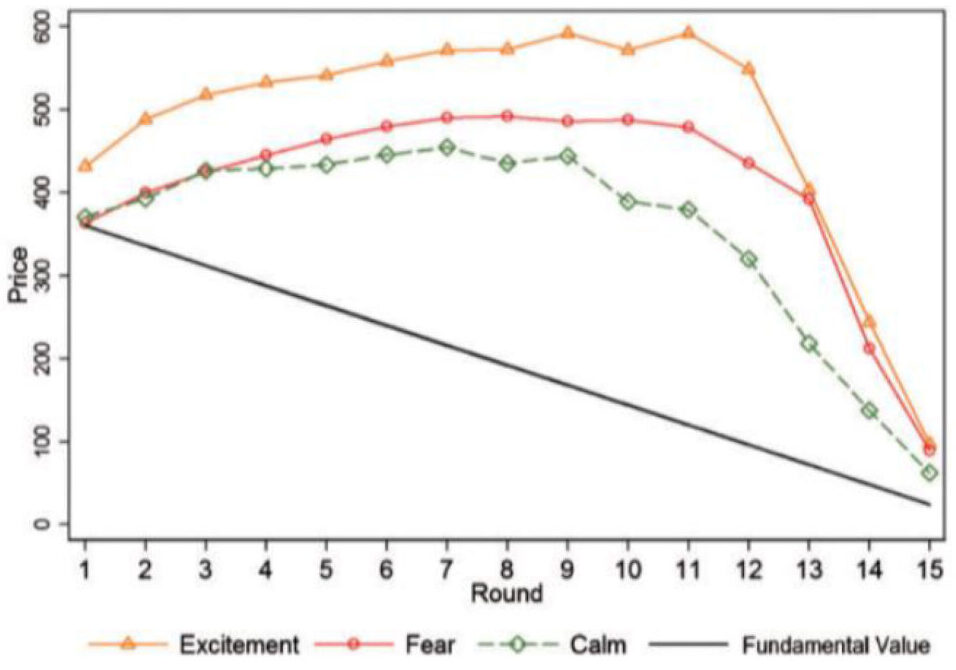
Source: Andrade et al. (2016), Bubbling with Excitement: An Experiment, p.453.

The results are even more grotesque if at the beginning of the experiment the participants are subjected to tests that icnrease their level of euphoria (yellow line) or fear (red line). In these cases, the bubbles inflate further and take longer to adjust; in fact, they never quite adjust, since in the last round, for example, the average price at which trades are executed is around $100, compared with an intrinsic value of $24 (the expected value of a single dividend).

Curiously, even in a state of fear, participants are susceptible to being swept up in the collective euphoria – the fear of missing out effect in all its glory!

Experimental economics has conducted many such games in recent decades, using small variations in the initial setup of the experiment to determine the extent to which certain factors determine the behaviour of bubbles. Some of the main factors that have been documented to facilitate the emergence, size and intensity of a bubble are:

  • The proportion of experienced versus inexperienced participants. Obviously, the more people participate in the experiment, the more accurate their stock valuations become.
  • A more uncertain statistical distribution of the dividend.
  • A statistical distribution of the dividend that includes the probability, albeit small, of outsize potential returns.
  • Buying on margin is allowed.
  • Interestingly, the possibility of short selling. Although short sellers tend to have a better understanding of the fundamental price of the stock in these experiments, they tend to start shorting very early, and then have to cover their losses at the peak of the bubble, which is thus prolonged over time.

The results of these experiments have profound implications for the functioning of markets in the real world because, as we have seen, bubbles can form even in simple environments. It is obviously difficult to know the extent to which any of these conditions are present in the real world, but I have no doubt that after a decade of easy money, financial market participants are clearly feeling exuberant.

I also believe that there are other factors behind the gains in equity indices so far this year. The proportion of people with little experience in the markets may be higher than ever (as evidenced by the rise of platforms such as Robin Hood and the retail investor), uncertainty is high (geopolitics, viruses, supply chains etc), the ability to buy and sell assets with highly skewed statistical distributions is also at high levels (as evidenced by the recent casino around the buy/sell of zero days to expiry options) and finally short sellers who have recently thrown in the towel by having to close out their positions.

Experimental economics can tell us why a bubble is forming, but unfortunately it cannot tell us how long it will last. In my view, and as I explain below, the best way to protect ourselves from these events is simply to be invested in assets that are free of these dynamics and in which we have confidence that their intrinsic value will continue to rise over time.


[1]In fact, as there are no interest rates or discount rates (the fifteen rounds are played back-to-back), the experiment is considerably simplified by relieving participants of the tedious task of discounting future dividends.

Disruption in Weight Loss Drugs, and the Dangers of Buying Into Hype

December 22, 2023 in Best Ideas Conference, Letters

This article is authored by MOI Global instructor Jeff Auxier, president of Auxier Asset Management, based in Lake Oswego.

Jeff is an instructor at Best Ideas 2024.

Over the last several years, more companies have gone public with sky-high valuations, little-to-no profit and big promises of transforming their markets. When money was cheap it was easy for a new business to attract significant investment. Not so today as the spigot is shut off.

One company that fell victim to overhype is Beyond Meat which went public in May of 2019. The alternative meat company’s stock surged 163% on its first day of trading which at the time made it one of the best day-one performances for an IPO in nearly 20 years. JPMorgan originally estimated that Beyond Meat would be able to grow their sales to $5 billion in 15 years. The hope was that millions would abandon traditional meat for plant-based meat which was deemed to be more environmentally friendly and sustainable. After the IPO, the market consensus was for Beyond Meat to turn free cash flow positive by 2022 and have compound annual sales growth of around 40%. Instead sales fell 10% that year and they have yet to attain positive free cash flow even today. The company continues to struggle due to factors like its premium price and low availability. Since the stock’s all-time high in July of 2019, it has fallen over 95%.

Another more extreme example of a torpedo is WeWork. Its valuation ballooned to $47 billion in 2019 before crashing to less than $100 million today and it is closing in on bankruptcy. Euphoria surrounding the growth of electric vehicles led Rivian’s valuation to surpass $120 billion before the company reported even a single dollar in revenue. The company’s valuation has since fallen to under $16 billion.

The Robinhood trading app tried to capitalize on the massive IPO craze by going public in 2021 with a peak market cap of over $45 billion. Since then the stock has declined over 80% to a market cap of around $9 billion. Talk is cheap and the markets tend to eventually punish bad behavior.

Disruption in Weight Loss Drugs

New weight loss drugs have recently become increasingly popular; some are proclaiming them as the next big breakthrough in the health industry. These products, called GLP-1 agonists, work by making patients feel less hungry and can also affect how the body absorbs fat. Novo Nordisk and Eli Lilly are the two leaders in this new market which analysts at Goldman Sachs and JPMorgan estimate could reach $100 billion by 2030.

Some investors are concerned that these drugs will be so effective at curbing appetites that they could fundamentally change consumption patterns and impact demand for businesses like food and beverage companies. Investors worry that fast food restaurants already contending with rising inflation will also have to deal with a potential loss in customers if the use of weight loss drugs becomes more common. It is estimated that just over 42% of US adults are obese and could potentially be prescribed weight loss drugs.

Wall Street has been quick to herald these drugs as the ultimate healthcare product, but it is important to take a more cautious stance, especially in the early stages of research. There are still many unknowns surrounding these treatments, specifically around potential side effects like thyroid tumors, pancreatitis, diarrhea and nausea. It is expensive too, with an average monthly cost for shots of around $1000.

In the third quarter excitement over these drugs led to indiscriminate selling in food, beverage, medtech and medical devices to name a few examples. It is similar to the selloff in traditional food stocks when Beyond Meat went public as referenced earlier in the letter. McDonald’s believes there are currently about five million people using obesity drugs with the potential to increase to 15 million in the next few years, which they figure could hurt volumes by one half a percent. Pepsi and Starbucks have seen no change in demand year to date.

Energy was the best performing S&P 500 sector during the quarter, up 12.2%. Continued supply cuts by OPEC+ have kept oil prices elevated as the West Texas Intermediate (WTI) Crude rose by 29% in the third quarter. The US Energy Information Administration (EIA) expects that OPEC+ will keep production limited for the remainder of 2023 and into 2024. They forecast an average Brent Crude spot price of $91 per barrel in the fourth quarter and an average of $95 per barrel for 2024. The recent conflict in Israel has fueled fears over the stability of global oil markets as there are uncertainties around what countries like Iran will do in response to escalations. Iran is one of the largest producers of oil in the world and in August their output reached 3.1 million barrels per day, the highest since 2018 (Reuters). Potential Iranian involvement should lead the US to enforce stricter sanctions on the country’s oil exports. Iran also controls the Strait of Hormuz which is the most important oil checkpoint in the world, with around 20% of global oil supply passing through daily.

Insurance Hard Market

Property casualty stocks are enjoying a hard-pricing market. Global commercial insurance pricing increased for most lines of coverage in the third quarter, according to Marsh McLennan, marking the longest run of consecutive quarterly rate hikes since 2012. US property rates are up 14% for the quarter. Auto insurance rates are up 15.5%, with rates in Florida up 88% and electric vehicles up over 70%. Disciplined operators benefit from rising prices and rising premium volume. In addition, higher interest rates improve portfolio cash flows. The insurance component of the S&P 500 trades at 12 times next year’s earnings, a steep discount to the overall market. We have a wide exposure to the property casualty industry with names like Berkshire Hathaway, Travelers, AIG, Marsh McLennan, AON and Ryan. In addition, health-related insurers like Aflac, UnitedHealth and Elevance are seeing positive fundamentals in pricing and volume trends.

In Closing

On a recent multistate trip we visited the new $40 billion Taiwan Semiconductor (TSMC) facility under construction in North Phoenix. The amount of cement required is straining supplies for the entire metro area. Over 60% of the workforce for that plant will have a masters or higher degree. This is just one of several plants going in as a result of the government CHIPS act. That roughly $52.7 billion stimulus has attracted another $200 billion in private funds which is just starting to filter through the economy. In addition, $433 billion of government spending is earmarked over the next 10 years under the Inflation Reduction Act. It is hard to see a recession in those industries related to such massive fiscal stimulus.

Most stocks and bonds have been in a grueling bear market for two years. More than half the Russell 3000 stocks are down over the past twelve months. Usually the last third of a bear market is a capitulation and the most painful. We are finally seeing attractive values in many businesses that have been experiencing multiple compression with tighter money, especially in smaller companies. Our biggest winners coming out of the 2000-2002 bear market were in smaller companies like Scottsdale credit card processor eFunds. It traded at a single digit p/e under $10, was debt free and ultimately acquired by private equity for over $37. During these challenging market conditions we strive to add value by mitigating risk through our cumulative knowledge and experience along with a ramped-up research effort. Our research centers on the earnings power and growing intrinsic value of the individual businesses we own. Longer term there is a direct correlation to the earnings and ultimate stock price return.

Miguel de Juan sobre Renault

December 22, 2023 in Ideas de inversión, MOI Global en Español

NOTA DEL EDITOR: Esta idea de inversión es obtenida de una carta a los inversores de Argos Arca Global A.

* * *

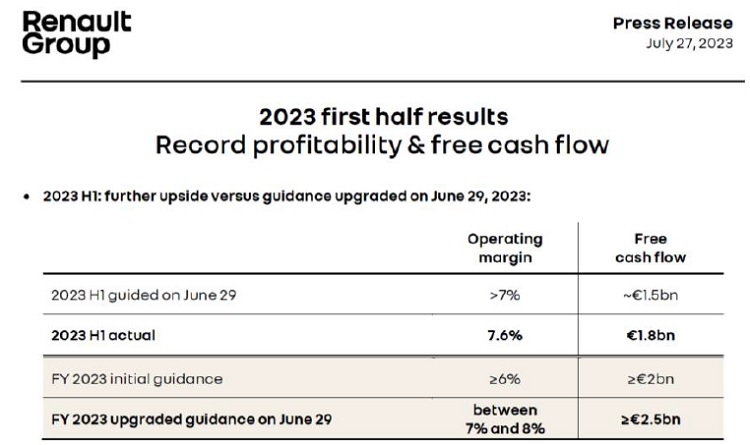
Hablemos ahora de otra de nuestras empresas: Renault [EPA: RNO] cuya evolución de negocios está yendo más que bien, avanzando sus previsiones y convirtiéndolas en resultados antes de lo que preveían.

Miembros, inicien sesión abajo para acceder al contenido restringido.

¿No eres miembro?

Gracias por tu interés. Ten en cuenta que MOI Global está cerrado para nuevos miembros en este momento. Si deseas unirte a la lista de espera para miembros hispanos, completa el siguiente formulario:


MOI Global