La evolución de la filosofía de inversión de Chuck Akre

August 20, 2025 in MOI Global en Español, Traducciones

Read in English

NOTA DEL EDITOR: La siguiente entrevista fue realizada en 2021.

* * *

Tuvimos el gran placer de conversar con Charles T. Akre, fundador de Akre Capital Management, sobre la evolución a largo plazo de su filosofía de inversión enfocada en la calidad.

En esta amplia conversación, Chuck habla sobre sus primeros años en el mundo de las inversiones, cómo perfeccionó su enfoque de inversión a lo largo del tiempo, las señales de alerta al evaluar equipos directivos, cómo algunas empresas deterioran el valor para los accionistas de manera imperceptible pero significativa con el paso del tiempo, y otros temas relacionados con la generación de rendimientos superiores a largo plazo en la inversión.

Chuck Akre fundó Akre Capital Management en 1989 tras 21 años en el negocio de valores en la firma Johnston, Lemon & Co., miembro de la Bolsa de Nueva York. En Johnston, Lemon & Co., gestionó diversas áreas del negocio, incluyendo la dirección de sucursales, el departamento de análisis y la gestión de activos. A partir de junio de 1993, Chuck operó la firma bajo el paraguas de Friedman, Billings, Ramsey & Co. En el año 2000, volvió a privatizar el negocio y trasladó la firma al pequeño pueblo rural de Middleburg, en Virginia.

* * *

Alex Gilchrist: Es un placer dar la bienvenida al legendario inversor Chuck Akre. Chuck se licenció en Literatura Inglesa en 1968 y posteriormente se incorporó a la firma Johnston, Lemon & Co., miembro de la Bolsa de Nueva York. En 1989, fundó Akre Capital Management. Desde allí, Chuck gestionó el FBR Focus Fund desde su creación hasta 2009. Ese mismo año, puso en marcha el Akre Focus Fund. Entre 1999 y 2009, logró una rentabilidad anualizada del 10% después de comisiones, frente a un -2,48% del rendimiento total del S&P 500. De 2009 a 2020, su rentabilidad anualizada fue de aproximadamente un 17% después de comisiones, en comparación con un 13,68% del S&P 500.

Durante los 20 años que trabajaste en Johnston, Lemon & Co., te dedicaste a aprender sobre inversiones y sobre los inversores. ¿Podrías contarnos qué fue lo que impulsó tu curiosidad y tu pasión por aprender sobre inversión, así como algunos de los hitos más relevantes de aquella etapa?

Chuck Akre: Tras licenciarme en Literatura Inglesa, no contaba con formación académica en negocios, economía ni materias afines. Empecé mi carrera como agente de bolsa en el verano de 1968. Era una hoja en blanco, un lienzo limpio. No sabía absolutamente nada. Me propuse averiguar qué es lo que hace que una inversión sea buena y qué es lo que convierte a alguien en un buen inversor, porque me bombardeaban desde todos los frentes con ideas, incluidas cuestiones sobre si el éxito se debía a la suerte o a si existían principios que realmente funcionaban. Traté de darle un enfoque con perspectiva. Eso es lo que he hecho durante el resto de mi carrera.

Miembros, inicien sesión abajo para acceder al contenido restringido.

¿No eres miembro?

Gracias por tu interés. Ten en cuenta que MOI Global está cerrado para nuevos miembros en este momento. Si deseas unirte a la lista de espera para miembros hispanos, completa el siguiente formulario:


Valentum sobre La Francaise de l Energie

August 18, 2025 in Ideas de inversión, MOI Global en Español

NOTA DEL EDITOR: Esta idea de inversión es obtenida de una carta a los inversores de Valentum Asset Management.

* * *

La Francaise de l Energie [XPAR: FDE] es un grupo de energías renovables francés que está desarrollando varios negocios muy específicos. El negocio histórico y, por ahora, todavía el más importante es la captura de gas metano (mucho más nocivo para el efecto invernadero que el gas natural) de antiguas minas de carbón en Francia y Bélgica, para evitar que salga a la atmósfera. Ese gas metano se captura y luego se vende como gas o se transforma y se vende como electricidad. En este momento tienen una capacidad operativa de 22,5 MW de electricidad, con 3 MW más a punto de obtener la licencia de producir, y otros 3 MW ya instalados y en trámite. El plan es llegar a los 100 MW a medio plazo. En este momento, la empresa también dispone ya de activos fotovoltaicos y de calor. Aunque los ingresos fluctúan (parte de la electricidad vendida está a precio fijo, parte a precios de mercado, la red troncal de gas en Francia no está siempre disponible), pensamos que, extrapolando el trimestre a marzo, y con los activos actuales, la empresa puede generar un EBITDA de unos €20m a €25m, lo que significa que cotiza a unas 10 veces EV/Ebitda, razonable para este tipo de negocio.

Miembros, inicien sesión abajo para acceder al contenido restringido.

¿No eres miembro?

Gracias por tu interés. Ten en cuenta que MOI Global está cerrado para nuevos miembros en este momento. Si deseas unirte a la lista de espera para miembros hispanos, completa el siguiente formulario:


Cartera 1S 2025 BrightGate Global Income Fund

August 15, 2025 in Ideas de inversión, MOI Global en Español

NOTA DEL EDITOR: El siguiente texto es obtenido de la semestral 2025 de SIH BrightGate Global Income Fund.

* * *

Productores de petróleo

Los productores de petróleo representan el mayor grupo de la cartera. La actualización de este semestre de este grupo es sencilla, ya ha tenido muy poca rotación. Nuestras principales posiciones, por peso, son DNO (a través de bonos senior e híbridos), IPCO, OKEA, Pearl Petroleum, Panoro Energy, EnQuest, Pandion Energy, Genel y BlueNord. Después del cierre del semestre vendimos IPCO, tras estar varios años en la cartera, dados los estrechos diferenciales a los que ha pasado a cotizar el bono. A pesar de que el mercado final de todos estos productores es el mismo, cada uno de ellos opera en geografías diferentes, con sistemas impositivos diferentes, tienen pesos relativos entre petróleo y gas natural diferentes y planes a futuro de desarrollo de los activos diferentes, con lo que la exposición no es tan homogénea como parece.

La principal incorporación durante el semestre han sido los bonos híbridos de DNO, que representan menos del 1% del Fondo (nuestra exposición a DNO asciende al 2% si incluimos los bonos senior en los que también estamos invertidos). DNO es una empresa que conocemos bien y en la que llevamos invertidos muchos años a través de los sucesivos bonos que ha ido emitiendo. Hemos vendido parte de los bonos senior que teníamos para poder adquirir dichos híbridos sin aumentar la concentración del Fondo en este emisor. En los últimos años DNO se ha embarcado en una política de adquisiciones en el Mar del Norte con el fin de diversificar su base de activos, que tradicionalmente ha estado en Kurdistán. A pesar del pobre desempeño operativo de los activos en Kurdistán en los últimos años con motivo del cierre del principal oleoducto de la zona, la empresa ha seguido generando abundante caja en un entorno de precios del petróleo de 70$ Brent que le ha permitido seguir teniendo un balance saneado, con deuda financiera neta negativa.

Miembros, inicien sesión abajo para acceder al contenido restringido.

¿No eres miembro?

Gracias por tu interés. Ten en cuenta que MOI Global está cerrado para nuevos miembros en este momento. Si deseas unirte a la lista de espera para miembros hispanos, completa el siguiente formulario:


Nishant Gupta on the Nuances of Investing Across Geographies

August 13, 2025 in Equities, Interviews, Transcripts

We had the pleasure of speaking with Nishant Gupta, founder and CIO of Kanou Capital, a London-based long/short energy transition fund.

Nishant has over two and half decades of investment experience working alongside Peter Lynch and other renowned investors through his roles at Fidelity Investments, TT International, and Lansdowne Partners. He is an expert on energy, industrials, and materials and has covered multiple geographies including Asia, EU, and the US. Furthermore, Nishant has been co-teaching the value investing course at London Business School since 2019.

In this exclusive interview, Nishant provides insights into structuring Kanou Capital, how his experiences shaped Kanou’s investment philosophy and nuances of investing across the different geographies. We also dive into the investment strategy and the energy transition space, as well as its corresponding capital cycle. Finally, we learn more about Nishant’s contributions at London Business School.

Overview:

  • Nishant Gupta’s Background
  • Structuring Kanou Capital
  • Kanou Capital’s Investment Philosophy (Cheap + Quality = Value)
  • Nuances in investing Europe and Asia versus the US
  • Kanou Capital’s Investment Strategy
  • Insights into the Energy Transition Space, and Capital Cycle Dynamics
  • Co-teaching the Value Investing Elective at London Business School

Tarek Andari: Tell us about your professional background and how the idea of launching Kanou Capital came about.

Nishant Gupta: Kanou capital is a fundamental long/ short hedge fund focused on energy transition. We launched Kanou Capital in February 2025 with a US$100 million seed. Our investment approach is highly differentiated, grounded in deep fundamental research, and focused on global sector coverage.

In terms of my background, I grew up in India and studied chemical engineering at IIT Bombay. Following graduation, I worked for five years in Japan as a software engineer, primarily at UBS Investment Bank, where my interest in finance began.

I then earned the MBA from Columbia Business School, participating in its value investing program, which greatly influenced my investment philosophy. After Columbia, I joined Fidelity Investments, spending nine years across their Boston, Hong Kong, and London offices. At Fidelity, I covered energy transition-related sectors such as industrials, materials, utilities, and energy, and managed analyst sector funds. This experience taught me rigorous fundamental investing, financial modeling, primary research, engaging deeply with management teams, and assessing long-term intrinsic value.

Subsequently, I joined TT International in London, a reputable boutique firm established by former Fidelity colleagues. At TT, I incorporated a macroeconomic perspective into my investing approach, complementing my bottom-up analytical foundation from Fidelity. Though I don’t consider myself a macro investor, this macro-awareness proved essential.

In 2019, I joined Lansdowne Partners’ energy fund, which later became Clean Energy Transition (CET), managing multibillion dollars in assets making it one of the largest dedicated energy transition funds globally. Here, I refined my expertise in shorting and disciplined risk management.

Kanou Capital is the combination of these experiences: the deep fundamental research approach from Fidelity, macroeconomic insights from TT International, and disciplined risk management from Lansdowne Partners and Clean Energy Transition.

Tarek Andari: Can we touch on structuring Kanou Capital, and maybe tell us some of the operational and fundraising challenges you’ve had, and how you initially approached building trust with your seed client to get going?

Nishant Gupta: Launching a new fund in the UK involves significant complexity and takes longer than other regions, particularly the US, which partly explains why fewer funds launch here.

When I left CET, I knew that I wanted to set up my own fund rather than joining another platform because the most important thing for me in any business is culture, and culture comes from the top, and you can only set it if you are setting your own firm. Additionally, my experience from three respected firms, Fidelity, TT, and Lansdowne, and our focus on energy transition, a critical long-term investment theme, opened doors to initial investor conversations.

I knew most of these investors were not Day One investors, but I knew we were building a long-term institutional quality product, so building these relationships was important. I am lucky that we have a lot of interest from some very high-quality investors who are closely following us. In these conversations, we discussed our investment style, our team’s strengths, and why we believe we have a repeatable framework for generating attractive risk-adjusted returns. We were fortunate to find an excellent partner who backed us with seed capital.

Operationally, given that FCA registration in UK can take time, we’ve outsourced non-investment activities such as trading, compliance, and operations. Fortunately, the industry has evolved significantly, making outsourcing efficient and seamless. We plan to gradually bring these activities in-house once our regulatory license is secured, likely early next year.

“The most important thing for me in any business is culture, and culture comes from the top, and you can only set it if you are setting your own firm”

Tarek Andari: Just to follow up, is Kanou capital registered as an LLP and US domiciled?

Nishant Gupta: Kanou Capital’s management company is UK-domiciled, and the fund itself is registered in the Cayman Islands. We structured the management company as an LLP because it allows us to treat team members as true partners, aligning incentives and fairly rewarding their contributions. My previous two firms were also LLPs, and I find this structure best reflects the collaborative culture we’re building at Kanou.

Tarek Andari: You’ve combined 3 investment frameworks built upon from your experience. So, what would be an ideal client then? Are they still long-term clients with sticky capital, measuring you on a long-term benchmark, or given the long/ short aspect, are you a bit shorter to near term on your results?

Nishant Gupta: That’s a good question. While energy transition is undoubtedly a long-term theme, we chose a long/short approach rather than long-only because the sectors we invest in tend to be highly volatile and cyclical, driven by macro factors like commodities, politics, and regulation. Our goal is to compound investors’ capital at double-digit rates over a long horizon while carefully managing volatility.

We see energy transition today as being on the cusp of major change, much like the technology sector was 25–30 years ago. This inflection point presents a significant opportunity to generate attractive long-term returns. Our investment philosophy focuses on deep fundamental analysis, understanding management teams, and assessing capital allocation decisions, while allowing these investments to play out over time rather than relying on short-term trading.

Our analysis indicates that dispersion in returns within energy transition sectors is comparable to that in technology, a sector where long/short strategies have successfully generated strong risk-adjusted returns over multiple decades.

Tarek Andari: You touched on the investment philosophy, happy to move into that next. You mentioned, starting in UBS then going to the value investing program, learning fundamental analysis, then looking at shorting. So, which experiences have influenced you the most or shaped your philosophy over time?

Nishant Gupta: Great question. The first big shift for me was the value investing program at Columbia Business School, where I learned firsthand from great guest lecturers who were practicing investors on the Wall Street. While studying there, I also worked part-time at a very reputable hedge fund called Tyndall Management, founded by the universally respected Jeff Halis. We did deep-dive research but took only a handful of new positions each year, an experience that taught me the importance of patience and discipline in investing.

At Fidelity, I saw these principles in action. Portfolio managers like Will Danoff and Joel Tillinghast – completely different styles, one growth, one value—both beat the market for decades. Early on, I also had the privilege of spending time with Peter Lynch. Each quarter, he would sit down with our small group of new analysts for candid, in-depth discussions about investing. His passion for stocks was infectious, even after all his success, and it was incredibly inspiring to witness.

One lasting lesson came from a portfolio manager at Fidelity who had a sign on his door: “Cheap is not value. Cheap + Quality is value” That line stuck with me. It became central to how I invest and is something I still teach my students at London Business School.

Covering cyclical sectors over the past two decades reinforced those lessons. Cycles create windows where high-quality businesses temporarily trade cheap. If you stay patient, you can collect steady singles and, once in a while, swing for that home run.

Investing is endlessly fascinating—you’re always learning. Even being right 60% of the time can yield outstanding results. That mix of value discipline, patience, and passion for stocks shaped me into the investor I am today.

“Cheap is not value, Cheap + Quality is Value”

Tarek Andari: Thank you for bringing up ‘Cheap + Quality = Value’, there are different shades of value investing as you mentioned, and that anchors the discussion well. Could you maybe share with our community some nuances you consider when looking at stocks in different geographies, for example, or assessing other investor strategies in different geographies in terms of portfolio, turnover duration, etc, maybe. How does that shape your investment strategy?

Nishant Gupta: Sure and let me also connect this to your earlier question.

At Kanou Capital, our philosophy centers on changes in ROIC (Return on Invested Capital), which we see as the single most important metric for any business. We analyze stocks as businesses, looking at market position, competition, long-term drivers, and management’s capital allocation. Mauboussin’s work, and our own analysis, shows that companies moving up quintiles generate outsized returns. The market tends to price short-term earnings quickly but often misses these gradual, multi-year improvements in ROIC, whether driven by culture shifts or better capital efficiency. That’s where we find the most opportunity.

This also shapes how we look at sectors. Fast-moving themes like AI are quickly priced in, but areas such as energy infrastructure, much of which is 50–60 years old, are slower-moving and overlooked. The shift to renewables, EVs, storage, and electrification will take decades. These long-duration changes allow us to invest with conviction, compound capital steadily, and avoid the volatility that often comes with chasing near-term themes.

“In the U.S., management incentives are closely tied to shareholder returns, leading to efficient capital allocation and quicker decision-making. In Europe, management teams think longer-term but often operate with less efficient balance sheets, which can keep valuations lower.”

Geography plays a role too. Charlie Munger used to say that you need to understand somebody’s incentive to understand how they are going to act. In the U.S., management incentives are closely tied to shareholder returns, leading to efficient capital allocation and quicker decision-making. In Europe, management teams think longer-term but often operate with less efficient balance sheets, which can keep valuations lower. On the other hand, Asia is a difficult market to invest in, because the mentality that minority shareholders are owners is only acknowledged by very few companies and very few management teams. We focus there on high-quality businesses with durable moats only because of this reason.

Our strategy revolves around identifying slow, durable ROIC improvements and partnering with management teams that are aligned with shareholders. These dynamics differ by region, but the core philosophy remains the same.

“Asia is a difficult market to invest in, because the mentality that minority shareholders are owners is only acknowledged by very few companies and very few management teams.”

Tarek Andari: Thank you. A good way to round off both questions. I’m aware of the tables that you’re talking about on TSR and quintile movements. I have two questions from the same paper. I believe he’s presented a dispersion of returns of economic profit for companies, and the Russell 3,000 for the 4–5 year period between 2018 to 2022, and the dispersion shows that a lot of the economic profit is concentrated in the best decile firms versus having a sort of a linear spread between worst to best. You see a lot of the economic profit at the top 10%. Do you see something similar in Industrials and Energy Transition? Or is it more spread out? And you have winners across the spectrum.

Nishant Gupta: I’d say it’s a bit more balanced in our sectors. Unlike technology, where you often see a “winner-take-all” dynamic, sectors that we invest in tend to be more cyclical, so the dispersion is wider. That said, we mostly focus on companies in the 4th and 5th ROIC quintiles, the second-best and best quality buckets. Occasionally, if a high-quality company temporarily falls to a lower quintile, we’ll step in, but we generally avoid the lowest end of the spectrum.

As Ben Graham put it, “The fastest way to lose money is to buy low-quality, highly cyclical companies during good times.” People get overly optimistic when conditions are strong and pile into weak businesses, and that’s when mistakes happen. That quote, written back in the ’50s, is still just as true today.

Tarek Andari: Another topic that Mauboussin touches on as well is the level of investment in intangible assets versus tangible, given your comparison to the technology sector, do you see this in Industrials and Energy Transition as well? If so, what frameworks are you using to assess quality on the intangible scale, versus tangible?

Nishant Gupta: That’s a good question. In our universe, these are mostly heavy capital cycle sectors. The bulk of the assets are tangible, and when it comes to intangibles, what you typically see on the balance sheet is Goodwill, mostly from past M&A. So we don’t face the same complexities around intangibles that you see in tech or brand-driven businesses.

Tarek Andari: Maybe now is a good time to bring up the Bloomberg report. Since we’re touching on the sector in a bit more detail. A strand of the energy transition sector, which is clean energy, in my mind maybe encompasses software companies, some more tangible assets and infrastructure maybe, across the spectrum of business models there. I will leave it to you to guide me on that. Bloomberg quoted you saying that the sector was dead for now so could you maybe walk us through the rationale? And maybe again a question on frameworks whether you use the capital cycle framework here at all to come to such a conclusion.

Nishant Gupta: The headline didn’t fully capture the essence of what I was trying to say. Energy transition is complex. When we think of energy, there are three components to the pie: a third is electricity, a third is transport, which is oil, and a third is heating, which is mainly natural gas. Now, with that composition, clearly the electricity part is growing. Helped not only by AI-driven demand but also by the shift away from oil in transport and gas in heating. More EVs mean more electricity use, and building codes are increasingly pushing electric based heating.

“When we think of energy, there are 3 components to the pie: a third is electricity, a third is transport, which is oil, and a third is heating, which is mainly natural gas. Now, with that composition, clearly the electricity part is growing”

Our focus is on going deeper in the supply chain of this long-term transition. The capital cycle has started. We are in the second year of a 2-3 decade investment cycle . We’re focusing on the supply chain. We look at the energy transition from a non energy lens. Our focus is to invest in industrials and materials because you can find lots of companies with low capital intensity and high ROIC.

“The capital cycle has started. We are in the second year of a 2–3 decade investment cycle”

Clean energy specifically is struggling right now because subsidies have created volatility rather than stability. I saw something similar back in 2007–08: policy noise drove boom-and-bust cycles that prevented the supply chain from planning capacity properly. Ironically, clean energy today is competitive on cost even without subsidies. If we removed subsidies and allowed demand to stabilize naturally, it would create more certainty and accelerate the build-out. But I really hope, because I do care about the environment and the planet, and we all should do, I really hope the renewables and cleaner fuel should take a bigger market share.

I’ll give you an example. I’m in Boston today visiting after a very long time. My investment journey started in Boston when I started in 2008. I remember Boston winters had snowfall everyday and big snowstorms every winter. I was shocked to learn that it barely snows in Boston anymore. And people are still debating whether there’s global warming or not. To go back to the meaning of Kanou. The word Kanou is a Japanese word which means ‘Possible’, and to my earlier point and to the energy transition, this word Kanou, it highlights the various opportunities, challenges, and uncertainties associated with moving towards a more sustainable and low carbon energy system. It acknowledges the complexity of this transaction involving technological, economic, social, and political dimension. The reason we chose Kanou, which means “Possible”, is that it is still possible. It’s getting late, but it’s still possible to stop and reverse climate change. But we don’t have a lot of time.

Tarek Andari: What KPIs then, or metrics, are you using here to gauge over or under capacity at different points in the market?

Nishant Gupta: In capital-intensive and manufacturing-driven sectors, the key KPI is utilization, but we also closely watch inventories, order intake, and organic growth.

Demand can be volatile in the short term, but over the long run, it usually tracks GDP-like growth rates. Supply, on the other hand, is easier to forecast in our sectors because it takes multi-years for new capacity to come online.

Another KPI we watch is marginal cost. Understanding both utilization and how the marginal cost curve is moving gives you a sense of where pricing power and profitability are headed.

Finally, we focus on free cash flow generation and how management reallocates that cash. We also emphasize ROIIC, or Return on Incremental Invested Capital, which is forward-looking. ROIC looks backward, but ROIIC answers: “If you invest a dollar today, what’s the expected return on that incremental capital?” That forward view is critical for judging management decisions and future returns.

ROIC looks backward, but ROIIC answers: “If you invest a dollar today, what’s the expected return on that incremental capital?” That forward view is critical for judging management decisions and future returns.

Tarek Andari: We have a couple of minutes left, should we conclude with your excellent contributions in academia over the past 7 years. I’m aware you’ve been a Visiting/ Affiliate lecturer at London business school co-teaching the value investing elective. Could you reflect on why you think this is very important to do? Is there any advice you’d share with the MOI Global community to be more engaged or aligned with an academic body?

Nishant Gupta: The Value Investing program I took at Columbia Business School was truly exceptional because it was all about learning from real investors and real-world situations, not just textbooks. At Columbia, every week we worked on fresh, live case studies, companies that were actively being debated in the market. You learn by doing the work, discussing with professors and fund managers, and engaging with classmates who are all analyzing different stocks. That kind of hands-on experience is invaluable. That’s what we try to do at London Business School.

Having spent 15 years alongside investors who consistently beat the market, I don’t question whether markets are efficient, I know they’re not. The key is figuring out how to exploit those inefficiencies. One of the core lessons we emphasize is that “cheap is not value”. Twenty years ago, buying low-multiple stocks might have worked, but with today’s quants and multi-managers competing on short-term moves, you need to focus on quality and on long-term undercurrents that the market often overlooks.

Our teaching emphasizes understanding businesses deeply: what they do, their drivers, how to value them, and only then looking at price. There’s a great line from an ex-Fidelity fund manager: “The paradox of investing is that the more long-term your perspective, the more short-term outcomes you get right”. That’s exactly what we want students to internalize, focus on the long-term fundamentals, and the near-term noise takes care of itself.

For me, giving back through teaching is personal. My parents were both schoolteachers. I learned a lot about investing at Columbia, and it feels like a responsibility to help the next generation of investors develop the same foundation.

Tarek Andari: Thank you that’s inspirational. If we can have maybe two more minutes, I would like to ask a challenging question. Why do you feel that it is relevant to teach value investing when the active investing space is under pressure?

Nishant Gupta: That’s a great question. I’d say there are many ways to make money in markets. I’m not claiming that value investing is the only way, but it’s the approach that has worked for me, and it’s what I know best, so it’s what I can teach with conviction.

When we talk about value investing today, it’s very different from what it was 20–30 years ago. Modern value investing isn’t just about buying something cheap on a low multiple. We’re happy to pay a fair price, even a premium, for a high-quality business with strong management, a clear MOAT, good growth prospects, and the ability to compound over time. To us, that combination – quality, durability, and growth at a reasonable price – is what creates real value.

We see our role as providing various frameworks and being a resource to students. It’s deeply rewarding to share what’s worked for us and help them develop the skills and mindset needed to invest with a long-term perspective.

Tarek Andari: Sure, and in terms of the tools being learned, and the applicability of the tools in a challenging active management industry. Would you say it’s still right to teach the class? And it’s important for these tools to be taught even though the prospects of a long-term career in this field may not be available for too long?

Nishant Gupta: I’d push back on the idea that long-term investing is dying. If you look at where the real capital sits, endowments and large institutions, they care deeply about long-term compounding. They value investors who can deliver steady double-digit returns and remain focused on the long game.

In my view, the key is to integrate technology into every aspect of money management and risk management.

That said, I understand where the question comes from. The increasing focus on short-term trading has created more volatility in markets.

Too often, investors let market moves undermine their conviction, but today’s markets are driven far more by flows and algorithms than by fundamentals. If you treat those moves as signals, it’s easy to get shaken out of good ideas.

Instead, focus on what you do best: deep research, conviction in your process, and holding through volatility. If you can do that, there’s still enormous opportunities for long-term investors who think independently. For students, my message is simple: be positive. The opportunity for thoughtful, long-term investing today is every bit as good as it was when I started in 2006, if anything, it’s better given the higher volatility due to increasingly short-term focus.

Tarek Andari: As a closing statement, can I ask you to provide a piece of advice, one you would have given yourself when starting out or when reflecting on your journey for the MOI Global community?

Nishant Gupta: I don’t think this will be something you haven’t heard before, but it’s timeless: do what you genuinely enjoy. Don’t choose finance, or any field, just because of the money. Look at Meta paying US$200 million to AI engineers. If you truly enjoy what you do, you’ll naturally get better at it, and the success will follow.

Tarek Andari: Perfect thanks so much, Nishant. I really appreciate it.

Nishant Gupta: Thank you for the opportunity.


The content of this website is not an offer to sell or the solicitation of an offer to buy any security. The content is distributed for informational purposes only and should not be construed as investment advice or a recommendation to sell or buy any security or other investment, or undertake any investment strategy. There are no warranties, expressed or implied, as to the accuracy, completeness, or results obtained from any information set forth on this website. BeyondProxy’s officers, directors, employees, and/or contributing authors may have positions in and may, from time to time, make purchases or sales of the securities or other investments discussed or evaluated herein.

Bestinver sobre BGC Group

August 11, 2025 in Ideas de inversión, MOI Global en Español

NOTA DEL EDITOR: La siguiente idea de inversión es obtenida de una carta trimestral de los fondos de Bestinver.

* * *

Tras la Segunda Guerra Mundial, el enorme crecimiento del mercado de renta fija ofrecía buenas oportunidades de negocio para los intermediarios financieros. En este contexto, en 1945 nació en B.G. Cantor & Co —germen del actual BGC Group— como bróker centrado en la operativa con bonos del Tesoro de EE. UU.

A medida que se fue dejando atrás la economía de guerra y el país se consolidó como primera potencia occidental, la industria de los fondos de inversión experimentó un enorme crecimiento. Para aprovecharlo, B.G. Cantor & Co —que, por entonces, ya se llamaba Cantor Fitzgerald— abrió en 1965 su división centrada en el inversor institucional de renta fija. Desde entonces, la marcha de la compañía y del mercado financiero norteamericano ha sido paralela.

Miembros, inicien sesión abajo para acceder al contenido restringido.

¿No eres miembro?

Gracias por tu interés. Ten en cuenta que MOI Global está cerrado para nuevos miembros en este momento. Si deseas unirte a la lista de espera para miembros hispanos, completa el siguiente formulario:


La Cartera de Salmón Mundi Capital en el 1S 2025

August 8, 2025 in Ideas de inversión, MOI Global en Español

NOTA DEL EDITOR: Este texto es obtenido de una carta semestral de Salmón Mundi Capital.

* * *

La estructura de la cartera mantiene un posicionamiento defensivo. A cierre del semestre las posiciones largas representaban el 74% de la cartera y las posiciones cortas el 51%. La distribución de las posiciones largas por sectores era la siguiente: petróleo (27%), oro, plata y mineras (20%), TMT (19%) y otros sectores (8%). Por otro lado, se mantienen posiciones cortas sobre índices internacionales de renta variable con el objetivo de proteger la cartera. La distribución de las posiciones cortas es la siguiente: EEUU (21%), Canadá (10%), Australia (9%) y otros (11%). La liquidez y bonos corporativos a corto plazo representan el 26% de la cartera.

Inversión en Oro y Plata

Los futuros del oro volvieron a alcanzar niveles récord en el trimestre, señal de que existen importantes desequilibrios en la economía. La demanda de los bancos centrales se mantiene fuerte, alcanzando por tercer año consecutivo compras de más de 1.000 toneladas, muy por encima de las 400-500 toneladas que compraban de media en la década anterior. El caso más llamativo es el del banco central de China ya que, según informó Goldman Sachs, está comprando en secreto casi diez veces más oro del que reporta. Por otra parte, este año se ha alcanzado otro nuevo hito, ya que el oro ha superado al euro como segundo mayor activo de reserva mundial.

El precio de la plata ha alcanzado en estos meses máximos de los últimos trece años, aun así, y debido al fuerte repunte del oro, el ratio del oro contra la plata sigue más favorable a la plata. Además, los repuntes en el precio de la plata tienden a seguir a los del oro, aunque con un decalaje.

Miembros, inicien sesión abajo para acceder al contenido restringido.

¿No eres miembro?

Gracias por tu interés. Ten en cuenta que MOI Global está cerrado para nuevos miembros en este momento. Si deseas unirte a la lista de espera para miembros hispanos, completa el siguiente formulario:


Interest Rate Paradigm Shift: Eastern Europe Poised for Revaluation

August 6, 2025 in Commentary, Diary, Equities, Europe, Ideas

This article is authored by MOI Global instructor Steve Gorelik, portfolio manager at Firebird Management.

Firebird has been investing in Eastern European equities for over thirty years, and over that time, we’ve learned to take a few things for granted: inflation and interest rates tend to be higher than in developed markets, and local currencies typically depreciate—gradually or abruptly—against the dollar and euro.

This pattern is well documented. Weaker institutions raise perceived risk and elevate inflation expectations. These expectations fuel actual inflation, which puts further downward pressure on the currency. Depreciation then raises the cost of imports, reinforcing inflation and creating a vicious cycle.

But what would happen if the circumstances change and these assumptions no longer hold true?

As noted in a recent FT Alphaville piece, “The U.S. is NOT an emerging market.”[1] While developed economies like the U.S. grapple with political interference in monetary policy, many of the emerging markets once dismissed as fiscal basket cases are now pursuing more orthodox, credible economic policies. Countries such as Brazil, South Africa, and Turkey are running restrictive interest rate regimes aimed at reining in inflation and restoring consumer confidence.

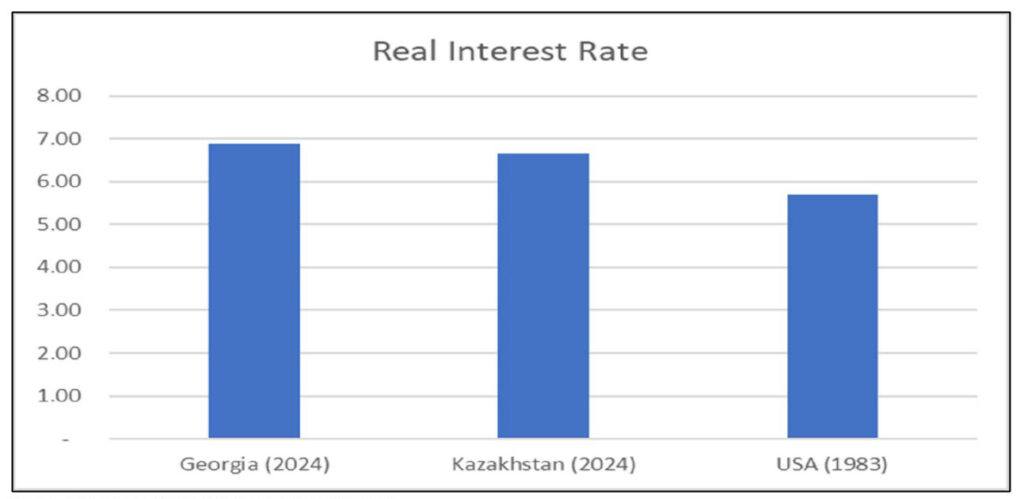
In our investment universe, in countries like Georgia and Kazakhstan, central banks maintain high interest rates while inflation is seemingly under control and has been coming down for the last two years. Real interest rates in these countries are well over 6%, which is higher than the peak reached in U.S. during the Volcker era. The central banks are run by western educated technocrats who have seen the first-hand impact that high inflation has on the economy and haven’t just read about it in textbooks.

Source: Bloomberg, Firebird Value Advisors Research

The latest policy rates for Kazakhstan and Georgia are set at 15.25% and 8% respectively, which raises a question: What happens to these economies—and to asset values—if interest rates begin to seriously decline?

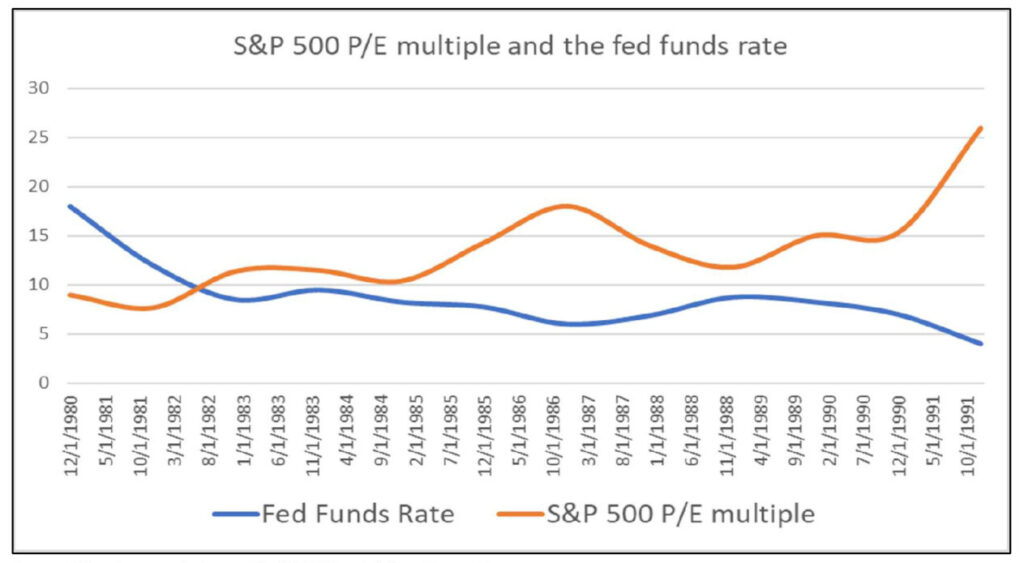
The U.S. offers a compelling historical parallel. From 1980 to 1990, real interest rates fell from nearly 6% to under 1%. During the same period, the Fed funds rate dropped from 18% to 7%, and inflation declined from over 12% to under 6%. This shift catalysed a virtuous cycle: declining rates spurred investment, which drove productivity and growth. Between 1983 and 1990, U.S. real GDP grew at an average annual rate of over 4%, compared with just under 1% in the preceding five years.

The effect on equity markets was even more dramatic. While corporate after-tax profits grew at 4.5% annually, the S&P 500 delivered returns of more than 14% per year, thanks in large part to multiple expansion.

Source: Bloomberg, multpl.com, Firebird Value Advisors Research

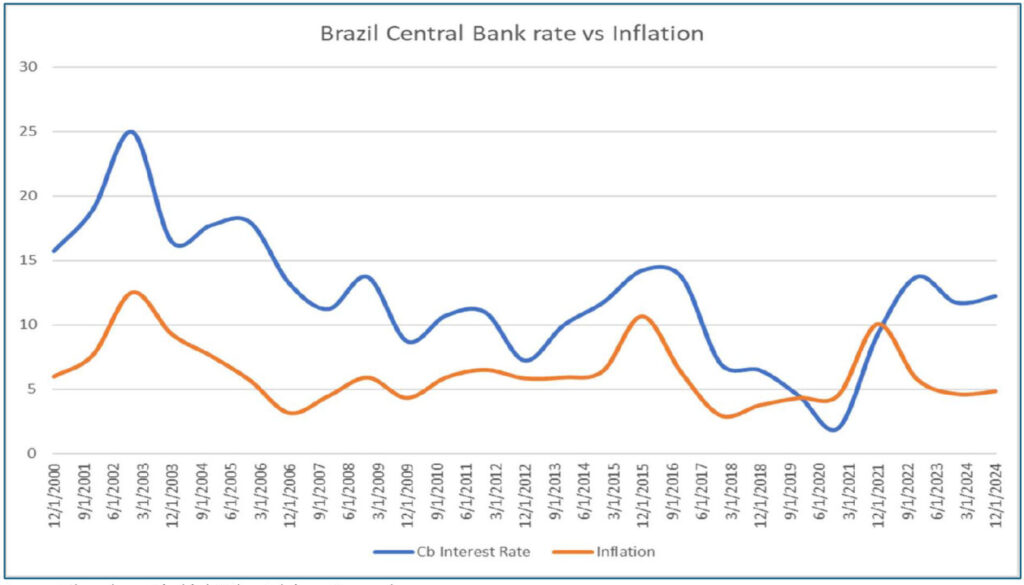
In another example from an emerging market, Brazil over the past two decades experienced multiple periods when real interest rates were sharply increased to combat inflation, and later brought down once price pressures were under control. In 2002, with inflation spiking above 12%, the central bank raised its target rate to 25%. This decisive action helped stabilize prices, and both inflation and interest rates declined steadily over the following decade. During that time, equity markets delivered annualized returns of 25%.

Source: Bloomberg, Firebird Value Advisors Research

Inflation surged again in 2015, prompting the central bank to raise rates to over 14%. By 2019, both inflation and policy rates had fallen to around 4%, and equities once again posted impressive returns of 27% per year. Remarkably, this performance occurred against a backdrop of intense political turbulence—including the Lava Jato corruption scandal, the impeachment of President Rousseff, the imprisonment of former President Lula, and the election of the highly polarizing far-right populist Jair Bolsonaro. This suggests that, in emerging markets, investors often care more about the direction of interest rates than the noise of political headlines—no matter how dramatic they may be.

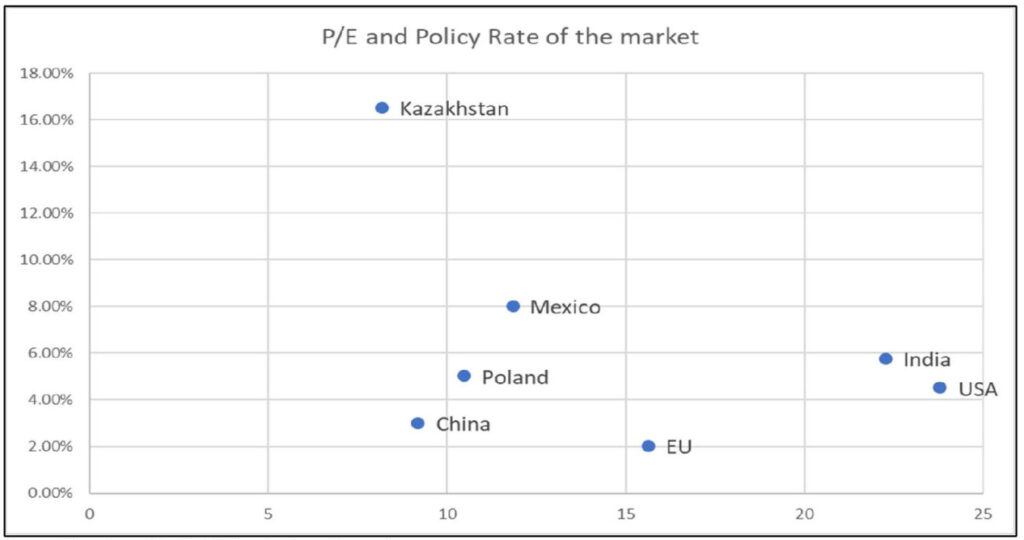
Looking at interest rates and equity valuations around the world, a clear pattern emerges: countries with higher policy rates tend to have equities trading at lower valuations. The theoretical explanation lies in the Discounted Cash Flow (DCF) model, where the interest rate is a key component of the denominator. In practice, however, it is important to consider not only domestic interest rates but also the discount rates used by the marginal buyers of securities. If the buyers are primarily domestic, then local interest rates and risk premiums apply. However, if the buyers are foreign, their funding costs and risk perceptions may differ significantly—either lower or higher—than those of the domestic audience.

Source: Bloomberg, Firebird Value Advisors Research

As shown in the earlier examples, high real interest rates often signal that rates are likely to decline once the central bank believes inflation is under control. When that happens, equity trading multiples typically rise, as the discount rate used by marginal buyers falls.

Going back to Georgia and Kazakhstan, we believe that these countries boast some of the bestmanaged companies in the emerging markets universe. Banks such as Halyk Bank and Lion Finance (Georgia) have been in recent years generating returns on equity in excess of 30%. Despite delivering outstanding results—EPS growth of 21% p.a. for Halyk and 33% for Lion since 2019—these companies remain astonishingly cheap, trading at just 3.5x and 6x earnings, respectively. With GDP growth already exceeding 5% in Kazakhstan and 9% in Georgia, a sustained decline in interest rates could provide the catalyst for multiple expansion and a rerating of these stocks.

In thirty years of investing, we saw some of the best opportunities emerge when long-held assumptions began to crack. Markets can be slow to adjust their frameworks, even when the underlying fundamentals have already shifted. This inertia creates pockets of profound mispricing—particularly in regions that are overlooked and where investors have been conditioned to expect certain outcomes. When perceptions finally catch up to reality, the adjustment tends to be substantial.


[1] https://www.ft.com/content/a9a9dd1e-36cf-4e2e-81d0-05c64a01871f

The content of this website is not an offer to sell or the solicitation of an offer to buy any security. The content is distributed for informational purposes only and should not be construed as investment advice or a recommendation to sell or buy any security or other investment, or undertake any investment strategy. There are no warranties, expressed or implied, as to the accuracy, completeness, or results obtained from any information set forth on this website. BeyondProxy’s officers, directors, employees, and/or contributing authors may have positions in and may, from time to time, make purchases or sales of the securities or other investments discussed or evaluated herein.
Por qué la innovación farmacéutica es crucial

August 4, 2025 in Industrias, MOI Global en Español

NOTA DEL EDITOR: Este texto es obtenido de una carta mensual de NAO Sustainable Asset Management.

* * *

En un momento en que las farmacéuticas vuelven a estar en el punto de mira —ya sea por los precios de sus tratamientos, por los largos periodos de exclusividad o por nuevas amenazas arancelarias desde EE.UU.— conviene recordar por qué existen estos incentivos. Innovar en medicina no solo implica años de investigación, miles de millones invertidos y altas tasas de fracaso; también significa abrir nuevas puertas donde antes solo había resignación. Gracias a esas apuestas de alto riesgo, hoy hablamos de curar cánceres con células del propio paciente o de corregir errores genéticos en bebés antes condenados. Como inversores sostenibles, creemos que premiar esta innovación responsable no es solo rentable, sino necesario: porque cuando invertir salva vidas, proteger el modelo que lo hace posible también es una forma de cuidar el futuro. Este comentario va por todos aquellos que necesitamos creer en los milagros.

Un avance médico sin precedentes

En los últimos meses hemos sido testigos de un hito histórico en la medicina: un bebé con una enfermedad genética rara ha sido tratado con éxito gracias a la edición genética personalizada. El pequeño, identificado como K.J., nació con un trastorno metabólico hereditario gravísimo que antes era sentencia de muerte, pero una innovadora terapia basada en CRISPR corrigió el defecto genético en sus células hepáticas, salvándole la vida. Este caso real y reciente ejemplifica cómo la biotecnología está revolucionando la medicina moderna, permitiendo curar o tratar enfermedades que hasta hace poco eran incurables. No es un hecho aislado: se enmarca en una revolución biomédica mayor que lleva gestándose décadas y que ahora está alcanzando su madurez.

De la medicina tradicional a la biotecnología moderna

La medicina de gran parte del siglo XX se basó en medicamentos tradicionales, moléculas químicas descubiertas a menudo por ensayo y error. Remedios históricos como la penicilina (descubierta por Alexander Fleming en 1928) inauguraron la era de los antibióticos, y las campañas de vacunación masiva lograron hitos como la erradicación de la viruela en 1980. Sin embargo, hasta finales del siglo pasado la mayoría de los fármacos se obtenían por síntesis química y tenían como diana procesos relativamente genéricos del organismo. La biotecnología vino a cambiar ese paradigma al permitir diseñar terapias vivas o biológicas, dirigidas específicamente a blancos moleculares de enfermedades. El auge de la biotecnología moderna comenzó en la década de 1970 cuando, por primera vez, los científicos pudieron cortar y pegar genes de un organismo a otro, creando microorganismos capaces de producir sustancias de interés médico. Este avance sentó las bases para una transformación radical en la forma de desarrollar fármacos.

Miembros, inicien sesión abajo para acceder al contenido restringido.

¿No eres miembro?

Gracias por tu interés. Ten en cuenta que MOI Global está cerrado para nuevos miembros en este momento. Si deseas unirte a la lista de espera para miembros hispanos, completa el siguiente formulario:


5 perlas de sabiduría de Warren Buffett

August 1, 2025 in Contenido Libre, Editor's Pick, MOI Global en Español

NOTA DEL EDITOR: El siguiente texto escrito por Javier Ruiz, CFA, es un extracto de una carta trimestral de Horos Asset Management.

* * *

Warren Buffett es el mejor inversor de todos los tiempos. Su capacidad para mantener la calma y aprovechar las oportunidades cuando otros entran en pánico es insuperable. SETH KLARMAN

El pasado 3 de mayo, Warren Buffett anunció que, tras 60 años liderando el conglomerado Berkshire Hathaway y con su 95.º cumpleaños a la vuelta de la esquina, ha llegado el momento de retirarse y ceder el testigo al que hasta ahora era el vicepresidente responsable de las operaciones no relacionadas con seguros: Greg Abel. El anuncio se produjo en un momento “perfecto”, tanto para Buffett como para los accionistas de Berkshire Hathaway, con la cotización del grupo en máximos históricos y una rentabilidad acumulada en estas seis décadas superior al 5.500.000% (alrededor de un 20% anualizado). Me cuesta imaginar que, con un vehículo de inversión comparable, alguien pueda acercarse alguna vez a lo logrado por Buffett.

Pero su legado va mucho más allá de sus resultados inigualables. Sus enseñanzas han sido un faro fiable en los mejores y peores momentos del mercado. Hacer una recopilación de todas sus perlas de sabiduría daría para escribir un libro (y, de hecho, ya hay varios), así que me limitaré a destacar cinco que nos han acompañado a Alejandro, a Miguel y a mí a lo largo de nuestra trayectoria profesional.

Lo más importante al evaluar negocios es saber lo que sabes y saber lo que no sabes. Esa es una filosofía que me ha funcionado muy bien

Por supuesto, con estas palabras, Buffett alude al concepto de círculo de competencia. Este principio se entiende muy bien, como ya destacamos en una de nuestras cartas trimestrales, con la famosa matriz de decisión expuesta por Donald Rumsfeld, secretario de Defensa de Estados Unidos durante la presidencia de George W. Bush, en una rueda de prensa de 2002. En ella distinguía entre certidumbres conocidas (lo que sabemos que sabemos), incertidumbres conocidas (lo que sabemos que no sabemos) e incertidumbres desconocidas (lo que no sabemos que no sabemos).

Como inversores, debemos mantener una honestidad intelectual radical y ser plenamente conscientes de nuestras limitaciones, para centrarnos en aquellos negocios o sectores donde realmente podamos realizar un análisis suficientemente robusto que minimice nuestros errores. En definitiva, debemos poner el foco en lo que sabemos que sabemos, saber acotar lo que sabemos que no sabemos y evitar aquellos escenarios que nos expongan a lo que no sabemos que no sabemos.

En nuestros inicios como equipo, tuvimos que enfrentarnos a esta realidad en algunas de nuestras inversiones, siendo el caso más paradigmático el de la antigua Viacom (compañía de medios propietaria de MTV, Nickelodeon o Paramount). Se trataba de una empresa que comenzaba a sufrir los efectos de un cambio estructural en su sector, con la irrupción de plataformas como Netflix o YouTube. No supimos identificar correctamente esa amenaza competitiva y, a posteriori, quedó claro que ese sector —al menos, en aquel momento— estaba fuera de nuestro círculo de competencia.

Con todo, aprendimos rápido: esa experiencia nos ayudó a evitar inversiones posteriores en compañías como Atresmedia o Mediaset, y a reconocer el verdadero valor de activos como YouTube, mientras fuimos accionistas de Alphabet (conglomerado propietario de Google).

Un buen negocio es como un castillo sólido con un foso profundo a su alrededor. Quiero tiburones en ese foso. Lo quiero intocable

Si en páginas anteriores mencionábamos la importancia de evolucionar como inversores, esta idea buffettiana es un claro ejemplo de ello. Buffett fue el discípulo más aventajado —y sin duda el más exitoso— de cuantos tuvo Benjamin Graham, el fundador de la escuela del value investing. Graham, que vivió en primera persona la Gran Depresión de los años treinta, ideó una metodología de inversión basada, grosso modo, en comprar compañías por debajo de su teórico valor de liquidación. Esta forma de invertir, vulgarmente conocida como “inversión colilla” (equivale a que un fumador se encuentre un cigarro a medio terminar tirado en el suelo: consumir las caladas que quedan puede ser desagradable, pero sale gratis), ponía el foco, por tanto, en el descuento sobre el balance de una empresa, y no tanto en su capacidad futura de generación de caja.

En un primer momento, Buffett adoptó con gran éxito esta metodología de inversión. Sin embargo, con el paso de los años —y bajo la influencia de su inseparable Charlie Munger— comenzó a virar hacia negocios de mayor calidad, bajo la premisa de que el tiempo es enemigo de los negocios mediocres y aliado de los grandes negocios. Pero ¿cómo distinguirlos? Para Buffett, la calidad de un negocio viene determinada, en gran medida, por lo que él denominó el foso del negocio. Al igual que un castillo estaba rodeado por un foso para protegerse de los invasores, las mejores compañías cuentan con barreras de entrada y ventajas competitivas que las resguardan de los ataques de la competencia. Cuanto mayor y más profundo sea este foso, más sostenible será su modelo de negocio y su rentabilidad futura. Esta transición llevó a Berkshire Hathaway a invertir, a lo largo de su historia, en empresas de altísima calidad como American Express, The Washington Post, Coca-Cola o Moody’s.

En HOROS, siempre hemos defendido esta idea, aunque también hemos dejado claro que no implica invertir exclusivamente en las compañías percibidas como las de mayor calidad —especialmente cuando no ofrecen un margen de seguridad adecuado—. A nuestro entender, cada sector puede esconder auténticas joyas capaces de generar retornos atractivos para el accionista. El propio Buffett, sin ir más lejos, también ha invertido en la industria del petróleo y gas, por citar un sector de gran ciclicidad. Para identificarlas, llevamos a cabo un análisis profundo de la cadena de valor de las industrias en las que invertimos y tratamos siempre de posicionarnos en aquellas situaciones más favorables en cada momento.

Sólo cuando baja la marea se descubre quién estaba nadando desnudo

Aunque esta famosa frase de Buffett puede interpretarse de muchas maneras en el mundo de la inversión, personalmente siempre la he asociado a los riesgos del endeudamiento excesivo. Durante los años favorables del ciclo de un negocio, resulta muy tentador para un equipo directivo aumentar el apalancamiento para acometer nuevos proyectos y aprovechar el viento de cola. El problema, claro está, surge cuando las vacas gordas se acaban y toca capear el temporal. En los contextos más negativos para una industria, el nivel de endeudamiento puede marcar la diferencia entre la supervivencia o la quiebra de una compañía.

Por supuesto, la naturaleza del negocio juega un papel clave a la hora de determinar si una compañía soporta un nivel de apalancamiento adecuado. Hay empresas que pueden convivir con una mayor carga de deuda gracias a la estabilidad de sus ingresos —como ocurre con los negocios defensivos—, mientras que aquellas que operan en sectores con fuerte variabilidad —como los cíclicos— pueden verse, siguiendo a Nassim Taleb, fragilizadas por niveles elevados de apalancamiento.

Con el tiempo, nos hemos vuelto cada vez más aversos a la deuda en nuestras inversiones. Nos guste o no, los escenarios negativos también terminan por materializarse, y las probabilidades de sufrir pérdidas permanentes de capital aumentan sensiblemente cuando las compañías presentan estructuras financieras débiles. Por todo ello, nuestras participadas suelen operar con caja neta o, en su defecto, con niveles muy reducidos de deuda.

La asignación de capital es el trabajo más importante de un consejero delegado

El equipo directivo desempeña un papel esencial —como hemos visto en los ejemplos de inversión de Horos Value Iberia— a la hora de destapar y generar valor para los accionistas. Posiblemente, Warren Buffett fue el primer gran inversor en reconocer plenamente esta realidad, en parte porque, desde sus inicios profesionales, se involucró activamente en la gestión de las compañías en las que invertía, ya fuera como accionista de control o, más adelante, como propietario a través de Berkshire Hathaway.

Todo equipo directivo debería comprender el abanico de opciones que tiene a su disposición como gestor del capital de una compañía, así como el impacto que cada una de sus decisiones puede tener en la creación de valor. Saber cuándo reinvertir en el negocio, adquirir otras compañías, modificar el nivel de endeudamiento, recomprar acciones, ampliar capital o repartir dividendos resulta fundamental. Como accionistas, nuestro deber es identificar y respaldar a aquellos directivos que demuestren criterio, disciplina y alineación a la hora de llevar a cabo esta labor esencial.

¿Cómo asegurarnos de ello? Observar el historial de decisiones del equipo directivo es, sin duda, un buen punto de partida. Sin embargo, y aunque más tarde sería popularizado por Nassim Taleb con su concepto de skin in the game (jugarse el pellejo), ya hace décadas que Buffett nos mostró el camino: invertir en compañías en las que los directivos se juegan su propio dinero junto al del resto de los accionistas. Si bien un sistema de incentivos puede ayudar a alinear intereses, lo verdaderamente poderoso es que los gestores sean también accionistas significativos de las empresas que dirigen. Por eso, una parte sustancial de nuestras carteras suele estar compuesta por compañías familiares, donde los fundadores siguen siendo también sus principales accionistas.

Primera norma: nunca pierdas dinero. Segunda norma: nunca olvides la primera norma

Por supuesto, todo lo anterior es condición necesaria, pero nunca suficiente para alcanzar rentabilidades satisfactorias y sostenibles. Falta el ingrediente más importante de todos: el margen de seguridad. Solo cuando invertimos con un descuento suficiente sobre la valoración razonable de una compañía estaremos realmente más cerca de cumplir la regla de oro de Buffett: no perder dinero.

Aquí es fundamental diferenciar entre dos conceptos que a menudo se confunden: las pérdidas temporales (sobre el papel) y las pérdidas permanentes de capital. Las primeras son casi inevitables y forman parte de la volatilidad natural de la renta variable. Por eso es clave, como también insiste Buffett, distinguir entre precio y valor. Las segundas, en cambio, son las que pueden arruinarnos como inversores y suelen estar asociadas a comprar negocios con escaso o nulo margen de seguridad. No lo olvidemos: una pérdida del 50% en una inversión exige una ganancia del 100% para recuperar el punto de partida. Y eso, créame, no es tarea sencilla.

El margen de seguridad no solo implica comprar barato o con descuento, sino que también engloba muchos de los aspectos que ya hemos comentado. Cuando invertimos en negocios que comprendemos (círculo de competencia), bien posicionados dentro de su sector (ventajas competitivas y barreras de entrada), estructuras financieras sólidas (endeudamiento nulo o limitado), y liderados por equipos directivos capaces y alineados con el accionista (buena asignación de capital), estamos incrementando sustancialmente el margen de seguridad de nuestra inversión.


MOI Global