Un outsider como asignador de capital

March 8, 2019 in Miscelánea, MOI Global en Español

NOTA DEL EDITOR: El siguiente texto escrito por Javier Ruiz, CFA, es un extracto de una carta trimestral de Horos Asset Management.

* * *

Dos compañías con resultados operativos idénticos y diferentes aproximaciones en su gestión de capital, generarán a largo plazo dos resultados muy distintos para sus accionistas.
— William N. Thorndike

La frase que acaba de leer pertenece a The Outsiders, un libro muy recomendable, en el que William Thorndike nos enseña, a través de ocho ejemplos reales, cómo la gestión de capital de los directivos de una compañía puede marcar una gran diferencia para sus accionistas. Como explica Thorndike, los equipos directivos de una compañía cuentan con cinco alternativas fundamentales a la hora de gestionar el capital. En concreto, pueden reinvertir en el negocio, adquirir otras empresas, reducir deuda, pagar dividendos y recomprar acciones propias. Tan importante son las alternativas que tienen como la forma de financiarlas. No tendrá el mismo impacto para el accionista emitir deuda, que ampliar capital o utilizar el efectivo generado por el negocio. Por tanto, la gestión de capital no es un tema baladí y se le debe dar la importancia que se merece si pretendemos contar con un proceso sólido de inversión.

Miembros, inicien sesión abajo para acceder al contenido restringido.

¿No eres miembro?

Gracias por tu interés. Ten en cuenta que MOI Global está cerrado para nuevos miembros en este momento. Si deseas unirte a la lista de espera para miembros hispanos, completa el siguiente formulario:

Lo Mejor de Charlie Munger en la Asamblea Anual 2019 de DJCO

March 6, 2019 in Miscelánea, MOI Global en Español

El pasado jueves 14 de febrero se celebró la asamblea general anual de Daily Journal Co [DJCO], casa editorial estadounidense. Como es tradición, Charlie Munger, presidente de la casa editorial y vicepresidente de Berkshire Hathaway [BRK-A;BRK-B], reunió a más de dos mil curiosos para escuchar y aprender de la sabiduría de este legendario inversor. Cabe destacar que es la primera vez que la asamblea es transmitida en vivo (al final encontrarás el video).

Estas son las mejores frases de Charlie ante la presentación y las respuestas a las preguntas de los asistentes:
Continue reading »

Sierra Wireless: Benefiting from Sustained Industry Growth

March 5, 2019 in Equities, Ideas, Letters

This post is excerpted from a letter by MOI Global instructor Jim Roumell, partner and portfolio manager of Roumell Asset Management, based in Chevy Chase, Maryland.

Sierra Wireless is an Internet of Things (IoT) provider empowering businesses to transform in the connected economy. The company offers a device to cloud solution, comprised of embedded and networking solutions integrated with its secure cloud and connectivity services. OEMs and enterprises rely on SWIR to deliver fully integrated solutions to reduce complexity, turn data into intelligence and get their connected products and services to market faster. SWIR has an estimated 30% of the market while competitors Telit and Gimalto are each estimated to have 20% market share.

SWIR operates under three reportable segments:

OEM Solutions — Wireless technologies and support of open source initiatives that enable OEMs and system integrators to get their IoT solutions to market faster. SWIR makes it simple to embed cellular, Wi-Fi, Bluetooth and Global Navigation Satellite System technologies, as well as manage devices, connectivity services, and data through its IoT cloud platform. Customers include automotive, transportation, energy, enterprise networking, sales and payment, mobile computing, security, healthcare and others.

Enterprise Solutions — Provides networking solutions comprised of cellular gateways and routers that are complemented by cloud-based services and on-premise software for secure device and network management.

IoT Services — Enables the digital transformation of enterprises through integrated IoT cloud and connectivity services. This segment is comprised of three main areas of operation: (i) cloud services, which provide a secure and scalable cloud platform for deploying and managing IoT subscriptions, over-the-air updates, devices and applications; (ii) global cellular connectivity services which are subscription-based and include flexible Smart SIM and core network platforms; and (iii) managed broadband cellular services, which include a combination of hardware, high speed connectivity and cloud services.

RAM has a history in investing in SWIR, as this is our third time in the stock. For many years, we spoke with recently retired CEO Jason Cohenour. After an extensive search, the company choose Kent Thexton to be President and CEO as of November 1, 2018. Mr. Thexton had been serving as interim President and CEO since May 31, 2018. He has extensive experience in the cellular wireless and IoT industries. We recently spoke with Jason Krause, COO, and David McClennan, CFO, and came away convinced that SWIR was continuing to move in the right direction.

Members, log in below to access the restricted content.

Not a member?

Thank you for your interest.  Please note that MOI Global is closed to new members at this time. If you would like to join the waiting list, complete the following form:

Disclosure: The specific securities identified and described do not represent all of the securities purchased, sold, or recommended for advisory clients, and the reader should not assume that investments in the securities identified and discussed were or will be profitable. The top three securities purchased in the quarter are based on the largest absolute dollar purchases made in the quarter.

Xavier Brun sobre ABInBev

March 4, 2019 in Contenido Libre, Ideas de inversión, MOI Global en Español

NOTA DEL EDITOR: Esta idea de inversión es obtenida de una carta de Trea European Equities.

* * *

Precio: 57,70€ (31 diciembre 2018)
Capitalización Bursátil = 116.500 Mill €
Deuda Neta ajustada = 108.730 Mill €
PER ajustado = 10,5x

La historia de Roma nace en 753 a.C. con la muerte de Remo a manos de su hermano Rómulo, ambos amamantados por la loba Capitolina cuando eran bebés. En ese momento, nace el primer período de la civilización romana: la Monarquía. Con la muerte del último rey Tarquino el Soberbio nace en 507 a.C. el segundo período: la República. En esa etapa, se desataron las guerras púnicas que llevaron a Roma a expandir su control en torno al mar Mediterráneo y a adquirir nuevos dominios (Hispania entre otros). En el 27aC nace el último período: el Imperio, de la mano del emperador Cesar Augusto. En esa época existían también dos Europas lingüísticas: la del latín y la del germano-celta, igual que existían prácticamente dos bebidas estrella: el vino, en la zona romana, y la cerveza, en la zona germano-celta.

Continue reading »

Capital Allocation, Corporate Governance, and Investor Relations

March 2, 2019 in Commentary, Equities, Featured, Letters

This article is authored by MOI Global instructor Phil Ordway, Managing Principal at Anabatic Investment Partners, based in Chicago, Illinois.

Replay and read a transcript of Phil’s session on this topic at Best Ideas 2019.

I recently attended a meeting hosted by one of our largest holdings, and afterward the CEO asked for my thoughts. I responded with my usual sermon on capital allocation, corporate governance, and investor relations. To my surprise, he was so receptive that he invited me to present to the company’s board of directors. His willingness to learn and solicit shareholder input are very encouraging signs.

My point to the board will be simple. They’re already running a great operation, and the culture is healthy and vibrant. There is a lot to like about the company, but if they want to go from good to great capital allocation is the way to get there.[1]

How a company chooses to use its cash is a crucial determinant of success or failure, but the results only show up over a period of years. The irony is that many companies – including the one in question here – are exceptional in their sophisticated, disciplined allocation of capital when it comes to physical assets, technology, people, etc. So why do many companies seem to neglect the financial aspect of capital allocation that encompasses the balance sheet, acquisitions, dividends, and share repurchases?

Most CEOs get the top job because of operational excellence, marketing talent, or other skills that have nothing to do with allocating capital. The board is supposed to choose and oversee the CEO, but most boards are similarly inexperienced when it comes to capital allocation. It doesn’t help that the board and the executive team often suffer from imperfect incentives as well.

The shareholders supposedly own the company – can they do something constructive in this regard? “Activist” investors and index funds are growing forces that often get the attention, but usually for the wrong reasons. Retail investors don’t have the ability or scale to have much of a voice, and the engaged, long-term institutional shareholder is a dying breed.

All hope is not lost. Excellent capital allocators are rare, but dozens of examples exist. Many exemplary companies have become healthier, more sustainable, and more valuable by making a conscious effort to improve their capital allocation. That’s why I think there are mutually beneficial solutions for companies and their shareholders. Company executives need to make the difficult, long-term decisions that position their companies for success. To do that they need supportive, engaged shareholders with the right mindset. Directors need to supply the framework and oversight to keep things on track.

Effective communication is the linchpin. A smart capital allocation framework, communicated through a thoughtful investor relations function, can attract patient, long-term, rational shareholders that will be an asset to the company. It is possible to create a positive feedback loop in this regard, but precious few companies even bother to try.

Effective companies have an investing mindset throughout the organization, especially at the top – the CEO and board must embrace their role as capital allocators if they’re going to succeed. Over time, these allocators-in-chief adopt many of the same practices and habits:

• a focus cash flow and per-share metrics;
• a long-term view and a willingness to absorb short-term pain;
• autonomy and decentralized decision-making;
• hiring for attitude and fit, not skills;
• an emphasis on culture, not just strategy;
• an openness to being different and looking (temporarily) dumb;
• a dedicated cultivation of the “right” investors, not the highest share price;
• frugality and humility.

It is just as important to consider what effective companies avoid. The don’t follow conventional practices like paying a dividend or repurchasing shares just to “return cash to shareholders” or “reward shareholders” or “enable more investors to own the stock.” They don’t spend a lot of effort courting the sell-side community or trying to increase the stock price. They don’t neglect shareholder communication or the annual meeting. They don’t ignore the problem and hope it will go away.

Perhaps the best way to sum it up is to consider Matt Rose, the outgoing CEO of BNSF Railway Co., who recently had this to say while reflecting on his two decades at the helm.[2]

Vantuono: Since BNSF became part of Berkshire Hathaway, you haven’t had to answer to Wall Street. Would you say that’s been an advantage?

Rose: Yes. When we did the deal in 2009, I told our management team that it would probably take us 10 years to look back and say whether or not this was a good experiment. And by that I meant, could we outperform vs. being a standalone company? And I think the answer is yes. Why is that? Warren has given me, personally, tremendous flexibility to run the company. He’s been very interested in our returns, and we have done a good job for him.

When we were publicly traded, I would go to sell-side conferences. It used to be me with investors and sell-side analysts. And then it changed. The meetings got larger. There’d be 20 hedge fund analysts; they all seemed to be under 30 years of age. Creating transparency about how you’re doing versus another company, and the old spirit of how you’re running your company versus somebody else, I think that’s fine. But when a hedge fund says, “I really want to know how you’re going to do next quarter” on a railroad that is making 30-, 40-, 50-year-long asset investments, it’s really not consistent.

The day after [shareholders approved the acquisition] I called Warren, and I said, “Okay Warren, you now own a railroad. Congratulations. What do you want me to do? You want me to come to Omaha and bring a power point and show you what our next five-year plan’s going to be?” And he said, “No. I want you to run this company like you own it, and you’re going to be in charge of it for the next 100 years.” And I don’t think that’s consistent with a hedge fund wanting to know what the next quarter’s going to look like. When you think about getting back to the customer, and working with the markets and customers to grow your business, these are not necessarily 10-year opportunities, but they’re not something that always shows up in the next quarter, or even in next year’s numbers.

Not every company can be acquired by Berkshire Hathaway, but that’s not the point. By cultivating a long-term investor’s mindset and the right shareholder base to support it, companies across the spectrum can get the same outstanding results.

[1]Capital allocation is a loaded term and it’s worth clarifying. Most investors think of capital allocation as the process by which a company decides how to use its excess free cash flow in pursuing growth opportunities, M&A, dividends, and share repurchases. The reality, of course, is that cash is fungible, and capital allocation also includes the purchase of software, “maintenance” spending on physical assets, etc. The better description might be “how a company decides to use its cash and assets,” but I will stick with the all-encompassing version of capital allocation.

[2] https://www.railwayage.com/freight/class-i/matt-rose-less-is-not-better/

Replay and read a transcript of Phil’s session on this topic at Best Ideas 2019.

Disclaimer: Gross Long and Gross Short performance attribution for the month and year-to-date periods is based on internal calculations of gross trading profits and losses (net of trading costs), excluding management fees/incentive allocation, borrowing costs or other fund expenses. Net Return for the month is based on the determination of the fund’s third-party administrator of month-end net asset value for the referenced time period, and is net of all such management fees/incentive allocation, borrowing costs and other fund expenses. Net Return presented above for periods longer than one month represents the geometric average of the monthly net returns during the applicable period, including the Net Return for the month referenced herein. An investor’s individual Net Return for the referenced time period(s) may differ based upon, among other things, date of investment. In the event of any discrepancy between the Net Return contained herein and the information on an investor’s monthly account statement, the information contained in such monthly account statement shall govern. All such calculations are unaudited and subject to further review and change. For purposes of the foregoing, the calculation of Exposure Value includes: (i) for equities, market value, and (ii) for equity options, delta-adjusted notional value.

THE INFORMATION PROVIDED HEREIN IS CONFIDENTIAL AND PROPRIETARY AND IS, AND WILL REMAIN AT ALL TIMES, THE PROPERTY OF ANABATIC INVESTMENT PARTNERS LLC, AS INVESTMENT MANAGER, AND/OR ITS AFFILIATES. THE INFORMATION IS BEING PROVIDED SOLELY TO THE RECIPIENT IN ITS CAPACITY AS AN INVESTOR IN THE FUNDS OR PRODUCTS REFERENCED HEREIN AND FOR INFORMATIONAL PURPOSES ONLY.

THE INFORMATION HEREIN IS NOT INTENDED TO BE A COMPLETE PERFORMANCE PRESENTATION OR ANALYSIS AND IS SUBJECT TO CHANGE. NONE OF ANABATIC INVESTMENT PARTNERS LLC, AS INVESTMENT MANAGER, THE FUNDS OR PRODUCTS REFERRED TO HEREIN OR ANY AFFILIATE, MANAGER, MEMBER, OFFICER, EMPLOYEE OR AGENT OR REPRESENTATIVE THEREOF MAKES ANY REPRESENTATION OR WARRANTY WITH RESPECT TO THE INFORMATION PROVIDED HEREIN. AN INVESTMENT IN ANY FUND OR PRODUCT REFERRED TO HEREIN IS SPECULATIVE AND INVOLVES A HIGH DEGREE OF RISK. THERE CAN BE NO ASSURANCE THAT THE INVESTMENT OBJECTIVE OF ANY SUCH FUND OR PRODUCT WILL BE ACHIEVED. MOREOVER, PAST PERFORMANCE SHOULD NOT BE CONSTRUED AS A GUARANTEE OR AN INDICATOR OF THE FUTURE PERFORMANCE OF ANY FUND OR PRODUCT. AN INVESTMENT IN ANY FUND OR PRODUCT REFERRED TO HEREIN CAN LOSE VALUE. INVESTORS SHOULD CONSULT THEIR OWN PROFESSIONAL ADVISORS AS TO LEGAL, TAX AND OTHER MATTERS RELATING TO AN INVESTMENT IN ANY FUND OR PRODUCT.

THIS IS NOT AN OFFER TO SELL OR SOLICITATION OF AN OFFER TO BUY AN INTEREST IN A FUND OR PRODUCT. ANY SUCH OFFER OR SOLICITATION WILL BE MADE ONLY BY MEANS OF DELIVERY OF A FINAL OFFERING MEMORANDUM, PROSPECTUS OR CIRCULAR RELATING TO SUCH FUND AND ONLY TO QUALIFIED INVESTORS IN THOSE JURISDICTIONS WHERE PERMITTED BY LAW.

ALL FUND OR PRODUCT PERFORMANCE, ATTRIBUTION AND EXPOSURE DATA, STATISTICS, METRICS OR RELATED INFORMATION REFERENCED HEREIN IS ESTIMATED AND APPROXIMATED. SUCH INFORMATION IS LIMITED AND UNAUDITED AND, ACCORDINGLY, DOES NOT PURPORT, NOR IS IT INTENDED, TO BE INDICATIVE OR A PREDICTOR OF ANY SUCH MEASURES IN ANY FUTURE PERIOD AND/OR UNDER DIFFERENT MARKET CONDITIONS. AS A RESULT, THE COMPOSITION, SIZE OF, AND RISKS INHERENT IN AN INVESTMENT IN A FUND OR PRODUCT REFERRED TO HEREIN MAY DIFFER SUBSTANTIALLY FROM THE INFORMATION SET FORTH, OR IMPLIED, HEREIN.

PERFORMANCE DATA IS PRESENTED NET OF APPLICABLE MANAGEMENT FEES AND INCENTIVE FEES/ALLOCATION AND EXPENSES, EXCEPT FOR ATTRIBUTION DATA, TO THE EXTENT REFERENCED HEREIN, OR AS MAY BE OTHERWISE NOTED HEREIN. NET RETURNS, WHERE PRESENTED HEREIN, ASSUME AN INVESTMENT IN THE APPLICABLE FUND OR PRODUCT FOR THE ENTIRE PERIOD REFERENCED. AN INVESTOR’S INDIVIDUAL PERFORMANCE WILL DIFFER BASED UPON, AMONG OTHER THINGS, THE FUND OR PRODUCT IN WHICH SUCH INVESTMENT IS MADE, THE INVESTOR’S “NEW ISSUE” ELIGIBILITY (IF APPLICABLE), AND DATE OF INVESTMENT. IN THE EVENT OF ANY DISCREPANCY BETWEEN THE INFORMATION CONTAINED HEREIN AND THE INFORMATION IN AN INVESTOR’S MONTHLY ACCOUNT STATEMENT IN RESPECT OF THE INVESTOR’S INVESTMENT IN A FUND OR PRODUCT REFERRED TO HEREIN, THE INFORMATION CONTAINED IN THE INVESTOR’S MONTHLY ACCOUNT STATEMENT SHALL GOVERN.

NOTE ON INDEX PERFORMANCE

INDEX PERFORMANCE DATA AND RELATED METRICS, TO THE EXTENT REFERENCED HEREIN, ARE PROVIDED FOR COMPARISON PURPOSES ONLY AND ARE BASED ON (OR DERIVED FROM) DATA PUBLISHED OR PROVIDED BY EXTERNAL SOURCES. THE INDICES, THEIR COMPOSITION AND RELATED DATA GENERALLY ARE OWNED BY AND ARE PROPRIETARY TO THE COMPILER OR PUBLISHER THEREOF. THE SOURCE OF AND AVAILABLE ADDITIONAL INFORMATION REGARDING ANY SUCH INDEX DATA IS AVAILABLE UPON REQUEST.

Asian Investing Summit 2019 Preview: Persistent Systems

March 2, 2019 in Asian Investing Summit, Equities, Ideas

This article is authored by MOI Global instructor Amit Chander, Partner at Baring Private Equity Partners India, based in Delhi.

Persistent Systems is a mid-tier IT services company based in India. It was founded in 1990 by current CEO Anand Deshpande, a first-generation technocrat entrepreneur. Unlike other Indian IT services companies, which were targeting Fortune 500 Enterprises in the US and offering application maintenance and support work, he focused on becoming a partner to technology companies in the US (Microsoft, IBM, SAP) and assisting them in their software product development from India, also referred to as Outsourced Product Development (OPD).

Anand has successfully led the company from a startup to a mid-size IT services player with revenue of USD 471 million in FY2018 and 9,000+ employees in offices across the world. The average ROE of the company for the last five years is ~25%.

Given its vantage point from servicing leading technology companies, it was able to spot the macro of technology spend shifting toward digital technologies earlier than its peers. However, it lacked the sales engine to engage with enterprise customers in their digital initiatives.

To plug this gap, it took a two-pronged approach, where it started acquiring end-of-life, low-priority IT products with a large customer base, giving it ready access to such customers and enabling it to showcase its capabilities by augmenting those products. At the same time, the company started increasing investments in sales and marketing by hiring senior sales professionals who came with requisite background in enterprise sales.

As a result, 21% of revenue comes from digital technologies, and it has 130 enterprise customers. The growth momentum from these initiatives has slowed in recent quarters, which has led to sharp correction in stock prices (down ~40% in January 2019 from 52-week highs). Post a modest pullback, this high-quality business is still valued at 6.4x EV/EBITDA based on March 2019 earnings (adjusted for ~$200 million in cash on the balance sheet). The company generates high free cash flow from operations. On a relative basis, the valuation is a 50% discount to its mid-cap IT peers.

Members, log in below to access the restricted content.

Not a member?

Thank you for your interest.  Please note that MOI Global is closed to new members at this time. If you would like to join the waiting list, complete the following form:

Learnings From India’s Mini-Lehman Crisis

March 1, 2019 in Asian Investing Summit, Commentary, Letters

This article is authored by MOI Global instructor Amey Kulkarni, Fund Manager at Candor Investing, based in Pune, India.

India had its mini-Lehman crisis when one of its infrastructure behemoths, IL&FS, defaulted on loans in early September 2018. Andy Mukherjee of Bloomberg termed the IL&FS default as India’s “Lehman moment”. It is estimated that IL&FS has a consolidated loan outstanding of more than $25 Bn. Not only have banks lent money to IL&FS, but also pension funds, mutual funds and even cash-rich corporates have lent to IL&FS.

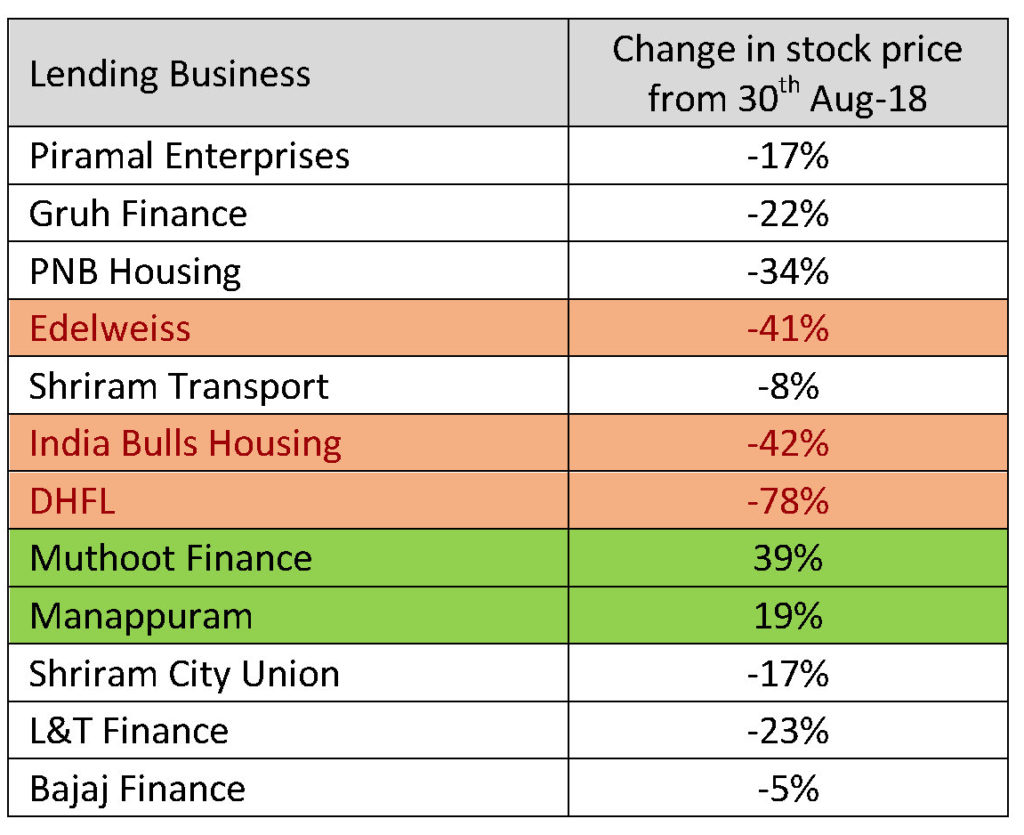
A panic spread through India’s financial markets. Money markets froze and lending businesses found it difficult to not just raise additional money, but also roll over existing loans. Stock prices of most lending businesses fell anywhere between 20% to 90%.

Lending businesses are evaluated using the commonly accepted CAMEL model

  • C – Capital Adequacy Ratio
  • A – Asset Quality
    Asset Quality refers to the riskiness of the loan assets, the financial vulnerability of the counter-party. Eg personal loans are riskier than secured mortgage loans.
    Non-performing Assets (NPA) and its trend over several years is a good proxy indicator of the asset quality.
  • M – Management Quality
    A conservative and capable management is important to success in a lending business because disbursing loans is easy, getting the money back in the difficult part.
  • E – Earnings/Return on Equity (ROE)
    Lending businesses grow at a multiple to the GDP growth and growth is not a concern in a fast-developing economy like India.
    However, if the lending business grows faster than ROE, it needs to raise additional equity capital, thus diluting the existing investors.  Though a higher ROE can be achieved by increasing the gearing ratio, reducing the cost-to-income ratio, operating in a segment where spreads are higher (eg. Gold loans, microfinance, SME lending etc.) are also safer/better ways of improving ROE.
  • L – Liquidity
    All lending businesses borrow from one to lend to the other and hence maintaining an appropriate asset liability match is critical to the survival of the business. Ability to raise money especially under adverse conditions is critical to sustainability of the business.

Emphasis needs to be laid on the fact that growth is not an evaluation criterion since disbursing additional loans is a very easy thing, getting back the money is difficult.

Over the last 20 years, India has been home to several 100-bagger lending businesses. HDFC Bank, Kotak Mahindra Bank, Shriram Transport Finance, Manappuram Finance are just a few sample names. Investing in Indian lending businesses has been very rewarding for investors in the past and is likely to yield good returns in the future as well.

Let us analyze a representative sample of 12 lending businesses operating in India and derive some insights and lessons which will serve us well when picking stocks in the future.

We have specifically chosen 12 non-banking finance companies because though they come under the regulatory supervision of either the Reserve Bank of India (RBI) or National Housing Bank (NHB), the central bank of India does not act as the lender of last resort.

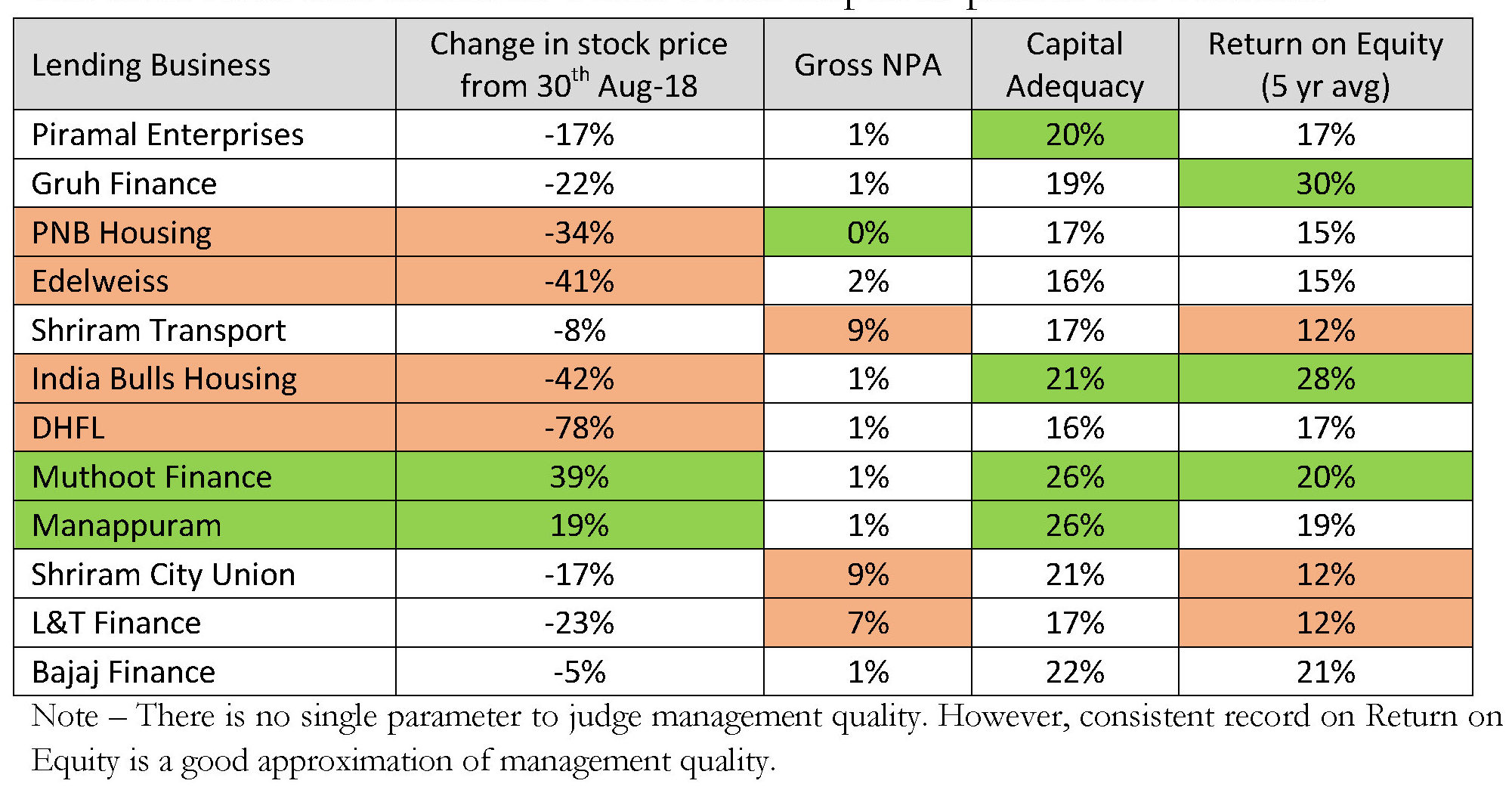
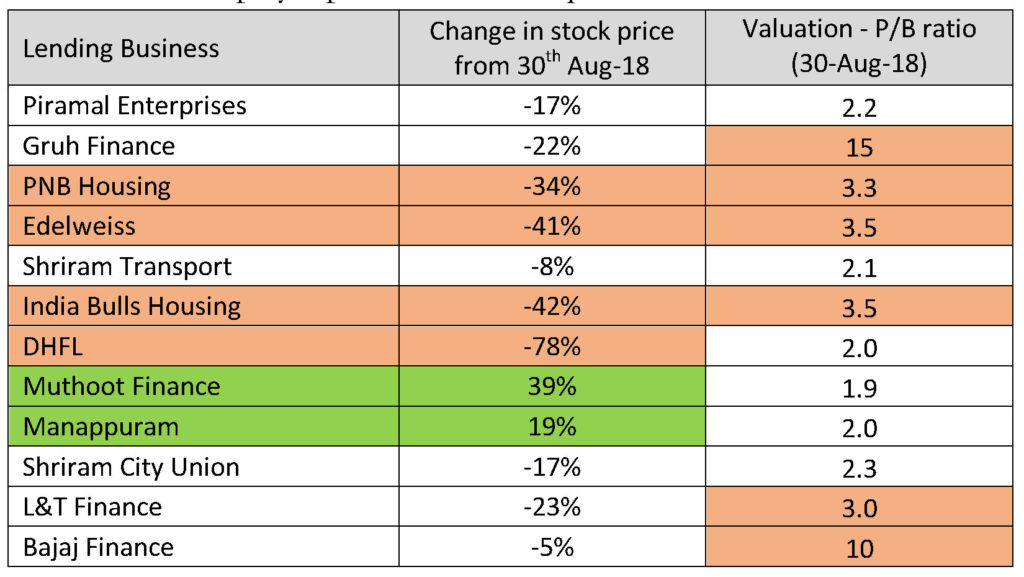
Stock prices of three companies Edelweiss, Indiabulls Housing and DHFL fell by more than (40%) since Aug-18. Stock prices of most other companies fell with the exception of gold loan companies – Manappuram and Muthoot Finance which have given +ve returns.

Could the CAMEL model have predicted this? Are there some lead indicators which would helped us predict this outcome?

Minimum regulatory requirement for capital adequacy = 12%

ROE (five-year avg) =20%+ vs. cost of borrowing of ~8%

If we carefully study the above table, we observe that companies with the maximum NPA (Shriram Transport, Shriram City Union, L&T Finance) have not been the biggest losers.

Also, companies with the lowest Return on Equity profile (Shriram Transport, Shriram City Union, L&T Finance) are not the biggest losers.
Again, all the companies have a healthy capital adequacy ratio (min 16%) which is comfortable and we could not have predicted the subsequent crash in stock prices of some of the lending businesses from this data.

Could we have predicted the laggard companies from asset-liability mismatch?

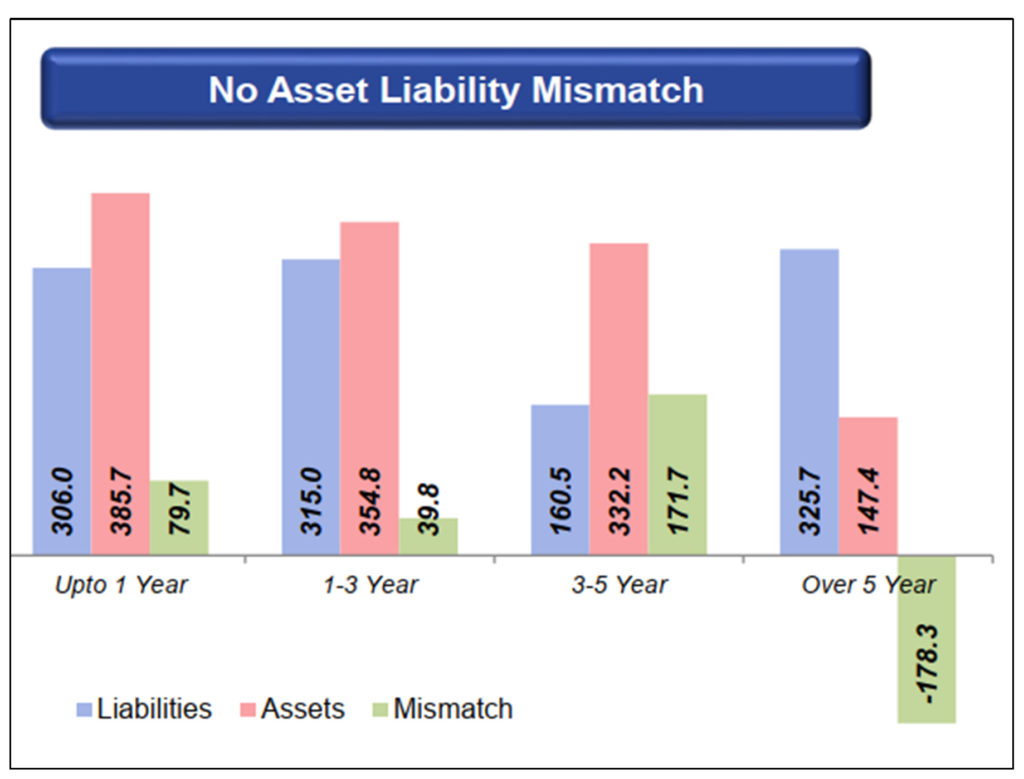
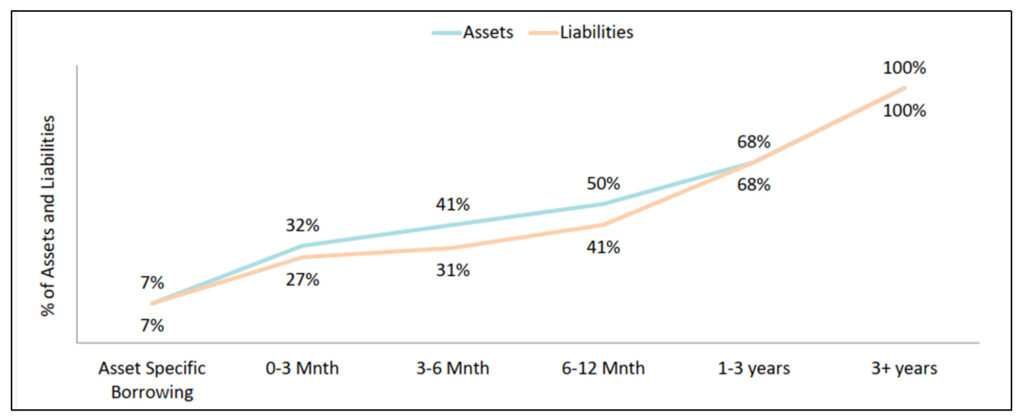
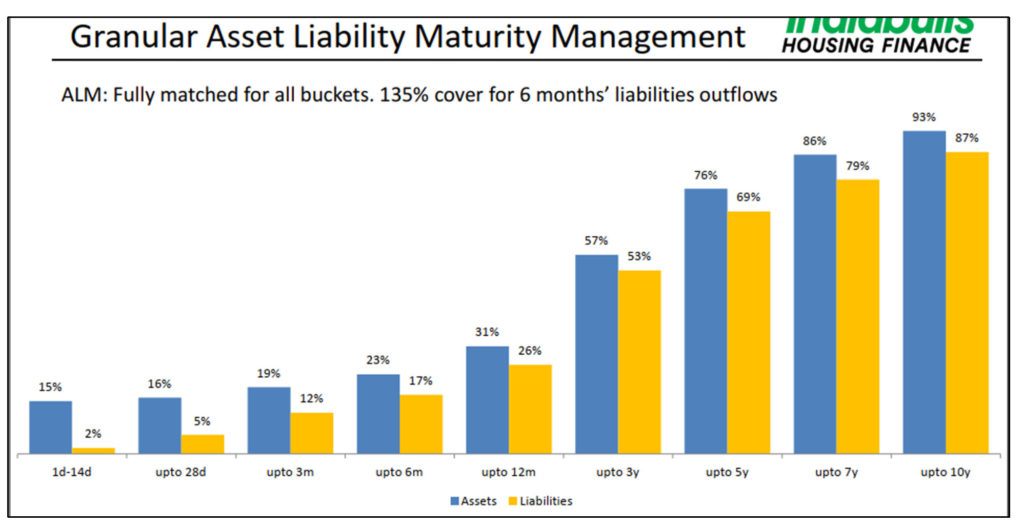
None of the laggards – Edelweiss, Indiabulls Housing or DHFL had an asset liability mismatch as of June 2018 before the default by IL&FS.

DHFL – No ALM mismatch

Edelweiss – No ALM mismatch

Indiabulls Housing – No ALM mismatch

Thus, analyzing the asset-liability position of the companies would not have given us any indication about which of the companies could be the worst hit. Did valuations play a part in the subsequent stock decline?

Paying more than 3x book value for a lending business that makes around 18-20% return in equity is in my opinion a rich valuation. Though the companies that were valued more than 3 times book value (India Bulls Housing, PNB Housing, Edelweiss, PNB Housing, L&T Finance) did fall substantially, Bajaj Finance (P/B of 10) and Gruh Finance (P/B of 15) did not fall as much.

Thus, pure valuations would also not have been a lead indicator of the fall in stock prices.

Since our quest for a lead indicator is not yielding much, let us look at what happened after the default by IL&FS and derive what the learnings are. After the default by IL&FS, the short-term debt market virtually froze and refinancing the commercial papers (short-term loans < 1 yr.) became difficult for even good quality lending businesses. Borrowing more to lend it further to the customers became a huge challenge. In fact, lending businesses found it difficult to repay their old borrowings.

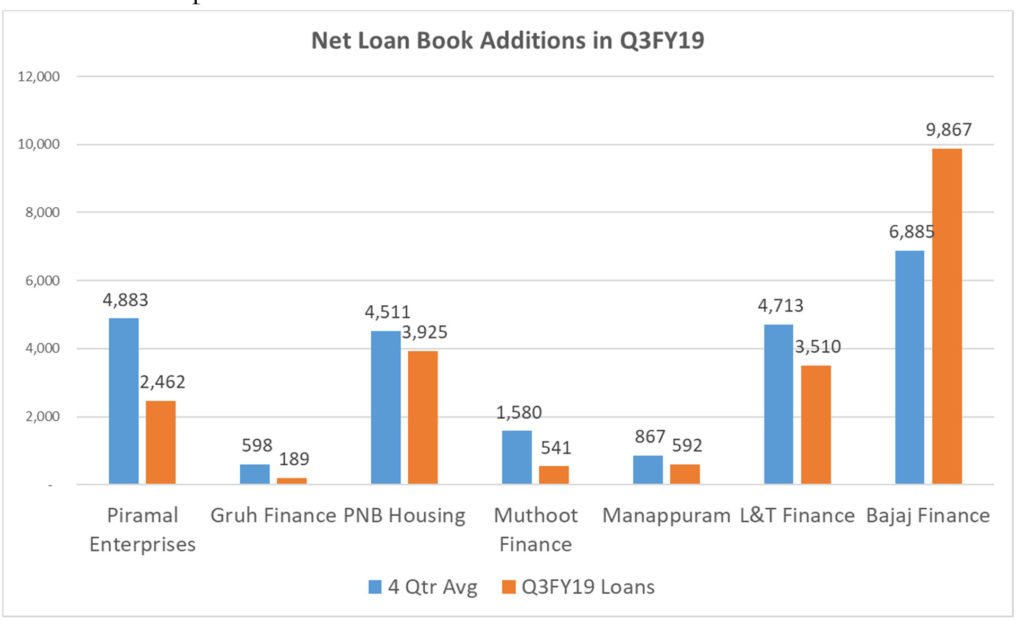
In this tight liquidity situation, have the lending businesses been able to grow their loan book?

The above chart compares the net additions to loan book (fresh loans – repayments) for CQ4 2018, with the average of the same numbers for the previous four quarters. The net loan addition for CQ4 2018 for most companies slowed down from their average for the previous four quarters. Bajaj Finance was the notable exception which actually managed to increase its loan book at a higher pace.

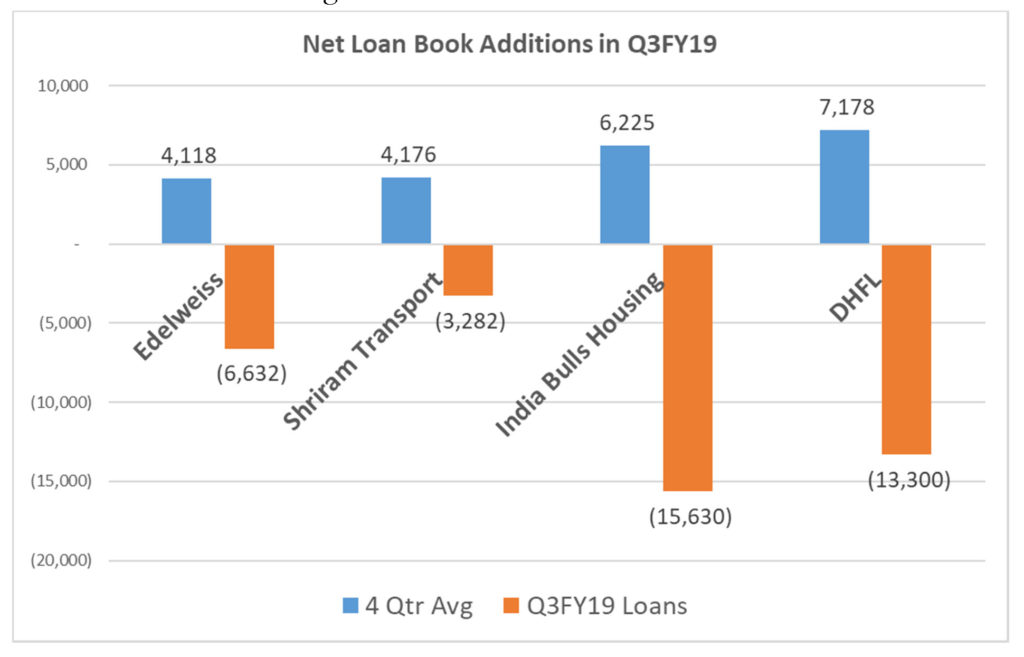
These companies saw a contraction in their loan books. They basically had to down-sell the loan book through securitization, thus reducing the on-balance sheet loans in CQ4 2018. Performance during such a crisis speaks volumes about the way the lending business is carried out. Financial Institutions that lend to these companies (banks/mutual funds etc.) will always know more about the lending practices of these companies than an average investor. The refusal of these financial institutions to make additional loans during the crisis times tells us about the confidence they have in these companies’ business model.

Though the stock prices of almost all lending businesses fell in this period, the biggest fall was companies which saw a decline in their loan book. Shriram Transport Finance which already has 8% gross NPAs, mediocre ROE profile (12%) and moderate valuations (P/B of 2.1) did not fall much as the stock price was probably already depressed. Surprisingly, Muthoot Finance and Manappuram – both gold loan lending businesses have given +ve returns. Goal loan lenders are the safest lending business because the collateral – gold has a ready market and is already in possession of the lender. In case of default, the lender can easily and quickly sell the gold collateral and recover its money.

Sometimes, despite a lot of data analysis and good process, one can get stuck in bad stocks. A way to avoid this is study the history of the company. Liquidity crises keep recurring at frequent intervals and the performance of the lending business during such periods is the litmus test of separating below-par businesses from investable businesses. Unless they drastically change their way of conducting business, lending businesses that struggled during this liquidity crisis will probably repeat a similar performance in the next crisis.

Los errores de inversión

March 1, 2019 in Miscelánea, MOI Global en Español

NOTA DEL EDITOR: El siguiente texto escrito por Javier Ruiz, CFA,  es un extracto de una carta trimestral de Horos Asset Management.

* * *

 La honestidad es el camino más rápido para evitar que un error se convierta en un fracaso.

— James Altucher

¿Qué es un error de inversión? Según el diccionario de la Real Academia de la Lengua, un error es una acción equivocada o desacertada. Si aplicamos esta definición al mundo de la inversión, concluimos, como no puede ser de otra manera, que un error se produce cuando la tesis de inversión (acción) no se cumple (equivocada o desacertada), independientemente de que la rentabilidad que hayamos obtenido sea positiva o negativa. Entender esto es de vital importancia para poder mejorar continuamente como inversores. No debemos juzgar una inversión atendiendo, únicamente, a la rentabilidad que nos haya reportado. Estará de acuerdo en que, hasta un niño de tres años eligiendo compañías al azar, puede ganar dinero en bolsa con alguna de sus inversiones, pero nunca de manera sostenible. ¿Cómo evaluar, entonces, si una inversión ha sido acertada o no? Analizando los pasos seguidos hasta realizar esa inversión, es decir, estudiando si el proceso de inversión ha sido el correcto.
Continue reading »

Korean Market Offers Opportunity After Tough 2018

February 28, 2019 in Asia, Asian Investing Summit, Commentary, Equities, Letters

This article has been excerpted from a letter by MOI Global instructors Chan Lee and Albert Yong, managing partners of Petra Capital Management, based in Seoul.

The year 2018 was the worst year in our recent memory with almost all equity markets in almost all regions substantially down. In addition, the market was extremely volatile to say the least. After all, a single tweet by President Trump or a slight change in the tone of Fed Chairman’s remarks caused the market to swing significantly in one direction or the other in a single trading day.

The Korean equity market was no exception and declined more than 17% (in Korean won terms) after suffering a tumultuous plunge in October. Many negative issues, including the Fed’s rate hike, trade war, slowdown in China, etc. contributed to the market decline. The U.S.-China trade war was probably the main contributor affecting Korean stocks because the worst outcome of this trade war will certainly hit the Korean economy hard given the country’s high dependency on trade, especially with China and the U.S. While virtually every emerging market registered steep losses, unfortunately, the Korean stock market was one of the worst performing markets in the world in 2018.

Historically, countries which successfully developed economy did so by protecting their market in some ways during the development stage and copied then advanced technology in a way which was probably unfair to existing developed countries. That is why the current actions by both the U.S. and China are totally understandable.

We think China, knowing this too well, is likely to give some concessions if it can save some face and protect its long-term national interest. Also, the U.S. is not likely to go too far because it also knows that its attempt to block China’s rise completely is almost impossible and will hurt the U.S. economy severely (even if it will ultimately hurt China more).

The U.S. stock market’s precipitous decline in December together with Apple’s earning shock citing lackluster China sales is a timely reminder of the significant interconnection and interdependence between the world’s two largest economies. That is why we believe that both countries will act more rationally with the motivation to reach some sort of compromise sooner or later. No rational fighter will try to knock out the opponent if he knows it will cripple himself at the same time.

A steep rate increase orchestrated by the Federal Reserve also contributed to the market decline in 2018. However, with signs of economic slowdown in the U.S. and still relatively low inflation, the Fed is likely to pause and exercise great patience in rate hike moves (after raising the Fed funds rate nine times since late 2015). This could also lead to a less strong U.S. dollar going forward and may take some pressure off emerging markets currencies and interest rates which would be positive news for Korean companies as well. But even if the Fed goes ahead and raises the rate steeply as originally planned, we think the long-term negative effect is already priced into the Korean equity market as evidenced by an ultra-low valuation.

Whenever a negative issue arises, the stock market initially moves assuming the worst case scenario. Thereafter, the market eventually adjusts to an appropriate level after digesting and analyzing all the relevant facts. At the current price levels in Korea, we think that most of the negative issues are already priced into the stock market. That is why we believe the recent market pull back is clearly overdone. If the market’s initial assumptions are incorrect and thus, the worst case scenario does not materialize, stocks are due for a bounce.

On the other hand, even if the market’s initial assumptions are correct, we still have little downside risk because the worst case scenario is fully priced into the market. Alas, the sad reality is that most investors become fearful when the market plunges as all humans are born to respond quickly to avoid danger in front of fear. That is why most investors tend to panic and sell even more after the market downfall without regard to rationality. In today’s environment, money flows seem to trump all other factors in determining stock prices. Therefore, unfortunately, money flows can effectively render fundamental analysis futile in the short-term.

While most of the negative issues we mentioned above affect the market temporarily, the lack of more transparent corporate governance is perennial and by far the biggest reason for the “Korea discount” which has been prevalent in the market for a long time. The improvement has been much slower than most investors hoped. But we have always believed that companies can change only under social pressure. Through many years of the government’s efforts together with several high-profile cases of awful corporate governance at some Korean chaebols, we feel the general public sentiment is finally changing significantly in favor of broader governance reform.

For example, even a few years ago, shareholder-friendly policy itself was thought to be detrimental to growth and viewed negatively by local investors. In the past, large Korean institutional investors typically either abstained or voted for whatever agenda forwarded by management at the shareholder meetings. But with the recent adoption of a Korean stewardship code by Korean institutional investors such as the National Pension Service, they are now bounded by stricter fiduciary duties and obliged to vote against management’s agenda which is not beneficial to minority shareholders. That is why we feel more sanguine that many Korean companies will finally begin returning more cash to shareholders. Although the pace of change may be much slower than we desire, the most important factor may be the change of direction itself. Also, we noticed that several local activist funds have sprung up recently. We expect the Korean market to re-rate the valuation upwards if this trend continues.

The Korean stock market has been one of the cheapest markets in the world in terms of valuation. After a large decline in 2018, the Korean market valuation looks even more compelling for long- term value investors. In sum, as we explained above, all the negative issues that we had last year are unlikely to turn out to be as assumed even in the worst case scenario. Also, it is extremely hard to find anyone who draws a rosy picture in Korea nowadays. In fact, fear definitely prevails in the current market. However, as Sir John Templeton once famously said, “bull markets are born on pessimism”, we have a contrarian view of a higher price for Korean equities in 2019. As an intelligent investor, we will use Mr. Market’s mood to our benefit.

We bought many undervalued stocks during the past few years when a great many value investors have suffered. In a market dominated by money flows, the stocks of mundane companies were abandoned for those that offered more growth. In other words, “hot” sectors kept rising because investors were buying rising stocks instead of undervalued stocks. Therefore, many value stocks kept going down because investors shunned these stocks.

As a result, many value managers experienced poor performance, resulting in investor outflows. This led to more selling – cheap stocks became cheaper while expensive stocks continued to rise. However, after the market plunge last year, we believe that the market environment has finally turned in favor of value investors like us as indiscriminate selling provides a great opportunity to buy competitive companies with strong cash flow at attractive price levels.

MOI Global