
Manish Bhandari on Value Investing in India

February 8, 2019 in Asia, Equities, Interviews

We recently had the pleasure of interviewing Manish Bhandari, managing partner and CEO at Vallum Capital Advisors, based in Mumbai, India.

MOI Global: Please tell us about your background and the genesis of your firm.

Manish Bhandari: I did my undergraduate studies in accounting and headed for post-graduate studies in business administration, with a major in finance. During my post-graduate days, I regularly followed a leading newspaper Business Line, which used to publish detailed industry analyses of various industries in India. I was always excited to find a treasure trove of industry information in those articles, and my inquisitiveness and desire to know more about various industries and companies motivated me to join an Institutional Broking Firm after completion of my Post-graduation.

I have worked in all three facets of capital markets – first five years of my career as a sell-side Institutional equity research analyst, subsequent six years in fund management with a global firm, ING Investments, managing $450 mn equity Asset Under Management of Mutual fund & Insurance portfolios, and the last eight years as co-founder of Vallum Capital, a boutique investment management firm managing capital on behalf of family offices in the Indian equity markets.

My six-year stint at ING gave me a good ringside view of money management, but I had a burning desire to build a firm that can overcome institutional constraints, such as disincentive for the concentration of positions, shorter review period (which hampers long-term investment results), and cherish the joy of entrepreneurship. “Vallum fossa”, a Latin word, is synonymous with a moat (a significant concept in investing). We are obsessed with identifying and analyzing moats in not just investee companies, but also in our approach to business, engagement with clients, communication with the external world, etc.

With this background in mind, I set on my entrepreneurial journey in the Year 2010-2011 along with co-founder Madhusudan Sarda, whom I met in my first job in the Year 2000 while both of us were starting our career as equity research analysts. He is a trained chemical engineer turned equity investor and brings a unique perspective to evaluating companies.

MOI Global: How do you define your investment universe and generate ideas?

Bhandari: We are guided by our investment philosophy of investing in mispriced securities value, in reference to underlying business dynamics, available at a reasonable price. Idea generation is a wide and diverse process that fosters both independent thinking and intellectually generous collaboration with the team. We use a blend of top-down and bottom-up research methodology for our idea generation process. We look for companies with characteristics, such as an ability to gain market share, challengers to a dominant player in an industry, companies having a return on capital employed more than the cost of capital.

We have a three-tier screening process to reach our desired goal of shortlisting potential investment candidates while navigating through a chaotic universe of around 600 companies with an Enterprise value of more than $300 mn in a diverse set of industries. Initial screening of stocks is done on the basis of various balance sheet and earnings parameters. This is followed by an evaluation of the accounting practices of potential candidates.

Once we have a handful of businesses to evaluate, we undertake detailed analysis of underlying business by reading annual reports, earnings transcripts, speaking to suppliers, competitors, following industry publications, etc. Usually, 40% of ideas get to the last level for the evaluation of valuation parameter. We pay great attention to the underlying business cycle and how EBDITA multiple valuations are trading in the cycle in context to long-term EBDITA multiple with some adjustment addressing the shortcoming of this before making a final judgment.

We periodically review changing edges in research while making incremental progress in testing and employing new processes and signals. Let me admit; it’s a harsh mental dialogue you are having with yourself. A decade back, there were 30-40 quarterly conference calls held while the number has crossed more than 550 this quarter in India. The access to management and information as an egdes which has exsisted, not any more. The globalization of trade and synchronization of monetary policy across the developed world is forcing investment professionals to understand the issues impacting them rather than relying solely on static information. Acknowledging this changing paradigm, we have expanded our reading horizon manifold, over the last few years.

MOI Global: What sources of competitive advantage have you found to be most durable?

Bhandari: There are different sources of the excellent performance of a company, which differs for each industry. Let me elaborate these sources: Brand and Distribution reach in consumer franchises, cost leadership in a commodity business, conservative financial management for companies in many other industries. While the sustainability of competitive advantages has become a tall order in these disruptive times, our experience suggests that people with good intellect staying for long periods with the company and appropriate use of technology is widest and sustainable moat (source of competitive advantage) for most of the businesses. In India, champions of wealth creation like Kotak Mahindra Bank, HDFC Ltd, M&M, and many other companies have showcased this advantage to the world. Although I fear in the rapidly changing world, this may also get challenged someday.

MOI Global: When it comes to equity analysis, how do you assess the quality and incentives of management? Which CEOs do you admire most?

Bhandari: India has a unique structure where the majority of companies are owned by the promoter or controlling families. Sponsor shareholders by virtue of their shareholding have all incentive for enhancing shareholder value. These days, many companies have emerged where professional management is leading the role on behalf of sponsor shareholders. We use a mix of quantitative and qualitative metrics to judge their incentive for value creation towards minority shareholders. We firmly believe that creating right strategy, culture, and process for running the company is a prerequisite for shareholder value creation.

Firstly, we look for intellectual fanatics who are driving companies on the best operational efficiency parameters within the Industry. This also helps us in avoiding relative value trades while evaluating companies.

Secondly, we eagerly look for data points to identify the management teams who have an inclination and the tenacity to endure short-term pain in order to gain long-term strategic advantage. We have an investment in a middle market oncology pharmaceutical company, which is expensing out Research and Development expenditure amounting to about 25% of profit before tax (PBT) for building long-term competitive advantage, much higher than industry.

Lastly, it is also about the conduct of trusteeship by managers toward minority shareholders. Our experience of managing money over the years helps in judging this aspect. An excellent balance of some of these aspects helps in judging incentive of management, which would create wealth for stakeholders. This is referred as qualitative skin in the game. Investors scanning companies on only quantitative measure as alignment of interest, have had missed one of the best compounding stories, a housing mortgage conglomerate in India, where the operating management holds an insignificant stake in the company.

I admire many CEOs and Promoters, but I would like to mention about Mr. Anand Mahindra, Chairperson of Mahindra and Mahindra Ltd for his ethics, value system, ability to spot the right opportunity, endurance in the conduct of business, and empowerment of his managers. He is an outstanding champion of shareholder value creation in business and a role model to many Indians.

MOI Global: Do you typically seek dialogue with the management teams of your investee companies? What is your view of the potential opportunities and hurdles to “activist” investing?

Bhandari: I am fascinated by your thoughtfulness for asking this question that has deep connotations. Superior access to management team does help understanding the culture, the ethos of the company, giving feedback to them and keeping a watch on understanding industry development. Institutional money managers have an advantage over boutique firms or amateur investors handling their own money.

However, I strongly believe this is not a prerequisite for investing or harvesting a successful Investment. When we started our firm with a meager capital under management, getting access and the opportunity to be heard was a challenge. I would call this a blessing in disguise for us. We built a wholly independent system of evaluating a company by speaking to a plethora of people like suppliers, customers, competitors, bankers, dealers of products, employees for the culture of firms and reinforcing our beliefs/opinions by reading industrial magazines, etc.

These practices gave us an excellent directional view of a company and positioned us to have far less reliance on what management, as an excellent sales person, might have to say about their company. Annual General Meetings, a less crowded platform is one of our primary engagements mediums with investee companies. It is structured events which help in gathering long-term data points and navigate through quarterly noises. Our ability to get independent evaluation has also prepared us for the possible introduction of MFID II rules, if any time in India considering negative consequences for firms’ dependent on evaluating ideas researched by broking firms.

Shareholder engagement is an evolving concept and activism is yet distant in India. The proxy advisory firms made a good beginning over the last few years. However, the progress is plodding due to inactivity of dominant pools of capital held by Mutual and Insurance Funds. The real push on the activism will come when the assets of alternative capital industry and family offices, who are far more concerned about the governance of the company, will reach a critical size. At Vallum, we actively formally communicate to the Board of our investee companies about our suggestion, grievances, giving a gentle nudge on issues concerning us.

MOI Global: Which aspects of the investment landscape in India do you believe are overlooked or misunderstood by foreign investors? What in your opinion is the biggest investment risk that applies distinctively to India as opposed to markets globally?

Bhandari: Investing world is mesmerized by high growth and favorable demographics of India markets. Every CEO of MNC has an aspiring statement about India’s consumption landscape. The investing landscape in the country has its own peculiarities and caveats for portfolio investors.

The earning power of demographics is unevenly distributed across the country, is growing at a slow pace, and is not a linear curve. In such case, overpaying for perceived linear or power law growth can be a graveyard for investments of growth investors. Hence, Investors must be cautious about the true potential of the growing landscape and value they are ascribing. It is an innate human nature on the part of management to communicate growth each year, especially when the world is generously rewarding growth.

Occasionally, Investors should refer to The adventure of Silver blaze when Sherlock Holmes hints at Watson to take a clue from “Dog which did not bark” to solve the mystery. Hence it is equally important to listen to guys who are cautious in their approach while conducting business in a high growth market.

Recently, Indian investors have come to terms with a BSE Sensex stock Yes Bank, widely owned by many institutional investors, growing at a frantic pace, having a charismatic promoter, with aggressive commentary but which has recently witnessed dislocation in underlying business as well as stock price. Vallum maintained a cautious approach towards such high octane growth companies as they leave less room for margin of safety and huge penalties on error.

Secondly, the country ranks low on innovation and, hence, many businesses sit on the edge of consolidation in order to achieve economies of scale, address regulatory, and technological changes. Last but not least, the country has allowed foreign direct investment (FDI) in most of the areas over the last two decades. This has a far-reaching consequence; many businesses owned by MNCs are unlisted (limited reporting of financials), while an investor with a myopic view may get fooled by randomness towards buying a listed business as a proxy of growth in that industry.

Consequently, it leads to a narrow set of stocks chased by a larger pool of capital leading to periodic overvaluation in pockets. I will not be surprised, over the next few years, if stock market indices cease to become proxy of a high economic growth rate of the country. Therefore, it is crucial for top-down investors to lay their feet on the ground and get a clear signal from the diverse set of data points while making investments.

MOI Global: Would you describe a case study that reflects your investment approach?

Bhandari: I will highlight two ideas in brief; one where we invested two years back and harvested this year, while the other is currently among our top position. As I mentioned, we follow a blend of top-down and bottom-up to screen potential mispricing of Ideas. Over the last half a decade, we have taken an active interest in development in China, the impact of its policies on a wide range of sectors.

We noticed an interesting opportunity emerging in likely shift from making of steel from the blast furnace to Electric Arc Furnace (EAF) in China, the rising crescendo of antidumping duties on steel across the U.S., Europe, which manufactures more than 70% of steel via EAF route. Interesting, EAF requires graphite electrodes as consumables for running furnaces. The electrodes industry, globally, went thorough tailspin, due to the deflationary impact of steel manufacture by blast furnace (an alternative to EAF Route). This led to consolidation and rationalization of the electrodes supply of around 20% of industry capacity.

The signal from bottom-up research on one among the two of the listed graphite electrode companies was very compelling: stock trading at Market cap of US $300 mn with cash of $100 mn on books, management with alignment of interest with minority, efficient operation, underlying business at cyclical low versus a bull cycle half a decade back while the stock price has remained stagnant at the same price for last five years. It was a perfect storm in the making. Subsequently, as envisaged, the electrode’s prices shot up five times, EBITDA shot up forty times over the next eighteen months, and the stock price increased eight times. Let me admit; we did not envisage such a dis-proportionate positive change in earning matrix, but investing thorough capital cycle did reward us in the process.

We have another position in Muthoot Finance, a company that extends loan against gold. This is a unique business proposition as India is one of the largest buyers of gold in the world and more than 50% of it finds its way in rural India. The gold owner pledges gold to meet the shortfalls of expenses and company extends approx. 70% of value against the pledged gold. There are only 3 companies of meaningful size in this business, and it has a legacy of a century.

Also, the company has started benefiting from the network effect by leveraging a referral base of 0.2 mn customer visits to their branches to build Micro Finance, affordable housing, and insurance business. I believe the legacy moat will help the company to grow faster without any dilution for a considerable period of time while the market has overlooked its strong franchisee.

MOI Global: How do you think about the art of valuing a business? To what extent do industry-specific considerations or industry comparable play a role and to what extent do you focus on “shareholder earnings” or free cash flow?

Bhandari: We believe the evaluation of business is science while understanding the bridge between the performance of a business and stock price is an art. An investor may own one of the indefatigable moats with the characteristic of a compounder, but still, it may translate into subliminal stock performance. The answer lies in trusteeship demonstrated by owners, the macro cycle of the flow of money, and many such factors, which are beyond the control of any investor and difficult to judge. Experience beats quant and art beat science here. I am in favor of using multiples of EBDITA for some industries for valuation as it is less distorted over shareholder earnings. We do use free cash flow with some caution. We have been devoid of the pleasure of evaluating monopoly tech platforms in India as we have none.

MOI Global: How do you strike the right balance between being concentrated in your best ideas while remaining sufficiently diversified to keep downside risks under control?

Bhandari: We invest in 20-22 opportunities, and top 10 holdings account for more than approx. 55% of fund value. Our portfolio turnover ratio is around 20-22%, which means an average holding period of more than three and a half years, although we have held many positions for more than six years. Public equity volatility can opportunistically help to lower the risk of permanent capital loss by allowing us to reduce our average purchase price and avoid the temptation of employing leverage. This approach to public market investing means that volatility is welcome, and no efforts are made to smooth investment returns.

Risks of permanent capital impairment are mitigated by avoiding leverage at the portfolio and company levels, employing a long-only strategy. Since we manage an open-ended fund and our fund size is growing, I have no precise answer on concentration as liquidity and impact cost is one of the criteria while investing and while exiting positions. We are of the opinion that buying a business at a moderate underlying business cycle takes care of business risk for our portfolio.

MOI Global: What is the single biggest mistake that keeps investors from reaching their goals?

Bhandari: One of the fundamental contradictions our industry offers is that short-term outperformance is rewarded while underperformance is met with withdrawal by investors. The short-term can be defined in terms of time period up to one year. This leads to pressure on the Managers to perform in the short term and follow the herd. This phenomenon and its implication on investment performance are explained in A Zebra in Lion Country by Ralph Wanger. A manager should admit that styles go out of fashion in the intermediate period and suitably communicate this to prospective investors, before engagement. This built trust with clients and sets the basis of long-term engagement.

MOI Global: Which one or two recent books have given you new insights into the art of investing?

Bhandari: The book, Capital Returns: Investing through the capital cycle – a money manager’s report by Edward Chancellor has left an indelible impression on me. The central theme of the book is that excessive investment drives down returns and leads inexorably to a boom-bust cycle. This was the case with the technology companies, the U.S. housing market, mining, energy companies globally and recently with Housing finance and Non-Banking Finance companies in India. From an investor’s perspective, one should avoid investing in sectors where investment spending is unduly elevated, competition is fierce while investing where capital expenditure is depressed, competitive conditions are more favorable and, as a result, prospective investment returns are higher. I would also recommend reading The Art of Contrary Thinking by Humphrey B Neill, which opens our mind to a range of possibilities and how to practice contrary thinking.

MOI Global: If you had to pick another investor to manage your money, who would you choose and Why?

Bhandari: I would like to hand over my hard earned savings to Mr. S. Naren, Chief Investment Officer of ICICI Prudential Mutual Fund in India (since the past fifteen years). The key characteristics that differentiate him from most of the managers in India are: his unique understanding of business cycle drawn from the knowledge of various asset classes, application of contrarian approach to Investing, and an attitude of trusteeship towards investors, which makes him unique in fund management business. He rose the ranks in his firm by starting with managing one equity fund of U.S. $50 mn in the Year 2005 to an AUM of $60 bn (debt and equity) presently as a CIO. I would consider this an extraordinarily remarkable achievement and an endorsement of his capabilities. I had the good fortune of working with him and was mentored by him while I was a sell-side analyst in the Year 2002 at an Institutional Broking Firm while he was overseeing research at the same firm.
Qué es la inversión Value y Growth: Ventajas y desventajas

February 8, 2019 in Contenido Libre, Miscelánea, MOI Global en Español

NOTA DEL EDITOR: El siguiente texto es un extracto de una carta trimestral, de Invexcel Patrimonio.

* * *

En el mundo de la inversión en renta variable hay dos grandes corrientes. La inversión value (inversión en valor) y la inversión growth (inversión en crecimiento).

Inversión value

El value investing (inversión value) trata de determinar el valor intrínseco de una compañía cotizada. Sólo cuando el precio al que el mercado nos la ofrece tiene un descuento significativo sobre el valor que percibimos, se invierte en ella. Las asunciones sobre las que se determina el precio suele tener en cuenta circunstancias normales de mercado, ser conservadoras, comprendiendo que hay momentos de euforia y depresión en un ciclo.

Inversión growth

La inversión growth trata de centrarse en las compañías que más crecerán en el futuro. Sus inversores están dispuestos a pagar valoraciones más altas bajo la premisa de que un crecimiento superior del activo compensará estos múltiplos superiores.

Por qué es mejor la inversión value

Hay dos razones principales por las cuales preferimos la inversión en valor. La primera es que se ha demostrado empíricamente (series históricas largas) que es la manera más consistente y segura de incrementar el patrimonio en el largo plazo.

La segunda, es que preferimos recomendar invertir en un activo medible, valorable, en lugar de en acciones cuya rentabilidad dependerá de imponderables no cuantificables de momento (“bola de cristal”) aún a riesgo de perder la rentabilidad de lo que está de moda. Nuestro principal objetivo es minimizar el riesgo inherente a una inversión bursátil, lo que nos cuesta conseguir invirtiendo hoy a precios elevados en un futuro desconocido, donde la incertidumbre es superior.

Es verdad que la recuperación de la gran crisis financiera de años anteriores ha sido lenta, causando gran impaciencia en la comunidad inversora. Los tipos de interés inusualmente bajos y una liquidez extra, cortesía de los bancos centrales, han provocado un apetito desmedido por todo aquello que huela a crecimiento, calmando así ese sentimiento de impaciencia, de querer ver resultados ¡ya!, aunque estos resultados se midan más en crecimiento que en beneficios.

Inversión value vs. Inversión growth

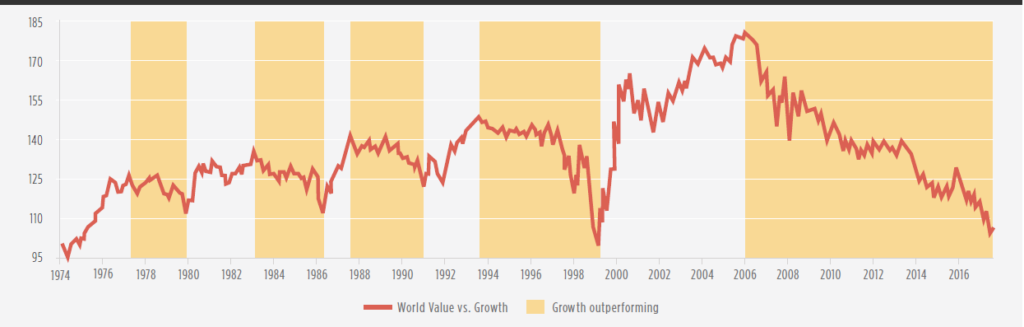
Hay períodos en los que la inversión growth supera a la inversión value (sombreado en amarillo), y épocas en las que pasa lo contrario. Pero como vemos arriba, y desde 1970 (base 100), la inversión value ha ido incrementando su ventaja hasta los 80 puntos porcentuales en 2007. Desde entonces la inversión growth ha recortado casi toda la ventaja en un periodo inusualmente largo de complacencia hacia todo aquello que crece.

Los criterios objetivos de valoración han quedado fuera de las prioridades de una mayoría. Si la compañía crece, es suficiente atractivo para tomar posiciones. Que el precio al que me lo venden sea caro, no importa, siempre y cuando crezca. Y si no crece no lo quiero, dando igual la caja que genere o lo rentable que la compañía sea. Bajo la premisa de que la compañía que crece es buena, el precio no es una variable a considerar.

Las desventajas de la inversión growth

Y no hay duda de que hay compañías extraordinarias en fase de intenso crecimiento, pero ¿y el precio?

En los años 60’s y 70’s ganaron enorme popularidad las llamadas “Nifty Fifty”, un grupo de 50 compañías consideradas de máxima calidad y cuyo crecimiento era constante. Coca Cola [KO], IBM [IBM], General Electric [GE], Johnson & Johnson [JNJ], Merck [MRK], Procter & Gamble [PG], Walmart [WMT]… eran algunos de sus representantes. Bajo la premisa de que quien compra calidad no puede equivocarse, su popularidad alcanzó tales cotas que de media alcanzaron a cotizar a 42 veces beneficios, más del doble que el mercado. Algunas como McDonald’s [MCD] o Walt Disney [DIS] lo hacían a 90 veces. En 1972, con la caída del gobierno de Nixon y la crisis del petróleo hubo una crisis bursátil que provocó caídas entre algunas de estas estrellas superiores al 80%, tardando una década en recuperar su valor.

No cabe duda que es preferible una compañía de calidad1 que una sin ventaja competitiva alguna, pero el precio que se paga debe tenerse en cuenta.

Las llamadas FAANG – por Facebook [FB], Amazon [AMZN], Apple [AAPL], Netflix [NFLX] y Google [GOOGL], tienen un PER medio de 115 veces. Pero no sólo éstas, las 50 compañías más grandes del S&P500 “Growth” cotizan a 32 veces beneficios, un 50% más que el generalista S&P500.

En los mercados suele llamarse “moat” cuya traducción literal es “foso”, a la ventaja competitiva de una compañía. Es lo que mantiene a tus enemigos (competidores) a una cierta distancia. La pregunta es ¿no estaremos pagando más por el foso que por el castillo que pretende defender?

______

1 Ésta nunca puede darse por segura. Xerox, Kodak, Polaroid, Simplicity Pattern, SS Kresge (hoy Kmart) eran también parte de este grupo de elegidas y su futuro fue mucho más incierto.

El contenido de este sitio web no es una oferta de venta ni la solicitud de una oferta para comprar ningún tipo de valor en ninguna jurisdicción. El contenido se distribuye solo con fines informativos y no debe interpretarse como un consejo de inversión o una recomendación para vender o comprar cualquier valor u otro tipo de inversión, o emprender cualquier estrategia de inversión. No hay garantías, expresas o implícitas, en cuanto a la exactitud, integridad o resultados obtenidos de cualquier información establecida en este sitio web. Los directivos, ejecutivos, empleados, y/o autores contribuyentes de BeyondProxy pueden tener cargos y pueden, de vez en cuando, realizar compras o ventas de los valores u otras inversiones discutidas o evaluadas en este sitio web.


Highlighted Tweet by pcordway

February 7, 2019 in Twitter

An Update on Our Investments in Airlines

February 6, 2019 in Ideas, Letters

This article is authored by MOI Global instructor Phil Ordway, Managing Principal at Anabatic Investment Partners, based in Chicago, Illinois.

If good investment ideas are said to be found in the gap between perception and reality, the airline industry has several candidates for the hall of fame. I don’t think I’ve ever found lower – or crazier – expectations than in the airline industry.

Recent headlines have been loud and definitive, as usual, even though the business reality is more nuanced. 2018 featured moderate capacity growth, much higher expenses for fuel and labor, and strong demand. The price of oil increased for much of the year, hurting margins and year-over-year comparisons. Then, just as oil spiked in early October and many market commentators assured us that the price of oil was going to cross $100 per barrel, the price collapsed and finished the year down 25%.

One thing I know is that oil prices will fluctuate and many – maybe even most – forecasts will prove useless. The airlines obviously can’t control the price of oil, but they have proven the ability to post good profits with oil above $100 per barrel and below $30 – a point that is lost on everyone in 2018 who seemed to worry about rising oil and falling oil. On my “worry list” for our airline investments oil doesn’t even make the top 10.

A more important – but likewise unknowable – macro factor is demand. Airlines are cyclical, albeit with differing business models that in some cases are quite adaptable and resilient. Decades of vicious competition and numerous restructurings and mergers have left an industry that is more than capable of thriving through the cycle. Again, I’m not here to argue that these are enterprise software companies about to conquer the world. Airlines must deal with a competitive, cyclical, capital- and labor-intensive industry, and that is not going to change. Likewise, the core attributes of the business are also unlikely to change, and I believe the current stream of earnings and cash flow is attractive and sustainable.

Alaska (ALK) equity returned (15.6%) in 2018 but the business made impressive progress. The Virgin America integration is almost done – with good results – and the company can re-focus on optimizing its assets. For several decades Alaska has run a smart, reliable, and profitable operation, but the market seems to imply that the company has forgotten everything it once knew.

The balance sheet is in good shape, with approximately half of the debt used to acquire Virgin American 25 months ago having already been paid down. Further deleveraging is likely in 2019, and the company has plenty of capacity to absorb shocks from the economy or its competitors. The core airline operation continues to offer good value and excellent service to its customers.[13]

The loyalty program remains a valuable and underappreciated asset. It is growing at a double-digit rate (in terms of members, cardholders, and cardholder spending) and producing precious, high-margin cash flow that requires almost no incremental capital. The loyalty program’s cash flow also enables the company to finance the fleet much more efficiently. In the old days Alaska (and other airlines) would have to use expensive debt or equity to buy new aircraft. Today, Alaska gets approximately $1 billion of financing or “float” from its loyalty program. Every month Alaska receives a payment from Bank of America based on the use of its card, but Alaska’s liability on that cash inflow is in miles or travel awards that customers do not redeem for 18-24 months, on average. Beyond the free use of money for a year or two, there is a “breakage” rate of more than 17% as miles/awards expire or are never redeemed. The result is a little bit like getting paid to borrow money.

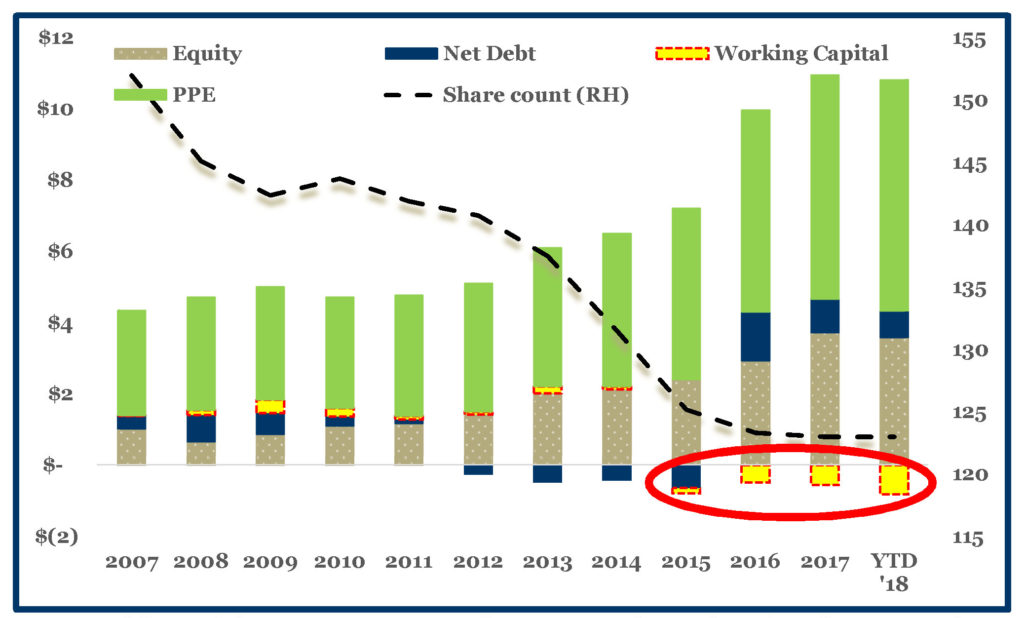
Consider the effect on the company’s balance sheet over time. In the chart below the company’s plant, property and equipment (shown by the green bars) grew from about $3 billion just over a decade ago to about $6.5 billion today. That significant investment was increasingly financed by the loyalty program’s cash flow. It is also notable that coming out of the global financial crisis in 2010, the company began to generate so much cash flow that it built up more cash than debt by 2012. By 2015 and 2016 working capital had turned negative as the cash flow from the loyalty program accelerated under more generous terms from Bank of America. These factors combined to enable Alaska to issue debt to pay for the all-cash Virgin America acquisition and finance its fleet at very attractive rates.

USD (LH) in billions and shares outstanding (RH) in millions. Source: Anabatic analysis of SEC filings. YTD as of Sept. 2018.

For this and many reasons Alaska’s future is promising. It maintains an appealing value proposition to its customers, a durable culture and engaged employees, a healthy balance sheet, and plenty of cash flow. Barring unforeseen changes this is an investment I hope to hold for many years.

Spirit (SAVE) was the big winner in 2018 as the shares returned 29.1%. Better yet was the progress the company made by optimizing its route network, achieving approximately 50% of revenue from non-ticket sales, and recording the best on-time performance in America in October 2018.

I have a deep appreciation for the power of a low-cost business model, and Spirit offers yet another example. Despite a big increase in pilot costs that took effect in 2018, Spirit’s unit costs declined year-over-year and its advantage relative to the industry is likely to widen over time. The “basic economy” fares introduced by other non-ULCC airlines has also partitioned the direct, price-only competition into a discrete segment, enabling rational long-term competition by all airlines.

Spirit’s balance sheet is in good shape with almost $1 billion of cash on hand. An economic downturn could well benefit Spirit if customers “trade down” to a cheaper airfare as they have in prior economic slowdowns. Nonetheless, a few major questions and potential snags remain.

  • 2018 came and went without a promised decision on the fleet. Within a few years Spirit will be at the end of its current order book and the company needs to decide how it wants to proceed. It might place a large A220 order, introducing a second aircraft type to the fleet. The A220 has impressive capabilities and unit economics it would also add considerable complexity and overhead. Adding the A220 would also reduce the attractiveness of a Spirit-Frontier merger, a deal that is not imminent but one that could be appealing at some point.
  • Spirit CEO Bob Fornaro announced his retirement in 2018, and on January 1, 2019 Ted Christie was promoted from President and CFO to CEO. Significant changes in strategy or operating performance are unlikely, but all management successions come with their own challenges (and opportunities).
  • Spirit is at a disadvantage to some of its non-ULCC competitors because it lacks the massive cash flow, margin, and financing benefits of a powerhouse loyalty program. The ULCC business model is by no means dependent on a loyalty program, but it’s a key asset for other airlines (as noted above).

Delta (DAL) is our “newest” airline investment. The stock price fell 8.7% in 2018 (including dividends) and it fell even more in early January 2019.

The company’s competitive position strengthened in 2018, continuing an impressive run that began more a decade ago. Delta was featured as an example in our July 2018 letter and I won’t repeat that discussion, but suffice it to say that Delta is a paragon of operational excellence and prudent management. I can think of very few businesses or management teams with such sterling credentials accompanied by such low expectations.

The capital allocation has also been good, if not quite perfect. Management has maintained a strong, investment-grade balance sheet and shored up the pension. The fleet has been expertly managed, with significant investment along the way. The share count has declined by 20% over five years due to repurchases made at attractive prices. New lines of business have been established in MRO and logistics, among others, driving several billion dollars of revenues at accretive margins. Delta now owns significant equity stakes in Air France-KLM, Aeromexico, Virgin Atlantic, China Eastern, and Gol to go with several international JVs. Its partnership with American Express, among the world’s very best co-branded marketing alliances, produces more than $3 billion of operating cash flow for Delta (along with exceptional margins, free cash flow, and float).

The ultimate test of our airline investments – and all our investments – will be the cash flows these companies produce over time. I remain very encouraged by our prospects and I would be glad to own these investments even if – especially if – the market prices declined further.

[1]Alaska won the annual JD Power award for highest customer satisfaction for the 11th straight year. It also won “Best U.S. Airline” from Condé Nast Traveler’s Readers’ Choice Awards; “No. 1 U.S. Airline for 2018” from AQR; and “Best travel rewards program” from U.S. News, among many others.

Disclaimer: Gross Long and Gross Short performance attribution for the month and year-to-date periods is based on internal calculations of gross trading profits and losses (net of trading costs), excluding management fees/incentive allocation, borrowing costs or other fund expenses. Net Return for the month is based on the determination of the fund’s third-party administrator of month-end net asset value for the referenced time period, and is net of all such management fees/incentive allocation, borrowing costs and other fund expenses. Net Return presented above for periods longer than one month represents the geometric average of the monthly net returns during the applicable period, including the Net Return for the month referenced herein. An investor’s individual Net Return for the referenced time period(s) may differ based upon, among other things, date of investment. In the event of any discrepancy between the Net Return contained herein and the information on an investor’s monthly account statement, the information contained in such monthly account statement shall govern. All such calculations are unaudited and subject to further review and change. For purposes of the foregoing, the calculation of Exposure Value includes: (i) for equities, market value, and (ii) for equity options, delta-adjusted notional value.

THE INFORMATION PROVIDED HEREIN IS CONFIDENTIAL AND PROPRIETARY AND IS, AND WILL REMAIN AT ALL TIMES, THE PROPERTY OF ANABATIC INVESTMENT PARTNERS LLC, AS INVESTMENT MANAGER, AND/OR ITS AFFILIATES. THE INFORMATION IS BEING PROVIDED SOLELY TO THE RECIPIENT IN ITS CAPACITY AS AN INVESTOR IN THE FUNDS OR PRODUCTS REFERENCED HEREIN AND FOR INFORMATIONAL PURPOSES ONLY.

THE INFORMATION HEREIN IS NOT INTENDED TO BE A COMPLETE PERFORMANCE PRESENTATION OR ANALYSIS AND IS SUBJECT TO CHANGE. NONE OF ANABATIC INVESTMENT PARTNERS LLC, AS INVESTMENT MANAGER, THE FUNDS OR PRODUCTS REFERRED TO HEREIN OR ANY AFFILIATE, MANAGER, MEMBER, OFFICER, EMPLOYEE OR AGENT OR REPRESENTATIVE THEREOF MAKES ANY REPRESENTATION OR WARRANTY WITH RESPECT TO THE INFORMATION PROVIDED HEREIN. AN INVESTMENT IN ANY FUND OR PRODUCT REFERRED TO HEREIN IS SPECULATIVE AND INVOLVES A HIGH DEGREE OF RISK. THERE CAN BE NO ASSURANCE THAT THE INVESTMENT OBJECTIVE OF ANY SUCH FUND OR PRODUCT WILL BE ACHIEVED. MOREOVER, PAST PERFORMANCE SHOULD NOT BE CONSTRUED AS A GUARANTEE OR AN INDICATOR OF THE FUTURE PERFORMANCE OF ANY FUND OR PRODUCT. AN INVESTMENT IN ANY FUND OR PRODUCT REFERRED TO HEREIN CAN LOSE VALUE. INVESTORS SHOULD CONSULT THEIR OWN PROFESSIONAL ADVISORS AS TO LEGAL, TAX AND OTHER MATTERS RELATING TO AN INVESTMENT IN ANY FUND OR PRODUCT.

THIS IS NOT AN OFFER TO SELL OR SOLICITATION OF AN OFFER TO BUY AN INTEREST IN A FUND OR PRODUCT. ANY SUCH OFFER OR SOLICITATION WILL BE MADE ONLY BY MEANS OF DELIVERY OF A FINAL OFFERING MEMORANDUM, PROSPECTUS OR CIRCULAR RELATING TO SUCH FUND AND ONLY TO QUALIFIED INVESTORS IN THOSE JURISDICTIONS WHERE PERMITTED BY LAW.

ALL FUND OR PRODUCT PERFORMANCE, ATTRIBUTION AND EXPOSURE DATA, STATISTICS, METRICS OR RELATED INFORMATION REFERENCED HEREIN IS ESTIMATED AND APPROXIMATED. SUCH INFORMATION IS LIMITED AND UNAUDITED AND, ACCORDINGLY, DOES NOT PURPORT, NOR IS IT INTENDED, TO BE INDICATIVE OR A PREDICTOR OF ANY SUCH MEASURES IN ANY FUTURE PERIOD AND/OR UNDER DIFFERENT MARKET CONDITIONS. AS A RESULT, THE COMPOSITION, SIZE OF, AND RISKS INHERENT IN AN INVESTMENT IN A FUND OR PRODUCT REFERRED TO HEREIN MAY DIFFER SUBSTANTIALLY FROM THE INFORMATION SET FORTH, OR IMPLIED, HEREIN.

PERFORMANCE DATA IS PRESENTED NET OF APPLICABLE MANAGEMENT FEES AND INCENTIVE FEES/ALLOCATION AND EXPENSES, EXCEPT FOR ATTRIBUTION DATA, TO THE EXTENT REFERENCED HEREIN, OR AS MAY BE OTHERWISE NOTED HEREIN. NET RETURNS, WHERE PRESENTED HEREIN, ASSUME AN INVESTMENT IN THE APPLICABLE FUND OR PRODUCT FOR THE ENTIRE PERIOD REFERENCED. AN INVESTOR’S INDIVIDUAL PERFORMANCE WILL DIFFER BASED UPON, AMONG OTHER THINGS, THE FUND OR PRODUCT IN WHICH SUCH INVESTMENT IS MADE, THE INVESTOR’S “NEW ISSUE” ELIGIBILITY (IF APPLICABLE), AND DATE OF INVESTMENT. IN THE EVENT OF ANY DISCREPANCY BETWEEN THE INFORMATION CONTAINED HEREIN AND THE INFORMATION IN AN INVESTOR’S MONTHLY ACCOUNT STATEMENT IN RESPECT OF THE INVESTOR’S INVESTMENT IN A FUND OR PRODUCT REFERRED TO HEREIN, THE INFORMATION CONTAINED IN THE INVESTOR’S MONTHLY ACCOUNT STATEMENT SHALL GOVERN.

NOTE ON INDEX PERFORMANCE

INDEX PERFORMANCE DATA AND RELATED METRICS, TO THE EXTENT REFERENCED HEREIN, ARE PROVIDED FOR COMPARISON PURPOSES ONLY AND ARE BASED ON (OR DERIVED FROM) DATA PUBLISHED OR PROVIDED BY EXTERNAL SOURCES. THE INDICES, THEIR COMPOSITION AND RELATED DATA GENERALLY ARE OWNED BY AND ARE PROPRIETARY TO THE COMPILER OR PUBLISHER THEREOF. THE SOURCE OF AND AVAILABLE ADDITIONAL INFORMATION REGARDING ANY SUCH INDEX DATA IS AVAILABLE UPON REQUEST.

Paco Paramés en México

February 6, 2019 in Contenido Libre, Miscelánea, MOI Global en Español

El pasado viernes 25 de enero, en México tuvimos el honor de recibir a Francisco García Paramés, mejor conocido como el “Warren Buffett europeo” por ser uno de los gestores value con uno de los mejores track records de Europa. Con treinta años de carrera como inversor profesional, Paco inició su camino en Bestinver, donde estuvo desde 1989 hasta 2014. Durante el periodo 2014-2016, Paco aprovechó para escribir su autobiografía: Invirtiendo a Largo Plazo (lee una reseña aquí). Oficialmente regresó a la gestión de activos a principios de 2017 con Cobas Asset Management, su propia firma de inversión que, en la actualidad, ha llegado a los 2 mil millones de activos bajo gestión.

El evento de la presentación del libro de Paco, organizado por Cobas, KuE Capital (México) y Mexico Value Partners, reunió a más de cien asistentes que, durante cuatro horas, pudieron aprender del inversor value hispano más destacado de todos. Al final del evento, se estuvieron vendiendo los libros de Paco, cuyas ventas fueron donadas a ValueSchool, la asociación sin fines de lucro de Paramés que tiene como objetivo difundir la educación financiera en España y en el mundo hispanohablante; además, Paco fue entrevistado por Sofía Macías, autora del Pequeño Cerdo Capitalista y una de las figuras más representativas de la divulgación de educación financiera en México.

* * *

(El siguiente contenido es una transcripción editada de una grabación y puede contener errores. La transcripción ha sido ligeramente editada por motivos de claridad y legibilidad).

Sobre la inversión en bolsa

Un inversor en Bolsa no debe intentar adivinar lo que van a hacer los mercados; adivinar la volatilidad; adivinar si los chinos van a arreglar sus problemas comerciales o no; no tiene que adivinar el futuro porque el futuro es muy difícil de adivinar […] Lo que tenemos que hacer es aprovecharnos de esas volatilidades.

Hay que tener en cuenta la reversión a la media. La reversión a la media es un concepto que nos gusta muchísimo. Algunas cosas bajan, otras suben… Entonces, no hay compañías que eternamente vayan a ganar un retorno sobre capital enorme.

En el mundo de la inversión hay que atacar dos cosas, que es: tener unas convicciones razonablemente claras de lo que vas a hacer con la inversión… con tu vida; pero teniendo la mente abierta a cosas distintas, e intentar aprender de otros.

En general, las mejores inversiones son aquellas en las que estás invirtiendo en un muy buen negocio, que por cualquier razón el mercado no está reconociendo. Entonces, tienes la doble ventaja de que un buen negocio crece mucho en valor cada año […] y luego tienes la ventaja de que el mercado tarde o temprano lo va a reconocer, que es la doble ventaja.

En los buenos negocios, el tiempo siempre lo tienes a tu favor; y en los malos tienes el tiempo en contra.

Sobre la renta fija

Yo jamás he invertido en renta fija y jamás voy a invertir. Porque me parece que estoy haciendo un riesgo adicional, que es el riesgo de la moneda y el riesgo de confiar en una clase política que en general tiene un horizonte temporal mucho más corto del que yo tengo.

Hay que invertir en activos reales siendo propietario. Yo nunca he sido acreedor de nadie, salvo algún préstamo a algún amigo, muy pequeñito… nunca he sido acreedor de un Estado, nunca he sido acreedor de un banco, no; propietario de activos, siempre.

Sobre su filosofía de inversión

Queremos comprar una acción como si fuéramos a comprar toda la empresa.

Hay que analizar activos: lo que me están dando y lo que yo estoy pagando por eso. Aquí lo evidente es ser contrario a los demás, y tener razón.

Nosotros somos generalistas: invertimos en todo tipo de cosas.

Nosotros invertimos en cosas que tenemos visibilidad en 10 a 20 años vista. Nosotros invertimos a largo plazo en negocios estables.

Cuanto más antiguo es un negocio, más posibilidades tiene de sobrevivir. Analizamos negocios que dentro de 10 años estén más o menos en la misma forma. Nunca invertimos en empresas disruptivas. Es decir, en empresas tecnológicas que van a cambiar las cosas muy claramente.

En 25 años gestionando Bolsa global en España, 45 empresas nos han quebrado. Una detrás de otra. 45 de 500. No siempre se puede acertar.

Pusimos más énfasis en la calidad de los negocios […] ¿Cómo mides la calidad de los negocios? La primera medida simple es: retorno sobre el capital empleado [ROCE]. Es decir, ¿cuántos activos tengo que invertir? y lo que estoy sacando en esos activos fijos.

El retorno medio sobre el capital de las empresas que invertimos es del 30%. O sea, muy alto. La media de la bolsa americana pues puede ser del 8%. Nos dedicamos a encontrar compañías mejores que la media.

Muchos de los errores que hemos tenido han sido en retail. ¿Por qué? Porque te crees que una marca que ha caído, la puedes recuperar. Ahora tenemos mucho cuidado con los retailers.

Sobre las trampas de valor

Antes no le dábamos tanta importancia a esa calidad […], pero te encontrabas con lo que se llama en el argot value, el value trap, que es aquel en el que la compañía está barata, pero lo va a estar siempre. ¿Por qué? Porque es un negocio malo, con retornos muy bajos, en un mercado super competitivo, en el que, si tienes un buen gestor y que ganas un poquito que los demás, pero en la vida es casi imposible de vivirlo.

Invertir en un negocio mediocre significa que el tiempo no está muy a tu favor que digamos; tampoco es necesario que estés en contra: puedes seguir ganando tu dinerito al cabo del tiempo. Pero si tienes algo verdaderamente único que no es fácil de replicar y que tiene mucho más valor, pues dentro de cinco, seis, siete años, vas a tener probablemente mejores retornos que en el otro; si estás comprando a un precio razonablemente parecido.

Sobre el sector shipping

Cuando empezamos a invertir en ese tipo de empresas, hace dos años, el mercado estaba caro, y no había oportunidades de inversión… Y vimos, accidentalmente, en el sector de shipping, una oportunidad, en un sector que llevaba muchos años de crisis, a precios cíclicamente bajos y situaciones interesantes […] Pero jamás se me ocurrió invertir en barcos.

Fuimos aprendiendo y ahora tenemos invertido el 20-25% del fondo en shipping. Más que nada por la oportunidad; un mercado infravalorado en un momento bajo de su ciclo […] A mí, francamente, nunca se me presentan oportunidades como esas en el mundo de la inversión.

Un barco es probablemente el mejor activo del mundo, porque es mucho mejor que una casa en la Quinta Avenida: La casa está en Nueva York, pero el barco se mueve de un país a otro. Por eso estas empresas trabajan con deuda, porque financiar un barco es bastante sensato.

Miscelánea

Los noventa fueron el final de veinte años que fueron los mejores años de la inversión bursátil, en el siglo XX.

Estamos en el fin del mercado bajista. Si te fijas, estamos condicionados por lo que ha hecho la bolsa americana, por lo que ha hecho el S&P, pues efectivamente está a máximos históricos […] La bolsa americana desde 2015, ha subido un 20%. Para mí el 2015 fue el pico del ciclo económico actual. Igual que el 98 fue el pico del 2000 […] Creo que estamos cerca del final del mercado bajista.

A mí, del mercado no me gusta hablar, pero lo que sí es verdad es que cuando tú comienzas a analizar compañías y ves que hay muchas interesantes, suele ser buena señal para comprar el mercado.

No conozco mucho sobre criptomonedas, pero las asimilo al oro. Es algo que tiene un valor en tanto haya confianza en ellas. Exactamente como el oro; y en principio, tiene más valor que ese. Entonces, es verdad que en algún momento dado pueden ser mejores que un papel que diga “páguese por el gobierno americano” […] Los bancos centrales nunca van a estar de acuerdo… a lo mejor ni los gobiernos tampoco por la misma razón que se salieron del patrón oro, para poder inflar las monedas.

Admiro a Warren Buffett por muchas cosas. Prácticamente todo lo que he dicho hoy, él [Warren] lo ha dicho antes, y mejor que yo. Me parece que es la persona que más ha aportado, no solo en inversión sino en gestión de empresas probablemente.

Mi día a día es muy parecido al que tenía hace 25 años. Empiezo leyendo los periódicos, ahora reviso lo que dicen los brókers, leo informes de algunas compañías, o vemos alguna noticia de una compañía… Hablamos con un experto, hablamos con los de la compañía, vamos a visitar algunas otras… ese es nuestro día a día… hablamos entre nosotros; no hay muchas reuniones […] Es algo muy tranquilo, muy aburrido para quien no le guste leer y estar tranquilo.

The Investment Philosophy of Thomas H. Lee Capital

February 5, 2019 in Equities, Full Video, Interviews, YouTube

We are pleased to bring you the following exclusive interview with Samuel Sheinin, managing director of Thomas H. Lee Capital.

Sam shared insights into the firm’s investment approach in a conversation with MOI Global contributor and former Barron’s columnist David Englander.

Members, log in below to access the restricted content.

Not a member?

Thank you for your interest.  Please note that MOI Global is closed to new members at this time. If you would like to join the waiting list, complete the following form:

Empresas japonesas: repletas de caja

February 4, 2019 in Ideas de inversión, MOI Global en Español

NOTA DEL EDITOR: Estas ideas de inversión presentadas por Marc Garrigasait, son obtenidas de una carta del fondo Japan Deep Value Fund.

* * *

La minusvaloración de las acciones en nuestra cartera es histórica. Estos son algunos datos:

  • Cerca de una tercera parte de la cartera la forman empresas con más caja y activos líquidos netos de deuda, que su valor en bolsa.
  • Un 45% de la cartera cotiza un múltiplo inferior a 3 veces su flujo de caja libre o free cash flow anual medio de los últimos cinco años., y un 55% si lo medimos en base al flujo de caja libre del último año (ratio EV/FCF).
  • De las que cotizan por encima de 5 veces, en la mayoría de los casos, sus ventas crecen a un ritmo superior al +5% anual.
  • El crecimiento promedio de las ventas de los últimos tres años es del +4,4% y la rentabilidad sobre el capital invertido o ROIC es del +32%.

 PD: Una empresa que cotice a un múltiplo de 3 veces su flujo de caja libre/Valor empresa, supone una rentabilidad estimada futura del 33% anual.

Continue reading »

My Investment Thesis on ITE Group

February 3, 2019 in Ideas, Letters

This article is authored by MOI Global instructor Mark Walker, Managing Partner at Tollymore Investment Partners, based in London.

Replay Mark’s session on ITE Group at Best Ideas 2019.

What should a demanding investor be willing to pay for:

  • A simple, founder-led business.
  • A provider of an enduring service, reflecting a business practice which is hundreds of years old with a high utility to cost ratio.
  • Geographically and industrially diversified end markets.
  • UK headquartered and listed enterprise.
  • Capital intensity of 1-2% of annual revenues.
  • Strong FCF conversion of earnings due to deferred income balances 50-70% of revenues.
  • Average through cycle returns on capital of around 30%.
  • Defensible moat facilitated by two-sided network effects barriers to entry.
  • Revenue visibility, with two thirds of following year’s sales forward booked.
  • Conservative capital structure.
  • Organic revenue growth of 11%.

ITE is involved in one business activity: it organises exhibitions and conferences. ITE hires venues and gathers a group of exhibitors and visitors, monetising the exhibitor side of the network by charging companies for floor space. The company operates across several sectors including construction, food, energy and travel and tourism and predominantly emerging market geographies.

While multi-year agreements can be struck to secure venue capacity, these agreements have the flexibility to modify capacity commitments ahead of changes in demand. There is good revenue visibility thanks to forward bookings.

Operating margins have been reasonably stable due to moderate operating leverage, but current levels of operating profitability of c. 22% are around 5ppts below mid-cycle levels. Some of the margin run off has come as a result of deferred revenue increases, with exhibitors securing their participation at future events at more competitive rates. What therefore may be surrendered in terms of income statement profitability is recovered via working capital inflows and FCF conversion. Despite this, as we will discuss, management has a plan to restore the business to operating margins in the high twenties.

ITE is an appropriately capitalised business given high revenue visibility, strong repeat business and multi-year agreements. Despite £50mn of debt funded M&A in FY18, net debt = £80mn, 1.4x EBITDA, two years of FCF and around one quarter of ITE’s equity. Revenue is recognised at the completion of an event; cash is received from exhibitors in advance and booked as deferred income. This is a costless source of finance and represents a working capital inflow when revenues are growing (but a drag on FCF when revenues decline, as they did FY15). This deferred income float has typically been c. 40% of sales, but since the founder of the business returned as CEO this has grown to two thirds, strengthening cash conversion.

A long track record of supernormal profits seems to emanate from two sources of competitive advantage: (1) Network effects: visitors are needed in order to attract exhibitors and vice versa, making it difficult for a non-established player to gain traction. And (2) intangible assets: trademarks and licences to operate venues, databases of consumers and exhibitors, brand reputation that makes participants reluctant to move away from a tried and tested event. The value chain is symbiotic: customers do not want competing trade shows; they want to know that their customers are going to be at the event they are attending that year. This is a form of efficient scale; there is only space for a handful of profitable operators within each region and industry niche.

I have classified this as a legacy moat business (rather than a reinvestment moat or a capital light compounder) due to the lack of greenfield organic opportunities to build new exhibitions around the world. However, ITE does have a strong foothold in several emerging markets including China and India. ITE has established market leading positions through fully owned subsidiaries and controlling interests in locally dominant exhibition brands. For example, it has a controlling stake in the market leading conferences business ABEC in India which runs 20 exhibitions across the country. ITE has offices in Beijing and Shanghai, operated through a JV with Hong Kong based Sinostar. ITE also runs conferences across Indonesia via a JV partnerships and wholly owned subsidiaries.

The organic growth trajectory has inflected positively, partly due to the economic stabilisation in a number of ITE’s end markets, and partly due to a business improvement programme put in place as a result of a change of CEO in 2016.

A series of macroeconomic and geopolitical shocks have beset ITE’s end markets and impeded business progress in the three or four years prior to 2017. These included the Russia-Crimea crisis and resulting trade sanctions at a time when Russia was a much larger part of ITE’s business, and a 70% collapse in the price of oil harming business in ITE’s energy-dependent central Asian markets.

This improvement in top line growth should bode well for the capacity of the business to meaningfully increase underlying cash generation, especially given the strides management is making in collecting cash for conference pre-bookings. As we will discuss, the market implies that the exact opposite will happen; that the sustainable cash the business can generate will wither significantly, and the stock has continued to move in the opposite direction to the business’s progress.

As legacy moat business with limited opportunities to build new shows organically, M&A will always be part of management’s capital allocation agenda. It is therefore important to understand the management team, their track record and incentives. The founder Mark Shashoua has returned to the business with a plan to improve the organic growth potential and profitability of the current portfolio. He is divesting the least profitable, sub-scale events. He has executed this transformation playbook at i2i Events, which enjoyed a doubling of revenues and profits before being acquired by Ascential Events under his five-year leadership prior to returning to ITE, the company he founded in 1991.

In 2018 ITE announced the acquisition of Ascential Events Limited from Ascential plc, based on an EV of £300mn. The target assets comprise two global exhibitions brands, Bett and CWIEME, and several UK exhibitions brands such as the Spring and Autumn Fairs and Pure. The CEO and COO of ITE Group are very familiar with these assets; they ran them together 2011 – 2016 as CEO and CFO.

Management incentives have improved with the management change and are reasonable but not standout. Base salaries for the CEO/CFO are £450k/£250k. Bonuses are a function of headline PBT, organic revenue growth, cash conversion and qualitative strategic targets. LTIP awards are based on recurring EPS and relative TSR versus a combination of the FTSE Small Cap and FTSE 250 Index constituents. What is interesting is that ITE’s earnings per share need to grow by 75% over the next two years for any of the LTIP to vest. For 100% of the LTIP to pay out ITE needs to generate EPS of 14.4p by September 2020, almost treble the FY18 EPS, and a 25% yield to the current share price.

All these measures were only introduced in 2017. While cash conversion is a sensible target, some measure of incremental returns on capital would be a welcome addition to the incentive programme, given the high cash generation of the business and the limited obvious long-term redeployment opportunities. I would say that the track record of the new leadership and some incentive framework progression are improving stewardship of a demonstrably wide-moat business that has suffered macro headwinds which have shown signs of dissipating. This is not a turnaround thesis; this is a fantastic, highly profitable business already, and one that can benefit from three tailwinds: (1) cyclical/macro mean reversion, (2) structural portfolio improvement driven by positive management change, and/or (3) a potential re-rating of the shares to reflect the former drivers.

The share price has collapsed since 2014 due to a series of macro and geopolitical events including the Russia/Crimea crisis, oil price collapse and rouble depreciation.

The share price has fallen by 50% in the last year to a 52-week low. More recently the company has suffered non-fundamental selling pressure as the portfolio has become much less emerging market focused. In my view the company’s stock price has moved in the opposite direction of the business’s performance and private business value.

ITE’s cash flow and owner earnings are materially higher than reported earnings per share due to a large deferred revenue float, impairments of prior capital allocation decisions and amortisation of quasi-permanent assets such as customer relationships and internally developed brands.

Trailing FCF of the business is c. £30mn (adjusting for restructuring costs and biennial events); this is 25% of ITE’s equity and debt funding and 19% of core Group revenues, excluding the contribution from Ascential. Organic revenue growth is running at double digit levels.

So that is what the business is generating. How is the market pricing that? The current £450mn market cap accounts for a £265mn rights issue-funded acquisition completed in the summer. So, the market is valuing ITE’s pre-acquisition cash flows at a 16% yield. This implies material FCF erosion in the core business or zero or negative FCF margins in the newly acquired assets. Or that ITE has massively overpaid for Ascential.

This despite the core business recording 11% organic revenue growth in 2018 and the acquired assets, which ITE’s management believe have been poorly managed, generating 31% EBITDA margins.

So, did ITE overpay for the deal? They believe they are paying 11.5x EV/EBITDA for an ungeared business that can grow revenues double digits. That seems reasonable. In the case of zero revenue or cost synergies they are paying 12.5x EV/EBITDA for a business with high barriers to entry and capex intensity of 1%. I don’t think that is expensive. It may just be the case that ITE is a better owner of this business because it is a core asset for them vs. non-core for Ascential. This is consistent with the comments Ascential have made about the deal (and with Mr. Shashoua’s prior comments to me about Ascential not being a strong competitor as the company focuses on its data and analytics businesses).

The market is not paying attention; I have spoken with large institutional owners of the shares appearing near the top of the register; for them ITE is a small part of a diversified portfolio and their understanding of the deal and management’s prior history with the assets reflected that. A conservative appraisal of private business value would imply 70% upside to the current price.

That is if we capitalise the trailing FCF generation of the core business at 6% and add the rights issue capital we arrive at an owner’s value of £750-800mn. The global industry is projected to continue to grow at 5% pa, with many of ITE’s markets expected to grow high single digits. This would also imply that management miss their own goals and LTIP targets substantially, as previously discussed. In fact, management is targeting (and is over-executing) high single digit revenue growth, margin expansion and large working capital inflows; this would result in FCF compounding 1.5x revenue growth.

Disclaimer: The contents of this document are communicated by, and the property of, Tollymore Investment Partners LLP. Tollymore Investment Partners LLP is an appointed representative of Eschler Asset Management LLP which is authorised and regulated by the Financial Conduct Authority (“FCA”). The information and opinions contained in this document are subject to updating and verification and may be subject to amendment. No representation, warranty, or undertaking, express or limited, is given as to the accuracy or completeness of the information or opinions contained in this document by Tollymore Investment Partners LLP or its directors. No liability is accepted by such persons for the accuracy or completeness of any information or opinions. As such, no reliance may be placed for any purpose on the information and opinions contained in this document. The information contained in this document is strictly confidential. The value of investments and any income generated may go down as well as up and is not guaranteed. Past performance is not necessarily a guide to future performance.

MOI Global