Kenneth Jeffrey Marshall on His Book, Good Debt Cheap

January 9, 2025 in Audio, Diary, Fixed income, Full Video, Interviews, Meet-the-Author Forum

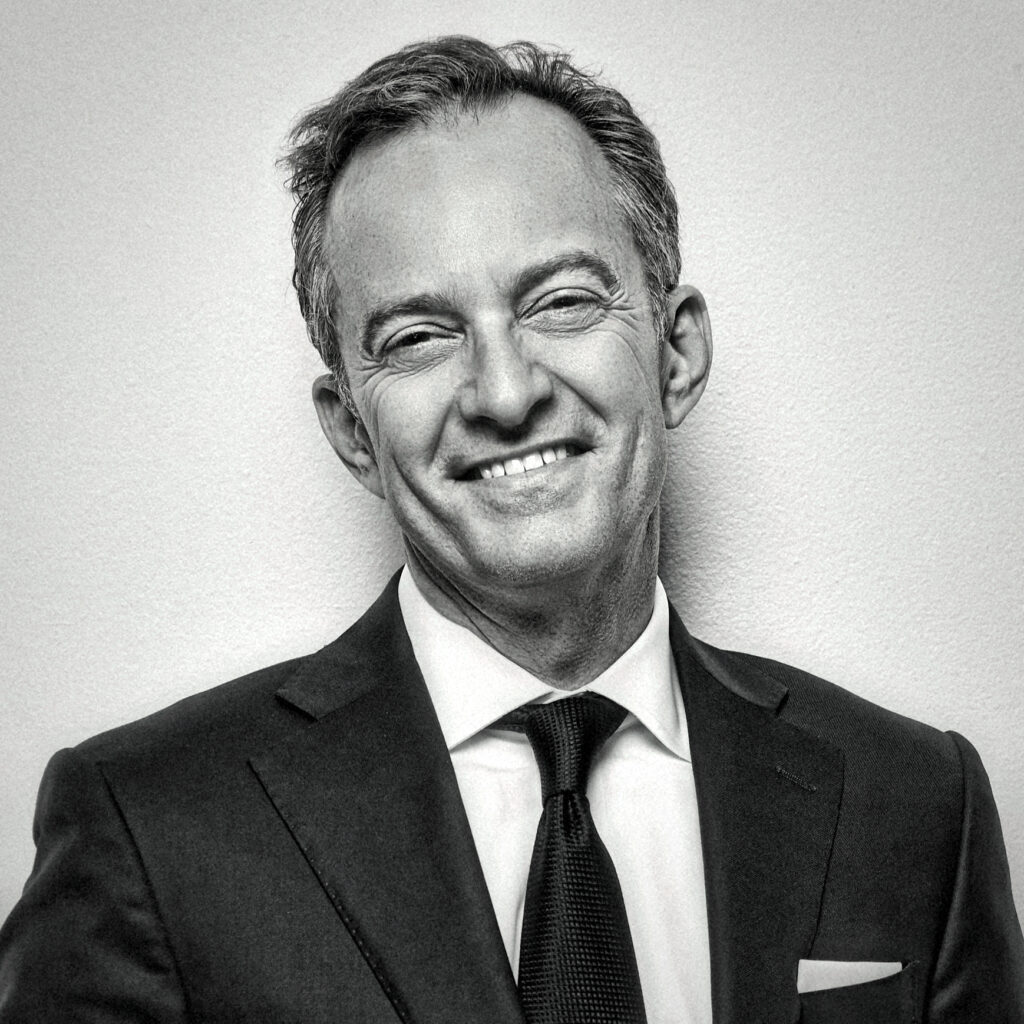
Kenneth Jeffrey Marshall discussed his book, Good Debt Cheap: Value Investing in Bonds, Preferreds, and Other Fixed Income Securities, at MOI Global’s Meet-the-Author Forum.

Research director Alex Gilchrist hosts MOI Global’s Meet-the-Author Forum. The event brings together members and a select group of book authors in the pursuit of worldly wisdom. We are delighted to have an opportunity to inspire your reading.

Watch the conversation (recorded in late 2024):
About the book:

Most fixed income securities return barely better than a bank savings account. Those that promise more often carry big risks.

But value investors are able to find bonds and preferreds that outperform without increasing risk. They use common sense and simple analyses to identify fixed income securities that beat even exceptional stocks. Their advanced perspective reveals remarkable opportunities that others miss.

This book moves you towards becoming such an expert. You’ll learn to:

  • SELECT great securities wrongly tossed into the junk bond dumpster.
  • DODGE the conventional metrics that mislead others.
  • FORESEE the exercise of embedded options.
  • FOCUS on the yield measures that matter and skip those that don’t.
  • ANALYZE contexts to view a preferred more as debt or more as equity.
  • INTERPRET economic indicators to predict conversions and redemptions.

This book shares with you a model for gauging fixed income securities from a value investing perspective. It brings key concepts to life with case studies that span industries from franchising to software to manufacturing, and geographies from the U.S. to Germany to Japan. And it does all this with straightforward language and clear math that anyone can understand.

In developing your skills you’ll master the nuances of debentures, notes, convertibles, floaters, zeros, bills, munis, paper, corporates, and sovereigns. You’ll understand duration, solvency, covenants, seniority, liquidity, and credit ratings. You’ll breeze through basics like bond ladders, yield curves, and tap issues. Most importantly, you’ll develop the justified confidence necessary to navigate the biggest, oldest securities market in the world. Make your experience in fixed income one of insight and success with Good Debt Cheap.

About the author:

Kenneth Jeffrey Marshall is an author, professor, and value investor. He is the author of the McGraw-Hill book Good Stocks Cheap: Value Investing with Confidence for a Lifetime of Stock Market Outperformance, which was also published in Chinese; Small Steps to Rich: Personal Finance Made Simple; and Good Debt Cheap: Value Investing in Bonds, Preferreds, and Other Fixed Income Securities. He teaches value investing and personal finance at Stanford University; industry analysis in the masters in engineering program at the University of California, Berkeley; and investing in the masters in finance program at the Stockholm School of Economics in Sweden. He holds a BA in Economics, International Area Studies from the University of California, Los Angeles; and an MBA from Harvard University.

The content of this website is not an offer to sell or the solicitation of an offer to buy any security. The content is distributed for informational purposes only and should not be construed as investment advice or a recommendation to sell or buy any security or other investment, or undertake any investment strategy. There are no warranties, expressed or implied, as to the accuracy, completeness, or results obtained from any information set forth on this website. BeyondProxy’s officers, directors, employees, and/or contributing authors may have positions in and may, from time to time, make purchases or sales of the securities or other investments discussed or evaluated herein.
La Importancia de los Planes a Medio Plazo del Management en Empresas Japonesas

January 8, 2025 in Contenido Libre, MOI Global en Español, Videos

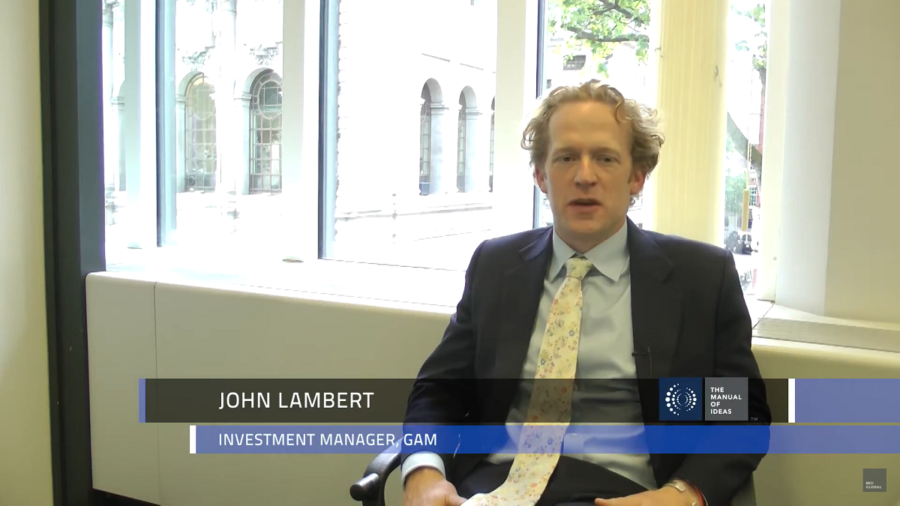
John Lambert, Investment Manager en GAM, explica la importancia de los planes a medio plazo del equipo directivo en las compañías japonesas.

El video tiene subtítulos al español. Para activarlos, dentro del recuadro del video, ve a “Configuración” → “Subtítulos“, y selecciona “Español“.

Los miembros de MOI Global pueden acceder a la transcripción completa.

Miembros, inicien sesión abajo para acceder al contenido restringido.

¿No eres miembro?

Gracias por tu interés. Ten en cuenta que MOI Global está cerrado para nuevos miembros en este momento. Si deseas unirte a la lista de espera para miembros hispanos, completa el siguiente formulario:

Distribution Businesses: Unsung Heroes of Consumer-Driven Economy

January 7, 2025 in Best Ideas Conference, Diary, Letters

This article is authored by MOI Global instructor Steve Gorelik, portfolio manager at Firebird Management.

Steve is an instructor at Best Ideas 2025.

In the last five years, only 25% of the 620 or so companies in the S&P 500 index managed to outperform the benchmark’s 15.5% annualized return. While some of the best performing names, like Nvidia or Eli Lilly, are well known to the public, one relatively obscure category of companies has done surprisingly well against a high-performing benchmark.

As of this writing, 26 publicly listed companies in the distribution business have market caps of around $1 billion or larger. Of the 26 companies on our list, 14 (or 54%) delivered returns better than the S&P 500 over the last five years. Moreover, the top five performers, which have annualized at 25% or better, have come from five different industries, suggesting that the business model, not the end markets, is the reason for the strong performance.

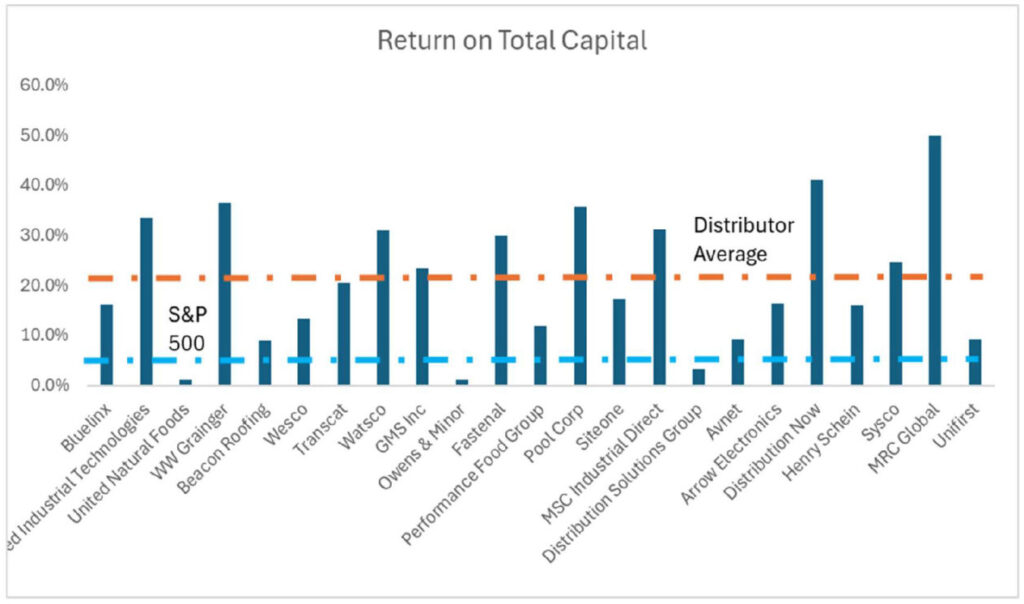
The advantage of the distributor’s business model comes from the high volume of small transactions going through large warehouses. While their margins are usually small, the capital efficiency is high due to the high velocity of sales and relatively small capital expenditures needed to maintain the distribution network. On average, distribution companies generate a return on total capital employed[1] in high teen/low 20’s percentage. This compares to roughly 4-5% generated by the S&P 500.


Source: Bloomberg, Firebird Value Advisors Research

As an aside, distribution businesses are unsung heroes of the consumer-driven economy. The coordination and technology required to get goods, some of which are perishable, from thousands of suppliers to tens of thousands of customers in a short period is truly remarkable. It is also mind-boggling that they do it profitably while marking up the cost of the products by only 15% – 30%.

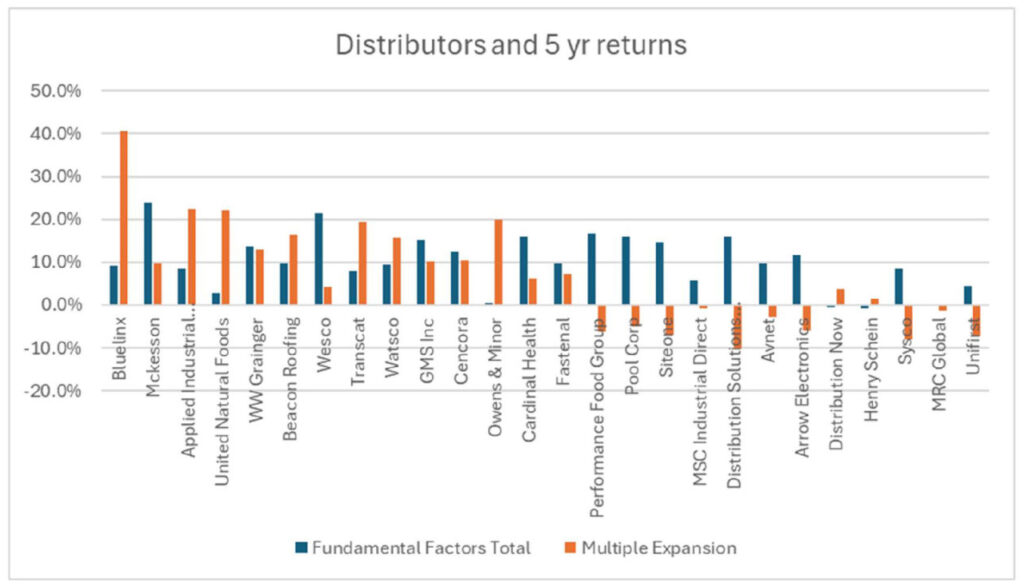
While half of the companies outperformed the market, the other half did not. To better understand the industry, we broke down the returns over the last five years into fundamental factors (revenue growth, margin expansion, dividends, share buybacks) and non-fundamental reason for multiple expansion. Unsurprisingly, the most common predictor of whether the company did well was the multiple expansion, which contributed 10% or more of annualized returns in some cases.


Source: Bloomberg, Firebird Value Advisors Research

With this in mind, the key question is which factors are more likely than not to result in multiple expansion. To do that, we ran a regression analysis with the following factors:

  • Revenue Growth – Did the company generate revenue growth of at least 5% per annum between 2018 and 2023
  • Share Repurchases – Did the company buy back more than 2% of shares per year in the last five years
  • Starting FCF Yield – Did the company trade at more than 7% FCF yield in the beginning of 2019
  • Significant acquirer – Did the company spend more than 50% of its free cash flow on M&A
  • Margin expansion – The change in operating cash flow margin between 2018 and 2022

Given that we have less than 30 observations, our analysis is not of an academic paper quality, but we think we have enough data to be “approximately right.”

The analysis suggests that the above factors, high starting free cash flow yield and high revenue growth, contribute positively to multiple expansion. Eight out of 14 companies that outperformed the market had both features, and none of the companies that underperformed the market had them. Both components must be present, as neither one of them is predictive on a standalone basis.

The portion of free cash flow spent on acquisition has positive predictive power as well, but it is almost fully o????set by the negative influence of companies with high revenue growth and a high percentage of cash on M&A.[2]

The other relevant factor is a positive change in operating cash flow margin. For each 1% improvement in the operating cash flow margin, the companies, on average, generated 2.4% of multiple expansion IRR per year.

Distributor margins are somewhat cyclical and dependent on macro factors such as inflation, supply chain disruptions, and the strength of end market demand, which impacts supplier rebates. Given that distributors operate at low margins, even a 1-2% change in profit margin can have a significant impact on their financials and, evidently, on stock market performance.

The outsized impact can go both ways. When the cyclical factors are working against distributors, as we are seeing currently in the food distribution space, these companies can experience significant declines in negative performance. The interplay between cyclical margins and macroeconomic conditions adds a layer of complexity to evaluating these companies and argues for an active management of these investments rather than a buy-and-hold approach. That said, the distribution sector is an essential segment of global trade and a fertile ground to look for investment opportunities.


[1] For the purposes of this calculation Return on Total Capital Employed is calculated as Cash Flow from Operations – Capital Expenditures/(Total Assets – Net Working Capital – Intangible Assets)
[2] Of the ten companies that spend more than 50% on M&A, 9 are also considered fast growing. While M&A factor technically delivers 28% of annualized IRR, the fast growing with M&A factor takes away 31% of IRR more than fully o????setting the benefit. This is why we are choosing to ignore this data point.

Members, log in below to access the restricted content.

Not a member?

Thank you for your interest.  Please note that MOI Global is closed to new members at this time. If you would like to join the waiting list, complete the following form:

La crisis financiera en China: ¿oportunidades de inversión o advertencias para los mercados?

January 6, 2025 in Miscelánea, MOI Global en Español

NOTA DEL EDITOR: El siguiente texto escrito por Javier Ruiz, CFA, es un extracto de una carta trimestral de Horos Asset Management.

* * *

Al igual que sucedió en Japón —cada uno con sus peculiaridades—, China vivió también, durante años, un gran crecimiento y desarrollo basados en un modelo económico dependiente de su gran capacidad exportadora. Sin embargo, el pinchazo de las economías globales durante la Gran Recesión de 2008 llevó a las autoridades gubernamentales a fomentar un mayor crecimiento que estuviera alimentado por la demanda interna (gasto). Esta demanda interna fue arropada, al igual que vimos (nuevamente) con el caso japonés, por un continuado incremento del endeudamiento privado que, como ya destacamos anteriormente, desembocó en el clásico boom descontrolado del sector inmobiliario, hasta alcanzar métricas que, difícilmente, podían no catalogarse como burbuja.

Miembros, inicien sesión abajo para acceder al contenido restringido.

¿No eres miembro?

Gracias por tu interés. Ten en cuenta que MOI Global está cerrado para nuevos miembros en este momento. Si deseas unirte a la lista de espera para miembros hispanos, completa el siguiente formulario:


Valentum sobre Eurazeo

January 3, 2025 in Ideas de inversión, MOI Global en Español

NOTA DEL EDITOR: Esta idea de inversión es obtenida de una carta a los inversores de Valentum Asset Management.

* * *

Eurazeo [EPA: RF] es una empresa francesa de gestión de activos alternativos con una peculiaridad muy interesante: comenzó siendo un holding de inversiones que posteriormente decidió crear su gestora de fondos para aprovechar el talento de gestión de su propio balance. Por tanto, la compañía tiene dos partes, (i) inversiones directas en compañías no cotizadas que ha comprado a través de su balance, y (ii) el negocio de gestión de fondos alternativos. Por lo tanto, podemos dividir la valoración de la compañía de forma muy clara en estos dos negocios.

Miembros, inicien sesión abajo para acceder al contenido restringido.

¿No eres miembro?

Gracias por tu interés. Ten en cuenta que MOI Global está cerrado para nuevos miembros en este momento. Si deseas unirte a la lista de espera para miembros hispanos, completa el siguiente formulario:


El regreso de las Small Caps

December 30, 2024 in Editor's Pick, MOI Global en Español

NOTA DEL EDITOR: El siguiente texto es obtenido de una carta trimestral de Castañar Investment Fund.

* * *

Por todos Vds. es sabida mi predilección por las empresas de pequeña capitalización. Son el sitio perfecto para encontrar empresas baratas, con crecimiento, sencillas y con skin-in-the-game.

Como ya he escrito en cartas anteriores, estas empresas se encuentran en un momento óptimo para invertir. Durante los últimos años, la combinación de altos tipos de interés junto con el auge de las grandes tecnológicas, ha hecho que éstas coticen a valoraciones récord. Por ejemplo, tenemos empresas en la cartera que no tienen deuda, tienen pedidos por un importe mayor que su capitalización y cotizan a dos o tres veces beneficios.

Miembros, inicien sesión abajo para acceder al contenido restringido.

¿No eres miembro?

Gracias por tu interés. Ten en cuenta que MOI Global está cerrado para nuevos miembros en este momento. Si deseas unirte a la lista de espera para miembros hispanos, completa el siguiente formulario:


Abaco Capital sobre Burford Capital y Litigation Capital Management

December 27, 2024 in Ideas de inversión, MOI Global en Español

NOTA DEL EDITOR: Las siguientes ideas de inversión son obtenidas de una carta de ABACO Capital.

* * *

El primer punto que queremos destacar son las reuniones con Christopher Bogart, CEO de Burford Capital, y Patrick Moloney, CEO de Litigation Capital Management (LCM), dos empresas clave dentro del sector de financiación de litigios y con un peso importante dentro de nuestras carteras.

El sector de financiación de litigios se enmarca dentro de los activos alternativos, de manera similar a lo que observamos en el capital privado (Private Equity) o en el capital de riesgo (Venture Capital). Sin embargo, hay una diferencia clave: los “exits” o retornos no dependen de los ciclos económicos ni de que otro inversor pague más por la inversión, sino que están determinados por la resolución de un juez o por la consecución de un acuerdo entre las partes en conflicto. Esta característica otorga a las inversiones en litigios una descorrelación significativa respecto a otros tipos de activos, lo que las convierte en una opción atractiva para diversificación.

Miembros, inicien sesión abajo para acceder al contenido restringido.

¿No eres miembro?

Gracias por tu interés. Ten en cuenta que MOI Global está cerrado para nuevos miembros en este momento. Si deseas unirte a la lista de espera para miembros hispanos, completa el siguiente formulario:


El auge y la caída de la burbuja financiera japonesa

December 23, 2024 in Miscelánea, MOI Global en Español

NOTA DEL EDITOR: El siguiente texto escrito por Javier Ruiz, CFA, es un extracto de una carta trimestral de Horos Asset Management.

* * *

A finales de los años 80, Japón vivió una de las burbujas financieras más importantes que se recuerdan. Tras la década de los 60, en la que el país se recuperó de la devastadora Segunda Guerra Mundial sustentándose en unas elevadas tasas de ahorro y un modelo económico basado en el crecimiento elevado de sus exportaciones, el país del sol naciente comenzó a apoyarse a finales de los 70 y, especialmente, en los 80 en un mayor endeudamiento. ¿El principal motivo? La fuerte apreciación del yen japonés, tras las Acuerdos de Plaza de 1985, llevó al Banco de Japón a reducir drásticamente los tipos de interés, alimentando un extraordinario boom crediticio que desencadenó el clásico ciclo insostenible de mala asignación de recursos y degradación de liquidez del sistema financiero (endeudándose a muy corto plazo y concediendo préstamos a muy largo plazo, por ejemplo). Esta expansión del endeudamiento engordó una burbuja bursátil e inmobiliaria como pocas veces se han visto en una economía de tal relevancia. En tan solo cinco años, el índice Nikkei —principal índice bursátil del país— triplicó su valor, mientras que el índice general de precios de la vivienda más que dobló.1

Miembros, inicien sesión abajo para acceder al contenido restringido.

¿No eres miembro?

Gracias por tu interés. Ten en cuenta que MOI Global está cerrado para nuevos miembros en este momento. Si deseas unirte a la lista de espera para miembros hispanos, completa el siguiente formulario:


BIE24: Protector Forsikring

December 19, 2024 in Best Ideas en Español, MOI Global en Español

NOTA DEL EDITOR: Alejandro Garza Salazar, CIO y portfolio manager de AZTLAN Equity Management, presenta su tesis de inversión sobre Protector Forsikring, en Best Ideas en Español 2024.

* * *

Resumen

Protector Forsikring ASA (Protector) es una compañía de seguros multinacional con sede en Noruega. La Compañía ofrece seguros de responsabilidad para grandes y medianas empresas y el sector público en Noruega, Suecia, Dinamarca, Finlandia y el Reino Unido. Ofrece seguros dentro de los segmentos de: Propiedad, Responsabilidad Civil, Automóviles, Personales y Viajes. Protector opera en seguros no marítimos. La Compañía tiene dos segmentos de negocio: Las líneas de negocio Comercial, que ofrece seguros para pequeñas y grandes empresas y programas de afinidad a través de corredores; y Sector Púbico, que se ha consolidado como aseguradora en el sector público en los países nórdicos con más de 600 municipios y más de 30 provincias.

La tesis de inversión de Protector radica en la combinación de una empresa aseguradora de alta calidad con alto potencial de crecimiento. Esto se da a través de su operación eficiente y de bajo costo que permite tener altos márgenes y métricas operativas muy superiores dentro de su industria, combinado con un modelo escalable exportable primero fuera de noruega al resto de los países nórdicos, y luego al resto de Europa y en el futuro posiblemente a otros países del mundo occidental. La alta rentabilidad y el alto crecimiento permiten proyectar un efecto compuesto muy potente en el crecimiento del capital de la compañía.

La sesión completa está disponible exclusivamente para miembros de MOI Global.

Members, log in below to access the full session.

Not a member?

Thank you for your interest.  Please note that MOI Global is closed to new members at this time. If you would like to join the waiting list, complete the following form:

Acerca del conferencista

Alejandro Garza Salazar es CEO y portfolio manager de Aztlan Equity Management y socio de Canales Legal + Finanzas (México). Anteriormente, fue portfolio manager y director de equity research en Ashmore Equities Investment Management (EE. UU.). También fue Vicepresidente de planeación estratégica y finanzas en Vitro; y banquero de inversión en Violy, Byorum &  Partners. Alejandro tiene una licenciatura en ingeniería química por el ITESM y un MBA por la EGADE Business School.

El desafío geopolítico de las tierras raras

December 16, 2024 in Industrias, MOI Global en Español

NOTA DEL EDITOR: Este texto es obtenido de una carta mensual de NAO Sustainable Asset Management.

* * *

Las tierras raras, un conjunto de 17 elementos químicos, se han convertido en componentes indispensables para numerosas tecnologías de vanguardia. A pesar de su nombre engañoso, estos elementos no son particularmente escasos en la corteza terrestre. Sin embargo, su extracción y procesamiento entrañan desafíos significativos, tanto técnicos como medioambientales.

Miembros, inicien sesión abajo para acceder al contenido restringido.

¿No eres miembro?

Gracias por tu interés. Ten en cuenta que MOI Global está cerrado para nuevos miembros en este momento. Si deseas unirte a la lista de espera para miembros hispanos, completa el siguiente formulario:


MOI Global