Uno no conoce realmente una compañía hasta que prueba el producto

November 2, 2018 in Miscelánea, MOI Global en Español

NOTA DEL EDITOR: Este comentario supone un extracto de la carta trimestral recientemente publicada a los partícipes de Andromeda Value Capital

* * *

Nos gustaría hacer tres matizaciones rápidas antes de entrar a ver los movimientos en cartera.

En primer lugar, vamos a intentar hacer un ejercicio a la inversa. Parte de nuestro trabajo cuando hablamos con los partícipes es siempre enfriar expectativas. Y como decía Charlie Munger, el secreto de un matrimonio feliz son bajas expectativas. En temas del amor no somos tan expertos, pero de inversiones sabemos algo más. Y para que una inversión sea fructífera, sin lugar a duda, el tener expectativas controladas es muy beneficioso.

Lo que queremos decir con esto es que nuestro objetivo, como se sabe, es hacerlo lo mejor posible, y en ello estamos… pero el mundo de la inversión no es un proceso lineal y se debe recordar que hay momentos de mayores retornos mientras que hay otros de épocas negativas. Aunque los primeros siempre son mucho más recurrentes que los segundos.

Miremos a McDonald´s [MCD], por ejemplo. En Andromeda hay mucho partícipe que está en su década de los 20 años, así que utilicémoslos como ejemplo, aunque es extensible a cualquier otra edad. Si cualquiera de estos partícipes hubiese comprado 10.000$ en acciones de McDonald´s el día que nació (se las tenían que haber comprado los padres, lógicamente…) habría pagado unos 5$ por acción, eso supone que habría recibido unas 2000 acciones. Sin embargo, McDonald´s cotiza a 165$ hoy día. Si hacemos la multiplicación de sus 2000 acciones por 165$ significa que tendría 330.000$ invertidos en McDonald’s. O visto de una manera teórica, si dividimos los 330.000 entre sus 28 años podríamos decir que el partícipe ha estado ganando 11.785 dólares al año que se materializan ahora que ya tiene 28 años. Esto significaría que este partícipe tendría una riqueza a sus 28 años que lo situaría en el percentil del 3% de los más ricos de su país.
Continue reading »

Tim Yates on Lessons Learned as a Public Company Director

October 29, 2018 in Featured, Podcast, The Zurich Project, The Zurich Project Podcast, Transcripts

In an episode of The Zurich Project Podcast, presented by MOI Global, Tim Yates discusses his illustrious career at the top of corporate America and reflects on the lessons learned as a director of numerous prominent public companies.

Tim has more than forty-five years of general and financial management experience. From 2007 until November of 2016 Tim was with Monster.com. During that time, he served as a member of the Board of Directors, CFO, and as CEO from 2014 to 2016. In November of 2016, Randstand Holdings, Inc. acquired Monster.com in a transaction designed to build on Monster’s global brand and online recruiting technology.

Previously, Tim was a member of the Board of Directors and Chief Financial Officer of Symbol Technologies. After implementing a successful turnaround of this manufacturer of Bar Code Scanners and Mobile Computers, Symbol was sold to Motorola in a $4 billion transaction. From 1971 to 1995, Tim was at Bankers Trust Company in a variety of management positions. From 1990-1995, Tim was Chief Financial and Chief Administrative Officer. Tim currently serves on the Board and Chairs the Audit Committee of CommScope, Inc, a $6 billion global leader in wireless and fiber optic solutions.

Tim has been an active private investor and mentor to early stage companies and currently serves on the Board Directors of Cyndx Holding Company, a secure cloud-based platform enabling financial institutions to obtain curated information about institutional investors. Tim was an early backer of OpenLink Financial – a private company which is the global leader in trading, risk management and financial software.

He received his MBA from Harvard Business School and his BA from Yale University.

The Zurich Project Podcast is on iTunes, Soundcloud, and Stitcher.

A transcript of the conversation is available to members of MOI Global.

Members, log in below to access the restricted content.

Not a member?

Thank you for your interest.  Please note that MOI Global is closed to new members at this time. If you would like to join the waiting list, complete the following form:

Marc Garrigasait sobre dos small caps japonesas

October 29, 2018 in Contenido Libre, Ideas de inversión, MOI Global en Español

NOTA DEL EDITOR: Estas ideas de inversión presentadas por Marc Garrigasait, son obtenidas de una carta del fondo Japan Deep Value Fund.

* * *

En julio compramos acciones de Miyaji Engineering [TYO: 3431], una empresa especializada en la construcción de puentes e infraestructuras. Lo más sorprendente fue descubrir que la acción cayó en bolsa de los 3.100 yenes/acción de nov-17 a los 1.900 de este verano, mientras sus pedidos firmados de nueva obra pública se multiplicaban por cuatro en cuatro años, lo que asegura una gran mejora en sus ventas y beneficios. Tras adquirirla en el entorno de los 2.000 yenes/acción, la empresa publicó resultados muy buenos y mejoró las expectativas, nada extraño viendo sus pedidos. El mercado se tomó muy positivamente la noticia y sus acciones subieron en tres semanas hasta los 3.000 yenes/acción. Miyaji Engineering tiene tan solo en su accionariado un 8% de inversores extranjeros. Su valor en bolsa a finales de septiembre, tras la fuerte alza en sus acciones, era de unos 170 millones de dólares, que se reduce a unos 78 mill. si incluimos su caja y activos líquidos. Miyaji ha generado 59 mill. de dólares de free cash flow en el último año con lo que cotiza a una ridícula valoración de 1,3 años (EV/Free cash flow) que supone una rentabilidad esperada superior al 70% anual (inverso de la ratio anterior).
Continue reading »

NAFTA and Sustainable Competitive Advantage

October 27, 2018 in Commentary, Letters, Macro

This article is excerpted from a letter by Alain Robitaille, portfolio manager of Robitaille Group at Desjardins in Quebec, Canada.

A topic garnering lots of media attention at the time of this writing is the difficulty facing President Trump and the Canadian government in reaching a new trade agreement. A major point of contention relates to supply management (quotas) in the farming sector, which controls milk, poultry and egg production.

Supply management has been in effect in Canada for several years, but it doesn’t exist in the United States. The framework coordinates the supply and demand of those products between producers and consumers. To be effective, the system limits imports of dairy products from other countries, but also ensures there is no surplus to be sold abroad. So, for the U.S. and several other countries, it represents a trade barrier that closes off the Canadian market thus creating an irritant, even though the Canadian market is very small.

That said, you may be wondering where I’m going with this. When are we going to talk investments? I’m getting to it. As you may know, before I became a portfolio manager, I co-owned a medium-sized dairy farm with my brother Marcel and my father. My brother and I ran the farm for ten years.

During that time, we “came across” Warren Buffett. In his books and interviews, Buffett often talks about sustainable competitive advantages (castles and moats). A competitive advantage allows a company to sell its products or services with increasing profitability over the years. What struck me most about his theory is that Buffett understood raw materials don’t enjoy the benefits of a competitive advantage. As he says, the average consumer doesn’t buy milk from a particular producer: he buys milk. Same thing for corn, chicken, etc.

Members, log in below to access the restricted content.

Not a member?

Thank you for your interest.  Please note that MOI Global is closed to new members at this time. If you would like to join the waiting list, complete the following form:

Disclaimer: None of these returns take management fees into account. This data represents past performance and does not guarantee future results. This document may contain statistics from third parties we consider to be reliable. Desjardins Securities makes no claim regarding the accuracy or completeness of the statistic information obtained, and readers should not rely on it in this respect. Alain Robitaille and Fanie Ouellet are registered as portfolio managers with self-regulatory organizations. They are authorized under the provisions of Rule 1300 of the Investment Industry Regulatory Organization of Canada (IIROC) to make investment decisions and provide advice on securities for managed accounts. Aside from Alain Robitaille and Fanie Ouellet, no member of Robitaille Group can exercise discretionary power over a client’s account, approve discretionary orders for a managed account or contribute to investment decisions taken on behalf of a managed account holder or to advice given with respect to such an account. Each of the Desjardins Securities advisors named on the front page or at the beginning of any section of this document confirms that the recommendations and opinions expressed within accurately reflect the personal opinions of the advisors with respect to the company and the securities discussed in this document, as well as any other company or security monitored by the advisor that is mentioned in this document. Desjardins Securities may have published opinions that are different from or even run counter to those expressed in this document. These opinions reflect the different perspectives, assumptions and analytical methods of the advisors who prepared them. Desjardins Wealth Management Securities is a trade name used by Desjardins Securities Inc., a member of the Investment Industry Regulatory Organization of Canada (IIROC) and the Canadian Investor Protection Fund (CIPF).

El proceso de inversión de azValor

October 26, 2018 in Miscelánea, MOI Global en Español

NOTA DEL EDITOR: Este texto es obtenido de una carta trimestral de azValor Asset Management.

* * *

Nosotros somos incapaces de prever las fluctuaciones de la bolsa, (nadie lo ha logrado de forma sistemática) y quien crea que hacerlo es esencial para invertir bien, no debería tener el dinero con nosotros. Un cliente me preguntó un día a qué nos dedicamos si no es a saber qué van a hacer los mercados.
Ahí va la respuesta, querido Gerardo. A esto nos dedicamos:
1. En primer lugar, a un trabajo relativamente mecánico:

  • Recopilar datos históricos de una empresa como, por ejemplo, cuánto vende y cuánto gana, aunque hay muchos más.
  • Ordenar esos datos en un formato nuestro que facilite su comparabilidad.
  • Recopilar los mismos datos históricos de todas las empresas de la competencia.

Continue reading »

Portfolio Composition: Compounders and Special Situations

October 25, 2018 in Letters, Special Situations, Wide Moat

This article is authored by MOI Global instructor Matthew Sweeney, founder and managing partner of Laughing Water Capital, based in New York.

Broadly speaking, our portfolio is comprised of two major investment archetypes: compounders and special situations.

In brief, compounders are businesses that can achieve supranormal returns on invested capital for long periods of time due to some combination of competitive advantages and/or extraordinarily talented management teams. Compounders typically justify a high multiple due to some combination of a predictable business, a longer runway to reinvest in the business at high rates of return, or the ability to return capital to shareholders. Identifying a compounder that is suitable for investment typically depends on identifying a great business and management team that are even better than the market realizes. As these are great businesses by definition, they will rarely appear cheap on any traditional metric outside of recessionary periods.

Special situations are investments where the business and management may be of lesser quality, but the opportunity exists less because of identifying a gap between the quality of the business and management vs. expectations, and more on identifying some failing in human nature or market structure that creates a mispricing. In the best cases, we will be able to find future compounders today, when they are available at special situation prices.

In the long term, I expect that our portfolio will increasingly tilt toward compounders. However, at the moment, our portfolio is tilting increasingly toward special situations. There is nothing wrong with this per se, but special situation investing will be less tax efficient, and has the unfortunate problem of requiring re-generation because unlike compounders, special situations are best sold when the temporary conditions that led to the mispricing have passed.

There are a number of reasons for the current tilt. First, in my view it is often more difficult to successfully identify compounders than special situations. Betting on a compounder can be thought of as betting that a company can defy the destructive forces of capitalism. Betting on a special situation can be thought of as betting that irrational behavior will eventually be replaced by rational behavior. I believe that betting on the return of rationality is simply a lower bar to step over.

To illustrate how difficult it is to successfully identify great businesses that are better than the market realizes, consider that in a recent interview, John Malone, Chairman of the Liberty Companies and easily one of the greatest investors of all time, told a story of how he advised Warren Buffett, literally the greatest investor of all time, to not invest in Microsoft, one of the greatest companies of all time led by one of the greatest entrepreneurs of all time, during its early days. If you are keeping score at home – that is one of the greatest, telling the greatest, NOT to invest in one of the greatest, led by one of the greatest. Buffett himself admits this was a colossal error of omission, and should be enough to cause any mortal to think twice before claiming they have found a business and management team so good that they are worth paying up for.

Second, special situations often resolve themselves over a defined – often short – period of time, independent of what the broader market does. To be clear, time is the friend of great businesses, which allows one to pay higher prices, but in today’s environment where we are likely closer to the end of the economic cycle than the beginning (although it can certainly continue longer than anyone expects), I believe it makes sense to tilt the portfolio toward shorter duration opportunities that are likely to be somewhat removed from broader market action.

Third, investing in special situations ties well with the competitive advantages we have as a small firm. For example, while Buffett evolved to focus primarily on compounders, when he managed smaller amounts of capital, he largely focused on special situations. Simply stated, there is often less competition investing in small special situations than there is when investing in larger compounders.

This document, which is being provided on a confidential basis, shall not constitute an offer to sell or the solicitation of any offer to buy which may only be made at the time a qualified offeree receives a confidential private offering memorandum (“CPOM”) / confidential explanatory memorandum (“CEM”), which contains important information (including investment objective, policies, risk factors, fees, tax implications and relevant qualifications), and only in those jurisdictions where permitted by law. In the case of any inconsistency between the descriptions or terms in this document and the CPOM/CEM, the CPOM/CEM shall control. These securities shall not be offered or sold in any jurisdiction in which such offer, solicitation or sale would be unlawful until the requirements of the laws of such jurisdiction have been satisfied. This document is not intended for public use or distribution. While all the information prepared in this document is believed to be accurate, Laughing Water Capital, LP and LW Capital Management, LLC make no express warranty as to the completeness or accuracy, nor can they accept responsibility for errors appearing in the document. An investment in the fund/partnership is speculative and involves a high degree of risk. Opportunities for withdrawal/redemption and transferability of interests are restricted, so investors may not have access to capital when it is needed. There is no secondary market for the interests and none is expected to develop. The portfolio is under the sole trading authority of the general partner/investment manager. A portion of the trades executed may take place on non-U.S. exchanges. Leverage may be employed in the portfolio, which can make investment performance volatile. The portfolio is concentrated, which leads to increased volatility. An investor should not make an investment, unless it is prepared to lose all or a substantial portion of its investment. The fees and expenses charged in connection with this investment may be higher than the fees and expenses of other investment alternatives and may offset profits. There is no guarantee that the investment objective will be achieved. Moreover, the past performance of the investment team should not be construed as an indicator of future performance. Any projections, market outlooks or estimates in this document are forward-looking statements and are based upon certain assumptions. Other events which were not taken into account may occur and may significantly affect the returns or performance of the fund/partnership. Any projections, outlooks or assumptions should not be construed to be indicative of the actual events which will occur. The enclosed material is confidential and not to be reproduced or redistributed in whole or in part without the prior written consent of LW Capital Management, LLC. The information in this material is only current as of the date indicated, and may be superseded by subsequent market events or for other reasons. Statements concerning financial market trends are based on current market conditions, which will fluctuate. Any statements of opinion constitute only current opinions of Laughing Water Capital LP, which are subject to change and which Laughing Water Capital LP does not undertake to update. Due to, among other things, the volatile nature of the markets, an investment in the fund/partnership may only be suitable for certain investors. Parties should independently investigate any investment strategy or manager, and should consult with qualified investment, legal and tax professionals before making any investment. The fund/partnership is not registered under the investment company act of 1940, as amended, in reliance on an exemption there under. Interests in the fund/partnership have not been registered under the securities act of 1933, as amended, or the securities laws of any state and are being offered and sold in reliance on exemptions from the registration requirements of said act and laws. The S&P 500 and Russell 2000 are indices of US equities. They are included for informational purposes only and may not be representative of the type of investments made by the fund. 

Why We Invest in Eastern Europe

October 25, 2018 in Deep Value, Europe, Letters, Macro

This article is authored by MOI Global instructor Steve Gorelik, portfolio manager at Firebird Management, based in New York.

Headlines:
“Sistema shares dive after Russian court freezes assets – CNBC.com”
“Law firm accuses ENRC of bribes, sanctions-busting and overpayment”
“Russia Laundered Millions via Danske Bank Estonia”
“Graham, Menendez crafting bill to crack down on Russia”

Eastern Europe has for the last two decades featured daunting headlines that would keep most reasonable people away from its capital markets. The Eastern European equity total return index is still more than 40% below its 2008 peak, and there are numerous current concerns. These include the authoritarian tendencies of various governments, and Western sanctions on Russia.

We at Firebird Management have been investing in the region for over 24 years and have seen it develop from newly independent countries gingerly entering the path of capitalism to diversified, vibrant economies prepared to face the challenge of economic cycles. Over this time, despite corrections in 1994, 1998, 2001, 2008, 2012, and 2014, our investors have been compensated for the volatility with generous returns for those invested over the longer term.

Below are a few reasons why we believe the current opportunity is as good as any that we have seen in our time investing in the region.

High-Quality Growth

Thanks to highly educated populations, increasingly globalizing economy, and low starting point, the EU convergence part of Eastern Europe (i.e., CE3, Baltics, Balkans) have been consistently generating GDP growth 2-3% above Western Europe. Countries like Romania and Poland serve as a vital part of the supply chain for companies in Western Europe. Starting as manufacturing hubs, these countries are increasingly looked upon as service, R&D and back office centers for larger companies.
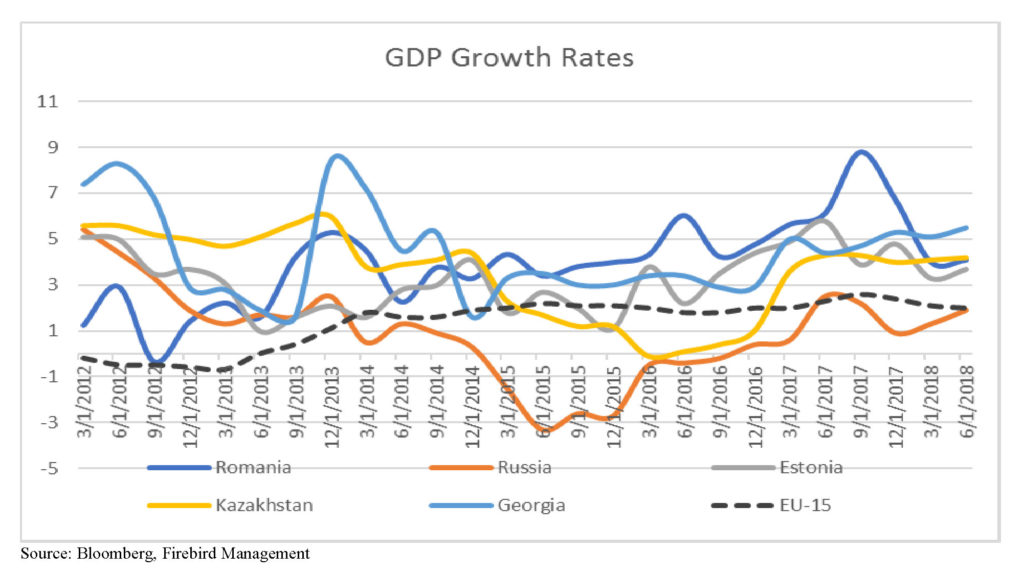
While the region has been growing for some time, the structure of growth has changed. Prior to the 2008 crisis, 6-7% annual increases in GDP were driven by foreign liquidity pumped in via the banking systems, and high current account deficits used to finance consumption.

When liquidity left the markets in 2008, the result was severe recessions, with GDP in some countries falling as much as 15%. In response, companies and governments cut spending, improved efficiencies, and cracked down on corruption that had prevented them from accessing EU structural funding. They were therefore able to build a base for the next phase of growth that we see today. As for Russia, corporates and the government refinanced much of their foreign currency borrowing into rubles, while floating the currency.

2018 brought higher global interest rates and with them a renewed bout of volatility in emerging markets dependent on foreign fund flows. Unlike Turkey, Argentina, and South Africa, the countries where we invest have balanced fiscal accounts and fund any current account deficits from stable sources such as FDI, tourism, and remittances. They have proven much more resilient.

Improved Corporate Governance

Despite the occasional negative headline, the overall quality of corporate governance has improved dramatically. Twenty-five years ago, after a half century in a centrally planned system, founders were starting companies from scratch in an unstable economic environment. The skill set required to launch a business in such conditions was different from the one it takes to succeed in a small open economy connected to global networks. In Russia as well, by now a new generation of mostly foreign educated managers has replaced the Red Directors who were in charge in the mid-1990’s.

As economies and businesses developed, so did business leaders. Owners started seeing the benefit of reinvesting profits in their companies instead of their offshore accounts. Running a clean company makes it easier to resist predation by corrupt government officials and others. Owners are also starting to see the wealth effect from higher market multiples of their companies.

The companies are also becoming better at allocating capital. Gone are the days of global empire building. Since 2008 easy funding for such projects has been hard to come by. As a result, companies have retrenched around their core competencies and started focusing on ROIC in their capital allocation decisions.

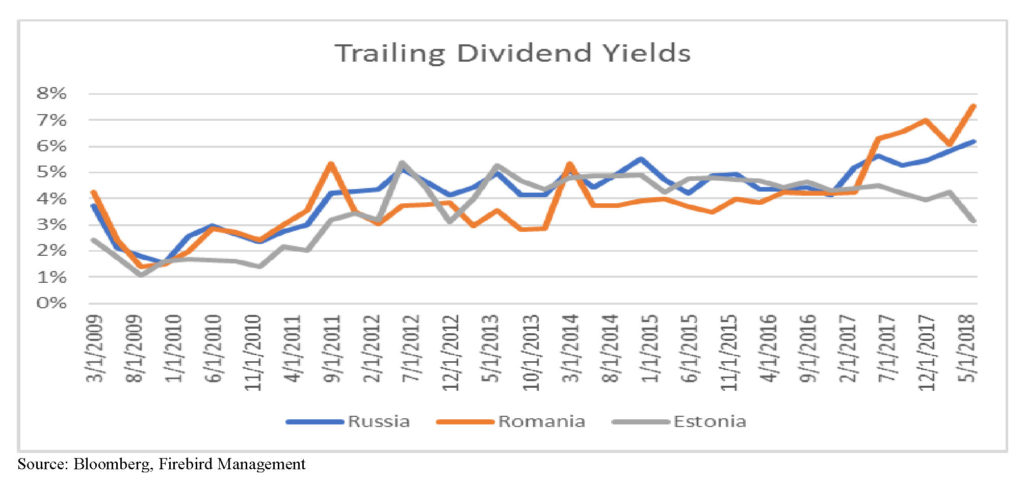
Better capital allocation decisions drive better returns for shareholders. Since 2009, the dividend yields of regional indices has increased dramatically, with many of the largest companies paying 6-8% dividends. The Russian RTS Index currently yields close to 6% while trading at 5.9x P/E. In 2003, when the Russian market was trading at similar valuations, the dividend yield was below 2%.
Cyclically Low Valuations

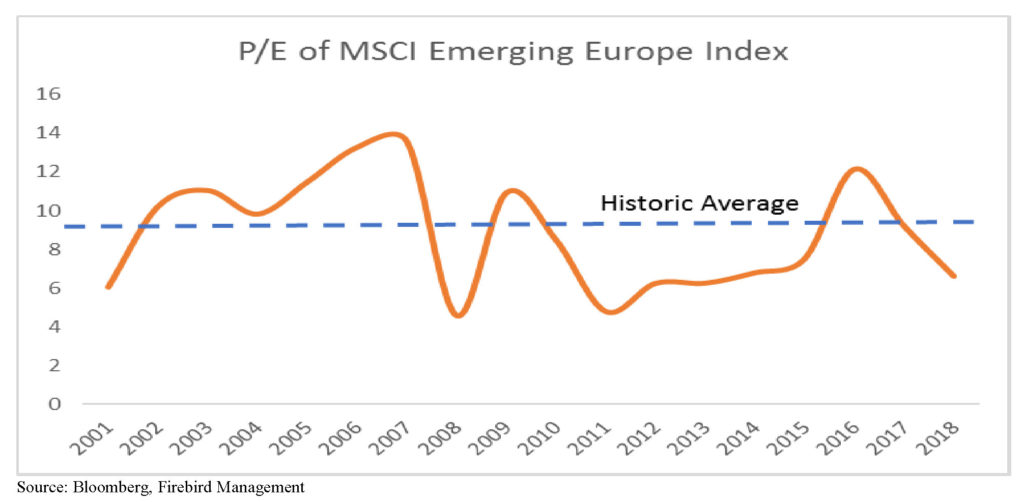
While the world’s equity markets have seen significant multiple expansion over the last few years, the additional liquidity that drove this rerating has largely passed by Eastern Europe. Most of the regional indices are still trading firmly in single-digit P/E range.
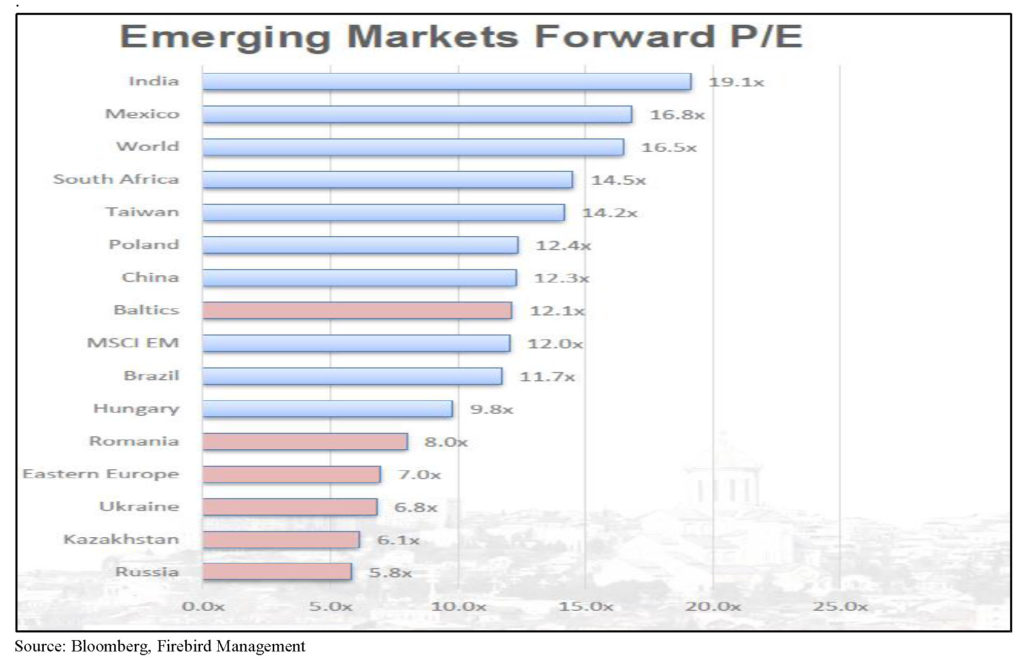
Even though multiples have not expanded, company earnings have. Companies making up the RTS Index grew sales and net income by 26% and 50% respectively since the beginning of 2016.

As a result of earnings growth, trading multiples contracted and are now close to historical lows.
Lack of Competition

A market in its most fundamental form is an equilibrium of supply and demand from buyers and sellers. Over the last few years, liquidity flooded the global markets and increased demand for investment options. This phenomenon resulted in record low yields spreads for bonds and high earnings multiples for many equity markets.
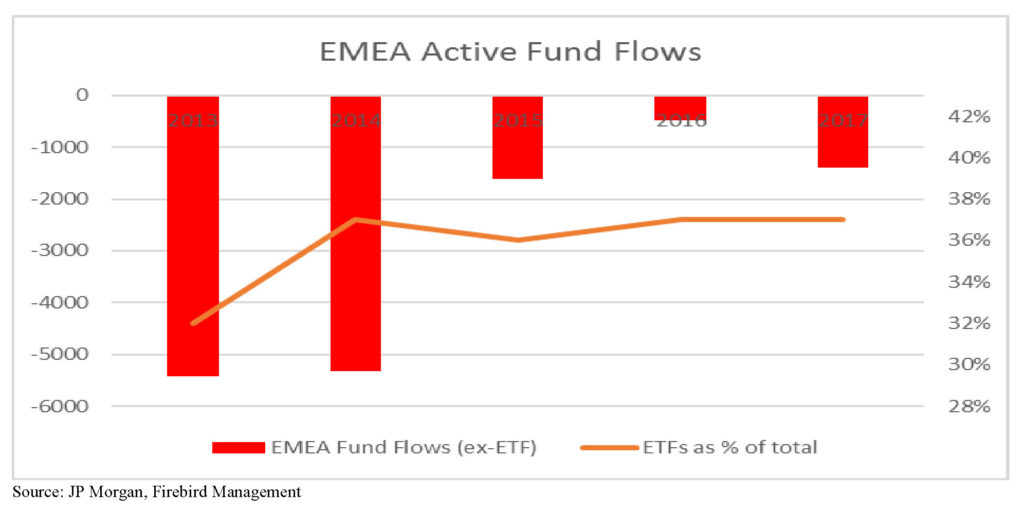

As the rest of the world enjoyed the fruits of central banks’ labor, foreign investors remained concerned about political headlines emanating from Eastern Europe. Regional conflicts and a perceived rise of authoritarianism combined to create an environment that was easier to overlook than to invest in. It also did not help that many of the smaller countries in the region are too small for large international investors. As an example, combined daily trading volume of the three exchanges in the Baltics is below $2 million. Lack of liquidity and negative headlines combined to create environment in which actively managed Eastern European equity funds have experienced net outflows for over five years.

Our markets, with few exceptions, are still lacking a natural domestic investor base that would come from retail and pension fund investors. Poland, with its well-developed pension funds required to invest in domestic equities, was an outlier with higher valuations and a mature equity market. Thanks to entrepreneurs viewing IPOs as a viable source of growth capital, Poland has over 800 listed companies.

In other countries, the domestic funding condition is bleaker. Pension funds as institutions have only started gathering scale in the last few years and for now are more comfortable investing in fixed income markets. Domestic equity allocation for the largest pension funds in the Baltic States is below 5% of total assets under management.

The good news about the lack of domestic sources of demand is that any change to the status quo would be positive. In Russia, where yields on bank deposits have fallen dramatically, we are seeing retail investors joining the market in record numbers.
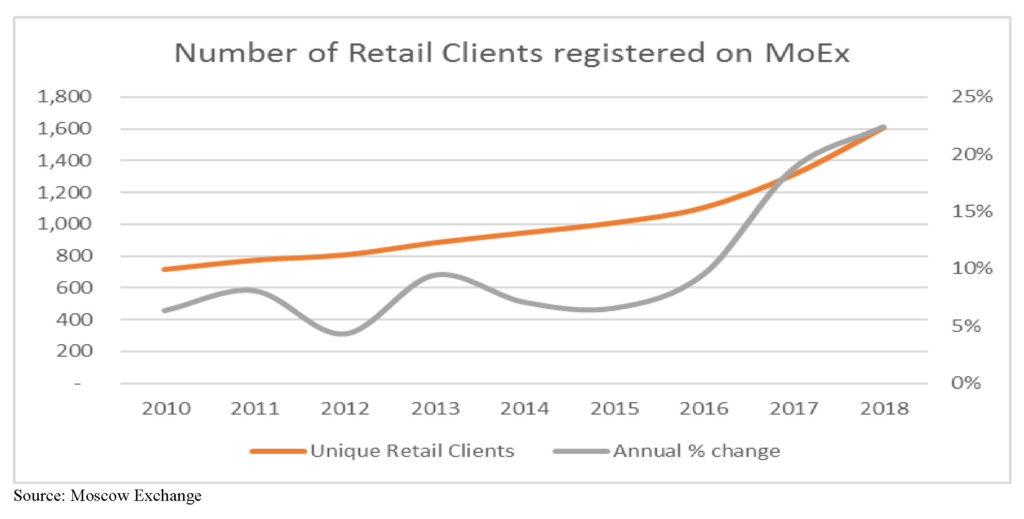

In other countries, like Estonia, governments are working on various programs to encourage deepening capital markets.

Being a professional investor in this environment is challenging but potentially very rewarding. The reverse of low P/Es are high earnings yields. We are buying high-quality growing companies at valuations that can deliver IRRs of 15% or more without any multiple expansion. And if the valuation does improve, then the returns on investments in Eastern Europe could be much higher.

MOI Global