Ashford: Wide-Moat Hospitality Services Business

September 25, 2018 in Audio, Deep Value, Equities, Ideas, Micro Cap, North America, Real Estate, Small Cap, Special Situations, Transcripts, Wide-Moat Investing Summit, Wide-Moat Investing Summit 2018, Wide-Moat Investing Summit 2018 Featured

Scott Miller of Greenhaven Road Capital presented his in-depth investment thesis on Ashford (NYSE American: AINC) at Wide-Moat Investing Summit 2018.

The full session is available exclusively to members of MOI Global.

Members, log in below to access the full session.

Not a member?

Thank you for your interest.  Please note that MOI Global is closed to new members at this time. If you would like to join the waiting list, complete the following form:

About the instructor:

Scott Miller is the founder of Greenhaven Road Capital, a boutique investment partnership that seeks out off the beaten path investments, modeled after the early Buffett partnerships. The firm is built on the belief that a focused investment manager can outperform an index by limiting fund capacity and by concentrating exposure on a few great ideas over a long time horizon. Experience as an owner-operator of businesses influence Greenhaven’s approach towards partially-owning companies rather than merely picking stocks. Prior to founding Greenhaven Road, Scott co-founded Acelero Learning, serving in a variety of roles over a decade from CFO to CTO, to Chief Strategy Officer to his current role of Board Member. Acelero Learning has grown from three people in an office “cube” in New York City to 1,500 employees serving 5,000 children across four states. Additionally, Scott managed a manufacturing business, with responsibility for hiring, firing, planning inventory, negotiating with suppliers and acquiring customers at a reasonable cost. Scott holds an MBA and a Masters in Education from Stanford University.

European Investing Summit 2018 Preview: LafargeHolcim

September 25, 2018 in Equities, Europe, European Investing Summit, European Investing Summit 2018, Ideas

This article previews an idea presentation at European Investing Summit 2018. It is authored by MOI Global instructor Samuel Sebastian Weber, an independent wealth manager based in Zug, Switzerland.

LafargeHolcim is the leading global construction materials and solutions company. Based on its targets for the next five years, the company trades at a discount to intrinsic value. Its current CEO has a strong track record of overdelivering on his targets, further strengthening the investment case.

Global Building Materials Industry and Competitive Dynamics

Building materials is a fragmented CHF 2’500 billion market and is forecasted to grow 2-3% per year. Excluding China, the size of the market is CHF 1’750 billion, of which cement and ready-mix concrete amount to CHF 200 billion each and aggregates to CHF 220 billion. The other building materials market, representing 65% of the total, is valued at CHF 1’130 billion (LafargeHolcim, Investor Presentation, 2017).

Cement is a powdered mineral binder whose hydration produces durable solids. Nowadays, it is mostly used for production of concrete, being mixed with aggregates and water. Construction aggregates include sand, gravel and crushed stone, which are the dominant materials in concrete, accounting for 60% to 75% of the initial mix. Water and cement make up 15 to 20% and 10 to 15% of the initial mix, respectively. The production of aggregates, cement and concrete fluctuates with economic booms and downturns and, during building slumps, can contract rapidly and significantly. US cement consumption, for example, surpassed its 1973 high of 82 million tons only in 1986, and reached a new peak in 2005 with 128 million tons. Five years later, it dropped by 45% to just 71 million tons, a figure reached for the first time in 1968. In 1900 and 1928 those figures stood at 3 and 30 million tons, a 10* increase in only 30 years (Vaclav Smil, Making the Modern World, 2013).

In their initial stage of development, countries need cement. At consecutive stages, the demand for aggregates and ready-mix concrete increases as building standards develop. Concrete (particularly its reinforced form) is now by far the most important manmade material both in terms of global annual production and cumulatively emplaced mass. Between 1945 and 2010, some 70 billion tons of cement were produced worldwide, and about 500 billion tons of concrete were integrated in structures, with 60% of the total put in place in the two decades between 1990 and 2010, and 35% between 2000 and 2010. Since 1986, global cement production has been dominated by China: During the 1980s Chinese cement output rose by 20%, during the 1990s it more than doubled, during the first decade of the twenty-first century it more than tripled to nearly 1.88 billion tons and in 2010 it accounted for about 55% of global output. In 2010, India produced 240 million tons, more than three times as much as the USA, with Brazil coming fourth (Vaclav Smil, Making the Modern World, 2013).

In the building materials market, products do not travel well due to significant transportation costs. Therefore, competitive dynamics are determined locally by supply and demand, input costs and competition. They differ materially between or even within countries and fluctuate significantly over time. While some markets face structural oversupply issues, others remain undersupplied. The global trend is one of increasing volume demand, driven by the need to maintain huge infrastructures and a growing and aging population that increasingly lives in urban environments and big megacities and is getting used to better living standards.

LafargeHolcim and Its Competitive Advantages

LafargeHolcim is the leading global construction materials and solutions company serving masons, builders, architects and engineers all over the world. The company produces cement, aggregates and ready-mix concrete which are used in building projects ranging from affordable, small, local housing to the biggest, most technically and architecturally challenging infrastructures. A new building project takes many years to complete, and customers usually work on multiple projects. Furthermore, different types of cement and aggregates are needed for specific mixtures. Lifelong partnerships and the requirement to adapt products to specific customer needs enable LafargeHolcim to build-up a reputation for reliability and quality.

In 2017, LafargeHolcim had a cement production capacity of 318 million tons and sold 229 million tons of cement, 279 million tons of aggregates and 51 million m3 of ready-mix concrete with market shares, excluding China, of around 8%, 2% and 3%, respectively. It has approximately 80’000 employees in more than 80 countries, a portfolio that is equally balanced between developing and mature markets and broadly balanced across the world, with 5 regions contributing at least CHF 1 billion to its CHF 6 billion of EBITDA (LafargeHolcim, Investor Presentation, 2017). The small market shares show that the company, despite its size and its missing exposure to China, has much room to grow in each of its segments.

The total cement grinding capacity of 318 million tons is distributed around the globe: 117 million tons in Asia Pacific, 73 million tons in Europe, 39 million tons in Latin America, 55 million tons in Middle East Africa and 33 million tons in North America. India is the by far biggest market in the Asia Pacific region with a cement production capacity of 68 million tons. The world’s biggest market, China, is clearly underrepresented with a capacity of “only” 11 million tons, despite being the group’s 5th biggest country ranked by capacity. LafargeHolcim’s capital intensive business model is reflected in its balance sheet, showing goodwill and intangible assets of more than CHF 15 billion, property plant and equipment of CHF 29 billion and total assets of CHF 60 billion (LafargeHolcim, Annual Report, 2017).

No other competitor has a comparable asset base, but most importantly, LafargeHolcim has very good regional market positions. It is number 1 in North America, number 2 in India and is among the top 3 suppliers in 80% of its markets, with no single market contributing more than 15% of its revenue. Its asset base, if used in an agile way, is one of the most important competitive advantages. Other advantages are: The ability to react to local market conditions using know-how to build many factories anywhere in the world, the ability to withstand local market downturns and spread best practices, secure access to raw materials, finance investments in IT and R&D, spread fix costs over a large number of produced tons and use its global distribution network and key account management systems to better serve customers.

The construction of a cement plant with a capacity of 1 million tons typically costs more than CHF 150 million. This represents around three years of sales, corresponding to an asset turnover of 30% (CEMBUREAU, Key Facts, 2017). Such a low turnover makes it very difficult for small local competitors to finance the investments needed to serve a growing local demand or withstand a prolonged local market downturn. LafargeHolcim’s sales are almost as high as its fixed assets, corresponding to a turnover of 1. Due to its profitability, it can allocate capital to the most attractive regions, strengthening its local competitive positions. And it can locally integrate its cement, aggregate and concrete businesses, further increasing the scale of operations.

For construction companies, which account for 40% of LafargeHolcim’s revenues, roads, mines, ports, dams, data centres, stadiums, wind farms, and electric power plants are often complex projects. Building faster and more efficiently means increased productivity and additional business. Due to its large size, LafargeHolcim can fund research and development activities, creating innovative products and solutions that deliver more for customers and meet specific needs, and it can also invest to make sure that those products are reaching the markets by creating networks of professionally-trained partners. The company’s international key account management team further supports major infrastructure players from the project design phase forward (LafargeHolcim, Annual Report, 2017).

Masons and individual homebuilders, which account for 60% of the company’s revenues, need materials and solutions close to where they live and work. LafargeHolcim therefore has built a network of 1’000 Disensa stores across Latin America, more than 600 similar stores in the Middle East and Africa and is planning to further expand this concept to India and Southeast Asia. The vision is to offer self-builders and smaller contractors a one-stop shop that not only supplies its own and third-party materials but also supports them with microcredits, technical help as well as complete kits for different phases of home building (LafargeHolcim, Annual Report, 2017).

All of this explains the profitability of LafargeHolcim’s operations. In 2017, its cement business generated recurring EBITDA of CHF 4’768 million on revenues of CHF 17’181 million, an EBITDA margin of 27.8%. The profitability of the aggregates and ready-mix concrete businesses lagged that of competitors, the former generating an EBITDA margin of 19% and the latter of only 6%. This substantial underperformance dragged down the average group EBITDA margin to 23%.

CEO and Management Culture

According to a 2015 McKinsey study, the cement industry – LafargeHolcim’s biggest business segment accounting for 65% of total revenues – has shown quite a strong return profile as expressed in total shareholder returns. From 1985 to 2015, the sector beat the MSCI market index with an average total shareholder return of 11% versus 9% per annum. However, all five large multiregional players belonged to the bottom quintile of companies, substantially underperforming regional players. The study identified overspending on capital expenditures and acquisitions as the main factors explaining the comparative underperformance of multiregional players. Trust in management, therefore, must be a key-pillar of this investment thesis.

Jan Jenisch took on the CEO role on September 1st, 2017. He is a very hands-on manager focused on execution, spending two-thirds of his working time on production sites or travelling to them. Soon after starting his job, he took impairment charges of CHF 1.7 billion on property, plant and equipment and CHF 1.8 billion on goodwill and implemented major changes to fundamental business processes. His overall aim is to increase the return on invested capital to more than 8% until 2022, implying profits of at least CHF 3.5 billion on current invested capital of CHF 43.6 billion. Within a few months, Jenisch reduced the executive committee from nine to eight members, replaced six of those members and eliminated a whole management level of 20 people. The 35 biggest markets now report directly to group management. Furthermore, he closed the subsidiaries in Singapore and Miami, reasoning that managers should spend time at the production sites instead of headquarters, and promised to implement similar changes on regional and country levels. He also terminated ongoing projects with McKinsey and BCG, arguing that internal employees should develop business concepts, not external consultancies. He did not sign the standard international employment contract that was negotiated with employee representatives by his predecessors but instead replaced it with specific local agreements (Bilanz, Der Bulldozer, 2018). Overall, the company aims to improve its operating efficiency and reduce selling, general and administrative expenses by CHF 400 million per annum from Q2 2019 on.

Business decision processes and reporting have been dramatically simplified. Local markets were empowered and made fully profit and loss accountable to better reflect the local nature of the business, increasing transparency and fairness throughout the organization. The two headquarters in Paris and Zurich were shut down and moved to a new office in Zug, Switzerland, reducing the headquarters’ size by more than 80%. Pricing decisions are delegated to local management who knows most about local business conditions. The previous 40 to 50 key performance indicators were reduced to four – growth, cash conversion, operational profit and capital returns – reducing the size of monthly reports from 140 to five pages (Bilanz, Der Bulldozer, 2018).

Importantly, capital allocation will be focused on the most promising regions and projects, while the aggregates and ready-mix concrete business will be improved operationally to close the performance gap with competitors. Growth will be funded through the divestment of selected assets in 2019 worth at least CHF 2 billion, excess free cash flow will be used to pay an attractive dividend and capex will be kept below CHF 2 billion per annum (LafargeHolcim, Annual Report, 2017). The increasing importance of the aggregates and concrete businesses in the group’s profitability will reduce overall capital intensity. Out of capital expenditures of CHF 1’387 million in 2017, the cement business consumed CHF 1’134 million. The aggregates business consumed less than CHF 170 million of capex, even though it sold 279 million tons compared to 229 million tons of cement and employed 650 plants compared to 220 cement plants. The ready-mix concrete business employed over 1’400 plants, consuming less than CHF 80 million of capex.

Agile, country-based growth strategies will target value-enhancing bolt-on acquisitions to leverage scale and margins. This year alone, LafargeHolcim made four such acquisitions, compared with zero in the past 5 years. A newly created fourth business segment, Solutions & Products, which currently includes precast, concrete products, asphalt, mortars and contracting and services, generates net sales of CHF 2.1 billion and is expected to grow to CHF 4 billion until 2022 (Bilanz, Der Bulldozer, 2018). This segment reflects an attempt to go closer to customers and provide them with products and solutions where the value provided, not the competitive situations, determines the price that can be asked from customers.

Due to the local nature of its businesses and the different stages of the building cycle they go through at any given point in time, LafargeHolcim is in a constant battle to use its global scale advantages while maintaining local agility. Given Jenisch’s track record at Sika and the very similar business challenges the two companies face, the chances are very high that he will manage those trade-offs well. Furthermore, Jenisch has a very strong track record of overdelivering on his targets. During his five years as CEO of Sika, he revised his targets upwards twice and increased revenues by 26% and profits by 230%.

Valuation

In 2017, LafargeHolcim generated more than CHF 26 billion of revenues and almost CHF 6 billion of recurring EBITDA. The company plans to grow those figures by 3-5% and more than 5% per year, respectively. It further aims to generate a ratio of free cash flow to recurring EBITDA of at least 40%, implying significant operational improvements.

If the company reaches those targets, it will generate recurring EBITDA of more than CHF 7.6 billion and recurring free cash flow of at least CHF 3 billion in 2022. As free cash flow includes both growth and maintenance capex, it understates the company’s true earnings. The investments needed to maintain the status-quo are shown in the footnotes of the annual report and based on these figures, LafargeHolcim’s true earning power will be around CHF 4 billion in 2022.

Applying a P/E multiple of 15 shows an intrinsic value of CHF 60 billion or CHF 41 billion discounted back to today with a discount rate of 8%. This looks very attractive compared with a market cap of less than CHF 30 billion, even more so when considering the attractive dividend yield of 4%, and should compensate investors for the significant profit shares of minority shareholders.

At the end of 2017, the company had debt of almost CHF 19 billion on which it paid an average weighted interest rate of 4.5%. The interest payments were comfortably covered by EBITDA and fixed rate liabilities made up almost 70% of the total, limiting the risk of sudden rate increases. Current financial liabilities of CHF 3,843 million were comfortably covered by existing cash, cash equivalents and unused committed credit lines. Future maturities will decrease significantly after 2018.

Concerning FX risk, 10.8% of the company’s debts were in CHF, 40% in EUR and 28% in USD. As a large part of the foreign capital is financed with matching transactions in local currency, the effects of the foreign currency translation on local balance sheets for the consolidated statement of financial position have not, in general, resulted in significant distortions in the consolidated balance sheet (LafargeHolcim, Annual Report, 2017).

European Investing Summit 2018 Preview: Imperial Brands

September 25, 2018 in Diary, European Investing Summit 2018

This article is authored by MOI Global instructor Edward Blain, Investment Professional at Orbis Investments, based in London.

Stockpicking is a zero-sum game. You can’t expect to produce alpha by buying the same shares as others — you need to do something different. One way to set yourself apart is to be a genius and see things that others cannot, which tends to be the unspoken assumption in the typical “stock pitch”. While this can work occasionally, it rarely does consistently. No matter how smart you may be, it’s very unlikely that you are so intelligent that you can keep beating the competition for years on end.

At Orbis, we prefer instead to focus on situations in which the odds may be stacked in our favour. This approach doesn’t necessarily require genius or brilliant intellectual insights. We just need to be able to decide if the person selling us a particular stock might be making a mistake. Fortunately, human nature provides plenty of reasons why this might happen.

Short-term noise is one of the more obvious examples. Few investors are willing or able to look past recent headlines or the next few quarters. Fewer still take the time to look further back for meaningful historical insights. We try to do both. In many industries, starting your analysis by looking at what’s happened to a company and its competitors over the last forty years can give a substantial advantage against those competitors for whom four years is ancient history.

Another frequent source of opportunity is the emotional roller-coaster of greed and fear. Frustrated holders of companies that have disappointed for a year or more are often eager — or even forced — to sell in despair, while potential new buyers have been scared away. This reduces competition for the shares, and can set the stage for pleasant surprises if there is even a modest improvement in the company’s fortunes. A similar dynamic is at play in the opposite direction with market darlings. Greed and euphoria can push prices far beyond any rational appraisal of intrinsic value, exposing shares to severe punishment on even the slightest disappointment.

Of course, the crowd is often right. Sometimes companies that have been a disappointment for a while really are doomed. While not necessarily being smarter than everyone else, if one can develop a deep enough understanding of the fundamentals to separate even some of those that are temporarily out of favour from those in terminal decline, then the odds become more favourable. We don’t always get these decisions right, but they almost always boil down to the same key question: What mistake are sellers making to create this mispricing?

In my talk at European Investment Summit 2018, hosted by MOI Global, I examine this question through the lens of one of our current holdings: Imperial Brands. Founded in 1901, Imperial was for many years the dominant tobacco company in the UK before diversifying into other industries in the 1970s. The company was acquired by the conglomerate Hanson in 1986, and later spun off and listed as a pure-play UK tobacco business in 1996. Since then, Imperial has expanded through international acquisitions in Europe, the US, and Australia.

By looking at the long-term view history of both Imperial and the tobacco sector across different geographic regions, we can form a view of what the future might look like. Regulations and social norms obviously differ from one market to another, but tobacco is fundamentally the same product and the same business that it has always been. And in many countries, tobacco has been the best-performing stock market sub-sector over the last half century or even longer. The combination of industry consolidation, a particularly benign competitive environment and low investor expectations have more than compensated for the impact of declining smoking rates and increased regulation.

Even better, tobacco shares have tended to exhibit defensive characteristics and can outperform when markets fall. We are confident that Imperial can raise prices sufficiently to drive continued earnings growth and dividend hikes, even as smoking rates continue to decline in most parts of the world. That makes Imperial particularly attractive to us at a time when many developed equity markets appear fully valued.

That said, tobacco investors have had plenty to worry about in the past 12 to 18 months. The US Food and Drug Administration (FDA) is pushing to reduce nicotine in cigarettes to trace levels, which would make the product less addictive and earnings streams less reliable. New “Heat Not Burn” technology has been showing promise, especially in Japan and Korea. Imperial is a laggard in this technology relative to competitors British American Tobacco and, especially, Philip Morris International’s IQOS. And Imperial has gone from one of the leading players in vaping to a laggard relative to US start-up JUUL. These seem to be the market’s core concerns, and we think there’s something to each of them. So what’s the mistake sellers are making? While they are all valid worries, we think it’s wrong to jump from these recent developments to the conclusion that the traditional cigarette business model is broken.

Firstly, we think some of these worries may be overblown. In the cigarette business, government efforts to persuade fewer people to buy your products are a given. Similarly, less harmful alternatives to smoking have been entering the market since nicotine patches and gum became widely available more than a generation ago. Each of the trends investors are currently worried about have major hurdles to navigate if they’re to continue at anything like their current rates for years to come, as I’ll discuss further in the presentation.

Secondly, and more importantly, quite a lot of pessimism appears to be priced into tobacco shares. At a current valuation of 10 times earnings versus its long-term historical average of 12 and the current market average of 18, the stock market believes that the future for Imperial is much worse than its past. This may be true—up to a point—but the relative valuation in an expensive market appears extreme to us. If even a bit of good news turns up to dispel the gloom then we believe the shares are likely to re-rate substantially. While we wait, Imperial’s 6%-plus dividend yield (versus about 2% for the global benchmark) compensates us well for owning it.

Disclaimer: Except as otherwise specifically stated, all information and investment team commentary, including portfolio security positions, is as of 7 September 2018. The views expressed are subject to change without notice. This presentation contains some forward-looking statements providing current expectations or forecasts of future events; they do not necessarily relate to historical or current facts. There can be no guarantee that any forward-looking statement will be realized. We undertake no obligation to publicly update forward-looking statements, whether as a result of new information, future events, or otherwise. Any discussions of specific securities should not be considered a recommendation to buy or sell those securities. A Fund may buy, sell, or hold any security discussed herein, on the basis of factors described herein or the basis of other factors or other considerations. Fund holdings will change over time.

European Investing Summit 2018 Preview: Akka Technologies

September 25, 2018 in Europe, European Investing Summit 2018, Ideas

This article is authored by MOI Global instructor Santiago Domingo Cebrián, portfolio manager at Solventis SGIIC, based in Barcelona.

Jack Welch, former CEO of the American company General Electric, stated the following words in one of his famous speeches: “The three most important things you need to measure in business are customer satisfaction, employee satisfaction and cash flow”.

This sentence fits seamlessly with the philosophy that the French company Akka Technologies has kept since its inception in 1984. First of all, the satisfaction of Akka’s customers is observed in that almost 95% of them repeat projects with the company, given that the interest is reciprocal because the client spends time and money in Akka and vice versa. Secondly, employee satisfaction is noted in its low employee turnover rate close to 17% compared to 25% of some of its competitors. In addition, Akka gets the most innovative projects, which serve as an incentive for young talents not only to begin their professional career with Akka, but to stay there for a long time. Thirdly, the cash flow has doubled in the last five years, showing the company’s enormous capacity to reinvest profits.

The three principles above-mentioned are a good starting point for any company, but what Akka does? This family business provides technology and engineering consulting services to carmakers, airplane manufactures, among others. For example, if Volkswagen wants to develop a project about the autonomous car or Airbus wants to design a new aircraft aerostructure, they contact Akka to help them in those projects, since Akka has the most specialized and experienced human capital. The knowledge of Akka engineers covers all the car technologies as you can see below.

Source: Akka Technologies

But before beginning with the company valuation, let us talk about the technology consulting sector, in which Akka operates.

This sector has the huge barrier of entry that implies being present in the list of certified suppliers of Daimler, Renault, Boeing, etc. In order to be eligible for projects from large manufacturers, you need to have a considerable size and execution capacity. This fact hinders the entry of new competitors in those lists, leaving ample room for the three biggest players in the sector: Altran, Alten and Akka.

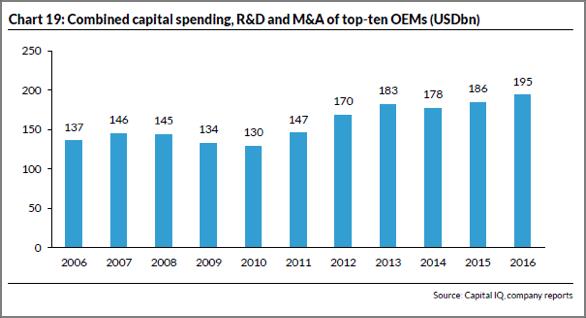
Also, it is a sector with a sustained, renovator and resilient growth. Sustained growth because it does not depend on a single technology or trend but covers all of them and its growth is the growth of innovation, which progresses at around 12% per year. Renovator growth because the new technologies set aside the old ones, making the processes more efficient and productive. Resilient growth because even during the last financial crisis, carmakers barely reduced their spending on research and development, as you can see below.

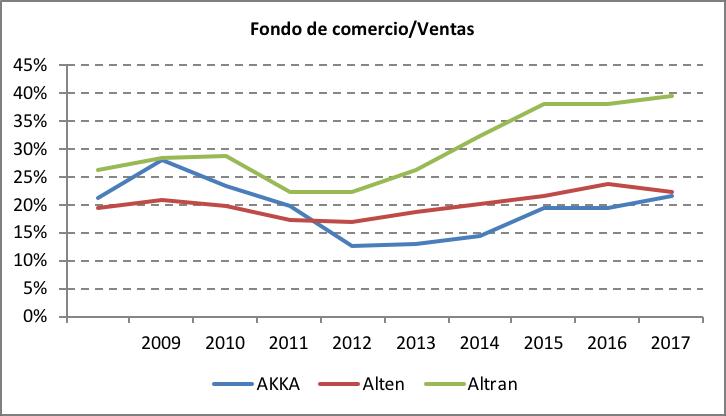
Moreover, it is a very fragmented sector, given that there are many small and inefficient companies. Therefore, the big players are keen on making acquisitions to reach the greater size the better. However, it is not a good choice to buy at any price, no matter how much you are interested in growing. In this matter, Akka also beats its competitors, as it prefers to make bolt-on acquisitions instead of big acquisitions. In addition, Akka buys cheaper than the rest of the players, as shows its lower goodwill to sales ratio.

Source: Company Statements

Once we have understood the sector in which Akka does business, we will move on to the figures. After successfully finalizing its latest strategic plan, Akka disclosed a new plan with targets for the year 2022. Its main objectives are: to double sales to reach 2.500 million euros, achieve an EBIT margin of 10% compared to current 7% and achieve a free cash flow of 150 million euros.

We are going to challenge these projections, because we want to check if they are really viable or not. On the sales side, that growth is based as much on buying other companies as on doing it organically. The organic growth is gonna be achieved by increasing sales to current customers and focusing on high added value technologies such as autonomous cars, artificial intelligence, and so on so forth. The margin improvement is plausible, since Akka has some projects in ramp-up, has a utilization rate below the average and its competitors already get that 10% margin, therefore Akka has triggers to get it too. If sales and margin targets are met, it will be relatively easy to achieve a free cash flow of 150 million euros.

After verifying that the plan is feasible, that Akka has an enviable position in a growing sector with high barriers of entry, with little debt in its balance sheet and with the ability to reinvest profits, the company valuation is relatively simple. We take the aforementioned 150 million euros of free cash flow, from which we subtract 10 million due to the integration costs of the acquired companies, given that this cost is recurrent in a sector with so many acquisitions. To those 140 million resulting we apply a multiple of 15x in line with the average of the sector, which gives us a company value of 2.100 million euros that compared to a market cap of 1.260 million euros, results in a margin of safety above 65%.

Note: this report is not a recommendation neither for acquisition nor sale. The here cited comments reflect personal opinions of the author.

Travelzoo: Attractive Unit Economics and Lifetime Subscriber Value

September 24, 2018 in Ideas, Letters

This article by MOI Global instructor John Lewis is excerpted from a letter of Osmium Partners, based in Greenbrae, California.

Travelzoo Inc.[1], together with its subsidiaries, provides travel, entertainment, and local deals from travel and entertainment companies, and local businesses in Asia Pacific, Europe, and North America. The company’s publications and products include Travelzoo Websites; Travelzoo iPhone and Android applications; Travelzoo Top 20 email newsletter; and Newsflash email alert service. It also operates the Travelzoo Network, a network of third-party Websites that list travel deals published by the company; and Local Deals and Getaway services, which allow its subscribers to purchase vouchers for deals from local businesses, including spas, hotels, and restaurants through the Travelzoo Website. The current market capitalization is approximately $157 million. (TZOO is a holding across all funds.)

• Achieved Record Subscribers base at 29.8 million

• Highly Attractive Unit Economics: Undiscounted Lifetime Value of $35 with subscriber acquisition cost of just $2.50 per sub.

• Guidance for Revenue Acceleration

• Valued at 1.4x Gross Profit vs. Peer group at 5x!

• We believe TZOO value to a Strategic Buyer is $30-40

• We believe as a standalone public company Travelzoo is worth $20-25+

• Over the last 16 years TZOO has averaged over +30% for both ROE and ROIC

• Since IPO averaged 5.3x EV/Sales, currently 1.3x EV/Sales

• 10Q filing showed, after earnings in late July TZOO repurchased 2.4% of the company for $13.60 per share.

• Over the last 7 years, TZOO has repurchased 28% outstanding shares paying an average of $17.48 a share.

• One negative: is the Founder’s Trust has been a seller, reducing his position from 54% to 51% of the outstanding shares in 2018. They need cash for the Trust, and were sellers as low as $7-8 as well.

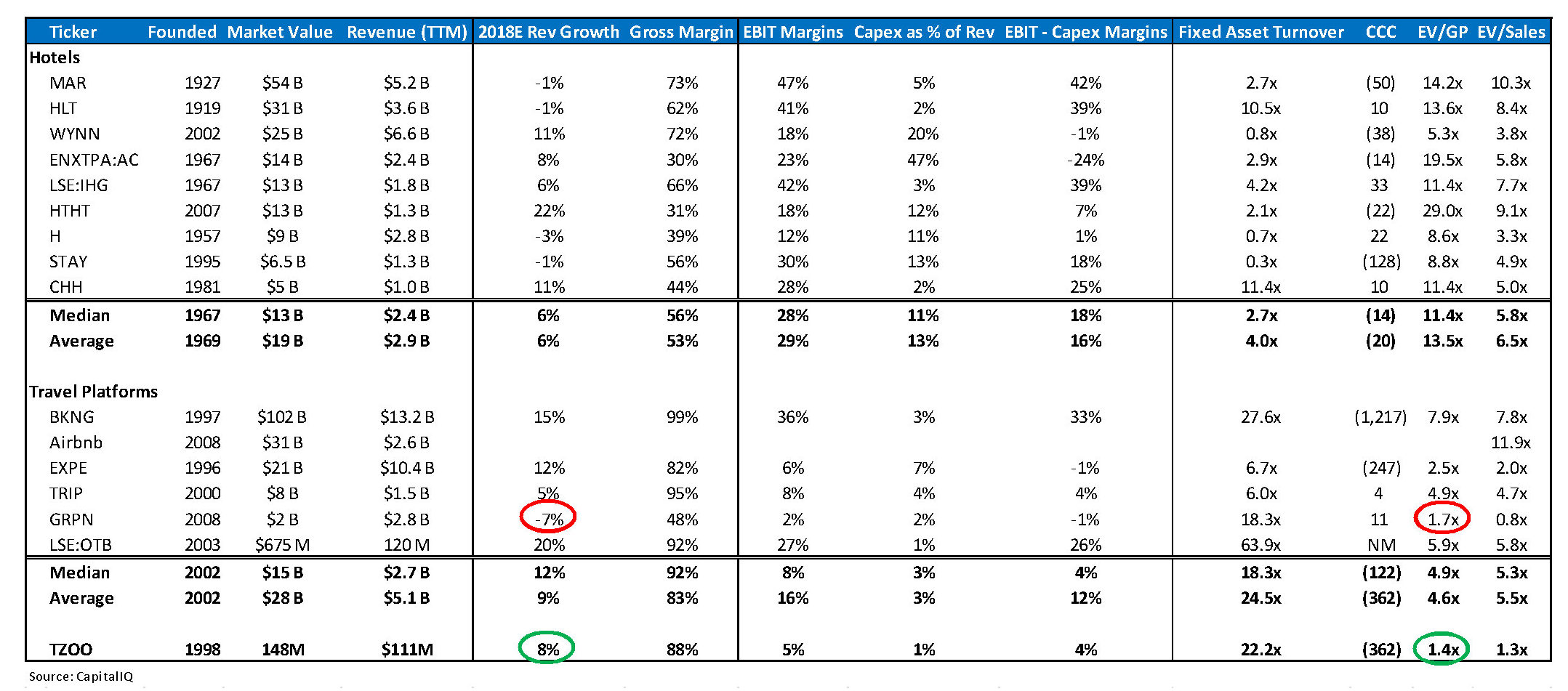
We believe in a sale to a strategic buyer, Travelzoo is worth between $400-500 million ($32-40) based on 4-5x gross profit of $100 million (88% gross margin) of which we believe a strategic buyer should be able to drop $40-60 million to the bottom line. Travelzoo public peer group trades exactly in this range with a median EV/Gross Profit of 4.9x with an average of 4.6x vs. TZOO at only 1.4x! In the higher range of valuations is On The Beach (OTB.L), which trades at 6x EV/Gross Profit and the lowest valuation is Groupon (GRPN) which is shrinking -7% and is valued at 1.7x EV/Gross Profit. Since the IPO in 2002, TZOO has averaged a valuation of 5.2x EV/Sales vs. the current 1.3x.

Standing on its own two feet, Travelzoo business trajectory is improving, as the company has guided to accelerating revenue growth in the 2H18 and doubling of revenue over 2-3 years with targeted 15-30% operating margins at scale. If this is achieved, we believe, over the next 3 years, Travelzoo could generate in aggregate $7-8 per share in EBIT, increasing the cash balance to $8-9 per share and push the stock to reach $50-60. Currently TZOO has a “safety net” of just under $2.00 in cash per share with $1.00 per share in EBIT from US and Europe (growing +6% and +8% yoy, respectively) or about 10x EV/ US & Europe EBIT. As a floor valuation, Groupon (GRPN) which is shrinking (-7%) trades at 1.7x EV/Gross Profit, applying this to TZOO yields $15.00 (TZOO is outgrowing GRPN by 15%).

From the company’s IPO in 2002, Travelzoo grew revenue from $10 million to $170 million in 2013 (revenue grew every year). In 2011, Travelzoo generated $3 a share in EBIT and stock traded between $80-100. On an EV/Sales basis, the peer group trades on average at 5.5x EV/Sales to Travelzoo’s current 1.3x EV/Sales. After rechecking our core thesis from a 360 degree perspective, we remain convinced TZOO is both significantly undervalued and delivers enormous value to both subscribers and travel partners. Travelzoo generated 22% Return on Capital for the trailing 12 months ended June 30th. Over the last 15 years, TZOO has achieved results that less than 1% of public companies have achieved: averaged over +30% for Return on Equity and Return on Capital. Finally, since the Travelzoo’s IPO the company has built a global brand as subscribers have grown nearly 10x over the last 16 years.

Travelzoo’s Flywheel of Value Creation

1. Travelzoo has very attractive member demographics:

• Mature: 69% are age 45+
• Affluent: 44% have household income over $100,000
• Smart: 89% are college educated
• Consumers: 67% are female
• Worldly: 85% have valid passports
• Travelers: 79% took 3+ trips last year.

2. Travelzoo Members are engaged and rate the platform highly

• The Travelzoo IoS App gets a 4.9 rating out 5 for IOS app w 17,000 reviews
• 90% of TZOO members would recommend to a friend,
• 90% were very satisfied with the product,
• 90% will make a future purchase via TZOO.
• We estimate average member stay as a Travelzoo Subscriber is 10 years.
• Travelzoo is the 3rd most followed travel business on Facebook with an active base of 4.4 million
• Travelzoo’s Mobile app has been downloaded 5.7 million times.

3. Travelzoo Partners/Suppliers

• Travelzoo partners/suppliers love Travelzoo as well. Why?
• Affluent members that spend more heavily at the property featured
• TZOO is an ad model vs. % take rate for a deal
• Travel suppliers generate exceptional returns but can’t place much $ at work vs. other channels
• Reach: TZOO has 30 million subscribers/members with total reach with partners to 70 million potential global travelers.

For further details: Travelzoo exhibits 43 case studies of Travel Partners’ success from TZOO’s services click here: Case Studies.

Travel Partners Love Travelzoo

Case Study: Las Vegas Hotel Books 10,500 Room Nights in 10 Days
A Las Vegas Hotel increased occupancy with Travelzoo’s products resulting in $650,000 in incremental revenue and delighted customers of which 93% enjoyed the experience and 91% plan to return.

Case Study: Canadian Vacation Company Generates Nearly $2,000,000
Canadian Company launched a 6-month Travelzoo campaign utilizing Travelzoo’s Top 20, Newsflash, and website placements resulting in nearly $2 million in revenue and 1,600 bookings.

Travelzoo has steadily grown the underlying earnings engine of the business, and in July TZOO hit a new record with nearly 30 million subscribers up from 20 million in 2011 when the stock hit $100. We think TZOO can meaningfully grow revenue off a large base of nearly 30 million subscribers as current revenue per sub is just over $4.00 and in 2012 revenue per subs was $7.00. New products and modest subscriber growth, especially in Asia, could lead to substantial shareholder value creation as the stock trades at 1.3x EV/Sales, a massive 70%+ discount to the peer group’s median and average multiple of 5.3x and 5.5x EV/sales, respectively. Furthermore, since the IPO, TZOO has averaged 5.3x EV/Sales. To quote TZOO CEO from the July earnings call “…we’ve shown in the last 3 quarters, revenue is going up, again, and this will continue, and we still hope that in 2019 that will even further accelerate.”

TZOO Offerings

Travelzoo’s main attraction are its curation of high value deals for both the member and partners. The Deal Expert’s job is to “guarantee that any deal with my name on it is truly the best rate anybody is going to pay for that experience, period.” The company offers an annual stipend and an additional three days to experience a Deal offered on Travelzoo’s website. These experts spend a lot of time not only researching, but negotiating then marketing the deal to its members.

In order to facilitate this curation to 30 million subscribers globally, Travelzoo has recently been investing heavily into its technology, revamping both mobile app and website (high rating on IOS and #3 on FB). They invested $2.5M for a 25% equity stake in WeekenGo and its packaging technology (members buy more when deals are bundled with hotels and flights). They also built their entire hotel booking technology/platform internally to allow members to book hotels directly through TZOO. With the customer’s interest in front, Travelzoo’s products attract and retain their user base, which allows partners access 30 million subscribers globally with a high return on marketing dollars. WeekenGo: https://www.weekengo.com/en-US

Travelzoo’s Exceptional Unit Economics

In addition to high quality deals and subscribers, we believe TZOO’s business has exceptional unit economics and operating leverage with scale. A subscriber currently generates $4.00 in revenue per year (TZOO has reached as high as $7 per sub) to generate $3.50 in gross profit (gross margins have always been above 85% for 20 years) and stays for around 10 years (est. annual churn = ~10%). We estimate the undiscounted lifetime value of a subscriber is $35 and TZOO acquires a subscriber for between $2-3, or 11x+ LTV/CAC. We estimate customer acquisition costs in the LTM were $2.50. With nearly 30 million subscribers, TZOO should be able to reach $7 in revenue per sub again from the current trough of $4 translating into $200 million in revenue. In other words, $1 more in annual revenue per subscriber = $30 million to the top line and $25+ million in gross profit.

Investments in Growth

It is not the first time TZOO has gone through a revaluation. We have seen this scenario play out in the late 2000’s when Europe division was losing money due to investments in growth and North America was highly profitable. Now, North America and Europe are highly profitable (and growing) and Asia is in a growth investment phase. As Asia reaches breakeven the true earnings power will be evident – North America/Europe currently generates ~$12-14mm of EBIT and Asia is losing $8-10mm. Given the recent investments in growth and a small share base (Founder owns 55% of 12.5M shares; 5.6M est. real float), there are wild swings in EPS quarter over quarter, but the investments are paying off, with all geographies increasing revenue year over year in 2018.

Recent Investments – we believe the following are strong ROI re-investment bets

• Investment in Asia Pacific Market for marketing & new hires

• Internally built entire hotel booking technology/platform – allows members to book hotels directly through TZOO.

• Marketing investment to maintain and grow subscribers in all 3 geographies: North America, Europe, Asia. (TZOO invests about $6 million a year to stay flat)

• WeekenGo and their packaging technology (members buy more when deals are bundled with hotels and flights) – $2.5M investment for 25% equity stake.

• Mobile App Development & Website revamp

• From 2011-2017, management bought back 3.5 million shares for $61 million at an average price of $17.43; reducing share count by 22% from 16 million to 12.5 million today. 500K share buyback plan was authorized on March 2018.

Travelzoo’s Comparable Companies

Travelzoo’s comparable companies consist of hotels and travel platforms that trade at many multiples higher than TZOO’s valuation, in some cases, for businesses that have dim forward looking estimates, declining sales, and are less efficient. For instance, Groupon recently had to pay IBM $83 million for patent infringement, sales are declining by 7% with 2% EBIT margins, and still trades at 1.7x EV/GP vs. 1.4x EV/GP for TZOO. On The Beach (LSE:OTB) a similar model to TZOO trades at 6x EV/gross profit as well as numerous other Travel platforms trade at an average of 4-5x EV/GP to TZOO’s 1.4x EV/GP.

Airbnb and Priceline (BKNG) trade at north of 8x sales and hotel companies trade at 4-10x sales. Airbnb and Priceline have very little CAPEX and 30% operating margins and Hotels have very high operating margins (own assets) but very high capex. However, TZOO has CAPEX of 1-2% of revenue with 90% gross margins and 15-30% target margins (current EBIT margins are very depressed) and we believe we will see substantial multiple expansion with very high incremental revenue growth. We think the stock should be currently around $20-25 per share.
From 2013-early 2018, Travelzoo was left for dead as the company divested non-core businesses and refocused on its core. Holger Bartel, who stepped down as CEO in 2010, has returned as of 2016 and is very focused on getting the business back in growth mode. In his last tenure as CEO from 2008-2010, TZOO appreciated in value from $6 per share to $42. Since the IPO in 2002, TZOO has averaged a valuation of 5.3x EV/Sales vs. the current 1.3x. Over the next 3 years Travelzoo could generate $7-8 per share in EBIT and this would lead to a cash balance pushing $8-9 per share, we believe the stock could reach $50-60. Given the guidance and recent investments in growth, we believe the stock should trade currently at least 2x EV/GP or $17 per share and much higher going forward. We believe TZOO has a bright future as either a standalone public company (provided the company can grow revenue at least double digits) or significant value to a strategic buyer in the $30-40 range.

To conclude, Travelzoo CEO’s comments from the July 2018 transcript does a good job of highlighting the improving investment thesis:

“I want to double the business — the size of this business in the next few years. But one thing that’s important to understand is as we grow revenue from $100 million to $150 million and, hopefully, to $200 million, operating margins will really improve. This is a business that has scale. Our operating costs are mostly fixed. And if you look back at Travelzoo’s history, in periods when we had fast growth, our earnings improved even further and even faster than revenue. So historically, our operating margins were running at something like 15% to 30%, and we really should get back to that level.”
– Holger Bartel, CEO of Travelzoo, July 2018 Earnings Call

TZOO Products:

• Top 20: Weekly email of the 20 best travel, entertainment and local deals

• Newsflash: “Breaking news” email delivered to a geo-targeted audience.

• Hotel Platform: Commission model for your hotel with no up-front costs

• Travelzoo Getaways: Targeted email promoting voucher-based hotel offers to a local audience

• Sponsored Stories: Custom content utilizing authentic storytelling to drive potential travelers to your destination.

• Featured Destinations: Customized microsite driving awareness and bookings through editorial, photos, branding and compelling offers.

• Local Deals: Geo-targeted email alerts and website placement generating new deals for restaurants, spas, attractions, activity and entertainment companies.

• Cost per click: Text ads placed on travelzoo.com and our partner’s websites reaching more than 70 million users worldwide.

Travelzoo guidance

• Guidance is for 15-30%+ operating margins

• Travelzoo on a trailing 12 month basis is showing growth for the first time in 4 years

• Travelzoo is guiding to accelerating revenue growth in 2H18, and further improvement in 2019

• Guidance is for doubling revenue over 2-3 years, this does not seem unreasonable with revenue per sub at $4 with a high of $6.50 less than 5 years ago plus new high margin products and recent investments.

• Travelzoo should have very significant incremental margins

• Trades for just 10x LTM North American/European Operating Income

• TZOO is valued at only 1.4x EV/Gross Profit/1.3x EV/Sales

• Public Comps median and average are 9x EV/GP and 11 EV/GP respectively and 6x EV/Sales and 7x EV/Sales respectively.

• Lifetime Value of a Subscriber $35 vs. ~$2.50 customer acquisition cost or 14x

• We believe TZOO could be acquired for $28-47 a share, as an acquirer would be able to capture 50% of gross profit to the bottom line and likely pay a 6-10x multiple or 3 to 5 multiple of current gross profit which is in line with the public peer group.

• Secret Escapes/On The Beach/Expedia/AirBnB/Booking/TRIP are all logical buyers of TZOO, TZOO would be a highly accretive deal.

While these are attractive economics…the story would improve further if:

1. Travelzoo revenue per employees improves off $300K, TZOO has reached a high of $800K and achieved 48% operating margin

2. Travelzoo improves revenue per subscriber from $4.00

3. Travelzoo then accelerates CAC spending

4. In the LTV/CAC ratio: Numerator LTV poised to increase (likely, with new products and revenue growth) and flat CAC.

5. IF TZOO gets to $6 in revenue per sub per year on 30 million subs this is a $180 million revenue company! Which also would lead to $6 * 10years $60 lifetime value/$2.50 or about 24x LTV/CAC. This is what has led to wild multiple expansion in the past.
______
[1] Market price as of the date of dissemination of the letter

Certain factual and statistical (both historical and projected) industry and market data and other information contained herein was obtained by Osmium Partners from independent, third-party sources that it deems to be reliable. However, Osmium Partners has not independently verified any of such data or other information, or the reasonableness of the assumptions upon which such data and other information was based, and there can be no assurance as to the accuracy of such data and other information. Further, many of the statements and assertions contained herein reflect the belief of Osmium Partners, which belief may be based in whole or in part on such data and other information. The information contained herein is provided for informational purposes only. This is not an offer to sell, or a solicitation to buy, limited partnership interests in Osmium. An investment in Osmium is not suitable for all investors. Graphs/charts are provided for illustrative purposes only and should not be relied on to form an investment decision. Stocks mentioned in the newsletter do not constitute a recommendation to buy or sell the individual securities.


Three Case Studies in Wide-Moat Investing, Thesis on Almacenes Exito

September 24, 2018 in Audio, Consumer Discretionary, Consumer Staples, Deep Value, Equities, GARP, Ideas, Mid Cap, South America, Transcripts, Wide Moat, Wide-Moat Investing Summit, Wide-Moat Investing Summit 2018, Wide-Moat Investing Summit 2018 Featured

Amit Wadhwaney of Moerus Capital Management shared his insights into global value investing as well as his investment thesis on Almacenes Exito (Colombia: EXITO) at Wide-Moat Investing Summit 2018.

Thesis summary:

Almacenes Exito is South America’s largest retailer, with a footprint covering 75% of the population of South America. It is the leading food-based retailer in Brazil, Colombia, and Uruguay, with formidable and defensible market shares in each country. It commands 42+% share of the formal Colombian retailing market, operating across different store formats (including e-commerce) that span the country geographically and across income segments. This dominant market position has allowed it to dispatch two (of four) new Chilean retailers that had arrived in Colombia a few years ago.

Both of Exito’s principal markets, Brazil and Colombia, are slowly emerging from significant economic downturns, during which retailing has been particularly hard hit.

By virtue of being listed in Colombia, a market far less well-trodden than that of Brazil or Mexico, the company has escaped the attention its peers have attracted. The company trades at 7x EBITDA, based on relatively depressed earnings, as compared to proximate peer Walmart de Mexico at 15-16x EV/EBITDA on earnings that are arguably not depressed.

Amit had previously presented his thesis on Almacenes Exito at Best Ideas 2017.

The full session is available exclusively to members of MOI Global.

Members, log in below to access the full session.

Not a member?

Thank you for your interest.  Please note that MOI Global is closed to new members at this time. If you would like to join the waiting list, complete the following form:

About the instructor:

Amit Wadhwaney is a Portfolio Manager and Co-Founding Partner at Moerus Capital Management LLC, and the founding manager of the Moerus Worldwide Value Fund. Mr. Wadhwaney has over 25 years of experience researching and analyzing investment opportunities in developed, emerging, and frontier markets worldwide, and has managed global investment portfolios since 1996. Prior to founding Moerus, Mr. Wadhwaney was a Portfolio Manager and Partner at Third Avenue Management LLC. Mr. Wadhwaney founded the international business at Third Avenue and was the founding manager of the Third Avenue Global Value Fund, LP, the Third Avenue Emerging Markets Fund, LP, and the Third Avenue International Value Fund, an open end mutual fund. Earlier in his career, Mr. Wadhwaney was first a securities analyst, and then Director of Research at M.J. Whitman LLC, a New York-based broker-dealer. Prior to joining M.J. Whitman, Mr. Wadhwaney was a paper and forest products analyst at Bunting Warburg, a Canadian brokerage firm. He began his career at Domtar, a Canadian forest products company. Mr. Wadhwaney holds an M.B.A. in Finance from The University of Chicago. He also holds a B.A. with honors and an M.A. in Economics from Concordia University; at Concordia, he was awarded the Sun Life Prize and the Concordia University Fellow in Economics, and he subsequently taught economics classes there. He also holds B.S. degrees in Chemical Engineering and Mathematics from the University of Minnesota.

La guerra por Twenty-First Century Fox

September 24, 2018 in Ideas de inversión, MOI Global en Español

NOTA DEL EDITOR: Esta idea de inversión presentada por Francisco Olivera, es obtenida de la carta del segundo trimestre 2018 de Arevilo Capital Management, con sede en San Juan, Puerto Rico.

* * *

Ha habido varios desarrollos con nuestras inversiones en el último trimestre, particularmente los que rodean la licitación de activos de entretenimiento de Twenty-First Century Fox [FOX] (“21CF”) y Sky plc [SKY] (“Sky”). La venta de los activos de entretenimiento de 21CF tiene varias piezas en movimiento. A continuación, compartimos una cronología de los procesos de venta y nuestros pensamientos/preguntas en el futuro.
Continue reading »

The U.S. versus the World

September 22, 2018 in Commentary, Letters

This article is excerpted from a letter by Zeke Ashton, managing partner of Centaur Capital Partners, based in Southlake, Texas.

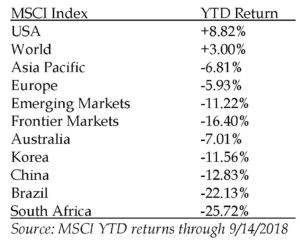
One interesting feature of the global investing landscape so far in 2018 is the nature to which the positive returns have been dominated by the U.S. stock market while the rest of the world markets are struggling and in many cases are down substantially. Below are various MSCI index returns year-to-date through September 14, 2018 across broad classifications (U.S., world, then the developed markets of Asia and Europe, and finally emerging and “frontier” markets) as well as some countries of interest.

The China return noted above is for the MSCI China index, but the local market indices are showing much worse returns (the Shanghai market is down 18% and the Shenzhen market is down 26%). There are other areas of distress in global markets as well, particularly in certain commodities and in precious metals (the U.S. listed “Gold Bugs” index is down 28.5% year-to-date and down 33% over the past year). Even Canada’s major index was showing a negative return on the year through mid-September despite being boosted by the ongoing cannabis investing boom.

The strong outperformance of U.S. stocks versus most of the rest of the world is starting to create a meaningful valuation differential between comparable companies listed on non-US exchanges and their U.S. listed counterparts. We are starting to see some intriguing valuations for high quality businesses outside the U.S. and particularly in Asian markets. Though we have historically been extremely North America-centric with regards to our holdings in the Fund, we do think that some of the best investing value available today is likely to be found outside the U.S. markets. If this trend of divergence in valuation persists or intensifies, you may begin to see a modest tilt in favor of non-U.S. stocks in the Fund portfolio over time.

Bear Market Math Strikes Again

Back in the September 2017 letter I discussed the wide variance in perception between how the financial media have in recent years come to describe a bear market (i.e., a quick 20% sell off followed by a recovery) and my own experiences of true bear markets (i.e., the 40/50/80 rule). In that letter I provided three examples of bear markets since I’d been investing in which the bear market math held true – the highest quality securities fell 40%, the median security fell 50%, and the worst stuff sold off by 80% with a lot of zeros mixed in. Well, it looks like we can add a fourth, as the crypto-currency boom that reached a fever pitch in early 2018 has now experienced a true bear market. This one has actually been quite a bit more spectacular than your average bear, in part because the craze reached such extreme levels on the way up and in part because it is so hard to know what any of these crypto-assets are worth (and, in many cases, whether there is any true intrinsic value at all) which has likely limited the conviction for buyers to step in on the way down. As of this writing bitcoin is down almost 70% from its early 2018 highs and the median or average decline in the crypto index is probably 80%. Many of the most egregious of the “crypto-crap” has already gone to zero or likely will be there shortly. It will be interesting to see if anything emerges from this particular mania that ultimately proves to be of unique or lasting value. My guess is that something probably will, though it may take awhile for the cleansing process to run its course.

Financial Crisis Retrospective and Lessons Learned

This month will mark the 10th anniversary of the fall of Lehman Brothers and the onset of the darkest period of the financial crisis of 2008. There has already been a lot of digital ink spilled on “what have we learned?” media pieces covering how the great financial crisis happened, how it might have been prevented, and speculation about what future crisis may or may not befall us or how potential future cases of financial destruction might be prevented.

My take-away from having read similar pieces after the dot-com bust and many historical articles and books describing other crises is that any lessons learned in the immediate aftermath of financial catastrophe are quickly forgotten during the next boom. In his classic 1994 book titled A Short History of Financial Euphoria, financial scholar John Kenneth Galbraith wryly noted the “extreme brevity of the financial memory.” Here is a representative excerpt from that book:

In consequence, financial disaster is quickly forgotten. In further consequence, when the same or closely similar circumstances occur again, sometimes in only a few years, they are hailed by an always supremely self-confident generation as a brilliantly innovative discovery in the financial and larger economic world. There can be few fields of human endeavor in which history counts for so little as in the world of finance. Past experience, to the extent that it is part of memory at all, is dismissed as the primitive refuge of those who do not have the insight to appreciate the incredible wonders of the present.

Whether one studies the tulip bulb mania or the crypto-currency craze, the same patterns emerge but always with just enough of a twist to make it feel like “this time it’s different.” Of course we will have bear markets and financial crises in the future, but we won’t likely see a perfect sequel to the global financial crisis of 2008 or the 2000-2002 bursting of the tech bubble or even the 2018 crypto-crash. The seeds of future crises will be slightly different from those that have come before, and the events that trigger the avalanche will as always seem to be fairly random and unpredictable in real time. The underlying cause of financial booms and busts – humans taking risk-seeking and speculative behavior to extreme levels after a period of prolonged recent success – has probably been around as long as there have been humans and markets.

This report is being furnished by Centaur Capital Partners (“Centaur”) on a confidential basis and does not constitute an offer, solicitation or recommendation to sell or an offer to buy any securities, investment products or investment advisory services. This report is being provided to existing limited partners for informational purposes only, and may not be disseminated, communicated or otherwise disclosed by the recipient to any third party without the prior written consent of Centaur.vAn investment in the Fund (“CVF”) involves a significant degree of risk, and there can be no assurance that its investment objectives will be achieved or that its investments will be profitable. Certain of the performance information presented in this report are unaudited estimates based upon the information available to Centaur as of the date hereof, and are subject to subsequent revision as a result of the CVF’s audit. The performance results of CVF include the reinvestment of dividends and other earnings. Past performance is not necessarily a reliable indicator of future performance of CVF. An investment in CVF is subject to a wide variety of risks and considerations as detailed in the confidential memorandum of CVF.vReferences to the S&P 500, NASDAQ Composite and other indices herein are for informational and general comparative purposes only. There are significant differences between such indices and the investment program of CVF. CVF does not invest in all or necessarily any significant portion of the securities, industries or strategies represented by such indices. References to indices do not suggest that CVF will or is likely to achieve returns, volatility or other results similar to such indices. This presentation and the accompanying discussion include forward-looking statements. All statements that are not historical facts are forward-looking statements, including any statements that relate to future market conditions, results, operations, strategies or other future conditions or developments and any statements regarding objectives, opportunities, positioning or prospects. Forward-looking statements are necessarily based upon speculation, expectations, estimates and assumptions that are inherently unreliable and subject to significant business, economic and competitive uncertainties and contingencies. Forward-looking statements are not a promise or guaranty about future events. The information in this presentation is not intended to provide, and should not be relied upon for, accounting, legal, or tax advice or investment recommendations. Each recipient should consult its own tax, legal, accounting, financial, or other advisors about the issues discussed herein.

MOI Global