Update on Marchex: Debt-Free, Even After Special Dividend and Buyback

September 13, 2018 in Equities, Ideas, Letters

This article is excerpted from a letter by MOI Global instructor Jim Roumell, partner and portfolio manager of Roumell Asset Management (RAM), based in Chevy Chase, Maryland. Jim is a valued participant in The Zurich Project.

MCHX reported a quarter that continued to underscore its intent to be the dominant player in call analytics. Revenue came in at $20 million, down from $22 million in the same quarter last year (in line with company guidance), as a result of its declining legacy marketplace business. The company added 8 new clients in multiple verticals including auto, health and home services. MCHX is leveraging its declining marketplace business into a company focused on call analytics, with A.I. capabilities.

Members, log in below to access the restricted content.

Not a member?

Thank you for your interest.  Please note that MOI Global is closed to new members at this time. If you would like to join the waiting list, complete the following form:

Disclosure: The specific securities identified and described do not represent all of the securities purchased, sold, or recommended for advisory clients, and the reader should not assume that investments in the securities identified and discussed were or will be profitable.

Daniel Gladis on His Investment Philosophy and Path in Investing

September 13, 2018 in Equities, Europe, Interviews, The Manual of Ideas, Transcripts, Wide Moat

We have learned so much from Daniel Gladis over the years, and yet there’s always something new to pick up from his investor letters and interviews. We are pleased to share below a recent exchange with Daniel about his path as an investor and key aspects of his investment philosophy.

Based in the Czech Republic, Daniel has amassed a market-beating track record since starting VLTAVA Fund in 2004. The value-oriented, research-driven investment fund focuses on good companies run by quality management teams. Previously, Daniel was director and chairman of the board of directors of ABN AMRO Asset Management (Czech) from 1999-2004.

Q: Tell us how you first discovered equity investing. Do you remember your first investment and how it turned out?

A: I discovered equities investing in 1992 thanks to the Coupon Privatization. As someone who had grown up under the communist regime, I found the idea simply amazing that through shares I could own stakes in various companies which create value through their businesses. I fell for it right away. I acquired my first shares in 1993, when companies from the first wave of the Coupon Privatization were introduced to the Prague Stock Exchange.

It sounds almost unbelievable today, but back then, in the mid-1990s, we had around 1,500 Czech listed stocks, of which maybe 100 were traded very actively. I really felt like I was in my element.

Concerning my first specific investment, I vaguely recall it was the Radegast brewery and the chocolate producer Čokoládovny. Of course, these were stocks that were part of the first wave of the Coupon Privatization. Those who participated in what was happening back then may remember that at the turn of 1993 and 1994 we saw explosive growth in the prices of Czech stocks. Whatever a person could get one’s hands on soared upwards. Growth of 15–20% per week, week after week, was no exception. In hindsight, I can see we had more luck than understanding. I made my first foreign investment some time in 1994.

Q: When did you first discover value investing? And what was your investment approach before that?

A: It was a long and winding road that led to value investing. In 1993, we established the stock brokerage Atlantik finanční trhy. We were focusing on institutional investors, and very quickly we became the Czech Republic’s largest brokerage firm in this segment.

My responsibility was to take care of foreign clients. Most of them were from the UK and the US. Back then, the Czech equity market was the only larger such market in Eastern Europe, and for a time we were the foreign investors’ favourite. Thanks to this, doors were open to us everywhere.

I made more than 200 visits to our foreign clients and had the unique opportunity to listen to them tell about how they invest. Among my clients there were even such legends as Seth Klarman and Jeremy Grantham. I quickly realized that I wanted to be on the other side of the phone – not to be the broker who makes trades for investors but the one who makes the decisions on investments.

My own investment approach at that time could have been described as amateur even though I didn’t realize that myself. The breakthrough came when I got my hands on Graham’s book The Intelligent Investor. It hit me like a bolt of lightning, and to this day I precisely remember where I read it. That was more than 20 years ago. There and then, I became a proponent and life-long student of value investing.

Q: Can you briefly describe your current investment approach?

A: The whole of my investing is based on two basic ideas. The first one is this: If an investor wants to have high returns over the long term, his or her portfolio must be dominated by stocks. History clearly shows that stocks bring the highest long-term return. Their predominance over the other classes of assets is completely overwhelming. In terms of relative returns, the future will probably look the same.

In addition, stocks bear lower long-term risk than do bonds and cash. This idea is surprising to a lot of people, because they are conditioned to an incorrect definition of risk and to thinking just the opposite. Stocks are also highly liquid, there is literally an inexhaustibly wide range on offer, and they are tax-advantageous for individuals.

The second idea concerns the selection of specific stocks. In my opinion, there is only one rational and reliable method of investing (regardless of the class of assets), and that is to pay a price that is lower than the value we get in return. Our selection of stocks focuses on seeking opportunities where the share price is substantially lower than is the stock’s value. There are relatively many such opportunities on the market because most investors are not willing to expend the effort to seek them out and moreover they have investment horizons that are too short.

History also shows that if there is anything in the stock markets that one can rely on it is the fact that, over the long term, a stock’s price follows the development of its value.

Q: How has your investment philosophy developed over time? Did you, like Warren Buffett, go through a conversion from a deep value investor who buys deeply undervalued companies of average to below-average quality to one focused on high-quality companies at reasonable prices?

A: There were more phases of development in my case. In the very beginnings – and that means during the first half of the 1990s – I knew barely anything about investing. My choice of stocks was, from today’s point of view, entirely amateurish. The interesting thing is that in those years I was achieving my greatest returns by far. Since that time, I haven’t even come close. Today I know that it had been largely a matter of luck. This period was very important, though, because I started to quickly gather experience and, due to my work as a broker, I began to know how markets work and also how large institutional investors think.

I remember the start of the second period exactly to the day, and it relates to when I read The Intelligent Investor. For the next few years, let’s say until 2004, I was almost orthodox in applying Graham’s approach. It was based on quantitative screening of stocks and a broader portfolio. It yielded good results, but, with markets becoming more expensive, the possibility for using this approach was gradually shrinking. There simply was nothing left to buy, and I had to adjust to that.

This was followed by a third period when my picking of stocks was supported by very sophisticated and intricate models involving enormous amounts of work. I believed this would be the right path which would bring the greatest added value. After several years, we evaluated this approach and concluded that, even though the results are good on average, their reliability is low in the individual cases. Some investments worked out great, while others were disappointing.

The lesson we learned from this is that trying to be too sophisticated is not beneficial. Once an investor starts to drown himself or herself in complicated models, he or she loses detachment and objectivity. If it’s necessary to craft a sophisticated model to demonstrate that a stock is cheap, it usually isn’t cheap. The cheapness of a stock must hit one right between the eyes at first view without requiring complex calculations. This was the conclusion we reached during this phase, some 9 years ago. Since then, we’ve been trying to simplify our investment ideas as much as possible, and so far this has been working out very well.

In a letter to shareholders at the end of 2017 I wrote this:

“Over those long nine years, we bought shares in 71 different titles. The portfolio’s turnover was higher during 2009–2011 because it was necessary to respond quickly to rapidly changing equity prices. In the following years, the turnover gradually came down. Out of the 71 stocks acquired, we have already sold 49 and are currently holding 22. Of the 49 stocks sold, we realised gains from 44 stocks and lost money on 5 stocks. Of the 22 stocks we are still holding, we are in positive-returns territory in 20 cases and in negative returns in 2 cases. Our history to date thus shows that we are making money on approximately 9 stocks out of every 10 we buy. We presume this will be similar also in future.”

So far, it seems that simplicity beats complexity. We have a minimum of losing investments and the spread of returns between the best and worst investments is relatively small.

When I look back to the individual phases of my development as an investor, I can see a certain logical progression. I think it can objectively be said that each phase has been a step forward. It is very probable that in a few years I will look back at the current phase very critically, and I believe I will manage progressively to move on and on. What I like about investing is that a person can constantly improve regardless of how much experience one has and in which phase one is presently. I try to learn something new every day and add piece by little piece to my cache of knowledge.

Q: Can you describe for us in a little more detail the sequence of the individual steps within your investment process?

Members, log in below to access the restricted content.

Not a member?

Thank you for your interest.  Please note that MOI Global is closed to new members at this time. If you would like to join the waiting list, complete the following form:

We thank Petr Cermak and his value investing site for the permission to share the English version of the interview originally published in Czech.

Highlighted Tweet by RayDalio

September 12, 2018 in Twitter

The Case for Thematic Value Investing

September 12, 2018 in Commentary, Diary, European Investing Summit 2018

This article is authored by MOI Global instructor Antonio Garufi, portfolio manager at Decalia Asset Management, based in Geneva, Switzerland.

The successful long-term investor is able to avoid big errors and select assets that deliver superior returns by buying them at the right price. It is not a sprint, but a marathon. During the journey, avoiding errors is the most difficult task. For this reason, the value investing philosophy puts the “margin of safety” concept at its core. This revolutionary idea stresses the need to avoid errors and the inevitability of incurring into some. Investing with a margin of safety means, in essence, buying assets at a price that minimizes the probability of being wrong. So what tactics can we use to reduce the probability of incurring into errors and increase the margin of safety? By investing in long-term trends.

Erroneously, the value investor is often seen as someone whose primary objective is to mechanically buy cheap companies. I prefer Seth Klarman’s point of view:

“Value Investing is actually a comprehensive investment philosophy that emphasizes the need to perform in-depth fundamental analysis, pursue long-term investment results, limit risks and resist crowd psychology.”

In go-go times, few investors keep a disciplined approach and weigh potential rewards against potential downside risks. After all, as Klarman said:

“It is easy to confuse genius and bull market.”

Following this consideration, we have to evaluate the current reality of a more-than-nine-years-old-bull market. Going forward, the question is: how can we invest, avoid errors, limit risks and still deliver superior returns? Once again the margin of safety concept comes handy. This concept can be employed not only in stock analysis but also in sector and trend analysis.

What is the chance of being wrong if we invest in a company operating in a strong structural trend? After all, isn’t value investing a long-term quest?

Theoretically, if the tide rises (i.e. the trend is positive) so should all the boats (unless there is a hole in the keel). If a company operates in a positive and structurally favorable long-term environment, this could create a downside protection cushion for the investor. Therefore, the successful risk-averse investor would be better off by starting to identify long-term trends. Once able to do this, he shall look for the best-positioned companies and avoid those with evident flaws.

The final stage would be to decide what price he should pay for the business in order to tilt the bet in his favor and avoid excessive downside risks. We could call this a three-layer margin of safety process. By building a portfolio in this fashion, the long-term investor can overcome the uncertainty that pervades current markets.

We tried to implement this framework by investing in a structural long-term trend, the Circular Economy. A trend that stems from two paramount issues: natural resource depletion & waste management. The circular economy implies a more sustainable use of natural resources and a more responsible consumption paradigm. From the old take, make & waste model, the new frontier is re-design, re-use & repair in order to avoid unnecessary waste.

Circular business models help reduce the environmental impact of our way of living but create positive profitability dynamics. A lower dependence on raw materials and a consequently reduced volatility of input costs create the opportunity for higher margins. The change of the ownership concept from property to sharing, increases the recurring revenue base and increases business visibility, thereby improving efficiency and working capital management.

Moreover, companies operating in production efficiency, innovation and new materials will push competitors into obsolescence. This shift in business models will not only improve the environmental impact of the economy, but will also create more jobs and growth.

Long-term investors, therefore, can benefit from this structural trend, improve their margin of safety, reduce business and investment risk while also helping the economy transition to a more sustainable model.

Good Companies Don’t Always Make Good Investments

September 12, 2018 in Letters

This article by MOI Global instructor Dominic Fisher has been excerpted from a letter of Thistledown Investment Management.

One of our investments, Kulicke and Soffa Industries, supplies capital equipment to electronic chip manufacturers. It recently held an analyst’s day. The company discussed its business objectives for the next three years. It then presented a range of profits for 2021. These suggest the share price should be around $48 today, against $27. (See reasoning below) The first investment in Kulicke and Soffa was in April 2015 at $14 by October 2015 the price had fallen 40%, and the fund trebled its investment. In March 2016, I presented the company to investors in Madrid. The presentation bombed. Three attendees told me what a mistake it was to present it. I saw a company with a dominant market position in a growing but mature industry, stable gross margins through industry cycles and a balance sheet full of cash. They saw a cyclical company, where profits had fallen 75% in the last two years, which had no plans to return money to shareholders and was making low returns on invested capital.

Another investment in the fund is Svenska Handelsbanken. The bank has a unique business model, and as a customer, I know how good it is. The bank has been particularly good at avoiding crises; its competitors have been bailed out by shareholders or the Swedish government, it has not. It has high returns on capital, barely recorded losses in the financial crisis and is the most highly regarded bank by customers in all its markets. I presented this bank to a conference in the summer of 2015 as a high-quality investment, which it is. My presentation was well received. The price has since fallen around 30% to the same level as five years ago.

Most investors want to buy good quality businesses, but if the quality is evident the price reflects it, and future returns are likely to be unexciting. The opposite also applies. I think the quality of the leading technology companies is evident today; the prices reflect this and future returns will be low.

K&S Simple Model

The company forecast earnings in a range of $4 to $4.75 by September 2021 at its July 10th analyst day.

If this is achieved earnings will have risen by over 20% per annum since 2018 as new applications for vehicles, lighting add to a growing core business.

I believe investors will be prepared to pay a market multiple for those earnings. Today that would be 17 times. Using the low profit forecast investors should pay 17 times $4 = $68 in September 2021.

Discounting that value at 10% to today gives a price of $48.

Clearly any number of things can turn out differently, but this is the basic logic.


Disclaimer: The information in this report is presented by Valu-Trac Investment Management Limited using all reasonable skill, care and diligence and has been obtained from or is based on third party sources believed to be reliable but is not guaranteed as to its accuracy, completeness or timeliness, nor is it a complete statement or summary of any securities, markets or developments referred to. The information within this report should not be regarded by recipients as a substitute for the exercise of their own judgement. The information in this report has no regard to the specific investment objectives, financial situation or particular needs of any specific recipient and is published solely for informational purposes and is not to be construed as a solicitation or an offer to buy or sell any securities or related financial instruments. In the absence of detailed information about you, your circumstances or your investment portfolio, the information does not in any way constitute investment advice. If you have any doubt about any of the information presented, please consult your stockbroker, accountant, bank manager or other independent financial advisor. Value of investments can fall as well as rise and you may not get back the amount you have invested. Income from an investment may fluctuate in money terms. If the investment involves exposure to a currency other than that in which acquisitions of the investments are invited, changes in the rates of exchange may cause the value of the investment to go up or down. Past performance is not necessarily a guide to future performance. Any opinions expressed in this report are subject to change without notice and Valu-Trac Investment Management Limited is not under any obligation to update or keep current the information contained herein. Sources for all tables and graphs herein are Valu-Trac Investment Management unless otherwise indicated. The information provided is “as is” without any express or implied warranty of any kind including warranties of merchantability, non-infringement of intellectual property, or fitness for any purpose. Because some jurisdictions prohibit the exclusion or limitation of liability for consequential or incidental damages, the above limitation may not apply to you. Users are therefore warned not to rely exclusively on the comments or conclusions within the report but to carry out their own due diligence before making their own decisions. Unless otherwise stated Equity Market price indices used within this publication are sourced or derived from data supplied by MSCI Inc 2018. Valu-Trac Investment Management Limited and its affiliated companies, employees of Valu-Trac Investment Management Limited and its affiliated companies, or individuals connected to them, may have or have had interests of long or short positions in, and may at any time make purchases and/or sales as principal or agent in, the relevant securities or related financial instruments discussed in this report. © 2018 Valu-Trac Investment Management Limited. Authorised and regulated by the Financial Conduct Authority (UK), registration number 145168. This status can be checked with the FCA on 0800 111 6768 or on the FCA website (UK). All rights reserved. No part of this report may be reproduced or distributed in any manner without the written permission of Valu-Trac Investment Management Limited. Valu-Trac™ is a registered trademark.

Sebastien Lemonnier to Share Investment Thesis on Dermapharm

September 12, 2018 in Diary, Equities

MOI Global instructor Sebastien Lemonnier, a featured speaker at the upcoming European Investing Summit 2018, serves as European equity portfolio manager at INOCAP Gestion, managing Quadrige Europe, the recently awarded top-performing UCITS fund by Agefi-Europerformance.

Sebastien’s investment strategy follows a pragmatic approach, implementing a rigorous stock-picking process based on five fundamental criteria:

1) Leading position in growing niche market,

2) International exposure,

3) Operating excellence,

4) Family owned,

5) Disciplined capital allocation.

Sebastien favors companies that provide differentiated, value-added solutions in existing but evolving industries. His investment conviction is built from an intense on-the-ground approach, with more than five hundred company meetings and site visits annually.

Last year, Sebastien presented his investment case on Barco, based in Belgium, which is up ~40% over the past year and remains among the fund’s top investment holdings.

At European Investing Summit 2018, coming up live online on October 11-12, Sebastien will discuss his latest top holding — Dermapharm, a family-owned leading manufacturer of patent-free branded pharmaceuticals, listed in Germany, with a market capitalization of €1.5+ billion.

Founded in 1991, Dermapharm focuses on specialist niche markets, such as vitamin D (originator of Dekristol) and dermatological products where R&D costs and the barriers to entry are relatively high. Implementing a “buy and build” approach, along with international expansion and operational excellence, the company generates strong free cash flow (with EBIT margin in excess of 20%). Profits are estimated to grow 20+% annually, while the valuation multiple recently stood at only 12x EBIT 2019.

“Admiro a los CEOs empresarios, aquellos que han montado sus empresas desde cero”

September 12, 2018 in Entrevistas exclusivas, MOI Global en Español

En esta entrevista con José Antonio Larraz, socio fundador de Equam Capital y miembro de MOI GLOBAL, conoceremos sus inicios como inversor, el enfoque de inversión de Equam Capital y algunos consejos que los inversores deben seguir.

MOI Global en Español: Cuéntanos acerca de tu formación y tu trayectoria.

José Antonio Larraz: Al acabar mis estudios de Empresariales y Derecho en España, empecé mi carrera profesional en banca de inversión, asesorando a empresas en operaciones de adquisición, salidas a bolsa, financiación, etc… Estuve cuatro años en Londres y Nueva York y fue una magnífica escuela de formación porque siendo muy joven tuve una gran exposición a los equipos directivos de compañías, estando involucrado en el asesoramiento sobre aspectos esenciales de desarrollo de las mismas.

Después de cuatro años en banca de inversión y entre medias un MBA en Insead, regresé a España y me incorporé a una sociedad de capital riesgo donde invertíamos en compañías no cotizadas a medio plazo. Básicamente comprábamos compañías que tenían negocios atractivos y que estaban operadas por buenos equipos directivos, y ayudábamos a estos en el desarrollo estratégico de las compañías y en la implementación de medidas en relación con el desarrollo orgánico e inorgánico, asignación de capital, financiación, planes de incentivos, etc… El horizonte temporal era normalmente de entre 5 y 7 años y participábamos en los consejos de administración de las compañías desde donde dábamos apoyo a los directivos. En mi caso tuve la suerte de participar en operaciones muy variadas tanto en cuanto a sectores (alimentación, retail, química…) como resultado de las inversiones. Aprendí varias cosas muy importantes pero destacaría i) la necesidad de paciencia, ya que para crear valor en un negocio es imprescindible el paso del tiempo, ii) la importancia de los equipos directivos; y iii) la forma en que los inversores privados e industriales piensan en relación al valor de los negocios.

Lo atractivo de las inversiones en compañías no cotizadas es que no tienes un precio de referencia diario ni por tanto la presión o distracción que de ello se deriva. Pero también hay aspectos negativos. Principalmente la dificultad de comprar a precios atractivos y de cerrar operaciones en un entorno que, al menos en España, se volvía cada vez más competitivo. Esto se hizo patente sobre todo a partir del año 2010, donde como consecuencia de la crisis empezaron a escasear las operaciones de compañías atractivas (los posibles vendedores de este tipo de compañías no estaban dispuestos a poner en venta sus compañías en ese momento) y a la vez había un exceso de liquidez como consecuencia del gran número de fondos que había levantado dinero antes de la crisis y que tenían que invertir lo antes posible. El caso es que en esa época se hizo muy difícil realizar operaciones a precios mínimamente atractivos y nosotros que nunca quisimos sobre pagar nos quedamos consistentemente fuera de los procesos. Todo esto llevó a que en unos pocos años vendimos nuestra cartera de participadas y al no hacer nuevas inversiones nos quedamos sin inversiones lo que nos llevó a disolver nuestro proyecto.
En ese momento me tuve que plantear como continuar mi carrera profesional. Tenía muy claro que después de más de 12 años invirtiendo en compañías quería seguir relacionado con el mundo de la inversión, pero también que estaba muy cansado del mundo transaccional donde básicamente sólo puedes comprar aquellas pocas compañías que en un momento dado están en venta y además con un resultado muy binario ya que después de varios meses de proceso de análisis y negociación de una operación sólo caben dos escenarios o cierras la operación o no tienes nada.

En este contexto, empecé a hablar con mucha gente y a plantearme la posibilidad de dar el salto a los mercados cotizados. Al principio tenía dudas de si el proceso de transición iba a ser fácil y si podría estar preparado para el cambio. Tres factores fundamentales me ayudaron a tomar la decisión:  i) Descubrí que había varios casos de gestores de fondos que habían hecho un cambio parecido; ii) la inversión en los mercados cotizados no me era totalmente desconocida ya que venía de una familia de larga tradición inversora en bolsa; y iii) encontré al socio adecuado (Alejandro Muñoz) para lanzar el proyecto ya que compartíamos una misma forma de entender la inversión y además él tenía la experiencia de haber lanzado previamente un vehículo y firma de asesoramiento como el que queríamos nosotros.

De esta manera en marzo de 2014 nació Equam y finalmente en enero de 2015 después de varios meses de trámites burocráticos y aprobaciones administrativas conseguimos lanzar nuestro vehículo Equam Global Value.
Continue reading »

Spark Networks: ~8% the Size and ~1% the Valuation of Match.com

September 10, 2018 in Ideas, Letters

This article by MOI Global instructor John Lewis is excerpted from a letter of Osmium Partners, based in Greenbrae, California.

Spark Networks, Inc.[1]provides online personal services in the United States and internationally. The company creates communities that help individuals to form life-long relationships with others who share their interests and values. Its primary properties include JDate.com and ChristianMingle.com, which are communities for the singles of Jewish and Christian faiths. The company was incorporated in 2007 and is headquartered in Berlin and New York. (LOV is a holding across all funds.)

• Spark revenue guidance is for $127-133 million in subscription revenue in 2018 (pre-merger Spark was at $27 million in revenue)

• 8 brands in 29 countries

• Guidance is for at scale 30-40% adjusted EBITDA margins

• Spark is valued at 1.3x EV/revenue vs. Match 9.0x ev/revenue

• Spark guidance is for 10-14% organic growth

• EBITDA margins guidance is for 50% margin expansion with 40% incremental EBITDA margins

• Spark is 8% the size of Match and 1/100th the valuation

• Key Brands: Elite Singles (82% college educated, decent market share in a number of countries), bought e-Harmony’s European operations called eDarling, JDate, ChristianMingle, LDS Singles, & Silver Singles

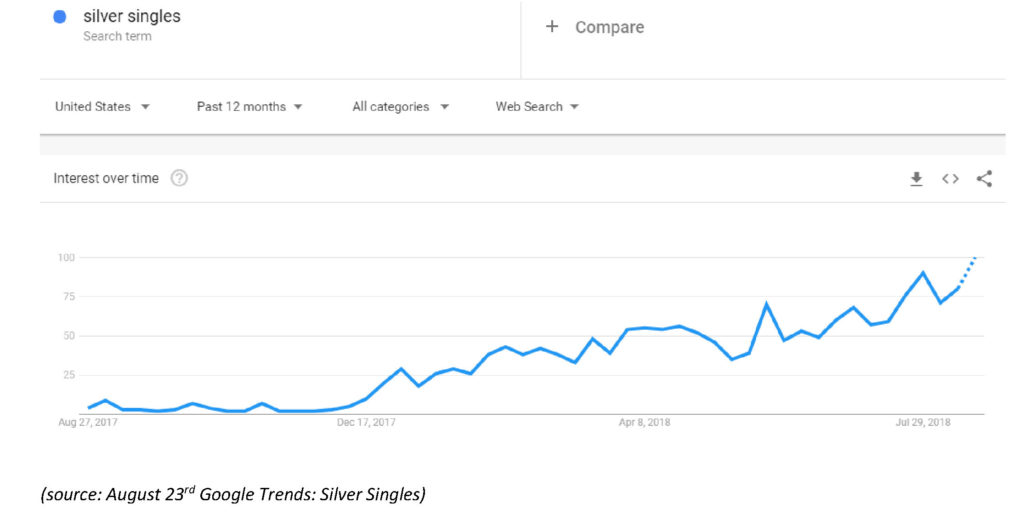
Spark: Silver Singles over 50 dating

LOV also has a homegrown new brand potential with, for example, Silver Singles, with what we believe to be a new successful launch in mid-December 2017. From a base of near zero in December 2017, Silver Singles in 1Q18 achieved 15% of total registrants. Silver Singles has subscription packages in 3, 6, and 12 month increments charging $115, $165, and $240 respectively. 100K subscribers at a purchase price between $100-200 would generate $10-20M in revenue. Due to marketing investments in Silver Singles growth 2018 EBITDA is being reduced by $5-6mm (without investments EV/EBITDA’18 is 7.8X). Spark has guided to cash flow positive 2H18 for Silver Singles.

Either through M&A or organic growth, we think LOV could reach scale of $200M+ in revenue over the next 2-3 years. We believe at $200-225 million Spark could reach 30% EBITDA margins, which would imply $4.60 a share in EBITDA. Spark has $40 million in untapped lines of capital for M&A. Spark is taking a much more aggressive approach on getting their story out, with two road shows with two investment banks this summer: Cowen and Stifel. Immediately following earnings on August 30th, Spark will present in San Francisco at a conference on September 6th. We think the upside is significant with modest execution in growing revenues.

Spark Metrics:
North America Subscriber Growth
2015 average – 15,240
2016 average – 46,453 (205% growth yoy)
2017 average – 83,870 (81% growth yoy)
2017 ending – 158,000

International Subscriber Growth
2015 average – 266,675
2016 average – 270,823 (2% growth yoy)
2017 average – 295,533 (9% growth yoy)
2017 ending – 307,000

Total Registrations
2015 – 5.8 million
2016 – 6.9 million (19% growth yoy)
2017 – 8.5 million (23% growth yoy)
______
[1] Market price as of the date of dissemination of the letter

Certain factual and statistical (both historical and projected) industry and market data and other information contained herein was obtained by Osmium Partners from independent, third-party sources that it deems to be reliable. However, Osmium Partners has not independently verified any of such data or other information, or the reasonableness of the assumptions upon which such data and other information was based, and there can be no assurance as to the accuracy of such data and other information. Further, many of the statements and assertions contained herein reflect the belief of Osmium Partners, which belief may be based in whole or in part on such data and other information. The information contained herein is provided for informational purposes only. This is not an offer to sell, or a solicitation to buy, limited partnership interests in Osmium. An investment in Osmium is not suitable for all investors. Graphs/charts are provided for illustrative purposes only and should not be relied on to form an investment decision. Stocks mentioned in the newsletter do not constitute a recommendation to buy or sell the individual securities.

Miguel de Juan sobre Exor

September 10, 2018 in Ideas de inversión, MOI Global en Español

NOTA DEL EDITOR: Esta idea de inversión es obtenida de una carta a los inversores de Argos Capital FI.

* * *

Hasta la confirmación por parte de Renta4 de que no admitía el traslado del Argos a otra entidad – cosas veredes, amigo Sancho- realizamos un par de operaciones de signo contrario, como os comenté a los argonautas de los que tengo sus datos- por cierto, gracias a los que os habéis animado a contactar conmigo… ¡cada vez somos más argonautas en relación!-, que son por un lado deshacer la posición que habíamos comenzado recientemente en Smart Metering Systems [SMS] – lo que por cierto es otro recuerdo de que no es conveniente “comprar tal empresa porque tal inversor lo ha hecho”: a veces nos equivocamos y en otras ocasiones la tesis de inversión inicial cambia de golpe y decidimos cambiar de parecer. Esto último es precisamente lo que ha sucedido con SMS… La idea inicial se basaba, entre otras cosas, en una perspectiva de plazo que se ha visto alargada en el tiempo por parte del regulador. Tras pensarla de nuevo, he creído que merecía la pena utilizar ese dinero en otra alternativa más atractiva y asumir las pérdidas correspondientes.
Continue reading »

MOI Global