Update on Medley Capital: 10+% Yield While Waiting for NAV Discount to Close

September 10, 2018 in Equities, Ideas, Letters

This article is excerpted from a letter by MOI Global instructor Jim Roumell, partner and portfolio manager of Roumell Asset Management (RAM), based in Chevy Chase, Maryland. Jim is a valued participant in The Zurich Project.

MCC reported quarterly results that were disappointing, but not totally surprising to us. We expected that MCC would report additional losses from its legacy second lien loan portfolio and that is exactly what occurred. Most importantly to our thesis is that the losses were well below our stress case scenario. Even in our stress case scenario, the Net Asset Value (NAV) per share of MCC is significantly higher than where the stock currently trades.

Members, log in below to access the restricted content.

Not a member?

Thank you for your interest.  Please note that MOI Global is closed to new members at this time. If you would like to join the waiting list, complete the following form:

Disclosure: The specific securities identified and described do not represent all of the securities purchased, sold, or recommended for advisory clients, and the reader should not assume that investments in the securities identified and discussed were or will be profitable.

Compound Mispricings in Moated Businesses: Buzzi Unicem, Nexen, KT

September 7, 2018 in Asia, Audio, Consumer Discretionary, Equities, Europe, Information Technology, Mid Cap, Small Cap, Transcripts, Wide-Moat Investing Summit, Wide-Moat Investing Summit 2018, Wide-Moat Investing Summit 2018 Featured

Keith Smith of Bonhoeffer Fund presented his in-depth investment theses on Buzzi Unicem (Italy: BZUR), Nexen Corporation (Korea: 005720), and KT Corporation (Korea: 030200) at Wide-Moat Investing Summit 2018.

Thesis summaries:

Buzzi Unicem (savings shares), together with its subsidiaries, manufactures, distributes, and sells cement, ready-mix concrete, and aggregates. The company has operations in Italy, the U.S., Germany, Luxembourg, the Netherlands, Poland, the Czech Republic, Slovakia, Ukraine, Russia, and Mexico. Buzzi is run and majority-owned by the Buzzi family. Buzzi has increased BV and dividend per share by 5% per year, EBITDA by 5% per year, and FCF by 15% per year over the past five years.

The savings shares recently traded at a P/BV ratio of 46%, look-through free cash multiple of 7.7x, and look-through EV/EBITDA of 3.0x. The savings shares (non-voting common shares) trade at a 45% discount to the common voting shares. Reasons for the discount include concerns about governance (but management is modestly compensated and owns 50+% of the stock), concerns about where we are in building cycle and competitive position in Italy.

Future catalysts for Buzzi shares include U.S. and Mexican infrastructure programs, a recovering European economy, consolidating Italian industry, pent-up demand for housing in the U.S., and reduced savings/common discounts in conversion transactions. If the shares traded at 9x EBITDA, lower than the industry average of 11x EBITDA, the stock would be more than a double, not including gains from dividends or a recovery in the Italian cement market.

Nexen Corporation (preferred shares) manufactures and sells rubber products in South Korea. It offers tubes and flaps, solid tires, carbon masterbatch pellets and sheets, golf balls, and bladders for tires. The company also exports and distributes products to ~140 countries. Nexen also owns 42% of Nexen Tire (~75% of Nexen’s value), a multinational tire company. Nexen Tire has increased BV and dividends per share by 17% per year and sales by 9% per year over the past five years.

The shares recently traded at a “look through” earnings multiple of 2.5x, and EV/EBITDA of 3.7x. The preferred shares (non-voting common shares) trade at a 28% discount to the common voting shares. Reasons for the discount include concerns about governance (but management is modestly compensated and owns 50+% of the stock), concerns about where we are in automobile sales cycle, and the competitive position of auto suppliers with electric cars.

Future catalysts for Nexen shares include continued use and increased demand for tires in electric cars, large aftermarket (not dependent upon the automobile sales cycle) contribution to profits, and decline in preferred/common discounts in Korea securities. If the shares traded at 7x EBITDA, the stock would be more than a triple, not including gains from dividends or increase in cash flows.

KT Corporation is a holding company that provides telecom services in Korea and internationally. The company offers local, domestic long-distance, and international long-distance fixed-line and voice-over-Internet-protocol fixed-line telephone services, as well as interconnection services; broadband Internet access service and other Internet-related services, including IPTV services; and data communication services, such as leased line and broadband Internet connection services to institutional customers. KT also develops real estate, provides FSS satellite and satellite TV service, credit card processing services, digital media agency services and video content and music production and distribution.

KT Corporation has been transformed over the past three years from a declining legacy telecom conglomerate to growing and more profitable and competitive telecom provider. Over the past three years, KT Telecom has generated three-year average ROE (adjusted for excess real estate) of 10% and BV-plus-dividend growth of 11% per year.

The shares recently traded at a “look-through” FCF multiple of 5.8x, and look-through EV/EBITDA of 1.5x. Reasons for the discount include a perception of a poor corporate governance (due to past CEOs) and a declining telecom business. KT is actually more of a quad telecom service provider that uses legacy telecom infrastructure as opposed to being a legacy telecom provider.

Catalysts include using IT legacy infrastructure to provide quad telecom services, further development of FT’s real estate, and development of video and music content. If the shares traded at 6x EBITDA with a holding company discount, the stock would be more than a triple, not including dividends, buybacks or cash flow gains from a growing telecom business.

The full session is available exclusively to members of MOI Global.

Members, log in below to access the full session.

Not a member?

Thank you for your interest.  Please note that MOI Global is closed to new members at this time. If you would like to join the waiting list, complete the following form:

About the instructor:

Keith Smith, the fund manager, brings over 20 years of valuation experience to the Bonhoeffer Fund. He is a CFA charterholder and received his MBA from UCLA. Keith currently serves as a Managing Director of a valuation firm and his expertise includes corporate transactions, distressed loans, derivatives, and intangible assets. Warren Buffett and Benjamin Graham’s value-oriented approach of pursuing the “fifty-cents on the dollar” opportunities, underpins Keith’s investment strategy. The combination of his experience and track record led Keith to commit most of his investable net worth to the Bonhoeffer Fund model.

Valentum sobre Facebook y Flow Traders

September 7, 2018 in Ideas de inversión, MOI Global en Español

NOTA DEL EDITOR: Estas ideas de inversión son obtenidas de la carta a los inversores  de Valentum FI.

* * *

Facebook [FB]

Ha sido la gran sorpresa (negativa) en estos resultados. Si bien los resultados no han sido ningún desastre, más allá de cierta ralentización del crecimiento, el discurso y los mensajes del equipo directivo han sido un jarro de agua fría que acabó con una caída del 18% en un día (pasando por un -25% intradía).
¿Qué es lo que han dicho?
En primer lugar, auguran una ralentización del crecimiento de la compañía. No obstante, dicen que esto nada tiene que ver con los anunciantes, quienes siguen disfrutando de unos retornos altísimos de su publicidad en las plataformas de FB. Parte de esta ralentización (ya anunciada en la call 1T18) vendría por la nueva normativa de Protección de Datos en Europa, aunque la pérdida de usuarios por esto ha sido mínima (1mn sobre una base de 250mn), sí que podría reducir los datos e información de personalizar la publicidad (aunque con un impacto escaso en nuestra opinión). En segundo lugar, la promoción de “stories” con bajos niveles de monetización. El tercer factor al que aluden es por el efecto en el tipo de cambio, algo sorprendente a la par que impredecible.
Continue reading »

Berkshire Hathaway: Don’t Try This at Home

September 5, 2018 in Letters

This article by MOI Global instructor Dominic Fisher has been excerpted from a letter of Thistledown Investment Management.

Warren Buffett and his business partner Charlie Munger have managed Berkshire Hathaway for 53 years generating returns of over 20% per annum. Einstein’s eighth wonder of the world, compounding, has turned a $100 investment 53 years ago into over $2 million today. This achievement explains why he is one of the world’s wealthiest men and why investors wait eagerly for the publication of the annual report containing his letter to shareholders. There are many lessons in what he writes; some seemed relevant to this fund.

The first lesson could be summed up; ‘Don’t try this at home’. Warren recommends that everyone, from the richest to the smallest investor, invests using index funds. I agree and for some years have given potential investors a “Letter to a potential investor” reproduced on the first page of these statements.  But he also acknowledges that a small number of investors may beat the market. Given his remarks in ‘The Intelligent Investor’, about the inhabitants of Graham and Doddsville those investors are likely to be value investors. That is what you get if you invest in this fund and is why most of my savings are invested alongside yours.

I agree with a second lesson from the report too. The stock market is expensive. He discusses his acquisition criteria at one point and writes that he wants to pay ‘a sensible purchase price’, his italics.  He continues, (my italics) ‘The last requirement proved a barrier to virtually all deals we reviewed in 2017, as prices for decent, but far from spectacular businesses hit an all-time high. Indeed, price seemed almost irrelevant to an army of optimistic purchasers.’ I have written repeatedly that prices are high– he seems to agree.

Finally, he wrote ‘another important investment lesson: Though markets are generally rational, they occasionally do crazy things. Seizing the opportunities then offered does not require great intelligence, a degree in economics or a familiarity with Wall Street jargon such as alpha and beta. What investors then need instead is an ability to both disregard mob fears or enthusiasms and to focus on a few simple fundamentals. A willingness to look unimaginative for a sustained period – or even to look foolish – is also essential.’

Leaf Group: Improving Fundamentals and Below-Peer Valuation

September 5, 2018 in Ideas, Letters

This article by MOI Global instructor John Lewis is excerpted from a letter of Osmium Partners, based in Greenbrae, California.

Leaf Group Ltd.[1], is an online digital media company composed of two service offerings: Content & Media (C&M) and Marketplaces. C&M publishes and distributes content, accumulating a library of articles, videos, and blogs across their properties such as eHow.com and Livestrong.com. They also operate two leading artist marketplaces, Society6 and Saatchi Art, which provides the global community of artist with an online commerce platform. Leaf Group’s current market capitalization is approximately $241 million. (LFGR is a holding across all funds.)

Leaf reported solid results:

• +20% revenue growth

• +35% in Media (+25% organic growth, an acceleration from +12% organic growth in 1Q18)

• +11% in Marketplaces (focus on gross profit improvement which grew 24% yr/yr)

• +42% growth in Saatchi Art (launched: reseller services which should further accelerate revenue growth)

• $32 million net cash or $1.30 a share

• Adjusted EBITDA was -$600K

• Guidance is for steady state EBITDA profitability starting 4Q18.

• Sum of the parts: $16-18 per share.

• Society6 launched at Target.

LEAF continues to build their platforms in both the Marketplace and Media segments. In the last 12 months, the Media segment contributed $0.90 per share to the operating contribution margin before corp. expenses (a strategic acquirer typically pays 8-11x this multiple), and grew revenue by 25% organically and 35% including the recent acquisition of Well+Good.

Online media companies monetize their content through an ad stack monetized by clicks per 1000 impressions (“CPM”). The ad stack ranked from highest revenue per visit is as follows: Direct (>$10 CPM), Programmatic ($5 CPM), Open Auction ($3 CPM), Google Adsense (<$1 CPM). The Well+Good acquisition comes with a direct sales force and participates in direct portion of the ad stack where CPMs are north of $10, we believe much higher for Well & Good. Total Media Revenue per visit (“RPV”) jumped to $19.00, up $4 from $15 a year ago. RPV without Well+Good was $17.81. For the quarter, LEAF had 770 million page views and generated $14.7 million dollars. Run rating for the year, a $1 increase in RPV will add $3+ million to the top line annually.

KKR bought WebMD for $3bn in July 2017 (very slight revenue growth) and paid 13x EBITDA and 3.4x EV/Sales. Everyday Health (EVDY) was acquired for $450 million or 21x EBITDA and 2.4x EV/Sales.

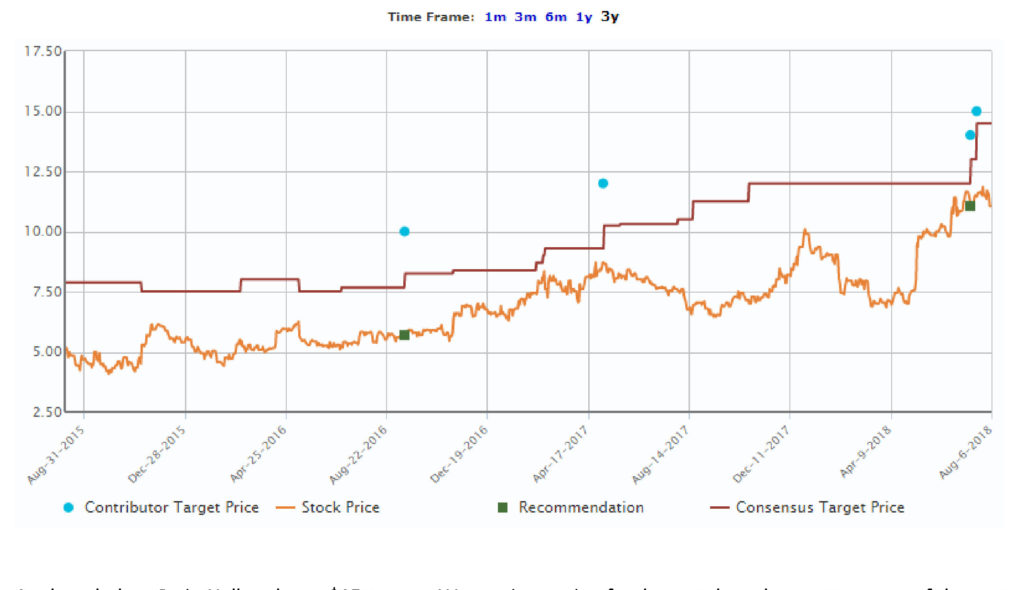
As shown below the 2 analysts that cover Leaf have moved their price targets up with accelerating revenue growth/scale from $7.50 three years ago to $14.50 today.

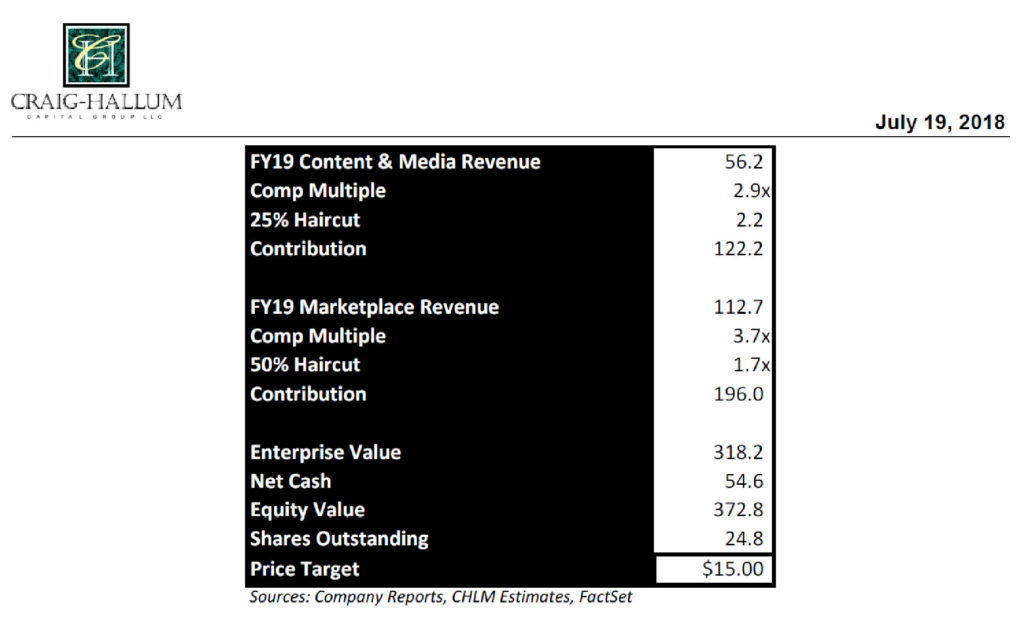
As shown below Craig-Hallum has a $15 target. We see improving fundamentals and come to a sum of the parts valuation of $17 which we believe is a 25-50% discount to peers.


______
[1] Market price as of the date of dissemination of the letter

Certain factual and statistical (both historical and projected) industry and market data and other information contained herein was obtained by Osmium Partners from independent, third-party sources that it deems to be reliable. However, Osmium Partners has not independently verified any of such data or other information, or the reasonableness of the assumptions upon which such data and other information was based, and there can be no assurance as to the accuracy of such data and other information. Further, many of the statements and assertions contained herein reflect the belief of Osmium Partners, which belief may be based in whole or in part on such data and other information. The information contained herein is provided for informational purposes only. This is not an offer to sell, or a solicitation to buy, limited partnership interests in Osmium. An investment in Osmium is not suitable for all investors. Graphs/charts are provided for illustrative purposes only and should not be relied on to form an investment decision. Stocks mentioned in the newsletter do not constitute a recommendation to buy or sell the individual securities.

Liquidity Services: GovDeals Alone Worth More Than Total EV

September 3, 2018 in Equities, Ideas, Letters

This article is excerpted from a letter by MOI Global instructor Jim Roumell, partner and portfolio manager of Roumell Asset Management (RAM), based in Chevy Chase, Maryland. Jim is a valued participant in The Zurich Project.

LQDT reported a solid quarter, with each of its three verticals – GovDeals, Capital Assets (ex-DoD) and Retail – reporting double-digit growth in GMV (gross merchandize value). The quarter exceeded management’s previous guidance on GAAP Net Loss, and Non-GAAP Adjusted EBITDA and was within range for GMV.

Members, log in below to access the restricted content.

Not a member?

Thank you for your interest.  Please note that MOI Global is closed to new members at this time. If you would like to join the waiting list, complete the following form:

Disclosure: The specific securities identified and described do not represent all of the securities purchased, sold, or recommended for advisory clients, and the reader should not assume that investments in the securities identified and discussed were or will be profitable.

“Cuando hay mucho dinero, se crean malas inversiones”

September 3, 2018 in Miscelánea, MOI Global en Español

NOTA DEL EDITOR: El siguiente texto es extraído de un comentario trimestral de Invexcel Patrimonio.

* * *

“Burbuja” es un término excesivo. Hay quienes se han hecho famosos prediciéndolas y quienes llevan décadas augurándolas sin acierto. Nosotros observamos y estudiamos, pero no predecimos. Si lo hiciéramos, probablemente seríamos tan poco certeros como la mayoría. Y observando, encontramos valoraciones excesivas que invitan a pensar que la irracionalidad se está agudizando, aunque muy concentrada en una serie de activos.

Dos razones encontramos detrás de esta subida extraordinaria del precio de algunos de éstos: las políticas expansivas por parte de los bancos centrales, y el frecuente e irracional comportamiento humano.

Hemos hablado algunas veces de la impresión de dinero propiciada por los principales bancos centrales. Valga recordar que, sin ser excesivamente partidarios de unas medidas que no permiten al sistema purgarse por sí solo manteniendo artificialmente vivos a actores ineficientes, entendemos la complejidad política y social que soportó esta decisión.

El dinero adicional causa una subida inmediata al precio del activo destino. Afortunadamente, gran parte de este “nuevo dinero” no ha llegado a la economía real (familias y empresas) en forma de préstamos. Se ha quedado en el sistema como liquidez, lo que tiene una parte positiva: no provocar excesivo sufrimiento a la economía al ser retirado, tal y como se ha observado en EEUU, donde la retirada de estímulos y la subida de tipos, en definitiva la normalización de la política monetaria, se está llevando a cabo sin consecuencias negativas en la economía real. De momento.
Continue reading »

Transocean: World Dominator of Offshore Drilling

September 1, 2018 in Audio, Deep Value, Energy, Energy Equipment & Services, Equities, Europe, Ideas, Mid Cap, Transcripts, Wide Moat, Wide-Moat Investing Summit, Wide-Moat Investing Summit 2018, Wide-Moat Investing Summit 2018 Featured

Arvind Mallik and Jonathon Fite of KMF Investments presented their in-depth investment thesis on Transocean (NYSE: RIG) at Wide-Moat Investing Summit 2018.

The full session is available exclusively to members of MOI Global.

Members, log in below to access the full session.

Not a member?

Thank you for your interest.  Please note that MOI Global is closed to new members at this time. If you would like to join the waiting list, complete the following form:

About the instructors:

Arvind Mallik is a Managing Partner of KMF Investments, a pure Pay-for-Performance Private Investment Partnership based in Denton, Texas. KMF seeks long-term capital appreciation by investing in companies whose intrinsic value is significantly higher than the market price. Over its ten years of operations, KMF has found opportunities in world dominating franchises, hard assets below replacement costs, businesses at large discounts to liquidation value, and firms with beneficial exposure to rising interest rates. Prior to founding KMF Investments, Mr. Mallik was a Senior Manager in the Strategy practice of Accenture. At Accenture, he helped global companies formulate and execute strategies to enter new markets, develop innovative new services and solutions, and reduce their operating costs to improve shareholder returns. Mr. Mallik obtained a BS in Chemical Engineering and BS in Bioengineering from UC Berkeley, and an MS in Chemical Engineering from MIT. He graduated with highest honors from both institutions.

Jonathon Fite is a Managing Partner of KMF Investments, a pure Pay-for-Performance Private Investment Partnership based in Denton, Texas.KMF seeks long-term capital appreciation by investing in companies whose intrinsic value is significantly higher than the market price. Over its ten years of operations, KMF has found opportunities in world dominating franchises, hard assets below replacement costs, businesses at large discounts to liquidation value, and firms with beneficial exposure to rising interest rates.Prior to founding KMF Investments, Mr. Fite was a Senior Manager in the Strategy practice of Accenture, where he helped companies improve shareholders returns. He is also an Adjunct Professor for the College of Business at the University of North Texas. Mr. Fite graduated with honors from the University of Arkansas with a BS and MS in Industrial Engineering.

Bunzl: Customer-Obsessed Business with Strong Corporate Culture

September 1, 2018 in Audio, Communication Services, Consumer Discretionary, Equities, Europe, GARP, Ideas, Jockey Stocks, Mid Cap, Transcripts, Wide Moat, Wide-Moat Investing Summit, Wide-Moat Investing Summit 2018, Wide-Moat Investing Summit 2018 Featured

Henrik Andersson of Didner & Gerge presented his in-depth investment thesis on Bunzl (London: BNZL) at Wide-Moat Investing Summit 2018.

Thesis summary:

Bunzl is a family company in disguise. It has set a high bar in how a corporation slowly but steadily, with the highest ethical standards, year in and year out keeps expanding its business one well-served customer at a time. It is a grand example of what is today known as a “compounding machine”.

At the face of it, Bunzl is a distributor of goods typically not for resale; to food stores, restaurants, large corporations, health care operations – the list goes on. It is the brooms to clean the stores, the kitchen disposables, the napkins in conference rooms, the first aid kits in offices, and the protection gloves in factories.

But as with all great business models, Bunzl provides something more in its daily operations. By managing customers’ working capital, solving complex logistics with a 98% fulfillment rate, being just-in-time, providing consultancy around procurement and providing push-through cost savings, Bunzl is one of these businesses that provides essential services that aids an entire operation but at a very small cost. It is like an iceberg – what you see above the water (i.e. Bunzl´s fee/margin) is a fraction of its true impact.

The company is governed by outstanding people, in a strong corporate culture with lots of responsibility and decentralization — words such as modest, hard-working, long-term, steadfast come to mind.

The full session is available exclusively to members of MOI Global.

Members, log in below to access the full session.

Not a member?

Thank you for your interest.  Please note that MOI Global is closed to new members at this time. If you would like to join the waiting list, complete the following form:

About the instructor:

Henrik Andersson has worked within a framework of investing in quality franchises in a concentrated portfolio setting since the early 2000s. After five years as an assistant fund manager and analyst at Handelsbanken Asset Management, in 2003 he launched a discretionary portfolio named European Quality with 15 holdings, inspired by Peter Cundill’s approach of “never shoot into the broom”. That later branched out to a family of funds named the Selective Funds. In 2011 he joined Didner & Gerge, an employee-owned asset management boutique, to launch a Global Equity Fund together with a colleague. D&G Global is now applying these same principles in trying to identify sustainably great companies with an appealing valuation starting point. Over the years, an increased emphasis has been put on corporate leadership with a clear preference for owner-operated companies with a history of outstanding operations.

Honma Golf: Turnaround at High-End Golf Club Maker

September 1, 2018 in Asia, Asian Investing Summit, Asian Investing Summit 2018, Asian Investing Summit 2018 Featured, Audio, Consumer Discretionary, Deep Value, Equities, Micro Cap, Transcripts

Siddharth Mehta of Beaconsfield Investment Management presented his in-depth investment thesis on Honma Golf (Hong Kong: 6858) at Asian Investing Summit 2018.

Thesis summary:

Honma Golf is a leading golf club manufacturer based in Japan. The company is known for quality and craftsmanship. Honma went bankrupt more than a decade ago and was purchased by golfing enthusiast and businessman Liu Jianguo from China. The books were cleaned up and the company delisted in Hong Kong two years ago. While sales and earnings are growing nicely, the shares recently traded at a deep discount to peers.

The full session is available exclusively to members of MOI Global.

Members, log in below to access the full session.

Not a member?

Thank you for your interest.  Please note that MOI Global is closed to new members at this time. If you would like to join the waiting list, complete the following form:

About the instructor:

Siddharth Mehta founded Beaconsfield Investment Management in 2010. Prior to that he worked as an analyst covering Asian equities at Fairfax Financial Holdings and as an associate analyst at Credit Suisse equity research. Born and raised in Chennai, India, Siddharth completed his bachelor’s of science degree from Purdue University.

MOI Global