The Impact of Technological Change on the Firm Boundary

March 26, 2018 in Asia, Asian Investing Summit, Commentary, Information Technology, Letters

This article is authored by MOI Global instructor Rajeev Mantri, director of private investment firm GPSK Investment Group and executive director of Navam Capital, an India-focused venture capital firm. Rajeev is an instructor at Asian Investing Summit 2018, the fully online conference featuring more than thirty expert instructors from the MOI Global membership community.

In a landmark paper titled The Nature of the Firm published in 1937, then-26 year old economist Ronald Coase addressed the question of why firms exist. “Outside the firm, price movements direct production, which is coordinated through a series of exchange transactions on the market. Within a firm, these markets transactions are eliminated and in place of the complicated market structure with exchange transactions is substituted the entrepreneur-coordinator, who directs production. It is clear that these are alternative methods of coordinating production. Yet, having regard to the fact that if production is regulated by price movements, production could be carried on without any organization at all, well might we ask, why is there any organization?”

Coase, who went on to win the Nobel Prize for economics in 1991 for his work as the pioneer of the theory of the firm, posited that the transaction costs of doing business in a market economy necessitated that individuals should organize themselves under the rubric of a firm. The world has changed unrecognizably since Coase developed the theory for why a centrally-planned institution like a firm exists in any market economy. The principal forces affecting the size and structure of the firm are government policy and technology. The Coasian lens of transaction costs helps explain why conglomerate firm structures are commonly found in emerging and frontier markets – wherever government policy-making is a powerful exogenous force and the rule of law is weak, it makes sense for firms to integrate vertically or expand corporate scope by entering new industries.

Over the last 25 years, technology too has had dramatic effects on the nature of the firm. Technological changes strike at the heart of possibly the most important strategic decision made by the capital allocator, christened the “entrepreneur-coordinator” by Coase. This is the decision of what to buy and what to build. Stated differently, technology has always been a critical determinant of setting and resetting the boundary of the firm, and momentous changes over the last three decades have hastened the speed at which this boundary shifts.

Shifts in the firm boundary inevitably lead to shifts in the value captured by the different actors in an industry. The rise of e-commerce undercuts both offline retailers and legacy brands. “Direct-to-consumer” means that even small, niche brands are able to gain global distribution without having an offline footprint. Retailers, product marketers and manufacturers who were operating in an equilibrium deemed to be settled by the dominance of organized retail are being disrupted by the emergence of new marketing and distribution channels enabled by the mobile internet that have made certain segments far less profitable or even irrelevant.

The media business has felt the impact of shifting firm boundaries even more dramatically than retail. In the old television entertainment business model, studios created content that broadcasters would licence, offsetting content acquisition costs with advertising. Now, technology has shifted the firm boundary to fuse content production and distribution, where consumers are willing to pay for an advertising-free viewing experience. In print media, content production and distribution that were both controlled by media houses have been disaggregated, as consumers read individual articles rather than bundles curated by professional editors that are distributed and discovered through channels the content producers have almost no control over.

Applying Coase’s insight, the transaction cost that caused the emergence of a firm in the industry value chain can be reduced or eliminated by technology. When this happens, the “entrepreneur-coordinator” or capital allocator of the firm must act to re-position the firm in the new context. Viewing technology as a force that reduces transaction costs and shifts the firm boundary is a powerful way to anticipate how an industry might change in response to innovation. Armed with this understanding, an investor can make better judgments about which businesses will accrue market power and which segments stand to lose.

azValor sobre Mota-Engil y Shutterfly

March 26, 2018 in Ideas de inversión, MOI Global en Español

NOTA DEL EDITOR: Estas ideas de inversión son extraídas de una carta trimestral de azValor Asset Management.

* * *

Invertimos en Mota Engil a finales de 2015 y principios del 2016; en ese momento acumulaba una caída de más del 70% desde los anteriores máximos alcanzados a mediados del 2014. Los agentes del mercado (analistas, brokers, etc.) “veían” una compañía “rota”, sufriendo por su exposición indirecta al desplome de las materias primas en sus negocios de construcción en zonas “tan de riesgo” como África y América Latina; además, su balance frágil (elevado endeudamiento) entrañaba un riesgo potencial de quiebra. “Mejor ni tocar” era la doctrina imperante en el mercado.

Mota es una compañía que conocemos desde hace casi 10 años y, por tanto, sabíamos de la calidad de su posición competitiva y la reputación de la familia Mota y su equipo de gestión. Por otro lado, la aparente situación de alto endeudamiento no era tan precaria si se tenía en cuenta la gran cantidad de activos no estratégicos propiedad de la compañía, algunos de los cuales tenían mucho valor a pesar de no contribuir de manera significativa a los resultados del grupo. Todo lo anterior, además, se apoyaba en nuestra visión, de la insostenibilidad a largo plazo de los precios de las materias primas de principios del 2016; y, por tanto, en nuestra convicción de que vendría una fuerte recuperación cíclica.

Continue reading »

The Underappreciated Value of a Long-Term Orientation

March 23, 2018 in Commentary

This article is authored by Felix Narhi, Chief Investment Officer and Portfolio Manager of PenderFund Capital Management. Read additional insights.

“I ask everybody not to think in two to three-year time frames, but to think in five to seven-year time frames.” –Jeff Bezos

Amazon is a remarkable enterprise that was built in part on an unwavering long-term orientation. Founder Jeff Bezos doesn’t care about quarterly earnings because he knows the near-term earnings simply reflect the actions and initiatives Amazon took years ago. He is always thinking about the direction of Amazon five to seven years out, rather than what is happening today. Such a perspective is highly unusual in the corporate world, but far more likely in founder-run firms.

It is also important in the investment world. Thinking long term impacts how you plan and where you allot energy, time, money and resources. While we try to navigate the near-term twists and turns of the market, we keep three long-term considerations front of mind.

1. The great 35-year interest rate cycle probably bottomed in 2016

Interest rates are likely headed up, possibly trending higher for a long time. As we speculated in our fiscal year-end commentary last year, this big news didn’t make any front-page headlines, but could have profound long-term implications on asset values and investment strategies. When great cycles turn, there are usually multi-year, if not multi-decade, consequences for investors.

Just ask Bill Gross, the former superstar bond manager of PIMCO, how much fun it can be to get the big cycle right and ride a secular wave for decades. Of note, Gross’ and PIMCO’s success coincided within an epoch of credit expansion – a period where those who reached for carry, that sold volatility, that tilted towards yield and more credit risk succeeded. What if zero -bound interest rates, that define the end of a total return epoch that began in the 1970’s, accelerated in 1981 and came to a mathematical dead end for bonds in 2016 and commonsensically for other adjoined asset classes as well?

We suspect many strategies that worked well over the last few decades may not work as well going forward, no matter how compelling the rear view mirror looks (we are looking at you, “bond proxies”, as noted in our July 2016 note Utilities – Reward-free risk?). In any case, fasten your seat belts – we are about to find out.

2. Disruptive periods like today change the opportunity sets

Many, if not most, industries are in the process of being reshaped by the disruptive forces of technological change. We believe one of the great lessons in microeconomics is to discriminate between when technology is going to help you and when it’s going to hurt you. We’re seeing this broadly as legacy companies struggle to match the agility and scalability of born-digital competitors like the FANGs (Facebook, Amazon, Netflix and Google), while keeping their cost structures competitive. Perhaps the most instructive case study is Sears vs Amazon with important lessons for other industries that are impacted by disruptive business models and technologies that are changing consumer behaviour.

A major disruptor purchased across multiple Fund mandates in early 2017 was Baidu, frequently referred to as “the Google of China”. We generally do not delve deep into our individual holdings externally, but Baidu was a rare exception written up last year here, which we believe was hiding in plain sight as a misunderstood and unloved megacap.

Another name in this category that we added in 2017 is TripAdvisor, the world’s largest travel site. We bought the stock initially last July and we doubled down following a sell-off in November. TripAdvisors’ solid reputation among travellers for reliable advice on hotels, restaurants and attractions had made it one of the largest and fastest growing online properties in the world. Yet, it remains very under monetized. In a nutshell, we believe either management will fix this issue, or it will be sold off to a strategic buyer at a premium relative to our entry price. As long as TripAdvisor’s many properties continue to grow unique monthly users, which feed its powerful network effects, internal value should continue to build at a healthy pace.

Ultimately, we believe this represents latent monetization and foreshadows significant potential upside as a standalone company, or a bigger premium as a takeout. Just consider Facebook after its IPO almost six years ago when management successfully pivoted from their desktop-centric model to a mobile-first strategy. The potential rewards for monetizing a massive and growing engaged user-base can be truly breathtaking. The stock has been a ten bagger since bottoming in August 2012.

Read more on the disruptive forces of technological change in this blog post, including comments on Syntel (SYNT) and Discovery (DISCK).

3. Just about everything is cyclical

As the saying goes, stocks aren’t usually cheap and popular at the same time. We often begin our search for opportunities in companies and industries we understand that are having problems. The stocks of such companies are more likely to be mispriced. We attempt to discern the source of consensus pessimism in such situations, and occasionally take the other side of the trade when we either have a variant view to the market, or we believe other important attributes are being overlooked by investors. These situations often take time to work out, but we prefer to remain patient as long as the firm is building internal value and improving their competitive position, even if the stock action is unfavourable in the interim.

Sometimes we make a mistake and our patience is misplaced. Either the facts change or our investing thesis is just plain wrong. In such cases, it’s best to sell and move on (Altisource Portfolio Solutions, sold in 2017, was a recent example). But often we find our mistakes are related to timing, particularly when the idea is a Compounder. Ultimately such businesses will grow in value and eventually bail out investors who timed their purchase poorly.

Bruce Flatt, the CEO of Brookfield Asset Management, recently penned another terrific letter that included some lessons learned by the management team. As it relates to this topic, Flatt wrote, “the single greatest way to dig ourselves out of mistakes is to be patient with investments and, in most cases, double down. This is the best way to recover losses, although it requires conviction as well as availability of the necessary capital. This is particularly important when we have acquired a good business, but our timing was poor. Doubling down in this case is virtually always the answer. However, one has to be careful because if the business is just a bad business, it only serves to compound the pain. But, generally we have found that in the absence of technological change in the extreme, doubling down and being patient is the most proven way to turn around an investment.”

Likewise, we endeavor to remain patient (or double down) with good businesses during periods of adversity when they are having problems – we have found that cyclical headwinds usually become a tailwind again. Some examples of top Pender holdings purchased during periods of adversity that went from “dogs” to “stars” and sold in the past year include Panera Bread, Wynn Resorts, KKR and Whole Foods. They were all founder-run firms which delivered exceptional returns to unitholders over our holding period.

“The time to buy is when there’s blood in the streets.” –Baron Rothschild

As such, we bought South Korean-based steel maker Posco in late 2014 as a deeply cyclical close-the-discount opportunity. Statistically speaking, we originally bought the stock at a very attractive valuation. The only prior period that Posco traded at lower levels since it started trading in the U.S. in 1994 was a small window during the 1997-1998 Asian financial crisis. The stock’s subsequent rebound was dramatic — a four bagger in less than two years. However, as we quickly (re)learned, every situation is different.

The year following our original purchase, the steel industry went through one of its most challenging cycles in history, crashing Posco to record-setting low valuation levels. The stock went from trading near the trough valuations relative to its past 20-year record, to setting new precedents for all-time lows that future generations will no doubt use as “worst case” historical examples (similar to how we referenced the Asian financial crisis as a “worst case” scenario). This excruciating period required us to draw upon our deepest reserves of patience and fortitude in late 2015.

As long we believe there is no fundamental impairment to the underlying business, we try to keep in mind, the time to buy is when there’s blood in the streets. We added to our position during this downdraft because of our conviction that Posco, as the world’s most efficient steel maker, would be a survivor. If the world’s manufacturing and construction industries required steel in the future, Posco would still be around to pick up the pieces after less efficient peers went belly up. Since then, operating conditions materially improved, non-core assets were either sold or restructured and debt was paid down meaningfully. Not surprisingly, the stock has been repriced and became one of Pender’s top performers in both 2016 and 2017 (we have been trimming our position during the run up).

In hindsight, our initial timing on Posco was less than ideal. However, because we added to our holdings during the downturn, we were able to generate a reasonable return for investors over our holding period. Importantly, the return on the incremental capital invested has been extraordinary. The moral of the story here is that as long as the facts remain at your side, one should always consider buying when there’s blood in the streets – even when it is your own blood.

Read more on taking advantage of cycles in this blog post, including comments on Liberty Global (LBTYA), Liberty Latin America (LILA), Platform Specialty (PAH) and Colfax (CFX).

Commissions, trailing commissions, management fees and expenses all may be associated with mutual fund investments. Please read the simplified prospectus before investing. The indicated rates of return are the historical annual compounded total returns including changes in net asset value and assume reinvestment of all distributions and are net of all management and administrative fees, but do not take into account sales, redemption or optional charges or income taxes payable by any security holder that would have reduced returns. Mutual funds are not guaranteed, their values change frequently and past performance may not be repeated. This communication is intended for information purposes only and does not constitute an offer to buy or sell our products or services nor is it intended as investment and/or financial advice on any subject matter and is provided for your information only. Every effort has been made to ensure the accuracy of its contents. Certain of the statements made may contain forward-looking statements, which involve known and unknown risk, uncertainties and other factors which may cause the actual results, performance or achievements of the Company, or industry results, to be materially different from any future results, performance or achievements expressed or implied by such forward-looking statements. © Copyright PenderFund Capital Management Ltd. All rights reserved. March 2018.

Miguel de Juan sobre Boston Omaha

March 23, 2018 in Ideas de inversión, MOI Global en Español

NOTA DEL EDITOR: Esta idea de inversión presentada por Miguel de Juan Fernández es obtenida de la carta a los inversores de Argos Capital FI correspondiente al mes de marzo de 2018.

* * *

Comencemos ahora a comentar la empresa americana: BOSTON OMAHA. En muchísimas ocasiones miramos atrás en un gráfico histórico y lamentamos- o deseamos- haber podido comprar esa o aquella empresa al inicio de dicho periodo. Imaginad poder haber comprado acciones de Berkshire Hathaway hace 30 años o cualquier otra de las que, ahora, podemos comprobar qué tan bien les ha ido.

Continue reading »

Selected In-Depth Investment Ideas

March 22, 2018 in Uncategorized

Last month I had the pleasure of hosting a group of MOI Global members in St. Moritz, Switzerland for the inaugural edition of Ideaweek, an opportunity to share and learn in an inspiring Swiss mountain setting. Here is how Ghana-based member Abdallah Toutoungi summed up his experience:

There’s something to be said about the caliber of influencers present in St. Moritz. The organic conversations allow for deep reflection on ideas and intimate discussions about business, life, and wisdom. Essentially, as John put it emulating Munger, “We try to operate in a seamless web of deserved trust and be careful whom we trust.” Although that might be the ultimate goal, MOI Global has been able to ‘carve the mountains’ to create an environment fertile for exceptional people to have candid conversations where you can understand the significance of the Chinese proverb, “A single conversation with a wise person is worth a month’s study of books.”

Time disappears behind the mountains and the conversation takes its place, breakfasts merge with lunches, and lunches with afternoon talks, and afternoon talks with dinners. Awaiting the morning, the night becomes too long and the morning can’t come fast enough to continue the conversations. These conversations span subjects broad and deep, from specific investments to best practices to operating a business to personal anecdotes and challenges.

Ideaweek was a resounding success, and we are already planning the 2019 edition. Invitations to selected members of MOI Global will go out in the near future. I hope you will consider joining us—there really is no better way to learn and form new friendships than in a relaxed, informal atmosphere, while engaged in winter activities and surrounded by like-minded people with a desire to grow as investors.

I am pleased to include impressions from Ideaweek 2018 in this issue of The Manual of Ideas.

In January we hosted Best Ideas 2018, the sixth annual edition of this fully online conference. The latest edition featured more than one hundred instructors from the MOI Global community, providing plenty “food for thought” and ideas for further research.

In this issue, we feature transcripts of some of the most enlightening sessions. We do not claim comprehensiveness, as many sessions that are not included in this issue also contain terrific insights and ideas. Explore Best Ideas 2018 in detail at http://moiglobal.com/i/

The sixth annual edition of Asian Investing Summit is upon us, and you are cordially invited as an MOI Global member! This fully online conference, to be held on Thursday and Friday, April 5-6, will feature the best ideas of more than thirty instructors from the MOI Global community, all of whom share a value-oriented investment philosophy and possess deep expertise in investing in Asia.

In the past, Asian Investing Summit and the other online conferences hosted by MOI Global were available to anyone purchasing a conference pass. Since last year, only members of MOI Global have access to these online summits. Access is not only exclusive to members but also fully complimentary.

Tune into the sessions at Asian Investing Summit 2018. You’ll enjoy LIVE access on April 5-6, followed by unlimited replay access.

I am excited to announce that we are accelerating efforts to create engagement and knowledge-sharing opportunities for members. On September 20, we will host the inaugural Latticework London gathering of intelligent investors, while on November 1, we will host The Frankfurt Conversation, a forum for learning and idea exchange. Member invitations will go out soon — I hope you’ll consider joining us!

Warm regards,

JOHN MIHALJEVIC, CFA
Chairman, MOI Global

Members, log in below to access the restricted content.

Not a member?

Thank you for your interest.  Please note that MOI Global is closed to new members at this time. If you would like to join the waiting list, complete the following form:

Selected In-Depth Investment Ideas

March 22, 2018 in The Manual of Ideas

Last month I had the pleasure of hosting a group of MOI Global members in St. Moritz, Switzerland for the inaugural edition of Ideaweek, an opportunity to share and learn in an inspiring Swiss mountain setting. Here is how Ghana-based member Abdallah Toutoungi summed up his experience:

There’s something to be said about the caliber of influencers present in St. Moritz. The organic conversations allow for deep reflection on ideas and intimate discussions about business, life, and wisdom. Essentially, as John put it emulating Munger, “We try to operate in a seamless web of deserved trust and be careful whom we trust.” Although that might be the ultimate goal, MOI Global has been able to ‘carve the mountains’ to create an environment fertile for exceptional people to have candid conversations where you can understand the significance of the Chinese proverb, “A single conversation with a wise person is worth a month’s study of books.”

Time disappears behind the mountains and the conversation takes its place, breakfasts merge with lunches, and lunches with afternoon talks, and afternoon talks with dinners. Awaiting the morning, the night becomes too long and the morning can’t come fast enough to continue the conversations. These conversations span subjects broad and deep, from specific investments to best practices to operating a business to personal anecdotes and challenges.

Ideaweek was a resounding success, and we are already planning the 2019 edition. Invitations to selected members of MOI Global will go out in the near future. I hope you will consider joining us—there really is no better way to learn and form new friendships than in a relaxed, informal atmosphere, while engaged in winter activities and surrounded by like-minded people with a desire to grow as investors.

I am pleased to include impressions from Ideaweek 2018 in this issue of The Manual of Ideas.

In January we hosted Best Ideas 2018, the sixth annual edition of this fully online conference. The latest edition featured more than one hundred instructors from the MOI Global community, providing plenty “food for thought” and ideas for further research.

In this issue, we feature transcripts of some of the most enlightening sessions. We do not claim comprehensiveness, as many sessions that are not included in this issue also contain terrific insights and ideas. Explore Best Ideas 2018 in detail at http://moiglobal.com/i/

The sixth annual edition of Asian Investing Summit is upon us, and you are cordially invited as an MOI Global member! This fully online conference, to be held on Thursday and Friday, April 5-6, will feature the best ideas of more than thirty instructors from the MOI Global community, all of whom share a value-oriented investment philosophy and possess deep expertise in investing in Asia.

In the past, Asian Investing Summit and the other online conferences hosted by MOI Global were available to anyone purchasing a conference pass. Since last year, only members of MOI Global have access to these online summits. Access is not only exclusive to members but also fully complimentary.

Tune into the sessions at Asian Investing Summit 2018. You’ll enjoy LIVE access on April 5-6, followed by unlimited replay access.

I am excited to announce that we are accelerating efforts to create engagement and knowledge-sharing opportunities for members. On September 20, we will host the inaugural Latticework London gathering of intelligent investors, while on November 1, we will host The Frankfurt Conversation, a forum for learning and idea exchange. Member invitations will go out soon — I hope you’ll consider joining us!

Warm regards,

JOHN MIHALJEVIC, CFA
Chairman, MOI Global

Members, log in below to access the restricted content.

Not a member?

Thank you for your interest.  Please note that MOI Global is closed to new members at this time. If you would like to join the waiting list, complete the following form:

The Two Things We Look for in a Management Team

March 22, 2018 in Commentary, Curated, Equities, Idea Appraisal, Letters, Skills

This article is authored by Todd Wenning, senior investment analyst at Ensemble Capital Management, based in Burlingame, California. Visit Ensemble’s Intrinsic Investing website for additional insights.

Imagine you went back to 2007 and told investors that within the next ten years, General Electric would cut its dividend twice. You’d have been mocked and ridiculed.

At the time, GE was one of five U.S. industrial companies with AAA-rated credit, had just increased its dividend by 11% (its 32nd consecutive annual increase), and was one of the largest companies in the world by market capitalization. Such an outcome would have seemed implausible.

Yet here we are. The GE story is complex (which in itself is a problem), but one of the causes of its recent decline was consistently poor capital allocation decisions.

Here’s Morningstar’s take: “(GE’s) ambitious overhaul came with an overly aggressive midterm financial target of $2 in earnings per share by 2018, which probably colored management’s capital allocation decisions in a manner that ultimately exposed GE’s investors to unnecessary risk.”

As the GE story illustrates, the way management allocates capital can have a massive impact on long-term shareholder returns.

Simple doesn’t mean easy

At Ensemble, the two things we look for in a management team are their intent to optimize return on invested capital (ROIC) and their skill at allocating capital to maximize shareholder returns.

You’d think that these two things would be common, but they are more the exception than the rule. Indeed, our eyes light up when we see multiple mentions of ROIC (or return on equity) along with a discussion on capital allocation in annual reports, management meetings, or quarterly earnings calls. It’s that rare.

Why might this be the case? One reason is poor incentives. You never hear of a stock jumping 10% because ROIC beat expectations. No, it’s usually because the company reported better-than-expected revenue or earnings per share. Perhaps not surprisingly, two of the most common financial metrics used in management bonuses are – you guessed it – revenue and EPS. Unfortunately, neither of those metrics alone tell you if the company is creating shareholder value.

Revenue and EPS growth are essential, of course, but we believe that if the company aims to widen its moat (that is, optimize long-term ROIC) and thoughtfully allocate capital, revenue and EPS will take care of themselves.

Decisions, decisions

There are three ways a company can return cash to claimholders: pay a dividend, buyback shares, or reduce debt. There are smart and dumb uses of each. What we want to see is that management has thoughtfully weighed their options based on return opportunities.

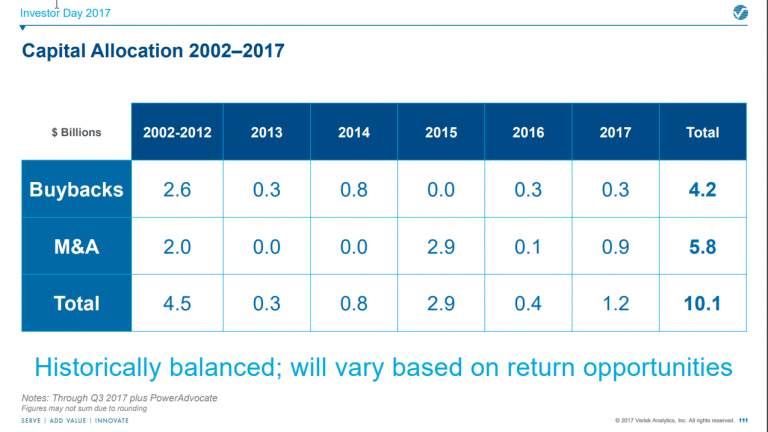
To illustrate, at its 2017 investor day, Verisk Analytics showed how the firm allocated capital between buybacks and M&A over the previous 15 years.

As the slide mentions, Verisk decides on buybacks or M&A depending on the available opportunities. Even if they don’t always make the correct assessment in hindsight, we like that there’s a process in place.

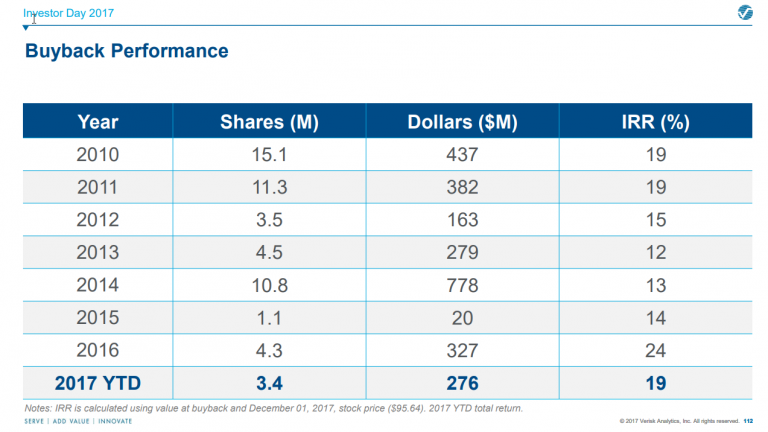
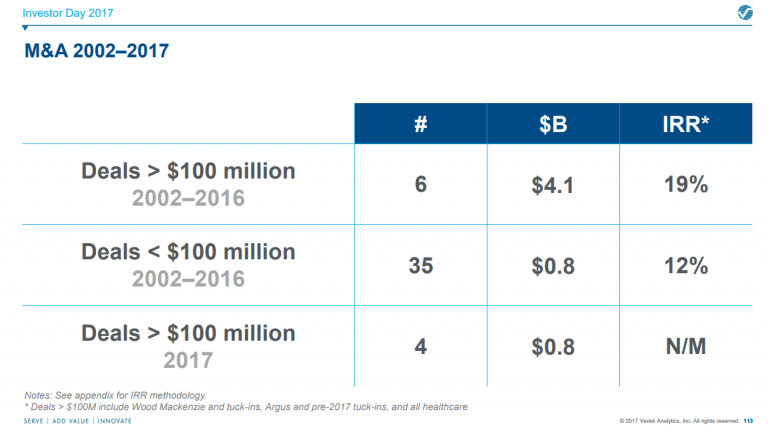
We were further impressed that Verisk followed the above slide with IRR results from their capital allocation decisions.

Again, this level of transparency is rare, but we welcome it and would like more companies to follow suit.

Companies with moats are rare, as are companies led by thoughtful capital allocators. Companies that have both are exceptional and are precisely the kind of firms we want to own in our portfolio.

Clients, employees, and/or principals of Ensemble Capital own shares of Verisk Analytics (VRSK).

The information contained in this post represents Ensemble Capital Management’s general opinions and should not be construed as personalized or individualized investment, financial, tax, legal, or other advice. No advisor/client relationship is created by your access of this site. Past performance is no guarantee of future results. All investments in securities carry risks, including the risk of losing one’s entire investment. If a security discussed in this blog entry is owned by an employee, principal and/or client of Ensemble Capital you will find a disclosure regarding the security held above. Should an employee, principal and/or client of Ensemble Capital subsequently purchase or sell any position in a security discussed in this blog entry, we will not update the above disclosure nor revise any archived blog entry after the date it is originally posted. If reviewing this blog entry after its original post date, please refer to our current 13F filing or contact us for a current or past copy of such filing. Each quarter we file a 13F report of holdings, which discloses all of our reportable client holdings. Ensemble Capital is a discretionary investment manager and does not make “recommendations” of securities. Nothing contained within this post (including any content we link to or other 3rd party content) constitutes a solicitation, recommendation, endorsement, or offer to buy or sell any securities or other financial instrument.

Highlighted Tweet by jtkoster

March 21, 2018 in Twitter
MOI Global